
July 10, 2026
Ancillary Income Property Management: 2026 Guide
Discover how ancillary income property management boosts revenue for multifamily properties. Learn effective strategies to maximize profits today!

Ancillary income property management is the practice of generating revenue beyond base rent by monetizing amenities, services, and operational systems already present at your property. Ancillary income accounts for 7–9% of effective gross income in stabilized multifamily portfolios. That share is not trivial. On a 100-unit building, it represents tens of thousands of dollars annually that either shows up in your net operating income or quietly disappears because no one tracked it. The industry term for this discipline is ancillary revenue management, and the property managers who do it well treat it as a structured income category, not a collection of miscellaneous fees.
1. Which ancillary income streams have the highest financial impact?
The top-performing ancillary income streams in multifamily properties are managed WiFi, RUBS utility billing, premium parking, on-site storage, and laundry programs. Each stream generates $50–$150 per unit per month when implemented correctly. That range sounds wide, but the spread reflects property size, market, and how well the program is structured.
Managed WiFi and RUBS utility billing are the two heaviest contributors. Together they account for nearly 60% of new ancillary NOI after full implementation. For a 30-unit building, that translates to meaningful monthly NOI gains from just two programs.

Pet rent is a pure NOI contributor because it carries almost no corresponding expense. A $50 monthly pet fee on 20 pet-owning households adds $12,000 annually to your bottom line without adding a single line item to your operating budget. Premium parking follows a similar logic in urban and suburban markets where covered or reserved spaces command a real premium.
Pro Tip: Start with the stream that requires the least capital investment. Pet rent and premium parking can be introduced at lease renewal with no infrastructure cost, giving you immediate NOI lift while you plan larger programs.
2. How package management shifts from cost center to revenue source
Package management is increasingly shifting from a complimentary courtesy to a fee-based amenity as delivery volumes continue to climb. Leasing teams at apartment communities spend hours each week receiving, sorting, and tracking packages. That time has a real cost, and most properties absorb it without ever accounting for it.
The shift to a fee-based model works best when it is built around infrastructure residents already value:
- Secure package rooms with 24/7 resident access remove the burden from staff entirely.
- Smart locker systems allow carriers to deposit packages without staff involvement and let residents retrieve them at any hour.
- Dedicated on-site package management services, like those offered by Fixmypackages, place a trained Package Manager at your community up to six days a week to receive, sort, and organize deliveries.
The revenue opportunity comes from structuring the service as a paid amenity and retaining the margin over the cost of management. Properties that do this effectively turn a budget drain into a line item that helps pay for itself.
Residents already expect secure, on-site package handling. The question is not whether to offer it. The question is whether you are charging for it in a way that covers your costs and generates a return.
However, the pricing approach matters. Premium package subscriptions can reduce resident satisfaction when residents perceive the service as something that should be included. Investment in self-service infrastructure tends to yield better long-term retention than charging a visible monthly fee on top of rent.
Pro Tip: Frame package management as a convenience amenity during tours, not as a fee line on the lease. Residents who see it as a benefit before they sign are far less likely to push back on the cost at renewal.
3. What accounting practices maximize ancillary income visibility?
Accurate tracking is the difference between ancillary income that improves your NOI and ancillary income that disappears into a catch-all account. Distinct revenue line codes for each income source prevent misclassification and give investors a clear picture of where money is coming from.
The most common accounting mistake in ancillary revenue management is bundling everything into “other income.” That approach hides the true performance of individual programs and makes it impossible to evaluate which streams are worth expanding.
The table below shows how to structure your chart of accounts for common ancillary streams:
| Revenue Stream | Recommended Account Label | Income Type |
|---|---|---|
| Pet rent | Pet Fee Income | Recurring |
| Parking fees | Parking Revenue | Recurring |
| Package management | Package Amenity Fee | Recurring |
| Late fees | Late Fee Income | Non-recurring |
| Move-in admin fees | Move-In Fee Revenue | Non-recurring |
| Storage rental | Storage Unit Income | Recurring |
Separating recurring from non-recurring ancillary income also matters for asset valuation. Buyers and lenders apply a cap rate to recurring NOI. Non-recurring income does not get the same treatment. Mixing the two inflates your apparent NOI and creates problems during due diligence.
Accrual accounting recognizes ancillary income when earned](https://riooapp.com/blog/ancillary-income-property-management-accounting), not necessarily when cash is received. A move-in fee collected in December for a January lease start belongs in January’s income, not December’s. Getting this right keeps your monthly reports accurate and your investor distributions defensible.
Pro Tip: Treat security deposits as liabilities on your balance sheet, not income. Misclassifying deposits as revenue is one of the most common errors in property accounting and creates serious problems at disposition.
4. How move-in and move-out services create ancillary revenue opportunities
Move-in and move-out windows are the highest-intent moments in a resident’s lifecycle. These lifecycle events capture 40–60% of total ancillary revenue opportunity because residents are actively making purchasing decisions and looking for help. That window is narrow, and most properties let it pass without capturing any of it.
The services residents need during a move are predictable:
- Moving company referrals through a vetted partner network
- Packing supply delivery arranged through the property or a partner
- Short-term storage for residents between leases
- Utility and internet activation through preferred provider partnerships
- Renters insurance enrollment at or before move-in
Partnership models work better than in-house programs for most operators. You do not need to hire movers or stock packing supplies. You need a referral agreement with a local moving company and a preferred provider for renters insurance. The revenue comes from referral fees, commissions, or required enrollment minimums.
The highest ancillary revenue streams align with high-intent resident moments, and move-in is the clearest example. A resident who just signed a lease is already spending money. Capturing a share of that spending requires nothing more than being present with the right offer at the right time.
The compliance benefit is real too. Requiring renters insurance at move-in protects the property from liability and generates a trackable income stream if you use a property-endorsed program with a revenue-sharing component.
5. How to time ancillary fee introductions without losing residents
Timing is the most underestimated variable in ancillary income strategy. Introducing pet fees mid-lease can cause lease conflicts and retention problems. The same principle applies to package fees, parking upgrades, and storage charges.
The correct approach is to introduce or adjust ancillary fees at lease renewal or with new tenants. Existing residents who signed under different terms have a reasonable expectation that their costs will not change until renewal. Violating that expectation damages trust and increases turnover, which costs far more than any ancillary fee generates.
New programs should be phased in with clear communication. Residents who understand what they are paying for and why are significantly more likely to accept the charge. A one-page explanation of what the package management program includes, sent 60 days before renewal, reduces friction more than any discount.
Operators are shifting from amenities for amenity’s sake to ROI-driven investments focused on convenience, connectivity, and control. That shift is visible in which programs properties are actually expanding. Package management, managed WiFi, and utility billing are growing. Rooftop decks and coworking spaces are stalling. The difference is that the first group generates recurring revenue. The second group generates photos for the website.
Key Takeaways
Ancillary income property management generates the most durable NOI gains when each revenue stream is tracked separately, timed correctly, and tied to services residents already value.
| Point | Details |
|---|---|
| Ancillary income scale | Ancillary revenue represents 7–9% of effective gross income in stabilized multifamily properties. |
| Top revenue streams | Managed WiFi, RUBS, parking, storage, and pet rent each generate $50–$150 per unit monthly. |
| Package management opportunity | Fee-based package services offset management costs and generate margin when structured correctly. |
| Accounting accuracy | Separate revenue codes for each ancillary stream prevent misclassification and protect NOI reporting. |
| Timing fee introductions | Introduce new ancillary fees at lease renewal or with new tenants to avoid retention problems. |
What I have learned about ancillary income after years in this business
The uncomfortable truth about amenity spending
Most properties I have seen spend money on amenities that look good on a tour but generate zero recurring revenue. A renovated clubhouse does not pay for itself. A well-run package room can.
The operators who build real ancillary income portfolios share one habit: they evaluate every amenity investment by asking what it returns, not what it signals. A managed WiFi program is not glamorous. Neither is RUBS utility billing. But both generate predictable monthly income that compounds across a portfolio.
Package management is the clearest example of this principle. Properties have been absorbing the cost of package handling for years without charging for it. The labor is real. The liability for lost packages is real. The resident expectation is real. What has been missing is the willingness to structure it as a paid service and communicate that value clearly.
The caution I would add is this: do not introduce fees faster than your operations can support them. A package fee that promises 24/7 secure access but delivers a disorganized room and missing deliveries will cost you more in turnover than the fee ever generated. Infrastructure first, revenue second.
— Craig
How Fixmypackages helps property managers monetize package management
Package management is one of the most overlooked ancillary income opportunities in multifamily real estate. Fixmypackages places a dedicated, on-site Package Manager at your community up to six days a week, handling receiving, sorting, and resident access so your leasing team never touches a box again.
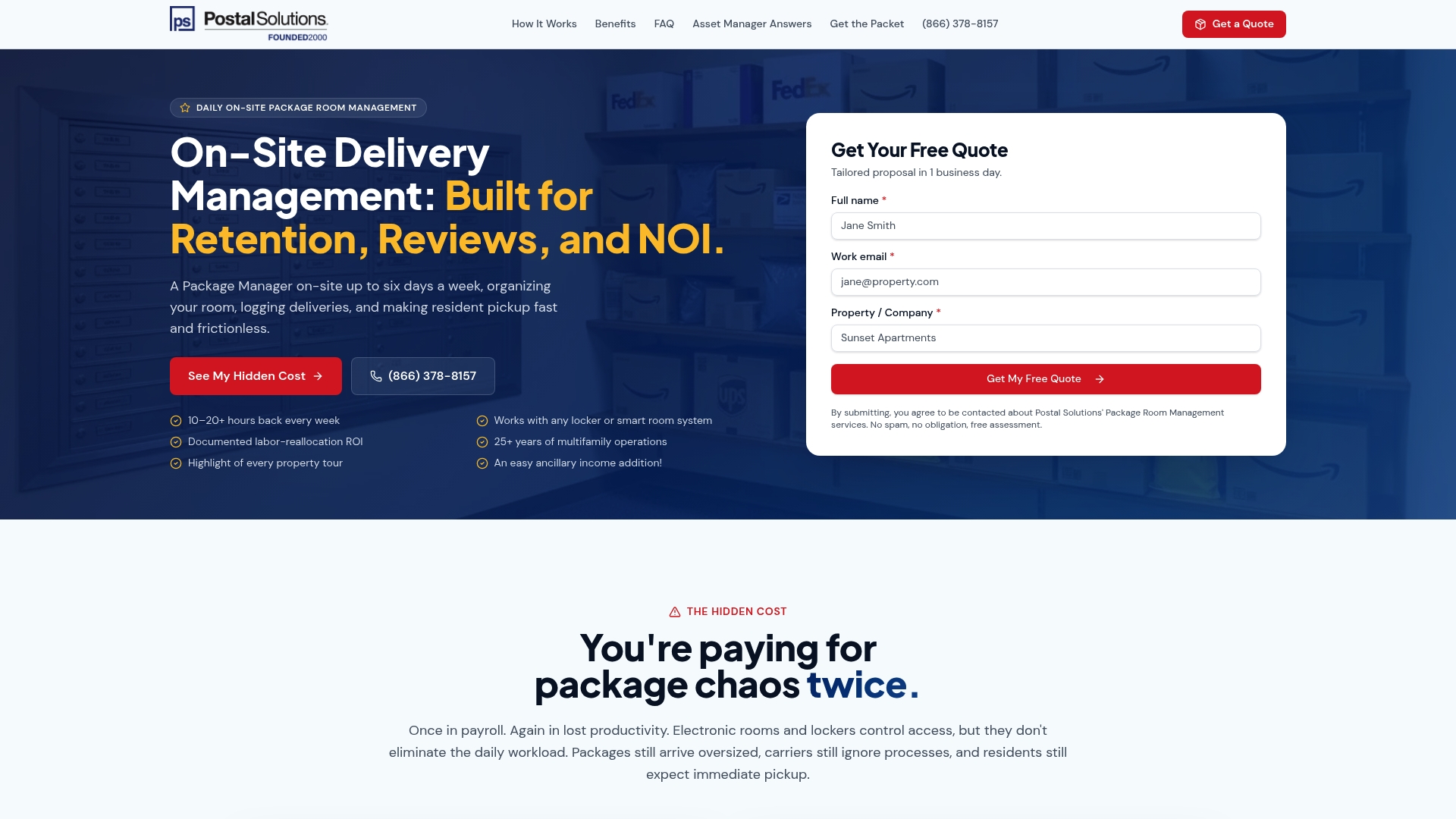
That recovered staff time goes directly back into leasing, renewals, and resident relationships. The package room itself becomes a showpiece amenity on tours. And because the service can be structured as a paid resident amenity, many communities retain the margin over the cost of management. Fixmypackages has been running on-site package operations for apartment and student housing communities for 25 years. If you want to see how this works in your market, the asset manager packet walks through the full financial model.
FAQ
What is ancillary income in property management?
Ancillary income is revenue generated beyond base rent, including fees for parking, pet ownership, package management, storage, laundry, and utility billing programs. It typically represents 7–9% of effective gross income in stabilized multifamily properties.
How do I start generating ancillary income at my apartment community?
Start with zero-capital programs like pet rent and premium parking, then introduce infrastructure-backed services like managed WiFi or package management at lease renewal to avoid mid-lease conflicts.
Can package management actually generate revenue for my property?
Yes. Package management shifts from a complimentary service to a fee-based amenity when structured correctly, with the margin over management costs retained as ancillary income.
How should ancillary income be recorded in property accounting?
Each ancillary stream should have its own revenue code in your chart of accounts. Bundling all ancillary income into “other income” hides program performance and distorts NOI for investor reporting.
When is the best time to introduce new ancillary fees?
The best time is at lease renewal or with new tenants. Introducing fees mid-lease creates lease conflicts and increases turnover risk, which costs more than the fee generates.
Recommended
Ready when you are
Fix your package room — start with a free proposal
Daily on-site Package Manager, resident text & email pings*, and a tour-ready amenity. Tell us your unit count and we'll send a right-sized proposal — usually within one business day.
- ✓ 10–20+ hours back every week
- ✓ Works with any locker system
- ✓ Faster, friction-free resident pickup
- ✓ An easy ancillary income addition