
July 12, 2026
Chain of Custody Meaning: A Legal Professional's Guide
Learn the chain of custody meaning and its critical role in evidence law. Master this essential concept for legal success today.

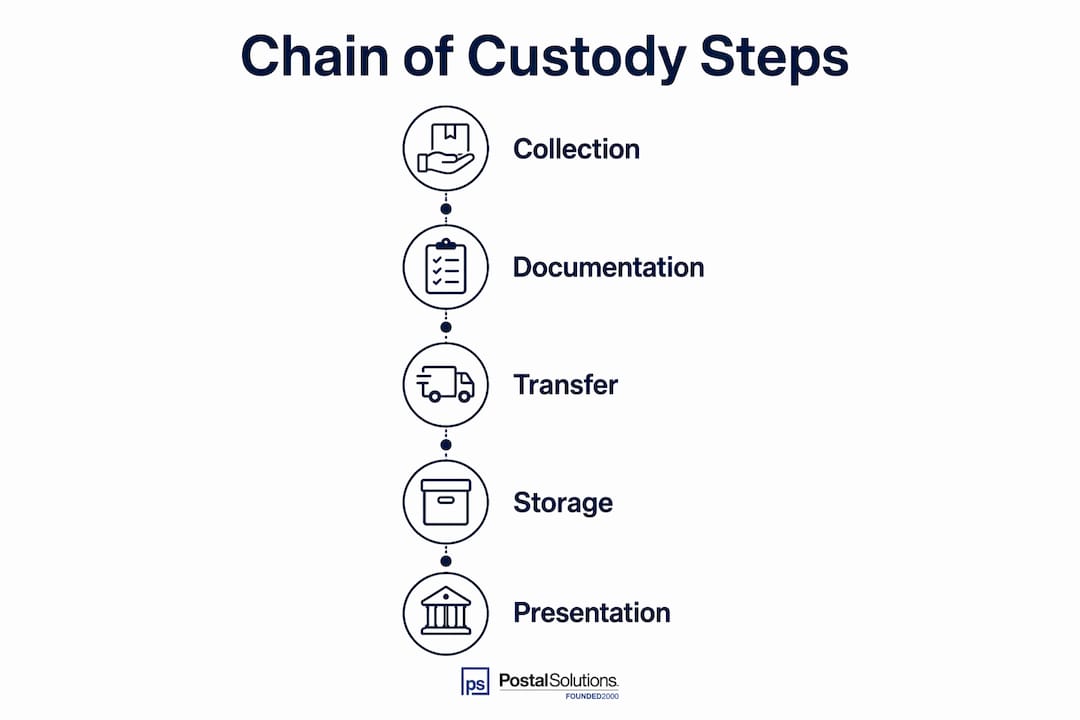
Chain of custody meaning refers to the complete, chronological documentation of every person who collected, handled, transferred, or stored a piece of evidence from the moment of its collection to its presentation in court. This concept is the backbone of evidence law in the United States. Federal Rule of Evidence 901 sets the governing standard, requiring a reasonable probability that an item is what it claims to be. Without an unbroken chain, physical evidence, digital files, and forensic samples all risk exclusion from trial. Understanding how this process works, where it fails, and how courts respond is non-negotiable knowledge for any legal professional or law student.
What is chain of custody meaning in U.S. law?
Chain of custody is defined as the documented, unbroken sequence of possession and control over evidence from collection through courtroom presentation. The term applies to both physical evidence, such as a weapon or a blood sample, and digital evidence, such as a hard drive image or cloud-stored communications.
Federal Rule of Evidence 901 establishes the legal standard: the proponent of evidence must show a reasonable probability that the item is authentic. This standard does not demand perfection. It demands accountability at every transfer point.

The definition of chain of custody also carries a storage requirement. Evidence is in legal custody only when stored securely with restricted access. A bag sitting in an unlocked room, even briefly, creates a gap that opposing counsel can exploit.
Two categories of documentation failures exist under this framework:
- Minor gaps: Missing a signature or timestamp on one transfer. Courts typically treat these as affecting the weight of evidence, not its admissibility.
- Missing links: An unexplained period where no one can account for the evidence’s location or handler. Courts frequently exclude evidence with missing links entirely.
In civil litigation, the concept extends further. Litigation hold suspends routine data deletion once litigation is reasonably anticipated. Failure to implement a litigation hold can trigger severe sanctions under Federal Rule of Civil Procedure 37(e), including adverse inference instructions against the offending party.
How does chain of custody work for physical evidence?
Physical evidence follows a strict sequence from the crime scene to the evidence room to the courtroom. Each step requires documentation, and each transfer requires a signature.
- Collection and scene security. An officer or detective collects the item, photographs it in place, and marks its exact location. The scene is secured to prevent contamination before collection begins.
- Packaging. The item goes into a container appropriate to its type: a paper bag for biological samples to prevent moisture buildup, a sealed plastic bag for firearms, or a static-free container for electronics. Tamper-evident seals are applied immediately.
- Logging. The collecting officer completes a chain of custody form recording the date, time, location, item description, and their name and badge number.
- Transfer to evidence custodian. The officer delivers the item to an evidence custodian, who signs for it. Both parties sign the log. The item enters a secured, climate-controlled storage room with restricted access.
- Each subsequent transfer. Every time the item moves, whether to a forensic lab, a prosecutor’s office, or a courtroom, both the releasing and receiving parties sign and timestamp the record.
An unexplained break in an evidence seal is treated by courts as tampering unless the break and resealing are logged with initials and a date stamp. This is not a technicality. It is the standard that protects evidence integrity.
Quantity drift is another common vulnerability. Small changes in evidence weight or count, such as a drug sample that weighs slightly less after lab testing, must be documented as sampling steps or they may be alleged as tampering. Defense attorneys know to look for these discrepancies.
Pro Tip: Always photograph tamper-evident seals before and after any lab analysis. That visual record, paired with a signed log entry, closes the most common gap defense attorneys target.
What unique challenges exist for digital evidence custody?
Digital evidence does not come in a sealed bag. It exists as data, and data can be altered without leaving a visible mark. This makes chain of custody documentation for digital evidence both more technical and more consequential than its physical counterpart.
The primary verification tool is the cryptographic hash. A hash is a mathematical fingerprint of a file or drive image. A single byte change invalidates the hash, and courts treat an invalidated hash as evidence of potential alteration. This standard applies under Federal Rules of Evidence 901 and 902, as well as Federal Rule of Civil Procedure 37(e).
Digital chain of custody documentation must include:
- The original acquisition method and the tool used to create the forensic image
- Hash values recorded at acquisition and verified at every subsequent access
- A timestamped log of every person who accessed the data, the reason for access, and the result
- Documentation of the storage medium, including its serial number and location
- For cloud-based evidence: who authorized access, when, and the platform’s audit log
Cloud-based digital evidence requires documenting who authorized access and when, and it includes platform audit logs as part of the chain of custody record. This extends traditional custody principles into environments where law enforcement does not physically control the storage medium.
Pro Tip: Request the platform’s native audit log in addition to your own access records. Courts increasingly expect both when cloud evidence is introduced.
Federal Rule of Evidence 902 allows certain digital records to be self-authenticating if they meet specific certification requirements. This can simplify admissibility arguments, but it does not eliminate the need for a complete custody log. Self-authentication addresses origin, not integrity over time.
What are the consequences of a broken chain of custody?
A broken chain of custody does not automatically destroy a case, but it creates serious legal exposure that prosecutors and civil litigants cannot ignore.
“Chain of custody is an independent legal safeguard. Appellate courts have reversed convictions based on chain of custody issues alone, regardless of the underlying forensic accuracy of the evidence.”
The practical consequences fall into two categories depending on the severity of the break:
- Evidence weight reduction. A minor gap, such as a missing signature on one transfer, typically stays in front of the jury. The judge instructs jurors to consider the gap when evaluating the evidence’s reliability. Defense counsel argues the gap; the prosecution explains it.
- Evidence exclusion. A missing link, meaning an unaccounted period of possession, often results in the judge excluding the evidence entirely before the jury ever sees it.
Defense attorneys target chain of custody gaps such as unlogged handoffs and time gaps during shift changes to create reasonable doubt. Night shift transitions at evidence storage facilities are a known vulnerability. If no officer logs the handoff between shifts, the defense has a legitimate argument that the evidence was uncontrolled during that window.
Chain of custody is also an active safeguard, not an administrative formality. The evidentiary value of evidence depends on the integrity of its preservation as much as on its initial collection. A perfectly collected piece of evidence can become inadmissible through poor documentation alone.
How can legal professionals apply chain of custody principles effectively?
Legal professionals on both sides of a case need a working command of chain of custody practices. Prosecutors must build airtight documentation. Defense attorneys must know where to probe.
For prosecutors and evidence custodians:
- Maintain a complete chain of custody log from the first moment of collection. Do not reconstruct it later from memory.
- Chain of custody logs qualify under the business records exception, Federal Rule of Evidence 803(6), allowing admission despite hearsay objections if a qualified custodian testifies to the routine and trustworthiness of the record.
- Assign a single evidence custodian per case where possible. Multiple custodians increase transfer points and documentation risk.
- Use a standardized chain of custody report form for every case. Consistency across cases strengthens the argument that your office’s records are reliable business records.
For defense attorneys:
- Request the complete chain of custody log in discovery. Compare every transfer entry against the evidence’s known location history.
- Identify shift changes, weekend gaps, and lab transfer periods. These are the most common points where documentation lapses occur.
- Consult a forensic expert before challenging digital evidence. Hash value discrepancies require technical explanation to be persuasive to a jury.
Pro Tip: When preparing a chain of custody witness for direct examination, walk through every transfer entry in sequence. Jurors follow a story. A custodian who can narrate the evidence’s journey from scene to courtroom is far more persuasive than one who simply confirms signatures.
The chain of custody report example most useful in court is a complete, unbroken log with no unexplained gaps, signed by every handler, and supported by a custodian witness who can explain the routine behind the records.
Key Takeaways
Chain of custody is a legal requirement, not a procedural preference. An unbroken, documented record of evidence handling is the difference between admissible proof and excluded material.
| Point | Details |
|---|---|
| Legal standard | Federal Rule of Evidence 901 requires reasonable probability of authenticity at every transfer point. |
| Documentation requirement | Every transfer needs a signed, timestamped entry recording the handler, date, time, and purpose. |
| Digital evidence integrity | Cryptographic hashes verify that no data was altered; a single byte change risks exclusion. |
| Broken chain consequences | Missing links lead to exclusion; minor gaps reduce evidence weight and invite jury scrutiny. |
| Business records exception | Properly maintained custody logs are admissible under ARE 803(6) with qualified custodian testimony. |
Chain of custody in practice: what 25 years of custody management teaches you
After working in custody and control operations for decades, the pattern I see most often is this: organizations treat documentation as something you do after the work is done. That instinct is exactly backward. The documentation is the work. The physical handling is only half the job.
In legal practice, this shows up constantly. A forensic analyst collects a sample perfectly, seals it correctly, and delivers it to the lab on time. Then a lab technician opens the seal without logging the break. That single undocumented step can unravel months of careful work. Courts do not grade on effort. They grade on the record.
The rise of digital evidence has made this harder, not easier. Cloud platforms, mobile devices, and remote storage create custody chains that span multiple jurisdictions and organizations. Legal professionals who treat digital custody as an IT problem rather than a legal one are setting themselves up for admissibility challenges they cannot win.
My recommendation: treat every transfer as if opposing counsel will scrutinize it in court. Because they will.
— Postal Solutions
Secure custody starts with the right systems

The principles behind chain of custody, accountability at every transfer, documented handoffs, and restricted access, apply far beyond the courtroom. Postal Solutions brings that same discipline to on-site package room management for apartment and student housing communities across the United States. Every package that enters a community managed by Postal Solutions is received, logged, secured, and tracked through a system built on the same logic that makes evidence custody defensible: no gaps, no unlogged transfers, and a clear record of who handled what and when. If your property needs a package operation that runs with that level of control, Postal Solutions has spent 25 years building exactly that.
FAQ
What is the definition of chain of custody?
Chain of custody is the chronological, documented record of every person who collected, handled, transferred, or stored a piece of evidence. It establishes authenticity and integrity from the moment of collection to courtroom presentation.
What happens when the chain of custody is broken?
Minor gaps typically reduce the weight a jury assigns to evidence, while missing links often result in a judge excluding the evidence entirely. Appellate courts have reversed convictions on chain of custody grounds alone.
How does chain of custody work for digital evidence?
Digital chain of custody relies on cryptographic hashes to verify that no data was altered, combined with timestamped access logs. A single byte change invalidates the hash and can result in evidence exclusion under Federal Rules of Evidence 901 and 902.
What is a chain of custody log?
A chain of custody log is a written or electronic record documenting each person who possessed or transferred evidence, including the date, time, and purpose of each transfer. These logs qualify as business records under Federal Rule of Evidence 803(6) when properly maintained.
What is a litigation hold and how does it relate to chain of custody?
A litigation hold suspends routine data deletion once litigation is reasonably anticipated, preserving potential evidence. Failure to implement one can result in severe sanctions under Federal Rule of Civil Procedure 37(e).
Recommended
Ready when you are
Fix your package room — start with a free proposal
Daily on-site Package Manager, resident text & email pings*, and a tour-ready amenity. Tell us your unit count and we'll send a right-sized proposal — usually within one business day.
- ✓ 16–30 hours back every week
- ✓ Works with any locker system
- ✓ Faster, friction-free resident pickup
- ✓ An easy ancillary income addition