
July 9, 2026
Package Security for Multifamily Communities: 2026 Guide
Discover essential strategies for package security in multifamily communities. Protect deliveries, enhance resident satisfaction, and reduce theft risks.
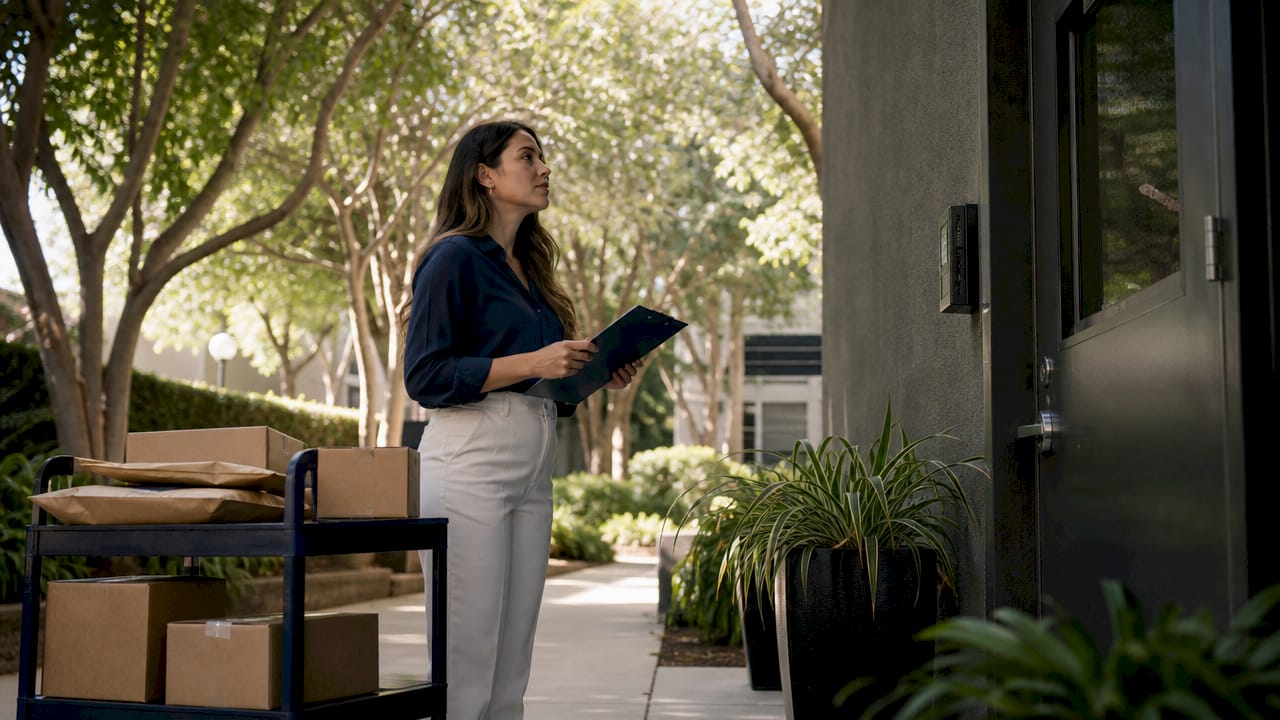
Package security is the coordinated set of physical controls, technology, and operational protocols designed to protect delivered parcels in multifamily communities from theft and misplacement. Apartment dwellers face a 3.5 times higher theft risk than residents in single-family homes, with roughly 104 million packages stolen in 2025 alone and annual losses reaching as high as $15 billion. For property managers, that number is not abstract. Parcel theft drives resident complaints, accelerates turnover, and erodes the trust that keeps leases renewed. Getting package security right is one of the most direct investments a multifamily community can make in resident satisfaction.
What makes package security so challenging in multifamily communities?
Multifamily properties carry structural vulnerabilities that single-family homes simply do not have. Shared lobbies, common hallways, and communal delivery areas give dozens or hundreds of residents, guests, and delivery drivers access to the same physical space. That shared access is the root of the problem.
High delivery volume compounds the risk. A 200-unit building might receive hundreds of parcels daily from UPS, FedEx, USPS, Amazon Logistics, and regional carriers. Each carrier operates on its own schedule and follows its own drop-off habits. That inconsistency creates gaps in the intake process that theft-minded individuals exploit.
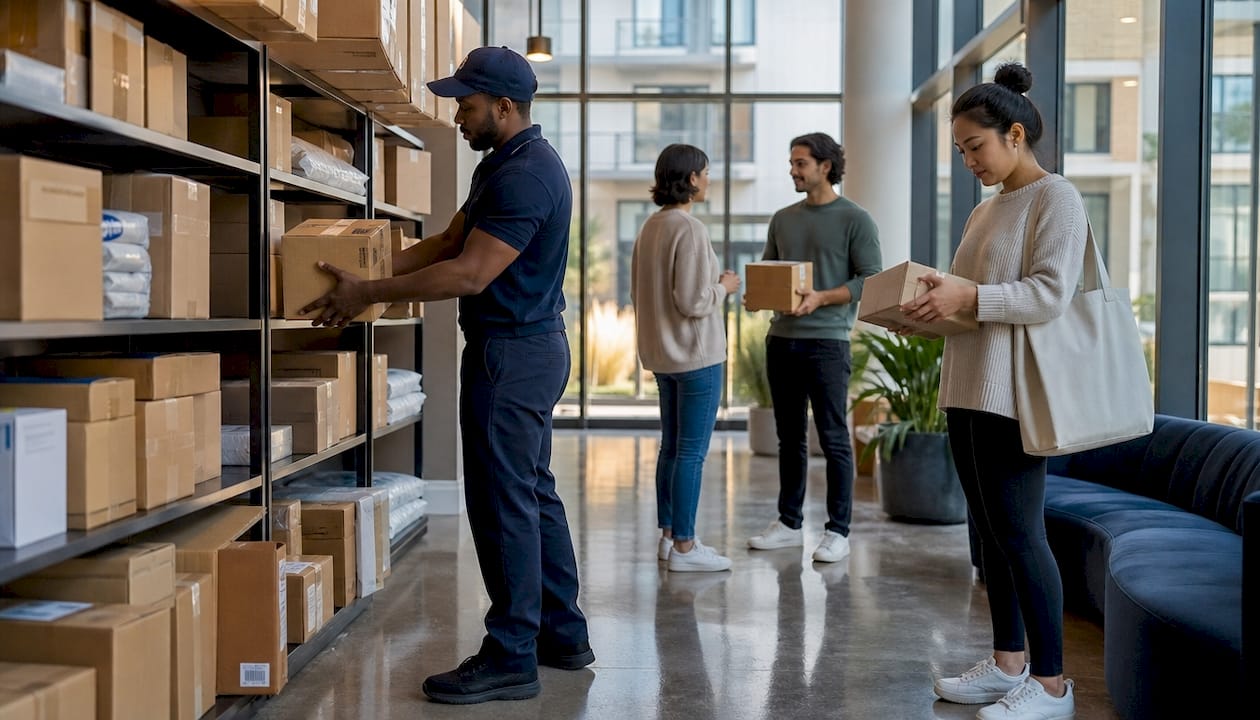
The most overlooked vulnerability is resident and guest traffic itself. A neighbor holding the lobby door open for a stranger, or a guest wandering near the package room, creates exposure that no camera alone can close. These are the “operational blind spots” that package rooms develop without controlled access and connected visitor management.
Key structural vulnerabilities in multifamily package handling include:
- Shared access points that allow unvetted individuals into delivery areas
- Multiple carrier handoffs with no standardized drop-off protocol
- Unmonitored package rooms that accumulate parcels without logged accountability
- Resident notification failures that leave packages sitting unclaimed for days
- No clear chain of custody from carrier drop-off to resident pickup
Package rooms without controlled access protocols do not just create theft risk. They create an environment where theft is nearly impossible to trace, because no one knows who was in the room or when.
The result is a system that looks organized on the surface but has no real accountability underneath. Property managers often discover the gap only after a theft complaint lands on their desk.
What are the core components of an effective layered package security strategy?
A layered security approach combining controlled access, video surveillance, and clear resident policies outperforms any single solution. No one tool closes all the gaps. The layers work together.
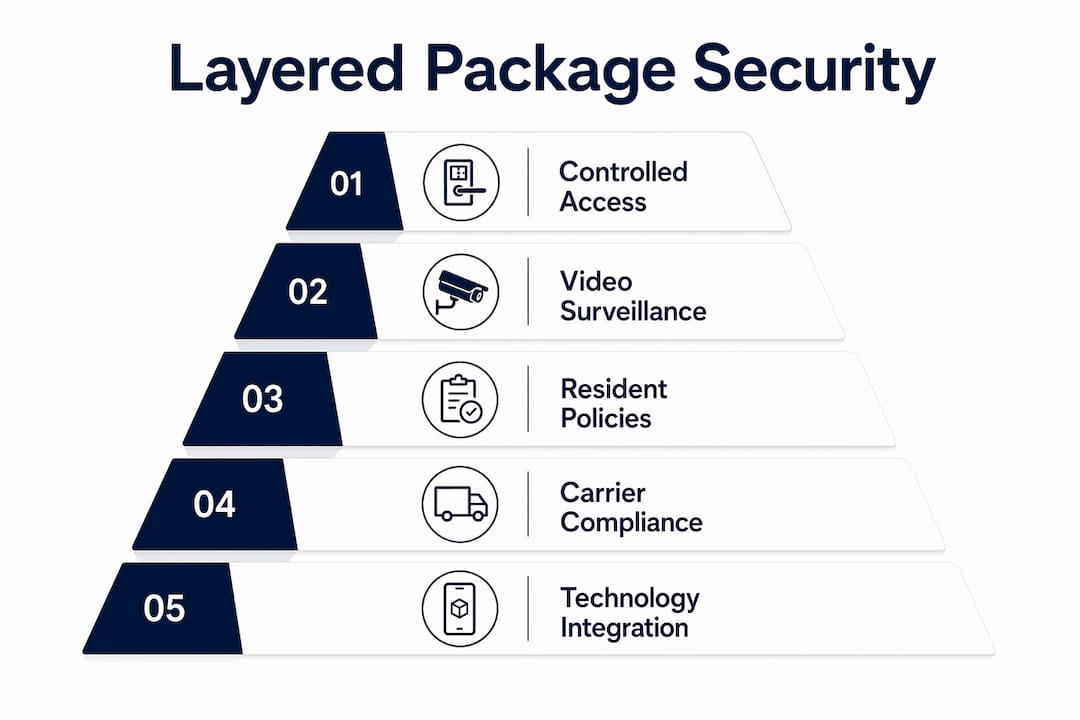
Controlled access
Controlled access means restricting who can enter the package room or locker area, and logging every entry. Key fobs, PIN pads, and mobile credential systems all accomplish this. The critical detail is that access must be logged, not just gated. A door that opens for anyone with a fob provides no accountability if the fob is shared or lost.
Scheduled delivery windows add another layer. When carriers know they can only access the delivery area between 8:00 AM and 6:00 PM, and that access is tied to a unique credential, the intake process becomes traceable.
Video surveillance with documented accountability
Cameras provide visibility, but cameras alone do not replace access control and documented workflows. A camera recording an empty room after a theft has occurred is not a security system. It is evidence collection after the fact. Effective surveillance pairs camera coverage with access logs, so every entry can be matched to a specific credential and time stamp.
GPS patrol tracking and physical security rounds add a human layer that technology cannot replicate. A visible security presence deters opportunistic theft more reliably than a camera that no one monitors in real time.
Resident policies
Clear resident policies close the behavioral gap. A 48-hour pickup window reduces package accumulation and the clutter that makes theft harder to detect. Designated delivery zones prevent carriers from leaving parcels in hallways or lobbies. Written policies distributed at lease signing set expectations before problems arise.
Pro Tip: Send residents a digital reminder when a package has been in the room for more than 24 hours. Prompt pickup reduces the window of exposure and keeps the package room organized.
| Security method | Strength | Limitation |
|---|---|---|
| Controlled access (PIN/fob) | Creates audit trail and restricts entry | Requires credential management |
| Video surveillance | Provides visual record of activity | Ineffective without access logs |
| Resident pickup policies | Reduces accumulation and exposure | Requires consistent enforcement |
| Smart lockers | Automated notification and secure pickup | Capacity and size constraints |
| Carrier SOPs | Standardizes intake and reduces errors | Requires proactive training |
How can property managers improve carrier compliance and manage package intake efficiently?
Carrier non-compliance is the leading failure cause in package security systems, reported by 70% of operators as their top frustration. A driver who leaves a parcel in the lobby instead of the designated delivery zone breaks the entire chain of custody. The package is now unlogged, unmonitored, and exposed.
The fix is not reactive training. Protocols must be standardized and distributed proactively at system deployment, before the first delivery is made. Waiting until a complaint arrives to train carriers is a structural mistake that most properties repeat.
A practical compliance workflow looks like this:
- Issue unique PIN or QR codes to each carrier before they begin deliveries at your property. Unique credentials create an audit trail and give drivers a clear incentive to follow the process.
- Distribute a written SOP to every carrier account manager, not just the individual drivers. Driver turnover is high. The SOP needs to live at the account level so new drivers receive it automatically.
- Log every delivery attempt against the credential used. Any delivery that does not match a logged credential triggers an immediate review.
- Conduct monthly compliance audits by pulling access logs and comparing them against carrier delivery records. Gaps in the data identify which carriers need retraining.
- Escalate persistent non-compliance to the carrier’s regional account manager with documented evidence. Carriers respond to documented patterns, not anecdotal complaints.
Pro Tip: When evaluating package management vendors, ask specifically how their system detects and flags carrier non-compliance. If the vendor cannot answer that question clearly, carrier compliance is not built into their process.
Issuing unique access codes to drivers does two things simultaneously. It creates an operational incentive for compliance, and it generates the audit data you need to enforce accountability. That dual function is what makes it the most cost-effective compliance tool available.
What role do package rooms, smart lockers, and technology play in secure package delivery?
Hardware and technology set the foundation for secure package delivery, but they do not run themselves. Each solution has a specific role, and each has real limitations that property managers need to understand before committing budget.
Smart lockers automate resident notifications and eliminate staff handling for individual packages. That is a genuine operational benefit. The limitation is physical. Each locker compartment holds one package regardless of size, and expanding a locker bank requires significant square footage and capital investment. A 300-unit building receiving oversized parcels will overflow a standard locker bank within weeks.
Package rooms scale better for volume and size variety, but they require connected workflows to function as a security asset rather than a liability. A package room without controlled access becomes an operational blind spot. Combining visitor management with access control gives property managers the operational intelligence they need to trace any incident.
Key considerations when evaluating hardware and technology solutions:
- Locker banks work best for communities with moderate volume and standard-size parcels
- Package rooms handle high volume and oversized items but require stricter access protocols
- Integrated software platforms that connect access logs, camera feeds, and resident notifications reduce staff burden and improve response time
- Offsite third-party delivery models remove the property from the intake process entirely but introduce new handoff risks and resident friction
| Solution type | Best fit | Key risk |
|---|---|---|
| Smart lockers | Moderate volume, standard sizes | Overflow on large or high-volume days |
| Managed package room | High volume, mixed sizes | Becomes blind spot without access control |
| Integrated software platform | Properties needing audit trails | Requires staff training and consistent use |
| Offsite delivery model | Properties with no on-site space | Resident friction and handoff failures |
Technology provides visibility. Process provides accountability. The properties that reduce theft complaints do both. Fixmypackages operates on exactly this principle, placing a dedicated on-site Package Manager at each community to handle receiving, sorting, and securing parcels up to six days a week.
Key Takeaways
Effective package security in multifamily communities requires layered physical controls, documented carrier compliance, and consistent resident policies working together, not independently.
| Point | Details |
|---|---|
| Layered security outperforms single solutions | Combine controlled access, surveillance, and resident policies to close all exposure gaps. |
| Carrier compliance is the root failure point | Standardize and distribute carrier SOPs at deployment, before the first delivery arrives. |
| Package rooms need connected workflows | Access logs paired with camera coverage create accountability that cameras alone cannot provide. |
| Smart lockers have hard capacity limits | Plan for overflow on high-volume days and for oversized parcels that lockers cannot accommodate. |
| Theft reduction protects resident retention | Building-level parcel protection directly reduces turnover costs and supports lease renewals. |
What I’ve learned after watching properties get this wrong for years
Most property managers I talk to have invested in at least one piece of technology before they call us. A camera here, a locker bank there. What they have not invested in is a process. That is where the gap lives.
The properties that cut theft complaints fastest are not the ones with the most hardware. They are the ones that standardized carrier intake first. When a driver drops a package in the lobby instead of the designated zone, no camera in the world recovers that package if no one is watching the feed in real time. The audit trail is what matters, and the audit trail only exists if you built it into the intake process from day one.
I have also seen property managers treat package security as a facilities problem when it is actually a retention problem. Apartment turnover costs roughly $4,000 per unit, and parcel theft is a documented driver of resident dissatisfaction. A resident who loses a package and gets no resolution does not renew. That math is simple.
The future of this space will include AI-driven visitor verification at delivery zones, and some platforms are already piloting it. But the properties winning right now are not waiting for AI. They are running tight intake protocols, issuing unique carrier credentials, and treating the package room as a leasing amenity rather than a storage closet.
View package security as a retention tool. The investment pays back in renewals, not just in recovered parcels.
— Craig
How Fixmypackages takes package security off your team’s plate
Property managers who want to stop managing packages and start managing their community have a direct path forward with Fixmypackages.
Fixmypackages places a dedicated on-site Package Manager at your community up to six days a week. That person receives, sorts, secures, and organizes every parcel so your leasing team never touches a box. The package room management service covers intake protocols, carrier compliance, and resident notifications, turning a persistent operational headache into a visible amenity. Regional services are available across markets including Richmond, VA, Portland, OR, and Phoenix, AZ. Many communities structure the service as a paid resident amenity and recover the management cost through that ancillary revenue.
FAQ
What is package security in multifamily housing?
Package security is the combination of physical access controls, video surveillance, carrier intake protocols, and resident policies that protect delivered parcels from theft or misplacement in apartment communities.
Why do apartments have higher package theft rates than houses?
Apartment dwellers face a 3.5 times higher theft risk than single-family home residents because shared lobbies, common hallways, and multiple carrier handoffs create exposure that private driveways and front porches do not.
What is the most effective way to prevent package theft in an apartment building?
A layered approach combining controlled access, documented surveillance, and clear resident pickup policies reduces theft more reliably than any single solution, with building-level prevention cutting theft complaints by 30% or more within one quarter.
How do you handle carrier non-compliance in a package security system?
Issue unique PIN or QR codes to each carrier before deliveries begin, distribute written SOPs at the account level, and audit access logs monthly against carrier delivery records to identify and address gaps.
Are smart lockers enough to secure packages in a large apartment community?
Smart lockers automate notifications and reduce staff handling, but each compartment holds one package regardless of size. High-volume or large-parcel communities will overflow a standard locker bank and need a managed package room to handle the full delivery mix.
Recommended
Ready when you are
Fix your package room — start with a free proposal
Daily on-site Package Manager, resident text & email pings*, and a tour-ready amenity. Tell us your unit count and we'll send a right-sized proposal — usually within one business day.
- ✓ 10–20+ hours back every week
- ✓ Works with any locker system
- ✓ Faster, friction-free resident pickup
- ✓ An easy ancillary income addition