July 17, 2026
Resident Retention Ideas for Apartments: 2026 Guide
Explore effective resident retention ideas for apartments in 2026. Discover strategies to boost renewals and reduce turnover costs today!

Resident retention is defined as the percentage of residents who renew their lease at the end of a lease term, and it is the single most controllable driver of net operating income in multifamily housing. The average cost to turn over one unit runs approximately $3,872, with vacancy rent loss alone often exceeding $700 for a 14-day gap. That is before cleaning, painting, or administrative labor. Residents who report a positive living experience are 73% more likely to renew their lease than dissatisfied residents. The math is unambiguous: keeping a resident costs far less than replacing one, and the resident retention ideas for apartments that work in 2026 are built around that reality.
1. What are the top resident retention ideas proven to boost renewals?
The most effective resident retention strategies share one trait: they address what residents actually value, not what managers assume they value. A dangerous confidence gap exists in the industry. 59% of property managers expect retention to improve, yet national retention has dropped to 57% in 2026. The gap exists because managers misdiagnose why residents leave.
Host community events that build real connection
Resident events are not just social programming. They are retention tools. A well-run community event gives residents a reason to feel attached to their building, not just their unit. Target events to your resident mix: young professionals respond to networking happy hours, while families respond to seasonal outdoor events. The goal is to create memories tied to the address.

Offer upgrade incentives tied to renewal
Lease renewal incentives work best when they feel personal. A free carpet cleaning, a fresh coat of paint in a preferred color, or a smart thermostat installation costs far less than a vacancy. Survey residents at the 6-month mark to learn what upgrades they want most. That data turns a generic renewal offer into one that is hard to decline.
Build proactive, multi-channel communication
Residents prioritize clear, multi-channel communication with tailored options: 49% prefer digital-only for payments, 43% for maintenance tracking, while 35% want human contact for neighbor issues. Matching the channel to the interaction type reduces friction and signals that management pays attention. A single communication channel for all issues is a retention liability.
Fix maintenance fast and follow up
Maintenance responsiveness is one of the strongest predictors of renewal. High first-time fix rates and post-repair satisfaction surveys correlate directly with lower turnover and lower vacancy costs. Residents do not expect perfection. They expect follow-through. A repair completed on time with a follow-up text is worth more than a discounted renewal offer sent after a string of ignored work orders.
Pro Tip: Send a brief satisfaction survey within 24 hours of every completed maintenance request. The data identifies friction points before they become move-out decisions.
Launch a loyalty or rewards program
Loyalty programs in multifamily housing are underused. A points-based system that rewards on-time rent payments, lease renewals, and referrals gives residents a tangible reason to stay. The cost per resident is low. The signal it sends, that long-term residents are valued more than new ones, is high. Several property management platforms now include built-in rewards modules that require minimal staff time to run.
2. How can technology and data-driven tools improve resident retention programs?
Technology does not replace the human side of retention. It makes human intervention faster and better targeted. The best operators in 2026 use data to find at-risk residents before those residents start searching for a new apartment.
- AI sentiment analysis: AI-powered sentiment tools scan maintenance requests, emails, and portal interactions to detect frustration and disengagement months before lease expiration. Early identification allows managers to intervene with a conversation, not a discount.
- Predictive renewal scoring: CRM platforms can flag residents who show behavioral patterns linked to non-renewal, such as reduced portal logins, increased complaint frequency, or late payments. A flagged resident gets personal outreach. An unflagged resident gets a standard renewal notice.
- Automated lease renewal workflows: Lease renewal outreach starting 90 to 120 days before expiration yields higher renewal rates than last-minute contact at 30 days. Automated reminders sent through a mobile-friendly portal remove friction from the signing process itself.
- Package room management as a daily touchpoint: On-site package management, like the service Postal Solutions provides, creates a positive daily interaction between residents and the property. Residents who pick up packages from a clean, organized, professionally run room associate that experience with the property’s overall quality.
“The best operators treat lease renewal as a victory lap for a year of well-run service, not a negotiation battle. Continuous experience management, not last-minute incentives, drives retention.” Lease Renewal Guide 2026 | Spanr
Integrating AI resident agents for proactive maintenance management, renewal reminders, and multi-channel communication is becoming an operational standard in well-run multifamily communities. These tools do not require large staffing increases. They require a willingness to act on the data they surface.
3. Which amenities most influence resident retention?
Amenity decisions should follow resident preference data, not gut instinct. 63% of renters rank in-unit washers and dryers as the most desirable apartment feature, and 71% consider the overall benefits and amenities package important when selecting a home. That data reframes the amenity conversation entirely.
| Amenity category | Resident priority level | Retention impact |
|---|---|---|
| In-unit washer and dryer | Very high | Directly cited in move-in decisions |
| Secure entry and lighting | High | Affects perceived safety and comfort |
| High-speed internet | High | Expected baseline in 2026 |
| On-site package management | High | Daily convenience and security |
| Cosmetic unit upgrades | Moderate | Increases perceived value at renewal |
Safety upgrades rank consistently high across renter surveys. Improved exterior lighting, key fob entry, and monitored package areas all reduce anxiety and increase the sense that management cares about resident wellbeing. These are not luxury features. They are baseline expectations for renters who have options.
Reliable high-speed internet is no longer an amenity. It is infrastructure. A property that cannot guarantee consistent connectivity will lose residents to one that can, regardless of rent price. Bundled internet as part of a resident benefits package is one of the fastest ways to add perceived value without a major capital investment.
On-site package management is an often-overlooked retention driver. Residents receive more packages than ever, and a lost or stolen delivery creates immediate frustration. A professionally managed package room removes that frustration entirely and turns a daily errand into a positive experience.
Pro Tip: Before your next capital budget cycle, survey current residents on which amenity improvement would most influence their decision to renew. The answers will almost always differ from what management expects.
4. What communication and pricing strategies reduce turnover?
Rent increases of 8% or more, or roughly $90 to $150 per month, often trigger lease reevaluation. That does not mean increases are avoidable. It means how you communicate them determines whether residents stay or start searching.
- Lead with market data. Show residents the comparable rents in your submarket. A $100 increase feels different when the resident can see that the next closest option costs $150 more.
- Set expectations at move-in. Residents who understand from day one that annual increases are standard and tied to market conditions are less likely to feel blindsided at renewal.
- Respond within 24 hours. Slow responses to maintenance requests and inquiries are a leading cause of resident dissatisfaction. Speed signals respect.
- Offer flexible lease terms. Month-to-month options, 6-month leases, and staggered renewal dates give residents a sense of control. That sense of control reduces the impulse to leave.
- Simplify the renewal process. A mobile-friendly digital lease that takes five minutes to sign removes the last barrier between a resident who wants to stay and one who decides it is too much trouble.
Clear communication is not just a courtesy. It is a retention tool. Residents who feel informed and respected are far less likely to leave over a rent increase they saw coming and understood.
Key Takeaways
Resident retention in multifamily housing is driven by consistent service quality, proactive communication, and amenities that match what residents actually value, not what managers assume they want.
| Point | Details |
|---|---|
| Turnover is expensive | Each unit turnover costs approximately $3,872, with vacancy loss as the largest single component. |
| Satisfaction drives renewals | Residents with positive experiences are 73% more likely to renew their lease. |
| Start renewal outreach early | Contacting residents 90 to 120 days before expiration significantly improves renewal rates. |
| Match amenities to preferences | 63% of renters rank in-unit laundry as the top feature; amenity decisions should follow resident data. |
| Package management adds daily value | A professionally run package room creates positive daily interactions that reinforce resident satisfaction. |
What 25 years of on-site package management taught us about retention
The conventional wisdom says retention comes down to price. Lower the rent increase, add a concession, and residents will stay. That framing is wrong, and the data backs it up.
What we have seen across hundreds of multifamily communities is that residents leave because of friction. Not price. Friction. A maintenance request that went unanswered for two weeks. A package that sat in a pile in the leasing office and got lost. A renewal notice that arrived 30 days before expiration with no context and no conversation. These are not price problems. They are service problems.
The operators who retain residents year after year are not the ones with the lowest rents. They are the ones who have removed the daily irritants that make residents start looking elsewhere. Package management is a perfect example. It sounds minor. A dedicated on-site Package Manager, a clean organized room, packages available 24/7. But residents notice. They notice every single day when they pick up a delivery without a problem. And they notice when that experience is missing at the next property they tour.
Retention is not a renewal season effort. It is a year-round operating standard. The ancillary income opportunity that comes from a well-run package room is a bonus. The real return is a resident who never seriously considered leaving.
— Postal Solutions
How on-site package management supports resident retention
Package Room Management by Postal Solutions removes one of the most consistent daily friction points in multifamily housing: package chaos. A dedicated on-site Package Manager works your community up to six days a week, receiving, sorting, securing, and organizing every delivery. Residents access their packages 24/7 through the room or lockers you already have.
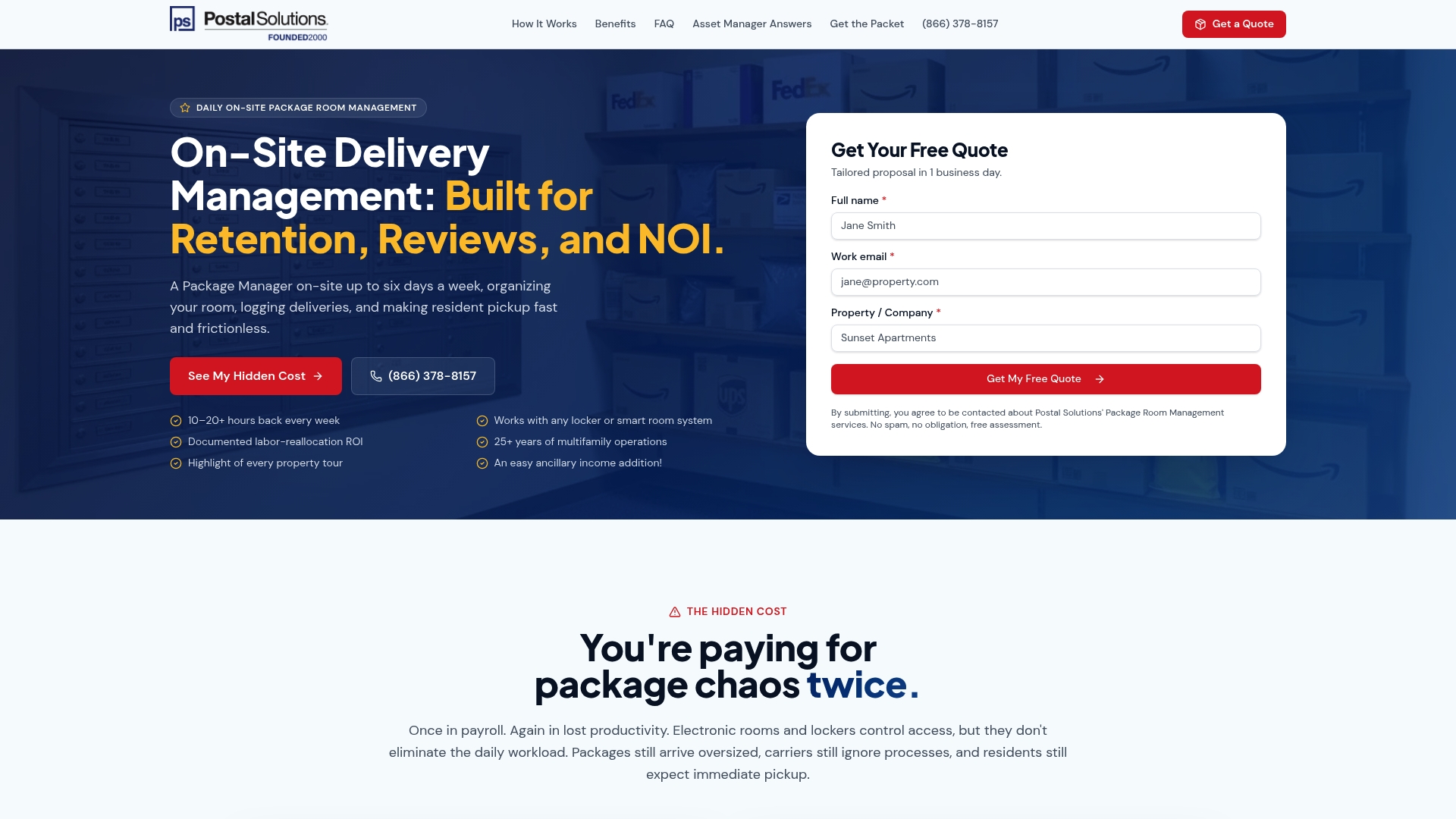
Your leasing team gets hours back every week. Time that used to go to sorting boxes and fielding “where is my package?” calls goes back to renewals, tours, and resident relationships. A professionally run package room also becomes a showpiece amenity on leasing tours, tangible proof that life at your property is easier than at the competition. Learn how it works and see why communities across the country trust Postal Solutions to run their package operations.
FAQ
What is the average cost of apartment resident turnover?
The national average cost to turn over a single apartment unit is approximately $3,872. Vacancy rent loss is typically the largest single component, often exceeding $700 for a 14-day vacancy.
How early should lease renewal outreach begin?
Renewal outreach starting 90 to 120 days before lease expiration yields significantly higher renewal rates than contact made at 30 days. Early outreach reaches residents before they begin actively searching for alternatives.
What amenities most influence resident retention decisions?
63% of renters rank in-unit washers and dryers as the most desirable feature, and 71% consider the overall amenities package important when choosing a home. Safety upgrades, high-speed internet, and on-site package management also rank highly.
How does package management affect resident satisfaction?
A professionally managed package room creates a positive daily interaction between residents and the property. Reliable, secure package handling reduces frustration and reinforces the perception that management delivers on its promises.
What communication channel do residents prefer for maintenance requests?
43% of residents prefer digital-only communication for maintenance tracking. Matching the communication channel to the specific interaction type improves satisfaction and reduces the operational load on leasing staff.
Recommended
Ready when you are
Fix your package room — start with a free proposal
Daily on-site Package Manager, resident text & email pings*, and a tour-ready amenity. Tell us your unit count and we'll send a right-sized proposal — usually within one business day.
- ✓ 16–30 hours back every week
- ✓ Works with any locker system
- ✓ Faster, friction-free resident pickup
- ✓ An easy ancillary income addition