
October 1, 2026
25 Years Experience: On Site Package Management for Property Managers
Operations guide for property managers on professionally managed on site package rooms. 25 years' field lessons, ROI checkpoints, KPIs, and a two week...

On-site package management, whether run through staffed package rooms or integrated locker systems, is the strongest choice for multifamily and student housing communities that see sustained high parcel volumes. It keeps deliveries secure, cuts resident wait times, and frees leasing staff from hours of sorting and searching for boxes. Properties with lighter, seasonal volume can often get by with simpler setups, but once daily parcel counts climb, on-site management becomes the operational backbone that protects both resident experience and staff time.
TL;DR:
- On-site package management is essential for high-volume properties to ensure security, reduce resident wait times, and free staff from parcel sorting.
- Staffed management provides better chain-of-custody, dispute resolution, and security, especially for oversized or refrigerated deliveries.
- A mix of locker systems and dedicated staff can optimize workflows, but volume, space, and resident demographics should guide the model choice.
- Regular audits, clear security protocols, and trained staff are critical to minimizing theft, losses, and resident complaints.
- Heavy parcel volume properties benefit most from a dedicated on-site Package Manager, which significantly improves efficiency and resident satisfaction.
Table of Contents
- What on-site package management includes
- Core differences between on-site and off-site or direct-to-door approaches
- Benefits of professionally managed on-site package operations
- Cost and ROI considerations: what to budget and how to model return
- How to choose the right on-site package approach for your property
- Why professional on-site package room management works
- Security protocols to prevent package theft and loss
- Staff training and procedures for handling packages safely and efficiently
- Emergency and exception handling processes
- Author perspective: practical next steps this quarter
- How Postal Solutions helps with on-site package room management
- Sources
- FAQ
What on-site package management includes
On-site package management covers three main models, and most properties end up using some combination of them. Smart lockers are self-service units where couriers scan and deposit parcels, and residents retrieve them with a code or app notification. Automated package rooms function similarly but at larger scale, often using shelving, cameras, or position-tracking to handle higher volumes and oversized items. Staffed package room management adds a dedicated person on-site who receives, sorts, logs, and organizes every delivery, whether it passes through a locker, a shelf, or a walk-in room.
Property teams choose a model based on a few practical factors:
- Space: Properties with a spare room or mailroom area can support a staffed operation; tighter footprints often lean on compact locker banks.
- Volume: Communities receiving dozens of parcels daily typically outgrow self-service lockers alone.
- Resident demographics: Student housing and high-turnover communities tend to generate spikes that stress automated-only systems.
- Existing hardware: Many properties integrate a staffed layer on top of lockers or rooms they already own rather than replacing equipment.
Carrier workflows matter here too. A well-run on-site operation logs every scan, syncs with resident contact information, and coordinates with property management software so pickup notifications and audit trails stay accurate.
Core differences between on-site and off-site or direct-to-door approaches
Off-site pickup points and direct-to-door delivery both shift the work and risk away from the property, but they trade away control that on-site management retains. The differences show up most clearly in four areas:
- Convenience and access: On-site package rooms and lockers give residents pickup access on their own schedule, often 24/7, without a trip off property; direct-to-door delivery depends entirely on the carrier reaching the resident’s actual unit, which fails often in buildings with restricted entry.
- Operational control and chain-of-custody: Staffed on-site handling creates a documented record of who received, logged, and released each parcel; off-site drop points and unmonitored doorstep delivery leave gaps that are hard to trace when something goes missing.
- Security and dispute evidence: A logged, on-site process gives the property a paper trail to point to when a resident disputes a delivery; without it, “it never arrived” claims are almost impossible to resolve fairly.
- Carrier compliance and staff burden: On-site systems with clear scan-in protocols reduce the “package dump” problem where drivers leave parcels in a pile rather than logging them individually, which in turn cuts the rework hours staff spend hunting for misplaced boxes.
The trade-off is straightforward: off-site and direct-to-door approaches ask less of the property but deliver less certainty, while on-site management asks more upfront coordination and returns tighter control over where every parcel is at any given moment. For a fuller breakdown, see this comparison of on-site versus off-site package management.
Benefits of professionally managed on-site package operations
A professionally run package room does more than store boxes. It changes how staff spend their day and how residents feel about the property.
- Reclaimed staff hours: Leasing staff stop sorting parcels and chasing lost deliveries, and that time shifts back to tours, renewals, and resident relationships.
- Faster pickup and less lobby congestion: Organized shelving and clear notification systems mean residents grab their packages in minutes instead of digging through a pile.
- Better documentation: Logged receiving and chain-of-custody records reduce disputes and give staff a clear answer when a resident asks where a parcel went.
- Amenity value on tours: A clean, well-run package room is something leasing teams can point to during a walkthrough as proof the property runs smoothly.
Residents notice. A very high percentage of residents with locker access use them weekly, and a large majority say package handling efficiency influences their leasing decisions, according to Parcel Pending’s 2025 resident preferences research. That is a strong signal that package handling is not a back-office detail. It is a factor residents weigh when deciding whether to renew or move on.
Cost and ROI considerations: what to budget and how to model return
Budgeting for on-site package management means accounting for a few distinct cost buckets and weighing them against what the property gets back in staff time and resident retention.
- Labor: Whether it is a dedicated Package Manager or a portion of an existing team member’s hours, this is usually the largest line item.
- Hardware: Locker banks, shelving, or smart-room equipment, either purchased outright or bundled into a service contract.
- Software: Notification systems, tracking platforms, and integrations with property management tools.
- Maintenance: Ongoing upkeep for lockers or scanning equipment, plus periodic audits to catch shrinkage or workflow gaps.
The return side of the equation comes from labor reallocation: hours that used to go toward sorting and searching for packages get redirected to leasing and renewals, work with a direct revenue connection. Some communities also structure package handling as a paid resident amenity, retaining the margin over the cost of management rather than treating it purely as overhead.
Properties with heavier daily parcel counts and tighter staffing tend to see the clearest return, because the labor savings scale with volume while the base cost of a dedicated Package Manager stays fairly flat. A practical way to check the math is to track current staff hours spent on package duties for a representative period, then compare that against what a managed on-site model would cost.
How to choose the right on-site package approach for your property
Choosing a package management approach starts with an honest look at your property’s volume and layout, not with which hardware looks most impressive in a demo.
- Audit current parcel volume. Count daily and peak-season deliveries for at least two weeks before deciding on scale.
- Assess available space. A dedicated room supports staffed management; a hallway alcove may only fit lockers.
- Factor in resident demographics. Student housing and high-turnover communities usually need more capacity buffer than stable, long-term communities.
- Plan for peak season. Move-in weeks and the holiday stretch can multiply daily volume several times over, so build in overflow capacity ahead of time.
- Decide on staffing model. Determine whether existing staff can absorb the workload or whether a dedicated manager is the better fit.
Once a model is in place, three KPIs tell you whether it is working: parcel volume, resident dwell time, and complaints per 100 packages. A dwell-time target of under 48 hours during peak periods is a common benchmark cited in multifamily package management guidance, and tracking it early flags capacity problems before they become resident complaints.
When talking to vendors or carriers, ask how their system handles overflow and oversized items, how it integrates with your property management software, and what happens when a driver skips proper scan-in. Red flags include a vendor with no carrier onboarding process, weak or inconsistent resident notifications, and lockers that overflow on a recurring basis. Any of those point to a system that will create more work than it saves.
Pro Tip: Run your parcel-volume audit during a normal week and a peak week separately. The gap between the two tells you how much overflow capacity you actually need.
Why professional on-site package room management works
Twenty-five years of running on-site package operations has shown a consistent pattern: hardware alone rarely solves the problem, but hardware paired with a dedicated Package Manager usually does. A trained person on-site catches what automated systems miss, oversized parcels that will not fit a locker, refrigerated deliveries that need immediate attention, and the misdirected packages that show up every week regardless of how good the scanning software is.
- Dedicated Package Managers work the property up to six days a week, receiving, sorting, and securing deliveries as they arrive.
- Locker and package-room integrations mean the model works with hardware a property already owns, no replacement required.
- Weekly audits catch shrinkage, misdelivery patterns, and overflow issues before they become resident complaints.
- Hybrid strategies, pairing lockers for routine parcels with staffed overflow handling for large or refrigerated items, cover the gaps either system alone would leave.
Package handling has shifted from a back-office task to a visible amenity that shows up on tours and affects renewal decisions.
Security protocols to prevent package theft and loss
Package theft and loss usually trace back to the same weak points: unlogged deliveries, unclear chain-of-custody, and unmonitored pickup areas. A solid on-site security protocol closes each of those gaps.
Every parcel should be scanned in at the moment it arrives, tied to the resident’s name and unit, and logged with a timestamp. That single step creates the record that resolves most disputes before they start. Access to the package room or locker bank should be restricted, whether through key fob, code, or staffed hours, so parcels are not sitting in an open area where anyone can walk off with one.

Camera coverage over the package area adds a second layer, and it matters most at the exact moment of drop-off and pickup rather than as general room coverage. Shelving that separates parcels by unit number, rather than piling everything by arrival time, also cuts down on grab-and-go theft because it is obvious when something does not belong to the person picking it up.
Regular audits catch shrinkage patterns that a single missing package would not reveal. A weekly reconciliation between what was scanned in and what was picked up flags problems, whether that is a process gap or something more deliberate, while the trail is still fresh enough to investigate. Properties that skip this step usually only discover a pattern after several residents have already complained.
Staff training and procedures for handling packages safely and efficiently
The strongest package security protocol still fails if the person running it was never properly trained. Staff handling deliveries need a consistent, repeatable process, not a general sense of “sort it and let residents know.”
That starts with scan-in discipline: every parcel gets logged the moment it arrives, no exceptions for a busy afternoon or a driver in a hurry. Staff also need a clear system for organizing by unit number rather than by carrier or arrival order, since mixed systems are where misplaced packages usually start.
Handling oversized, fragile, or refrigerated items calls for its own short protocol. A grocery delivery or meal kit cannot sit on a shelf for a day the way a book order can, so staff need a clear rule for what gets refrigerated immediately, what gets flagged for same-day pickup, and who to notify when something needs special handling.

Notification procedures matter just as much as physical handling. Residents should get a text or email the moment their package is logged, not hours later, and staff should know how to resend a notification when a resident says they never got one. Training should also cover what to do when a resident arrives to collect a package that is not yet logged, since that moment, handled poorly, is where most complaints start.
Emergency and exception handling processes
Even a well-run package operation runs into exceptions: a misplaced parcel, a damaged box, a resident insisting they never received something the log shows was picked up. What separates a good operation from a frustrating one is having a clear process for each of these before they happen, rather than improvising in the moment.
For a misplaced package, staff should have a standard search protocol: check the log for the last scan, check the shelving by both unit number and carrier, and check whether the parcel was accidentally logged to a similar unit number. Most “lost” packages turn up through one of those three checks.
Damaged items need a documented condition report at the moment they are discovered, ideally with a photo, before the resident is notified. That protects both the resident and the property when a claim needs to go back to the carrier.
Resident disputes are the trickiest exception, and they are exactly where a logged chain-of-custody earns its cost. When a resident says a package never arrived but the log shows a scan-in and a pickup signature or code entry, staff have something concrete to point to rather than a he-said-she-said conversation. When the log shows no scan-in at all, that is useful too. It tells the property the parcel likely never made it past the carrier, and the resident should be pointed toward a carrier claim rather than a property investigation.
Author perspective: practical next steps this quarter
Start with a two-week parcel-volume and space audit before touching hardware or staffing decisions. Most properties overestimate what a locker bank alone can handle and underestimate how much staff time goes into package chasing.
Pilot a hybrid model if you are not sure a fully staffed room is justified, and track dwell time and complaints per 100 packages for a month. Spend equal effort on carrier communication and resident notifications; a system only works as well as the weakest link between the two.
Once you have real numbers, take them to leadership. A KPI report makes the case for investment far better than an assumption ever will.
— Postal Solutions
How Postal Solutions helps with on-site package room management
A dedicated Package Manager works on-site up to six days a week, handling the parts hardware alone cannot.
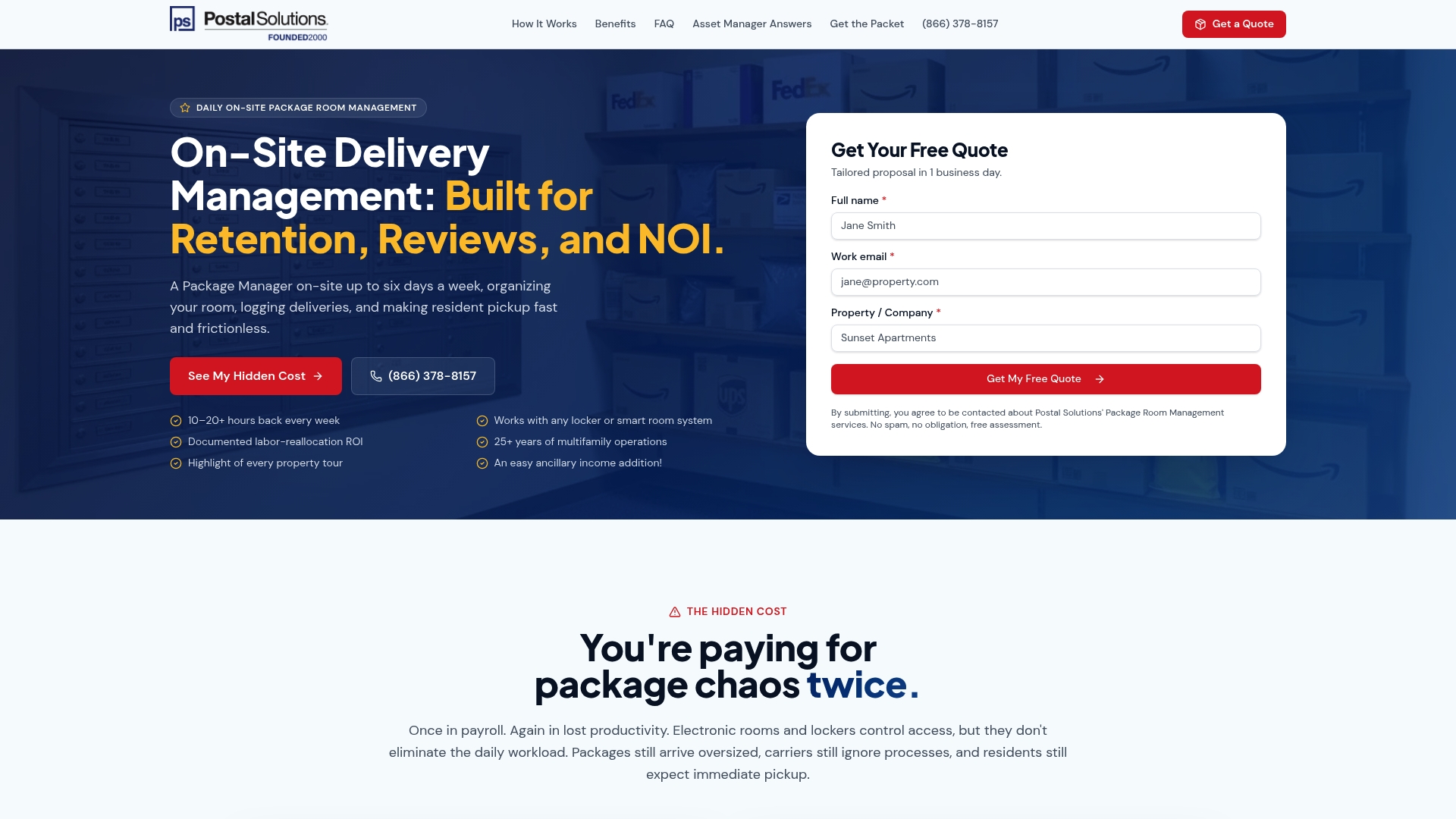
- Daily on-site package management, including receiving, sorting, and securing deliveries.
- Weekly package room audits to identify shrinkage and workflow gaps.
- Resident pickup support and overflow handling for packages requiring special attention.
- Integration with any locker or package room system your property already owns, including HelloPackage and other hardware you may already have installed.
Properties with sustained parcel volume and stretched leasing staff tend to gain the most benefit. Visit the Postal Solutions service page to see current service details or request a quote for your property.
Sources
For deeper specifications and benchmarks, consult USPS PO-632 centralized mailbox guidance for locker installation ratios, the Pitney Bowes Parcel Shipping Index for parcel-volume trends, and Apartment List’s multifamily package management guidance for KPI benchmarks.
- Key findings from Parcel Pending’s 2025 resident preferences report | NAA
- Multifamily package management guidance | Apartment List
FAQ
What is package management?
Package management is the process of receiving, sorting, securing, and making deliveries available to residents at a multifamily or student housing property. It can run through smart lockers, an automated package room, or a staffed on-site operation, and often combines more than one of these depending on parcel volume.
How does package delivery work at apartments?
Carriers typically drop parcels at a central location, either a locker bank, a package room, or a staffed drop-off point, where they are scanned and logged against the resident’s unit. Residents are then notified by text or email and retrieve their package using a code, app, or staffed pickup window.
What is Parcel Pending by Quadient?
Parcel Pending by Quadient is a smart locker system used by multifamily properties to automate package storage and resident pickup. Its own resident preferences research found that more than 90% of residents with locker access use them weekly.
Can you give me an example of a package manager?
A Package Manager is a staff role dedicated to receiving, sorting, and securing deliveries on-site, often working a property up to six days a week. Postal Solutions provides dedicated Package Managers as part of its on-site package room management service, handling everything hardware alone typically misses, including oversized and refrigerated items.
What KPIs should I track for package management?
The core KPIs are parcel volume, resident dwell time, and complaints per 100 packages. A dwell-time target of under 48 hours during peak periods is a common benchmark used to catch capacity problems early, according to multifamily package management guidance.
Recommended
Ready when you are
Fix your package room — start with a free proposal
Daily on-site Package Manager, resident text & email pings*, and a tour-ready amenity. Tell us your unit count and we'll send a right-sized proposal — usually within one business day.
- ✓ 16–30 hours back every week
- ✓ Works with any locker system
- ✓ Faster, friction-free resident pickup
- ✓ An easy ancillary income addition