
August 17, 2026
Reduce Package Inquiries With Daily On-Site Management
Outsource daily package management to reduce inquiries, reclaim staff time, and ensure seamless tracking for multifamily properties.

The fastest way to reduce package inquiries at a multifamily property is to outsource daily on-site package room management to a dedicated Package Manager. This single operational change addresses the root causes behind most resident complaints: lost items, unclear pickup status, and carrier drivers who bypass intake procedures.
Property teams that make this switch typically see three things happen at once:
- Staff time recovers immediately. Leasing agents stop fielding “where’s my package” questions and get back to touring prospects and processing renewals.
- Inquiry volume drops measurably. With a dedicated person logging every parcel and notifying residents the moment it arrives, the confusion that drives most complaints disappears.
- Chain-of-custody tightens. Every package gets scanned, shelved, and tracked, which means fewer disputes over lost or stolen items and a paper trail when something does go wrong.
The practical next step is straightforward: run a 30 to 60 day pilot at one property, or request a proposal to see what a full-service package operation looks like for your unit count and package volume before rolling it out portfolio-wide.
Key Takeaways
Outsourcing daily on-site package room management reduces resident package inquiries by fixing chain-of-custody gaps, automating notifications, and enforcing carrier compliance at the source.
| Point | Details |
|---|---|
| Outsource the daily operation | A dedicated on-site Package Manager cuts inquiries by removing lost-item confusion and staff overload at the source. |
| Prioritize carrier compliance | A significant share of operators rank carrier compliance as their top improvement goal, ahead of adding locker capacity. |
| Match the model to your property | High-volume urban sites, mid-size suburban communities, and premium buildings each favor a different solution model. |
| Run a real pilot | Measure baseline inquiries and staff hours first, then track results over a 30/60/90 day rollout. |
| Convert time saved into dollars | Roughly six staff-hours a day at 75 packages is a common labor-cost benchmark to build your ROI case around. |
| Consider Postal Solutions | Its daily Package Manager model, backed by 25 years of experience, is built to hit these exact priorities. |
Table of Contents
- How a Daily Package Manager Cuts Resident Inquiries
- Comparing the Solution Models Property Teams Actually Use
- What Questions Should You Ask a Package Room Vendor?
- Building a Realistic Pilot and Rollout Plan
- What ROI Should You Expect From Outsourcing?
- Which KPIs Prove the System Is Working?
- A Property Sees the Difference in Weeks, Not Months
- Why Property Teams Are Ready to Let This Go
- How Postal Solutions Handles the Package Room So You Don’t Have To
- Sources
- FAQ
How a Daily Package Manager Cuts Resident Inquiries
Most resident package complaints trace back to one of two failures: the item can’t be found, or the resident doesn’t know it arrived. A dedicated on-site Package Manager closes both gaps by design, not by accident.
Chain-of-custody logging eliminates the guessing game. When every parcel gets scanned at intake and logged again at pickup, staff can answer “where’s my package” in seconds instead of digging through a pile of boxes. Properties that still rely on ad hoc shelving or a leasing agent’s memory lose track of items constantly, and every lost item generates at least one inquiry, often several as the resident follows up.
Automated notifications remove ambiguity before it becomes a phone call. A resident who gets a timestamped text with a photo of their package and a pickup code has no reason to call the office. Compare that to a property where residents find out packages arrived only by walking past the mail room. A well-built notification system turns a reactive front desk into a proactive one.
Reduced staff burden means better answers when inquiries do happen. A leasing agent juggling a tour, a phone call, and a package search gives worse service on all three. Remove the package task entirely and the remaining resident interactions get faster and more accurate.
Carrier compliance is the piece most operators underestimate. Driver-caused failures, packages left in hallways, dropped at the wrong door, or scanned as delivered before they physically arrive, are a leading root cause of resident complaints, and enforcing carrier compliance through consistent SOPs closes that gap at the source.
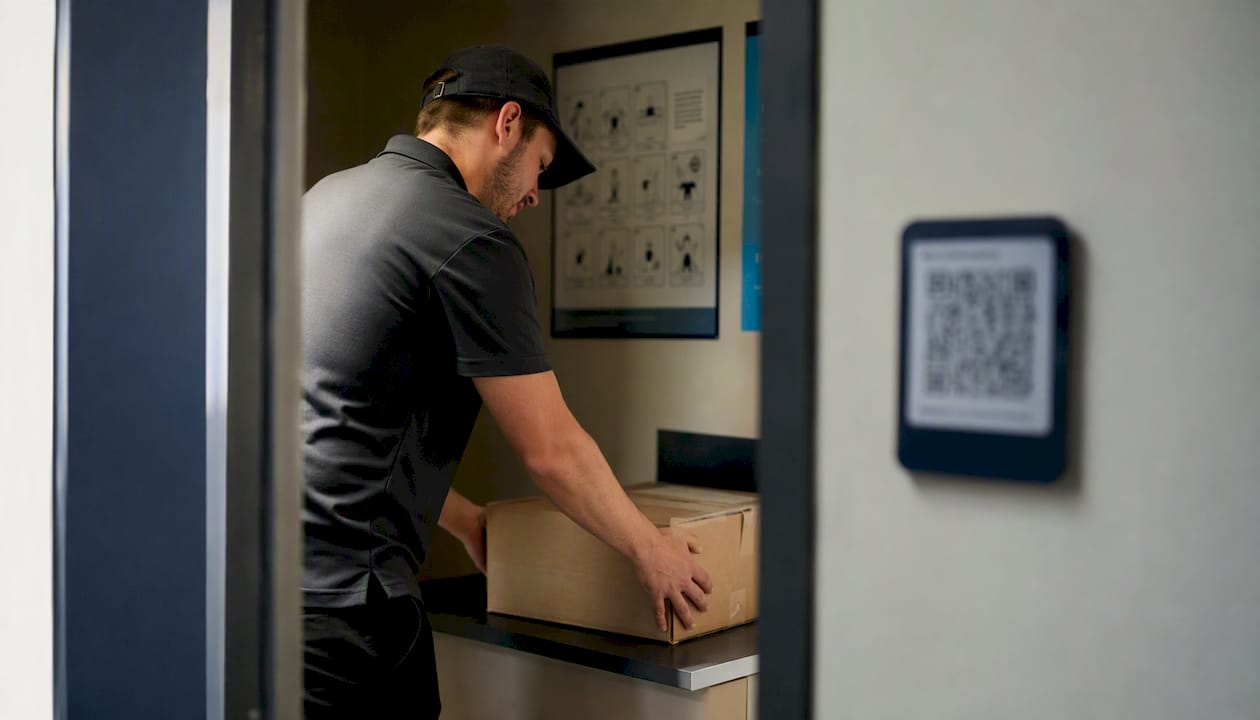
Pro Tip: Give every carrier a single-page pictorial SOP posted at the delivery entrance, paired with a QR code or PIN system for room access. Drivers who can see the process in five seconds are far more likely to follow it than drivers handed a paragraph of written instructions.
Comparing the Solution Models Property Teams Actually Use
Not every property needs the same setup, and choosing the wrong model is how operators end up buying hardware to solve a process problem. Here’s how the main approaches stack up.
- Dedicated on-site Package Manager (outsourced daily service): A trained person works the property up to six days a week handling intake, sorting, notifications, and audits. Best fit for mid-size to large communities with consistent daily volume and existing locker or package room infrastructure. The main trade-off is a recurring service fee, offset by staff hours recovered and stronger carrier accountability.
- Locker systems: Fixed electronic lockers work well for smaller properties with lower daily volume. They struggle with oversized or refrigerated items and hit capacity limits fast during peak seasons, which pushes overflow packages back onto staff.
- AI-powered smart package rooms: Computer-vision systems using flexible shelving can triple effective storage capacity compared to fixed lockers in the same footprint, which suits high-volume urban buildings with limited square footage. They still depend on carrier compliance to log intake correctly, so the hardware alone doesn’t solve driver-caused failures.
- Off-site third-party delivery: Packages get rerouted to a facility and delivered on a schedule, eliminating on-site space needs entirely. This fits premium communities where residents already expect white-glove service and will accept a delivery fee, though it shifts control (and cost) away from the property.
- Hybrid approaches: Combining a Package Manager with locker or smart-room hardware covers both the process gap and the space constraint, often the strongest fit for properties with mixed unit types or seasonal volume swings.
The common mistake is defaulting to more lockers when the real problem is process. Operators frequently add hardware to fix a compliance problem, and it rarely works, because the bottleneck was never storage capacity.
What Questions Should You Ask a Package Room Vendor?
Selecting the right approach means asking vendors specific, hard-to-fake questions rather than accepting generic marketing claims. Use this sequence in an RFP or vendor call:
- How exactly do you detect and document carrier non-compliance, and what happens when a driver bypasses the intake process?
- What’s your workflow when a package is reported lost or stolen, and what’s your average resolution time?
- What SLA metrics do you commit to (pickup time, notification speed, audit frequency) and how are they reported?
- What does your staffing model look like, on-site hours per day, backup coverage, and turnover history?
- Do you carry liability insurance for lost or damaged packages, and what does it actually cover?
- Does your system integrate with our existing property management software and locker or room hardware?
- What does onboarding look like, and can we see a sample weekly or monthly report before signing?
- Will you run a pilot before we commit to a full contract?
Watch for these red flags during vendor conversations:
- Vague or evasive answers about how they handle driver non-compliance.
- No concrete measurables for lost or stolen packages, just reassurance.
- Reporting cadence that’s quarterly at best, with no weekly visibility.
- Reluctance to offer any kind of pilot or trial period.
Match the decision to your property’s actual numbers. A 400-unit property receiving 150 packages daily with a dedicated package room needs a full-time Package Manager. A 60-unit building with light volume might do fine with a locker system alone. Standardizing these decision rules across a portfolio prevents uneven implementation where one property thrives and another quietly fails.
Building a Realistic Pilot and Rollout Plan
Before changing anything, measure your baseline: daily package volume, current weekly inquiry count, staff hours spent on package tasks, and any recent loss or theft incidents. Without this baseline, you can’t prove the new system worked.
| Phase | Milestones |
|---|---|
| Days 1-30 | Baseline measurement, vendor onboarding, staff and Package Manager training, carrier SOP distribution to all major delivery companies |
| Days 30-60 | Pilot goes live at one or two properties, resident launch notifications sent, daily intake and notification workflows running, first weekly audit completed |
| Days 60-90 | Full reporting cadence established, resident feedback collected, KPI comparison against baseline, decision made on portfolio-wide rollout |
Operational checklist items to confirm before go-live:
- Access control for the package room or locker bank is tested and secure.
- Signage at the delivery entrance and package room is posted and carrier-visible.
- Intake workflows account for oversized, fragile, and refrigerated items.
- Data integrations with your property management software are confirmed working.
- A contingency procedure exists for power outages, system downtime, or staff absences.
Resident communication matters as much as the operational setup. Send a launch email and text explaining what’s changing, where packages will be held, and how notifications will work, then follow up during week one with a short reminder, since most confusion happens in the first few days when habits are still forming.
What ROI Should You Expect From Outsourcing?
The math starts with staff hours. A commonly used industry calculation: 75 packages a day at roughly four to five touches each adds up to more than six staff-hours daily just handling deliveries. Multiply recovered hours by your loaded hourly wage for leasing staff, and the labor-dollar savings become concrete fast, often enough to offset a large share of the service fee on its own.
Pricing models vary by property profile:
- Per-property flat fee works well for predictable, mid-to-high volume communities.
- Per-unit, per-month fits portfolios that want consistent budgeting across properties of different sizes.
- Per-package pricing suits smaller or seasonal properties with variable volume.
- Blended models combine a base fee with volume-based adjustments for peak periods like move-in season or the holidays.
Beyond labor savings, two other levers change the math. Many communities structure the package room as a paid resident amenity, turning a cost center into a break-even or margin-positive line item. And reduced resident friction around lost packages tends to support retention, since package disputes are a recurring source of move-out complaints.
Operator priorities back this up directly. In one industry survey, 60% of operators ranked better carrier compliance as their top improvement goal, with reduced staff burden close behind at 50%. Expanding locker capacity ranks lower as an improvement goal compared to process fixes, evidence that process fixes, not more hardware, are what operators actually want.
Which KPIs Prove the System Is Working?
Track a small set of metrics consistently rather than a long list sporadically. The core KPIs worth reporting are resident inquiry volume specifically about packages, staff hours spent on package-related tasks, package loss or theft rate, carrier compliance rate, average pickup time, and resident satisfaction tied to package handling.
| Cadence | What to report | Owner |
|---|---|---|
| Weekly | Package volume, notification delivery confirmation, any carrier non-compliance incidents | On-site Package Manager |
| Monthly | Inquiry volume trend, staff hours saved, loss/theft incidents, average pickup time | Property manager |
| Quarterly | Resident satisfaction feedback, carrier compliance rate trend, cost-per-package comparison | Regional or portfolio manager |
For a pilot, aim for realistic first-90-day targets rather than dramatic ones: a meaningful drop in weekly package inquiries, near-zero unresolved loss incidents, and full carrier SOP adoption from your top three delivery companies (usually the largest volume drivers). Scaled operations across a portfolio should tighten these targets further once baseline data from the pilot property is in hand.
A Property Sees the Difference in Weeks, Not Months
Consider a mid-size suburban community struggling with a package room that had become a second job for the leasing staff. Boxes piled up faster than anyone could log them, residents called the office daily asking where their deliveries went, and two staff members were spending a combined chunk of every afternoon just managing the mess. After bringing in a dedicated on-site Package Manager with daily intake, chain-of-custody scanning, and automated resident notifications, the property saw package-related calls to the office drop sharply within the first month, staff hours previously lost to package sorting went back to leasing and renewals, and resident feedback around delivery reliability improved noticeably.
What this kind of transition typically delivers:
- Fewer resident phone calls and walk-ins about missing or delayed packages.
- Staff hours redirected from box-sorting to leasing tours and renewal conversations.
- A documented chain of custody that resolves disputes in minutes instead of days.
- A package room that becomes a tour talking point instead of a liability.
Property teams considering this shift can request a proposal or download the free implementation guide to see how the numbers apply to their own unit count and package volume.
Why Property Teams Are Ready to Let This Go
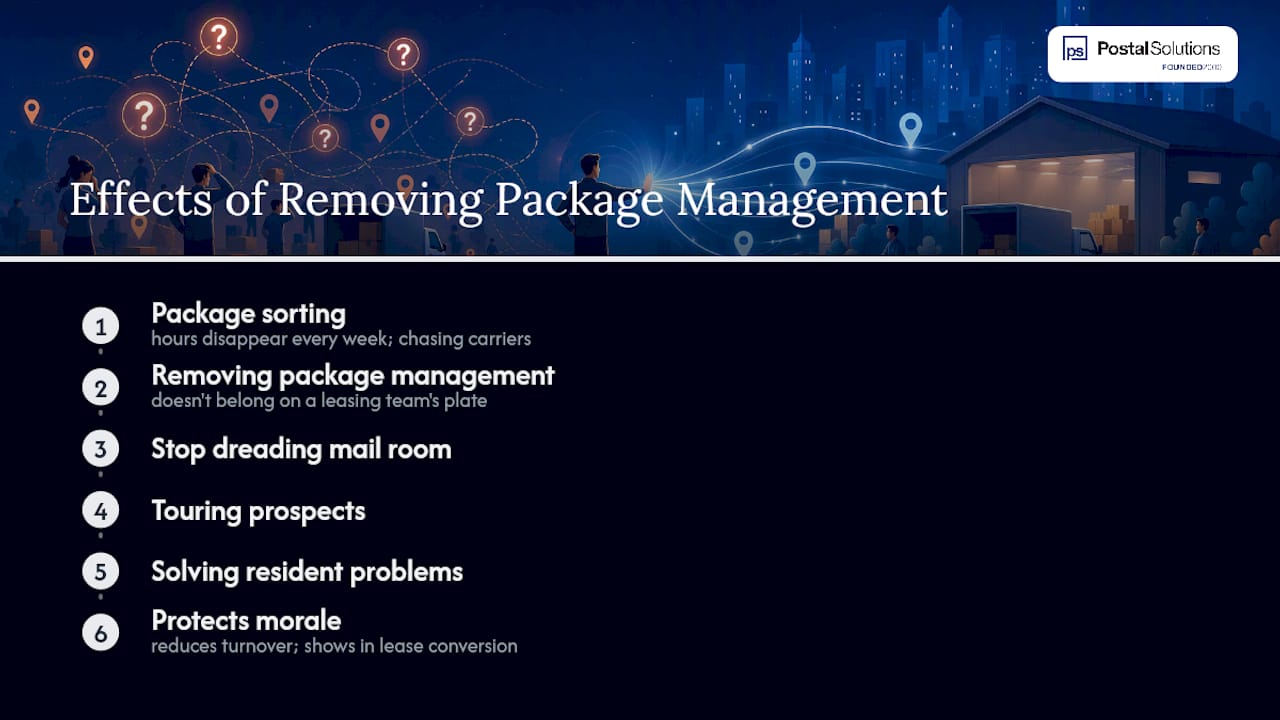
Ask any leasing agent what they actually signed up for, and “package sorting” is never on the list. Yet at property after property, that’s exactly where hours disappear every week: chasing carriers, calming frustrated residents, and re-shelving boxes that should have been logged correctly the first time. This isn’t a staffing problem you fix by hiring one more person. It’s a task that doesn’t belong on a leasing team’s plate at all.
Removing package management from daily responsibilities does something that’s easy to underestimate until you’ve watched it happen: it changes what the front office actually feels like. Staff stop dreading the mail room and start focusing on the parts of the job that brought them into property management in the first place, touring prospects, solving resident problems that actually need a human, closing renewals. Industry guidance on staff wellbeing increasingly points in this direction too: removing no-win, high-friction tasks from front-desk teams protects morale and reduces turnover, and package wrangling is about as no-win as tasks get. Nobody gets thanked for finding a lost box. Everybody hears about it when one goes missing.
The properties that make this change first tend to see it show up in lease conversion, too. A prospect touring a building with an organized, staffed package room reads that as a signal the whole operation is run tightly. A prospect touring past a pile of unclaimed boxes reads the opposite, whether that’s fair or not.
How Postal Solutions Handles the Package Room So You Don’t Have To
Postal Solutions is the practical alternative to asking your leasing team to double as package clerks. Instead of splitting attention between tours and tracking numbers, your community gets a dedicated on-site Package Manager working up to six days a week, handling intake, sorting, chain-of-custody logging, resident text and email notifications, weekly audits, and overflow or refrigerated item handling, all integrated with whatever locker or package room hardware you already have.
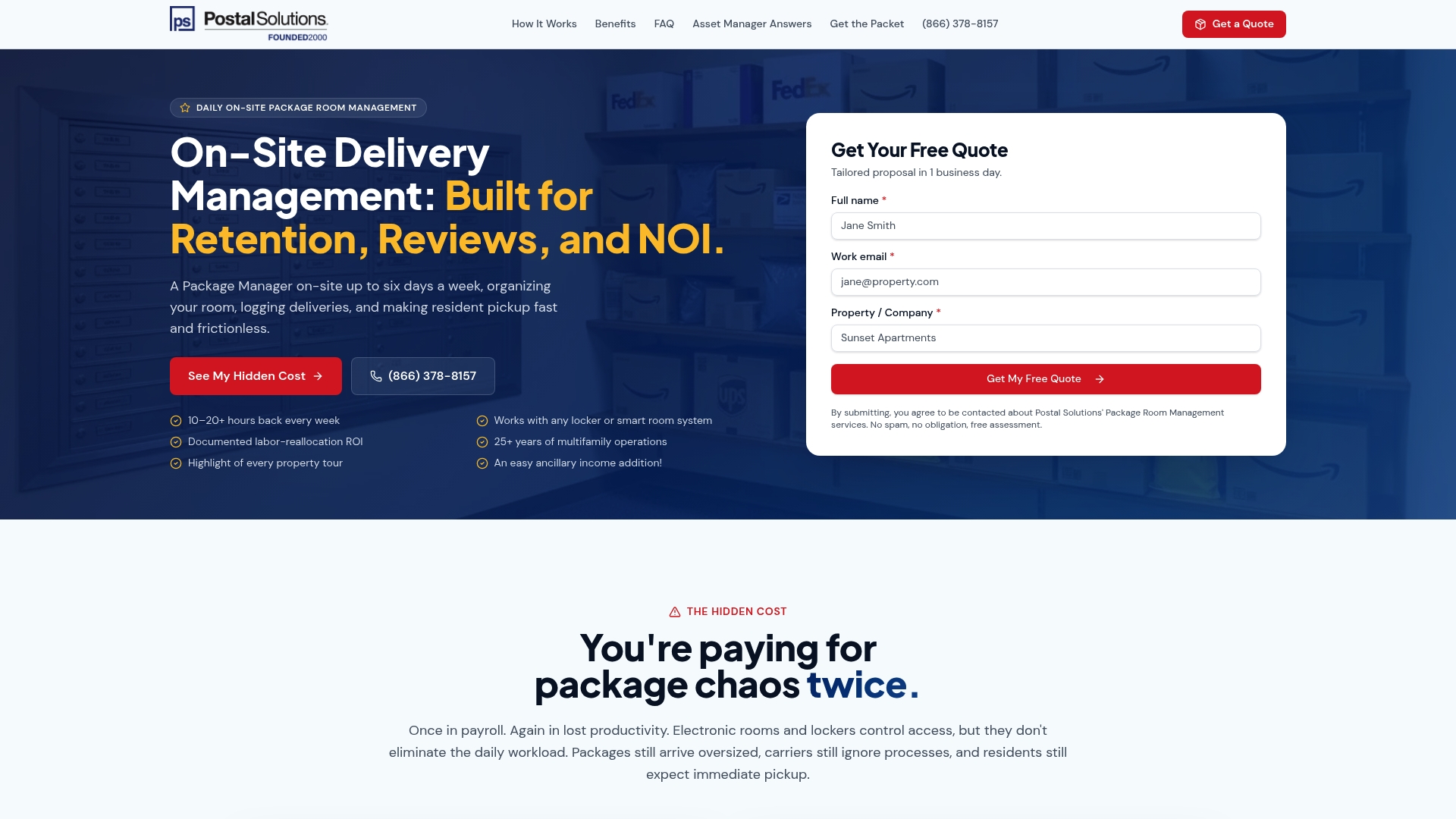
With 25 years managing on-site package operations, the model is built around the same priorities operators care about most: tighter carrier compliance and real staff-hours recovered, not just another piece of hardware. Every contract includes a tailored labor-cost analysis so you can see the numbers for your own property before committing.
Ready to see what it looks like for your community? Download the free Package Room Management guide to walk through vendor questions and a pilot plan on your own timeline, or reach out directly to request a proposal for your property or portfolio.
Sources
- A Framework for Solving Multifamily’s Package Management Problem | Insights by Blueprint
- Mental health strategies for multifamily leaders
Use these sources alongside your own baseline data when building an internal business case or drafting an RFP for vendor comparison.
FAQ
How quickly can outsourcing reduce package inquiries?
Most properties see a noticeable drop in resident calls and walk-ins within the first 30 to 60 days of launching a dedicated on-site Package Manager, once notifications and chain-of-custody logging are running consistently.
What’s the biggest cause of resident package complaints?
Carrier driver non-compliance, packages left in hallways, misdelivered, or scanned before physical delivery, are a leading root cause, which is why enforcing standardized carrier SOPs matters more than adding storage hardware.
Do I need a smart package room or can a Package Manager work with my existing lockers?
A dedicated on-site Package Manager integrates with whatever locker or package room hardware you already have, so you generally don’t need to replace existing infrastructure to see inquiry reductions.
How do I calculate ROI before signing a contract?
Multiply your daily package volume by average touches per package to estimate staff hours consumed, then apply your loaded hourly wage; a common benchmark is roughly six staff-hours daily at 75 packages.
What should I ask a vendor before choosing them?
Ask specifically how they detect carrier non-compliance, what SLAs they commit to, how they handle lost or stolen packages, and whether they’ll run a pilot before a full contract, vague answers on any of these are a red flag.
Recommended
- Give Your Leasing Team Hours Back | Postal Solutions
- Package Notification System for Apartments: A Manager’s Guide — Postal Solutions Blog
- Resident Package Management for Property Managers: A Practical Guide — Postal Solutions Blog
- Postal Solutions vs Package Concierge — Multifamily Package Room Management
Ready when you are
Fix your package room — start with a free proposal
Daily on-site Package Manager, resident text & email pings*, and a tour-ready amenity. Tell us your unit count and we'll send a right-sized proposal — usually within one business day.
- ✓ 10–20+ hours back every week
- ✓ Works with any locker system
- ✓ Faster, friction-free resident pickup
- ✓ An easy ancillary income addition