
July 30, 2026
Package Notification System for Apartments: A Manager's Guide
Explore the advantages of a package notification system for apartments. Boost efficiency, enhance resident experience, and streamline delivery management.
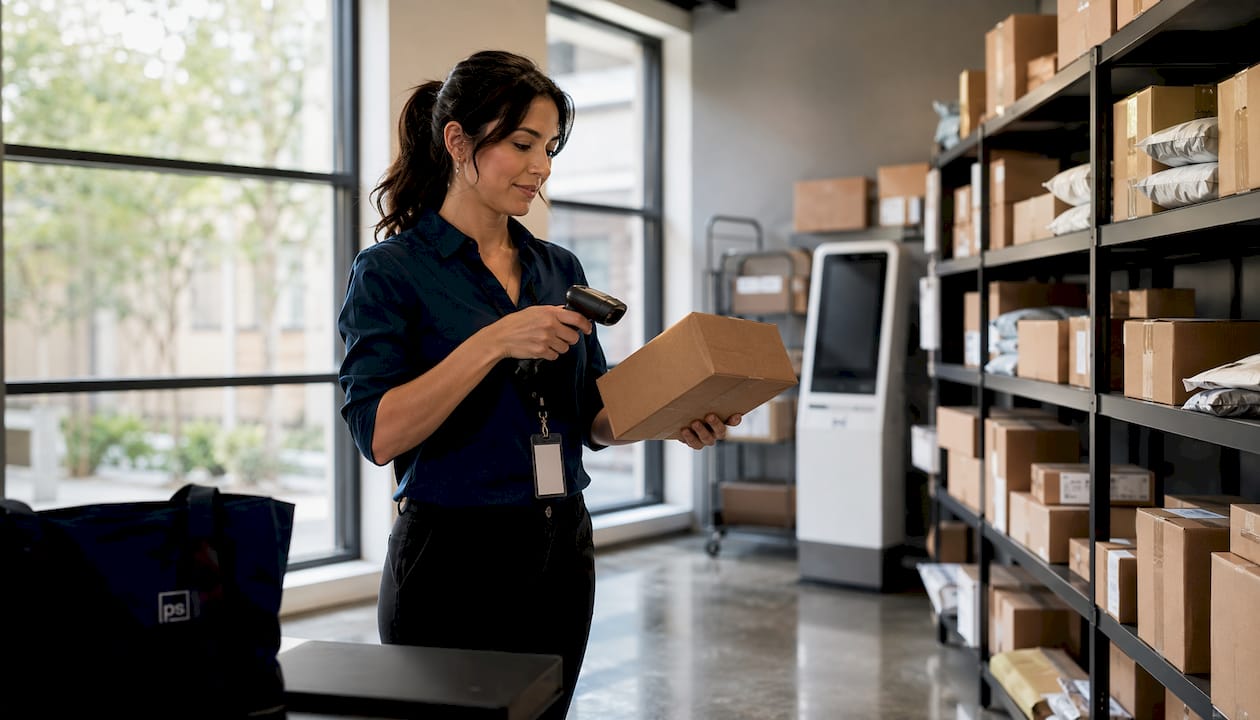
For apartment communities that want predictable, lease-winning delivery service, daily on-site package room management is the recommended solution. A dedicated Package Manager handling daily intake, logging, and resident notifications removes the operational drag from your leasing team while turning your package room into a visible amenity that closes tours. Postal Solutions has delivered this model for 25+ years — request a site assessment to see what it looks like at your property.
Automated package notification systems helped residents pick up parcels 43% faster in earlier studies, but technology alone doesn’t solve the problem. Someone still has to receive the boxes, log them, handle the oversized ones, and make sure nothing disappears. That’s the gap a managed service fills.
Table of Contents
- What does a full-service package room management program actually cover?
- Why property managers and owners see real returns from this service
- What an on-site Package Manager does every single day
- How to price on-site package room management and calculate ROI
- What does onboarding actually look like?
- How to evaluate providers and spot the ones that will fail you
- How Postal Solutions delivers measurable results
- Key Takeaways
- Why on-site management beats hardware-only approaches
- Postal Solutions handles the package room so your team doesn’t have to
- FAQ
What does a full-service package room management program actually cover?
A package notification system for apartments is one piece of a larger operation. Full-service on-site package room management covers the entire daily cycle:
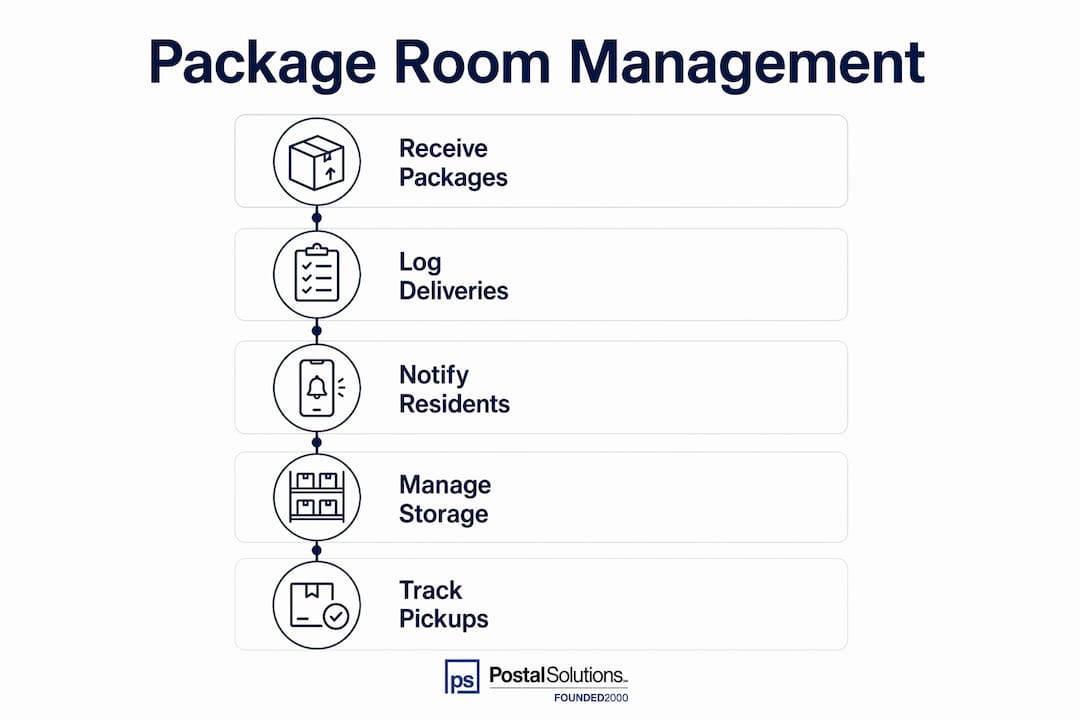
- Daily intake: Receiving packages from all carriers, scanning labels, photographing items, shelving by unit, and sending timestamped text and email notifications to residents
- Chain-of-custody logging: Every package gets a digital record from arrival to pickup, creating an audit trail that resolves disputes fast
- Overflow and oversize handling: Items too large for lockers, refrigerated deliveries, dry-cleaning, and guest packages all get routed and stored appropriately
- Weekly audits: Full inventory reconciliation to catch unclaimed packages before they become a problem
- Hardware integration: The service works with whatever package room or locker system you already have, including smart parcel lockers and access-controlled rooms
What it does not cover: carrier-owned routing decisions, off-site warehousing (unless separately contracted), or package delivery to individual unit doors. The service operates within your existing footprint.
Locker-only systems are dimensionally rigid and overflow during peak seasons. A hybrid model, lockers handling routine volume and a staffed room managing overflow and oversized items, is operationally more resilient. On-site management makes that hybrid work.

Why property managers and owners see real returns from this service
Package management is now a top amenity for multifamily properties, and modern residents evaluate communities on how well they handle deliveries. The operational and financial case is equally strong.
Operational benefits:
- Staff hours reclaimed from sorting, logging, and chasing lost deliveries
- Reduced misdelivery and theft risk through chain-of-custody records
- Fewer resident complaints and dispute calls for leasing staff to handle
Financial benefits:
- Lower turnover risk: residents who trust their package operation renew at higher rates. Hidden costs of manual handling include lost leasing hours, liability exposure, and significant turnover expense
- Ancillary income potential: many communities charge residents a modest monthly amenity fee and retain the margin over management cost, converting a budget line item into a revenue contributor
Leasing and marketing benefits:
- A professionally run package room is something your team can physically show on tours
- Professional package solutions are frequently cited by new residents as an important leasing factor
- Positive resident experiences translate to better online ratings and word-of-mouth referrals
At a property without a managed solution, each package can take four to five staff touches to reach its recipient. With a typical volume of packages and average handling time, manual package management consumes multiple staff hours daily — time that belongs in leasing, not the mailroom.
What an on-site Package Manager does every single day
This is where the service model gets concrete. A dedicated on-site Package Manager, working your community up to six days a week, runs the following:
Daily intake flow:
- Receive all carrier deliveries at the designated intake point
- Scan and log each package with a timestamp and photo
- Shelve items by unit number in the package room or locker system
- Send residents an automated text and email notification with package details
Ongoing maintenance:
- Maintain chain-of-custody records for every item from arrival through pickup
- Conduct weekly audits to reconcile inventory and flag unclaimed packages
- Log carrier incidents (damaged items, misdeliveries, access issues)
Edge-case handling:
- Oversized items staged in designated overflow areas
- Refrigerated and perishable deliveries routed to cold storage
- Holiday surge management with adjusted staffing and intake schedules
Pro Tip: Ask any prospective provider for a sample daily log and a sample weekly audit report before signing. If they can’t produce one, their chain-of-custody process exists on paper only.
How to price on-site package room management and calculate ROI
Common pricing models
| Model | How it works | Best fit |
|---|---|---|
| Flat monthly fee | Fixed cost per property regardless of volume | Stable, predictable volume |
| Per unit per month (PUPM) | Fee scales with unit count | Growing or variable-size communities |
| Hybrid (base + per-parcel) | Base covers staffing; per-parcel covers surges | High-volume or seasonal properties |
| Ancillary income share | Community charges residents; retains margin over management cost | Properties seeking revenue offset |
A simple ROI framework
- Calculate current staff cost. Multiply daily package volume by five minutes per package, then by your staff hourly rate. At 75 packages and $20/hour, that’s $125 in daily labor, or roughly $3,750/month.
- Add turnover risk. If even one renewal is saved per year because of a better resident experience, and turnover costs approximately $4,000 per unit, the service has already paid for itself in avoided cost.
- Add ancillary income. If 200 units pay $10/month in amenity fees, that’s $2,000/month in gross revenue before management cost.
Hardware bundling affects upfront costs. When a provider bundles locker or room hardware with the management contract, ask for the total cost of ownership over 36 months, not just the monthly fee. Some bundled contracts include hardware maintenance; others pass repair costs back to the property.
What does onboarding actually look like?
Implementation typically runs four to eight weeks from contract signing to full launch. Here’s the sequence:
- Site assessment (Week 1): Provider surveys the package room or locker setup, carrier access points, and network/power availability
- SOW and contract signing (Week 1–2): Scope of work finalized, SLAs agreed, staffing model confirmed
- Site prep (Week 2–4): Any required electrical or network upgrades completed. Electrical safety requirements for multi-unit buildings vary by jurisdiction — confirm compliance before hardware installation
- Staff hiring and training (Week 3–5): On-site Package Manager hired or assigned, trained on your specific hardware and carrier workflows
- Carrier onboarding (Week 4–6): Standardized carrier communication packages distributed, including pictorial SOPs and QR/PIN codes for drivers. Carrier messaging and upfront driver training materially improve compliance and reduce friction at launch
- Pilot days and full launch (Week 6–8): Supervised pilot period with daily check-ins, then full handoff
Common bottlenecks: electrical or network upgrades that require building permits, carrier communication delays, and resident announcement timing. Build two weeks of buffer into your go-live date.
- Require the provider to supply resident announcement templates and carrier instruction packets as contract deliverables
- Confirm the provider handles carrier re-training if compliance slips post-launch
How to evaluate providers and spot the ones that will fail you
Questions to ask in every RFP
- How do you enforce carrier compliance, and what tools do you use?
- What is your chain-of-custody process, and can you show a sample log?
- Which property management systems and resident apps do you integrate with?
- What are your SLAs for notification turnaround and dispute resolution?
- How do you handle oversized, refrigerated, and holiday-surge volume?
- What insurance and indemnity coverage do you carry?
Red flags
- Vague answers on carrier compliance (“we communicate with carriers” is not a plan)
- No weekly audit process or no sample audit report available
- No cold-storage or oversize handling protocol
- Hard vendor lock-in on proprietary hardware with no exit path
- Unclear data ownership terms in the contract
Contract must-haves
- Performance SLAs with defined remedies for missed targets
- Audit rights: your team can request records at any time
- Data ownership: resident notification data belongs to the property, not the vendor
- Exit and transition plan: what happens to records and hardware if you switch providers
- Training deliverables: written documentation of carrier SOPs and staff procedures
Pro Tip: Review the third-party vendor management checklist before finalizing any package room contract. The questions that trip up operators most often involve data ownership and exit terms, not pricing.
Better carrier compliance was the top improvement area selected across an operator sample. Ask every vendor how they solve it specifically, not just whether they address it.
How Postal Solutions delivers measurable results
Postal Solutions has run on-site package room management for apartment and student housing communities for 25+ years. The service model centers on a dedicated on-site Package Manager working up to six days a week at your property.
Postal Solutions’ operational capabilities include daily receiving and chain-of-custody logging, weekly audits and inventory reconciliation, resident text and email notifications with package photos, integration with any existing locker or package room hardware, oversized and refrigerated delivery handling, and peak-period surge management for move-ins and holidays.
Outcome highlights property teams consistently care about: leasing staff hours returned to revenue-generating work, a measurable reduction in missing-package disputes, and a package room that functions as a showable amenity on leasing tours. A third-party case study reported a 94% reduction in package-related staff time after a managed deployment — the magnitude will vary by property, but the directional result is consistent with what on-site management produces.
Key Takeaways
Daily on-site package room management converts a staff-hour drain into a leasing amenity and potential ancillary income stream for apartment communities.
| Point | Details |
|---|---|
| Notifications alone aren’t enough | A full delivery notification system requires daily intake, logging, and audit processes behind the alerts. |
| Staff time adds up fast | At 75 packages/day and five minutes per package, manual handling consumes over six hours of staff time daily. |
| Turnover cost justifies the investment | Avoided turnover costs often exceed the annual management fee on their own. |
| Carrier compliance is the top failure mode | Ask every provider specifically how they enforce carrier workflows, not just whether they address it. |
| Postal Solutions | 25+ years of on-site package room management, with a dedicated Package Manager model built for apartment communities. |
Why on-site management beats hardware-only approaches
The industry keeps defaulting to hardware when the real problem is operational. A new locker bank doesn’t train drivers, log chain-of-custody, conduct weekly audits, or handle the refrigerated grocery delivery that showed up on a Saturday. Hardware is infrastructure. Management is what makes it work.
At Postal Solutions, we measure success by one thing: whether your leasing team has stopped thinking about packages. When that happens, the package room has done its job. Communities that reach that point tend to show it in their renewal rates and their leasing tour feedback, not just their operational metrics.
Postal Solutions handles the package room so your team doesn’t have to
Your leasing team’s time is worth more than sorting boxes. Postal Solutions provides a dedicated on-site Package Manager, working your community up to six days a week, handling every step from carrier intake to resident notification. The package room runs. Your staff focuses on leasing.
Properties with an existing package room or locker system can be onboarded in as little as four to eight weeks. Request a site assessment to get a scope of work and a sample ROI estimate for your community. If you’re evaluating Postal Solutions against other options, the Postal Solutions vs. Package Concierge comparison page walks through the service model in detail.
FAQ
What is a package notification system for apartments?
A package notification system for apartments automatically alerts residents by text or email when a delivery arrives. Full-service programs pair these alerts with on-site intake, logging, and secure storage so notifications are accurate and packages are ready for pickup.
How much staff time does manual package handling actually consume?
At a property receiving 75 packages per day, manual handling at five minutes per package consumes over six hours of staff time daily. That time comes directly out of leasing and resident-relations work.
What should I require in a package room management contract?
Require performance SLAs, weekly audit rights, clear data ownership terms, an exit and transition plan, and written carrier SOPs as contract deliverables. Vague carrier compliance language is the most common red flag.
Can a package room be structured as ancillary income?
Yes. Many communities charge residents a monthly amenity fee for managed package service and retain the margin over the management cost, turning the program into a net revenue contributor rather than a pure expense.
How does Postal Solutions integrate with existing hardware?
Postal Solutions works with any existing package room or locker system, including smart parcel lockers and access-controlled rooms. No hardware replacement is required to start the service.
Recommended
Ready when you are
Fix your package room — start with a free proposal
Daily on-site Package Manager, resident text & email pings*, and a tour-ready amenity. Tell us your unit count and we'll send a right-sized proposal — usually within one business day.
- ✓ 16–30 hours back every week
- ✓ Works with any locker system
- ✓ Faster, friction-free resident pickup
- ✓ An easy ancillary income addition