
July 29, 2026
Resident Package Management for Property Managers: A Practical Guide
Discover how effective resident package management can save staff time, enhance leasing, and reduce theft in your property management operations.
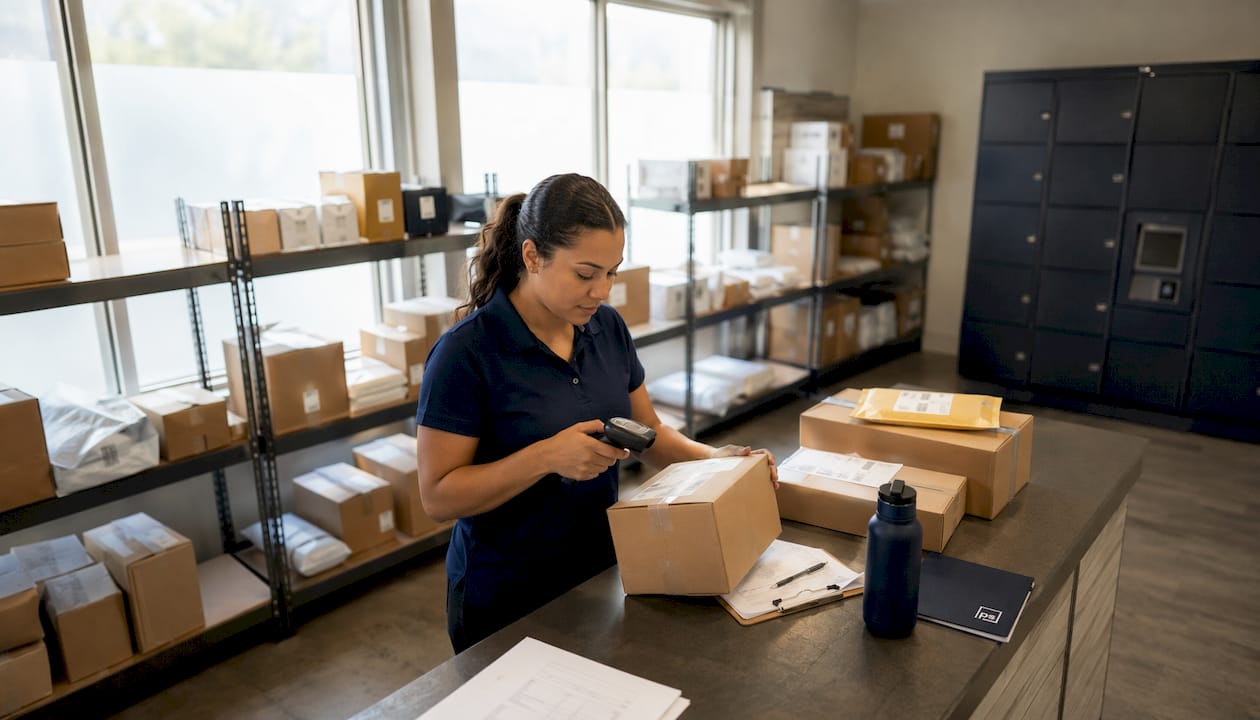
For most mid- to high-volume apartment and student housing communities, professional on-site package room management is the clearest path to recovering staff time, protecting resident experience, and turning a daily operational headache into a leasing asset.
Here’s what that looks like in practice:
- Staff hours back. Without a dedicated Package Manager, package wrangling can consume multiple staff-hours per day across receiving, sorting, and resident pickup support.
- Leasing and renewals protected. Most renters report that package convenience influences their initial leasing decisions and a significant portion say seamless package handling affects renewals.
- Theft and liability reduced. Chain-of-custody logging and weekly audits create a documented record that protects the property and the resident.
Postal Solutions has been running on-site package operations for apartment and student housing communities for 25+ years, with active installations in Ann Arbor, Berkeley, Eugene, and beyond.
Table of Contents
- What does a resident package room operation actually look like day to day?
- Why does professional package management affect leasing, renewals, and your bottom line?
- What do on-site service models and pricing typically look like?
- How do you evaluate and select a managed on-site package solution?
- What does onboarding and implementation actually look like?
- What does the ROI look like in a real installation?
- How do you make the package room a leasing asset, not just a utility?
- Key Takeaways
- Why Postal Solutions recommends on-site professional management
- Postal Solutions’ On-Site Package Room Management
- FAQ
What does a resident package room operation actually look like day to day?
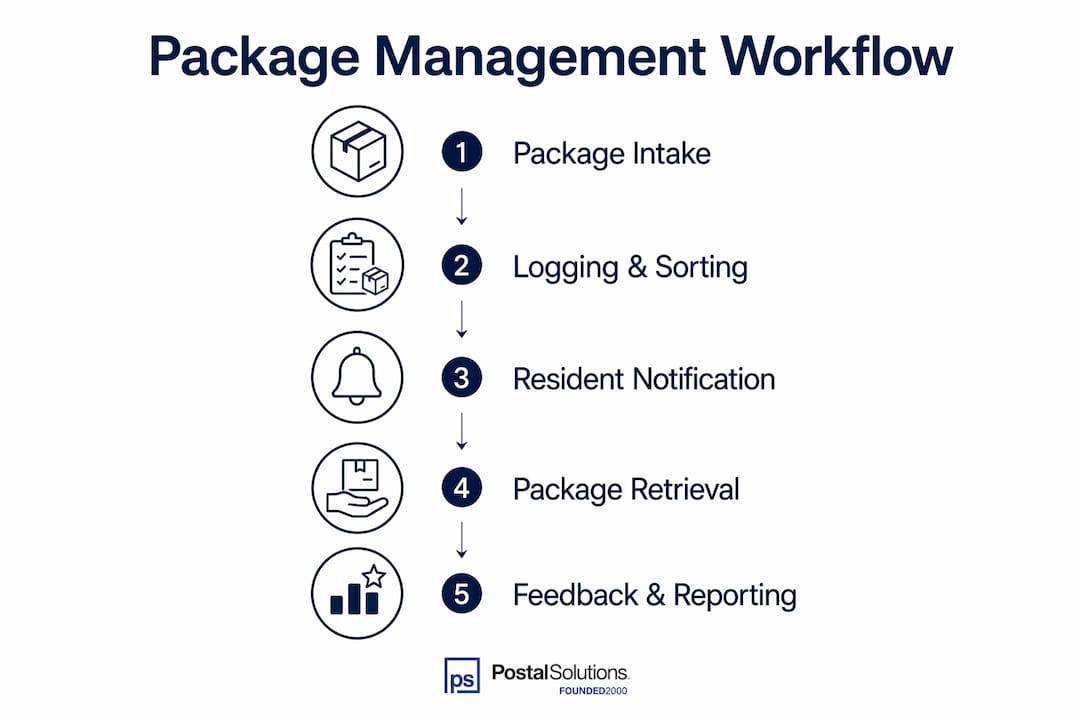
On-site package room management is a dedicated, staffed service where a trained Package Manager handles every step of the parcel lifecycle at your property: receiving deliveries from carriers, scanning and logging each item into a chain-of-custody record, sorting and shelving by unit, notifying residents by text and email, managing oversized and refrigerated items, supporting resident pickup, and running weekly audits.
Core daily tasks include:
- Receiving and signing for all carrier deliveries at the designated intake point
- Scanning and logging each package into the chain-of-custody system
- Sorting and shelving by unit number or resident name
- Handling oversized, fragile, and refrigerated items in dedicated zones
- Sending automated resident notifications (text and email)
- Supporting resident pickup and resolving any discrepancies
- Conducting weekly audits and reconciling inventory
The service integrates with whatever hardware you already have. Whether your property uses electronic lockers, a smart package room with kiosk access, or a traditional shelved room with access control, the on-site Package Manager works within that system rather than replacing it. A typical shift looks like this: a UPS driver arrives, the Package Manager receives and scans each parcel, logs it against the unit roster, shelves it, and the resident gets a text within minutes. The resident picks up using a PIN or QR code at any hour. No staff involvement after intake.
Why does professional package management affect leasing, renewals, and your bottom line?
Residents weigh package handling as a top amenity when choosing and renewing leases. One survey ranked it second only to on-site gyms. That’s not a soft preference. Every property that fumbles package delivery is handing a leasing argument to the building down the street.

A 400-unit urban building can log a high volume of packages on a typical day. At properties without a managed solution, each package can require multiple staff touches and time per touch, adding up to significant staff-hours daily — hours that belong in leasing conversations, not the package room.
| Metric | Unmanaged Property | Managed On-Site |
|---|---|---|
| Daily staff touches per package | 4–5 | 1 (intake only) |
| Resident notification speed | Manual or delayed | Automated at intake |
| Chain-of-custody documentation | Inconsistent | Logged every parcel |
| Peak-season overflow risk | High | Managed with surge staffing |
| Theft/loss liability exposure | Elevated | Reduced via audit trail |
Theft, negative reviews, and turnover costs compound fast when package operations break down. A single lost parcel dispute can generate a public review that costs more in leasing conversion than a month of management fees. Resident satisfaction tied to package delivery is a direct retention lever, not a nice-to-have.
What do on-site service models and pricing typically look like?
Pricing for managed on-site package room services generally takes one of three shapes: a per-property flat monthly fee, a per-unit per-month rate, or a hybrid model where the property charges residents an amenity fee and retains the margin over the management cost.
Factors that move the number up or down:
- Unit count and daily package volume
- Required labor coverage (days per week, hours per shift)
- Hold-time policy (most properties run 5–7 business days)
- Hardware integration complexity
- Oversized, refrigerated, or special-delivery handling requirements
- Peak-season surge staffing (move-in weeks, Black Friday)
A 150-unit suburban property with moderate daily volume and a five-day coverage schedule will land at a meaningfully lower cost than a 400-unit urban building that needs six-day coverage, refrigerated zones, and surge staffing during move-in. The amenity-fee offset model is worth evaluating: many communities charge residents a modest monthly fee, cover the management cost, and retain the difference as ancillary income. For more on structuring that, the ancillary income guide covers the mechanics in detail.
Watch for hidden fees: overtime charges during peak surges, per-item fees for oversized or refrigerated handling, and admin or audit fees that aren’t included in the base rate. Get itemized pricing in writing before signing.
How do you evaluate and select a managed on-site package solution?
Start with a focused checklist and require written answers on three non-negotiables: carrier compliance enforcement, chain-of-custody documentation, and peak-surge handling. Vendors who hedge on any of these are telling you something.
Must-ask vendor questions:
- How do you enforce carrier compliance and handle non-compliant drivers?
- What does your chain-of-custody log include, and how often are audits run?
- Does your service integrate with our existing locker or package room hardware?
- What are your SLAs for package hold times and resident pickup windows?
- How is surge staffing handled during move-in or peak delivery seasons?
- What are the insurance and liability terms for lost or damaged parcels?
- What are your staffing hours and days of coverage?
Red flags to watch for:
- Vendor avoids or deflects carrier compliance questions
- No weekly audit process or vague audit description
- Surge plan is “we’ll figure it out” rather than a written protocol
- Pricing is bundled with no line-item breakdown
Carrier non-compliance is the most common failure mode for any package system. Drivers bypassing intake processes break the chain of custody before the Package Manager even touches the parcel. Evaluate vendors explicitly on how they handle this.
| Property Type | Recommended Model | Top 3 Evaluation Criteria |
|---|---|---|
| Small (fewer units) | Per-property flat fee | Cost predictability, coverage hours, audit frequency |
| Mid-size (hundreds of units) | Per-unit per-month | Carrier enforcement, integration fit, surge plan |
| High-volume (300+ units) | Hybrid amenity-fee offset | Capacity, chain-of-custody rigor, staffing depth |
The asset manager packet from Postal Solutions is a useful procurement-ready resource for teams building an RFP.
What does onboarding and implementation actually look like?
Typical onboarding runs several weeks depending on integration complexity and staffing. Here’s the realistic sequence:
- Pre-contract discovery. Site survey, package volume baseline, carrier list, and hardware audit.
- SOP creation. Carrier-specific intake procedures, signage placement, and escalation paths for non-compliant drivers.
- Staff training. Package Manager trained on your hardware, your resident roster, and your hold-time policy.
- Pilot launch (30–60 days). Live operations begin; track dwell time, staff-hours recovered, resident complaints, and pickup speed.
- Full rollout. Adjust staffing, coverage hours, and surge protocols based on pilot data.
- Ongoing weekly audits. Inventory reconciliation, chain-of-custody review, and resident notification log check throughout the first 90 days.
For pilot success metrics, track: average package dwell time, staff-hours per week recovered from package duty, resident pickup time (intake to pickup), and complaint volume. Set a target for each before the pilot starts so you have a clean before-and-after comparison.
Carrier training and signage deserve a line item in your rollout budget. Seasonal surges like Black Friday and move-in week create overflow conditions that expose every gap in carrier compliance. A simple escalation path — Package Manager flags non-compliant driver, property manager contacts carrier account rep, incident is logged — handles most situations without drama.
What does the ROI look like in a real installation?
Consider a 300-unit community where leasing staff were spending several hours per day on package duty before bringing in a dedicated on-site Package Manager, resulting in significant direct payroll absorbed by package tasks. After implementation, staff time on packages dropped to intake handoff only. The recovered hours went back to leasing calls, tours, and renewal outreach.
The soft benefits compound the math. Properties using managed on-site operations report dramatic reductions in resident wait time and fewer package-related complaints. Fewer complaints mean fewer negative reviews. Fewer negative reviews mean better leasing conversion. One avoided turnover at a $1,500/month unit covers months of management fees.
Installations where this model has proven effective include:
- High-density urban apartment communities with 200+ units
- Student housing properties with concentrated move-in and move-out peaks
- Suburban communities with active e-commerce resident profiles
- Mixed-use properties where lobby congestion from packages was a visible problem
How do you make the package room a leasing asset, not just a utility?
Design is both a functional and a leasing decision. A well-designed package room that residents can see on a tour signals operational competence in a way that a cluttered back hallway never will.
Top design goals: high visibility from common areas, secure access control, flexible shelving for oversized items, a dedicated refrigerated zone where the resident profile warrants it, and ADA-compliant routing.
Practical design choices:
- Open shelving over fixed lockers where space allows — open-shelf systems can hold significantly more parcels per square foot than fixed-compartment lockers
- Clear carrier intake signage that directs drivers to the correct drop zone
- Dedicated oversized and refrigerated sections, even if small
- 24/7 resident access via PIN or QR code kiosk
- Good lighting and a camera at the intake point
On leasing tours, the package room is a show-and-tell moment. “Packages are received, logged, and waiting for you 24/7 — you’ll never miss a delivery” is a concrete, memorable benefit. That’s a stronger close than a generic amenity list. For move-in communications, resident expectations around deliveries are high from day one, so introducing the package room process in the welcome packet sets the right tone immediately.
Pro Tip: Assign QR or PIN codes to frequent-route drivers for your top three carriers. It speeds intake, reduces driver workarounds, and dramatically improves compliance on high-volume delivery days.
Key Takeaways
Professional on-site package room management recovers staff hours, protects leasing and renewals, and turns a daily operational burden into a documented, auditable amenity.
| Point | Details |
|---|---|
| Staff time is the hidden cost | At properties without a managed solution, each package can require four to five staff touches and several minutes per touch. A 370-unit community averaging 75 packages per day can lose multiple staff-hours daily before bringing in a dedicated Package Manager. |
| Leasing and renewals are at stake | Package convenience ranks among the top amenities influencing both initial leasing and renewal decisions. |
| Carrier compliance is the top failure mode | Require written vendor answers on driver enforcement and chain-of-custody before signing any contract. |
| Onboarding takes 4–8 weeks | Plan for a 30–60 day pilot with defined success metrics before full rollout. |
| Postal Solutions is an available partner | Postal Solutions provides dedicated on-site Package Managers for apartment and student housing communities across the U.S. |
Why Postal Solutions recommends on-site professional management
After 25 years running package operations at apartment and student housing communities, the pattern is consistent: properties that treat package handling as core infrastructure outperform those that treat it as a leasing office side task. The operational case is straightforward. The part that gets underestimated is the carrier compliance piece. Hardware alone doesn’t solve it. A locker system or smart room is only as good as the drivers who use it correctly, and most properties have no one whose job it is to enforce that. That’s where a dedicated on-site Package Manager changes the equation. Installations in Ann Arbor, Berkeley, and Eugene have shown the same thing: once you have someone accountable for intake, the audit logs stay clean, the complaints drop, and the leasing team stops fielding “where’s my package” calls. One honest caveat: the service works best when leasing teams are briefed upfront on what the Package Manager does and doesn’t do. Setting that boundary clearly in week one prevents scope creep and keeps the operation running the way it’s designed.
Postal Solutions’ On-Site Package Room Management
Your leasing team is too expensive to spend three hours a day sorting boxes. Postal Solutions puts a dedicated on-site Package Manager at your property up to six days a week — receiving, logging, shelving, and notifying residents — so your staff can focus entirely on leasing and retention.
The service works with whatever hardware you already have: electronic lockers, smart package rooms, or traditional shelved rooms with access control. Weekly audits, chain-of-custody documentation, and surge staffing for peak seasons are included. Many communities structure it as a resident amenity fee and retain the margin, turning a cost center into a modest income line. See how the managed service compares to locker-first alternatives, or request a site survey to get a tailored labor-cost analysis for your property.
FAQ
What is a resident package management service?
A resident package management service is a staffed, on-site operation where a dedicated Package Manager receives, logs, sorts, and holds parcels for residents, then notifies them for pickup. It replaces ad hoc leasing-staff involvement with a documented, chain-of-custody process.
How much staff time does on-site package management recover?
At properties without a managed solution, each package can require four to five staff touches and several minutes per touch. A 370-unit community averaging 75 packages per day can lose multiple staff-hours daily before bringing in a dedicated Package Manager.
What should I ask a vendor before signing a package management contract?
Require written answers on carrier compliance enforcement, chain-of-custody audit frequency, surge staffing protocols, and hardware integration. Vendors who are vague on carrier compliance are the highest-risk choice.
How long does onboarding take?
Typical onboarding runs 4–8 weeks, covering site survey, SOP creation, staff training, and a 30–60 day pilot before full rollout.
Can a package room generate ancillary income for the property?
Yes. Many communities charge residents a modest monthly amenity fee for the service, cover the management cost from that fee, and retain the difference as ancillary income, converting a budget line item into a revenue contributor.
Recommended
Ready when you are
Fix your package room — start with a free proposal
Daily on-site Package Manager, resident text & email pings*, and a tour-ready amenity. Tell us your unit count and we'll send a right-sized proposal — usually within one business day.
- ✓ 16–30 hours back every week
- ✓ Works with any locker system
- ✓ Faster, friction-free resident pickup
- ✓ An easy ancillary income addition