
July 27, 2026
Package Room Reviews: What Property Managers Should Check
Discover essential insights on package room reviews that every property manager needs. Improve resident satisfaction with effective package solutions.
Managed on-site package room operations consistently outperform hardware-only setups in resident satisfaction scores. If your community receives roughly 150 packages per week and that number spikes to around 270 during the holidays, the question isn’t whether you need a real package program. It’s which model will hold up under that pressure. For most multifamily properties with an existing locker or package room system, an operations-first managed approach delivers the most consistent package room reviews because it controls the variables residents actually notice: how fast they’re notified, how quickly they can pick up, and whether anything ever goes missing.
- Managed on-site (staffed, daily operations): best for communities with moderate-to-high volume, existing hardware, and leasing teams stretched thin
- Locker-first: works well for lower-volume properties with capital for installation and minimal oversized deliveries
- In-house with upgraded SOPs: viable when staff hours are available and volume is predictable
- Hybrid: lockers for standard parcels plus staffed overflow for peaks and oversized items
If your footprint is small, volume is low, or capital is the binding constraint, a locker-first or upgraded in-house approach may be the right starting point.
Table of Contents
- What Do Residents Actually Judge in Package Room Feedback?
- Which Package Room Model Actually Fits Your Building?
- The Operational Checklist Reviewers Are Silently Scoring You On
- What Does a Package Room Program Actually Cost, and When Does It Pay Back?
- How to Run a 30–90 Day Pilot and Score the Results
- How Postal Solutions Runs On-Site Package Management
- Key Takeaways
- Why Operations Beat Hardware Every Time
- Postal Solutions Makes It Easy to Get Started
- Useful Sources
- FAQ
What Do Residents Actually Judge in Package Room Feedback?
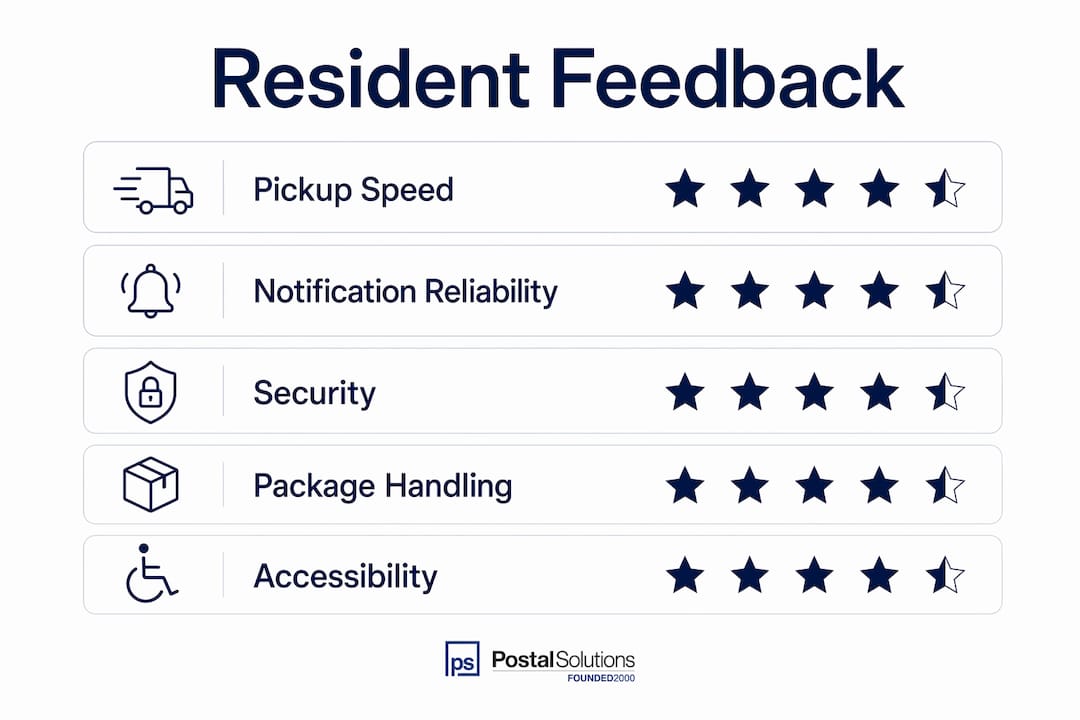
Residents rate convenience outcomes first. The NMHC/Kingsley survey makes this clear: pickup speed, notification reliability, and perceived security drive satisfaction more than the presence of lockers alone. Meanwhile, 77% of communities already have dedicated package space, so the differentiator is how well that space is operated, not whether it exists.
By the numbers: 85% of package storage is secured; 58% of communities have camera systems; 50% use controlled-access touchscreens. Only 4% offer refrigerated lockers, yet 43% of those communities report daily use — a small but real demand you can’t ignore.
The resident-facing signals that show up in package handling feedback:
- Time-to-notification: how quickly a resident hears their package arrived
- Median pickup time: how long packages sit before retrieval (target under 48 hours at peak)
- Chain-of-custody visibility: can the resident (and your team) trace every package?
- Oversized and perishable handling: a clear policy here prevents the complaints that spike during the holidays
- Pickup instructions: signage, hours, and access clarity reduce “Where’s my package?” desk traffic
- Camera and access-control presence: residents notice this; it signals security even when nothing goes wrong
Each of these maps directly to an operational task your team controls. Notification speed depends on your scanning workflow. Pickup time depends on hours of access and reminder cadence. Improving resident satisfaction starts with measuring these signals, not just installing hardware.
Which Package Room Model Actually Fits Your Building?
There’s no universal answer. The right model follows your constraints: available space, capital, staff hours, and the volume profile your building actually sees.
| Dimension | In-House | Lockers Only | Managed On-Site | Hybrid |
|---|---|---|---|---|
| Staffing model | Existing leasing staff | Carrier self-service | Dedicated on-site manager | Staff + locker automation |
| Coverage hours | Office hours only | — | Up to 6 days/week | — lockers + staffed hours |
| Hardware integration | Minimal | Locker system required | Works with existing hardware | Locker + overflow room |
| Oversize & perishable | Ad hoc, often management office | Poor fit | Defined workflow | Staffed overflow handles it |
| Notifications | Manual or inconsistent | Automated via locker | Text/email on receipt | Automated + staffed backup |
| Cost shape | Low upfront, hidden labor cost | High capex, low opex | Monthly service fee | Moderate capex + service fee |
| Security/auditability | Variable | Locker audit trail | Chain-of-custody logs + audits | Combined audit trail |
| Peak scalability | Breaks down | Overflow risk | Managed surge protocols | Most resilient option |
A few things worth knowing about each:
- In-house looks cheap until you count the hours. 68% of community managers spend 1–4 hours per week on packages, and that scales fast during the holidays.
- Lockers automate the easy cases but fail on oversized items. 52% of managers store overflow in the management office, which defeats the purpose.
- Managed on-site handles the full range, including perishables and oversized items, without requiring new hardware.
- Hybrid is the most resilient setup for high-volume properties: lockers absorb standard parcels, staffed overflow catches everything else.
For properties that can’t install lockers, smart locker alternatives are worth reviewing before committing to a capital project.
The Operational Checklist Reviewers Are Silently Scoring You On
Residents don’t write reviews about your SOP. They write about whether their package was there when they expected it. Here’s the daily workflow that produces the outcomes they notice:
- Accept and scan every package at the point of receipt — no exceptions
- Log to chain-of-custody system immediately (carrier, time, condition)
- Shelf and organize by unit number or resident name
- Send notification within minutes of logging (text and email)
- Verify pickup when the resident retrieves the package; log the handoff
- End-of-day reconciliation: confirm every package on the shelf matches the log
KPIs to track weekly:
- Average time-to-notification (target: under 15 minutes from receipt)
- Median pickup time (target: under 48 hours during peak)
- Unclaimed package rate at 72 hours
- Lost or misplaced incidents per 1,000 packages
- Staff hours per 100 packages processed
Pro Tip: Design chain-of-custody logs with the minimum fields staff will actually fill in every time: carrier, unit number, timestamp, and condition. Add a photo field for high-value or damaged items. A log that’s 80% complete because it’s simple beats a perfect template nobody uses.
Automated package management systems reduce manual logging errors and protect chain-of-custody, but the SOP discipline has to come first. On the compliance side, keep resident notification data (phone numbers, email) in your property management system, not on paper logs, and document your perishable handling policy in writing so liability is clear if something spoils.
What Does a Package Room Program Actually Cost, and When Does It Pay Back?
ROI comes from three levers: labor reallocation, resident retention impact, and ancillary income. The math is straightforward once you quantify the hours your team is currently spending.
Primary cost drivers:
- Labor (in-house staff hours or managed service fee)
- Hardware purchase and installation (lockers, access control, cameras)
- Software or subscription fees for notification and tracking systems
- Space rework or dedicated room buildout
- Refrigerated storage for perishable handling
| Project type | Typical setup timeline |
|---|---|
| Locker installation (entry-level) | 4 weeks from contract to live |
| Staffed on-site program onboarding | 2–4 weeks (site survey through first live day) |
| Hybrid implementation | 6 weeks depending on hardware scope |
ROI sketch: If your leasing staff currently spends 3 hours per week on packages at a fully loaded cost of $25/hour, that’s roughly $3,900 per year in direct labor. Add the desk-traffic cost during tours and the renewal risk from package-related failures — lost packages and slow pickups correlate directly with lower renewal rates — and a managed program that costs less than that labor figure pays for itself before you count ancillary income.
Hidden costs to plan for: peak-season temp labor if you’re running in-house, oversized-item storage during the holidays, and insurance riders for high-value package liability. A managed provider typically absorbs the first two. For ancillary income potential, many communities structure the managed service as a resident amenity fee, retaining the margin over the management cost.
How to Run a 30–90 Day Pilot and Score the Results
Start with a clear baseline, then measure against it. A short pilot gives you enough signal to make a confident decision without a long-term commitment.
Interview questions for any provider or in-house process change:
- What are your staffing hours and how do you handle coverage gaps?
- Walk me through your audit procedure and how often it runs.
- How do you integrate with our existing locker or package room hardware?
- What’s your SLA for resident notifications from point of receipt?
- How do you handle oversized items and perishables?
- What insurance or liability coverage applies to packages in your care?
- Can you provide references from communities with similar volume profiles?
Pilot plan:
- Establish baseline KPIs in week 1 (current notification time, pickup time, complaint count)
- Run the new process or provider for 30–90 days with no other changes
- Measure the same KPIs weekly
- Survey residents at day 45 and day 90 with a 3-question pulse (satisfaction, speed, security)
- Compare results against baseline; apply the scoring rubric below
Scoring rubric (weighted):
- Pickup speed: 30%
- Notification reliability: 25%
- Security and audit quality: 20%
- Resident feedback score: 15%
- Cost per package processed: 10%
Score each criterion 1–5, multiply by weight, and sum. A 30-day window is enough to catch notification and pickup-time trends. Ninety days captures a peak period, which is when most programs either prove themselves or fall apart.
How Postal Solutions Runs On-Site Package Management
Postal Solutions’ On-Site Package Room Management delivers measurable improvements in pickup speed, notification rates, and staff hours reclaimed. The service works with whatever hardware you already have.
What the service includes:
- Daily acceptance, sorting, and shelf organization
- Chain-of-custody logging on every package
- Resident text and email notifications sent on receipt
- Oversized and perishable item handling with defined escalation workflows
- Weekly audits and documented reconciliation
- Integration with existing lockers or package room systems
- Up to six days per week of on-site coverage
Onboarding steps:
- Site survey and volume baseline
- SOP alignment with your existing workflows
- Staffing schedule set and resident communication sent
- KPI baseline established; pilot period begins
- Recurring weekly audit cadence locked in
With 25+ years of on-site package room operations, Postal Solutions has worked through every exception: holiday peaks, refrigerated deliveries, carrier non-compliance, and oversized items that don’t fit anywhere standard.
Key Takeaways
Managed on-site package room operations outperform hardware-only approaches because they control the variables residents actually score: notification speed, pickup time, and chain-of-custody reliability.
| Point | Details |
|---|---|
| Measure pickup time this week | Track median pickup time and time-to-notification; these two KPIs move resident scores fastest. |
| Plan for the holiday spike | Average weekly volume rises from ~150 to ~270 packages during peak; your model must handle that without breaking. |
| Run a 30–90 day pilot | Use the weighted scoring rubric (pickup speed 30%, notifications 25%) to judge any process change objectively. |
| Notifications drive pickup behavior | Proactive text and email reminders reduce dwell time and free shelf space without adding staff. |
| Postal Solutions as managed option | Postal Solutions’ On-Site Package Room Management handles daily operations and peak periods using your existing hardware. |
Why Operations Beat Hardware Every Time
The property management industry has a hardware reflex. Volume goes up, packages pile up, and the default response is “we need more lockers.” It’s an understandable instinct, but it misses the actual problem.
Lockers without a staffed overflow plan still create resident frustration during the holidays. A package room with cameras and access control but no consistent SOP still generates lost-package complaints. The hardware sets the ceiling; the operations determine whether you ever reach it.
What actually moves review scores is operational consistency: staff who scan every package on receipt, notifications that go out within minutes, and a weekly audit that catches discrepancies before a resident does. Postal Solutions has built that consistency across communities for over 25 years, with weekly audits and chain-of-custody procedures that hold up under scrutiny. The package security protocols that matter most aren’t the cameras. They’re the habits.
Postal Solutions Makes It Easy to Get Started
Your leasing team wasn’t hired to sort boxes. Postal Solutions’ On-Site Package Room Management puts a dedicated Package Manager on-site up to six days a week, handling every step from receipt to resident pickup, using the locker or package room system you already have.
The first step is a site survey: Postal Solutions reviews your current volume, hardware, and workflows, then builds an SOP and staffing schedule matched to your community. Within 2–4 weeks, your team is out of the package business. Within 90 days, you have KPI data to show ownership and a package room that leasing can point to on tours.
Many communities also structure the service as a resident amenity fee, turning a former budget drain into a line item that helps pay for itself. Request a site survey to see what that looks like for your property.
Useful Sources
- NMHC/Kingsley Package Delivery Report (2018) — primary data on package volume, security features, and community benchmarks
- NMHC/Kingsley Survey Presentation — detailed findings on locker adoption, overflow handling, and resident expectations
- NMHC Package Survey Infographic — refrigerated locker data and usage rates
- Multi-Housing News: Handling the Package Delivery Challenge — staff time data and locker adoption gap analysis
- Parcel Pending: Multifamily Mailroom Best Practices — automation benefits, chain-of-custody, and resident retention connections
- Postal Solutions On-Site Package Room Management — service overview and onboarding details
FAQ
What do residents look for in package room reviews?
Residents consistently rate pickup speed, notification reliability, and perceived security above all else. The presence of lockers matters less than how consistently the operation runs.
How many packages does the average apartment community receive?
The average community receives roughly 150 packages per week, rising to about 270 per week during the holidays, according to the NMHC/Kingsley survey.
What’s the fastest way to improve package handling feedback scores?
Cut your time-to-notification and median pickup time first. Proactive text and email alerts sent within minutes of receipt reduce dwell time and desk complaints faster than any hardware change.
How does Postal Solutions’ managed service work?
Postal Solutions places a dedicated Package Manager on-site up to six days a week to handle daily acceptance, sorting, chain-of-custody logging, resident notifications, and weekly audits, using your existing hardware.
How long does it take to see results from a new package room program?
A 30-day pilot is enough to measure notification speed and pickup-time trends. A 90-day window captures at least one peak period, which is the real test of whether a program holds up.
Recommended
Ready when you are
Fix your package room — start with a free proposal
Daily on-site Package Manager, resident text & email pings*, and a tour-ready amenity. Tell us your unit count and we'll send a right-sized proposal — usually within one business day.
- ✓ 16–30 hours back every week
- ✓ Works with any locker system
- ✓ Faster, friction-free resident pickup
- ✓ An easy ancillary income addition