
July 18, 2026
Third Party Vendor Management Checklist for Property Managers
Streamline your operations with a third party vendor management checklist. Ensure compliance and vendor performance for successful property management.

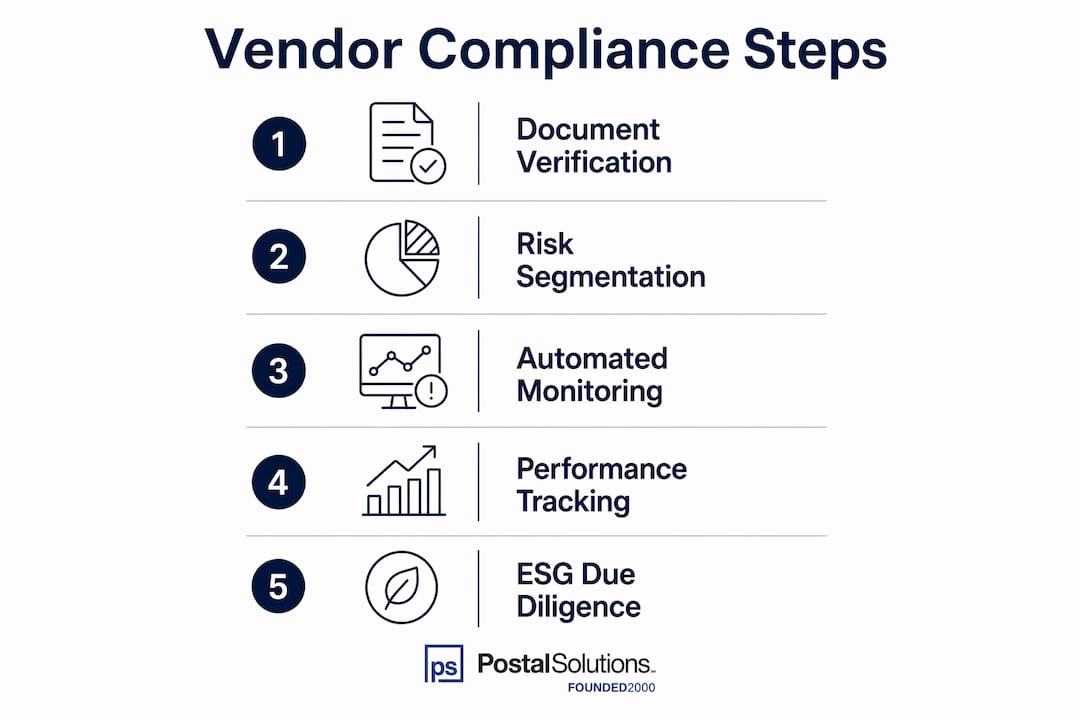
A third party vendor management checklist is the structured framework property managers use to verify compliance, reduce liability, and maintain vendor performance across every stage of the vendor relationship. Without one, unvetted contractors access resident units, expired insurance policies create uncovered liability gaps, and leasing teams absorb the operational fallout. For property and asset managers overseeing multifamily or commercial portfolios, the industry term is “vendor credentialing,” and a thorough checklist is the backbone of any credentialing program. The difference between a property that runs well and one that doesn’t often comes down to how rigorously this process is enforced.
What does a third party vendor management checklist require?

A complete vendor management checklist covers four non-negotiable document categories: a verified W-9, a Certificate of Insurance (COI), state-verified trade licenses, and background checks for any personnel entering resident units. Each document serves a distinct legal and operational purpose, and missing any one exposes the property to liability that no lease clause can fix.
The COI requirement goes deeper than most managers realize. A generic COI on file is not sufficient legal protection. Specific endorsement forms CG 20 10 and CG 20 37 must appear on the certificate, confirming the property owner is named as Additional Insured for both ongoing operations and completed work. Without those form numbers, a claim can be denied even when a COI exists.
The full document checklist for vendor onboarding includes:
- W-9 with verified Tax Identification Number (TIN): Required for IRS compliance and payment processing.
- Certificate of Insurance with Additional Insured endorsement (CG 20 10 and CG 20 37): Confirms coverage applies to the managed property.
- State-verified trade license: Cross-checked against the relevant state licensing board for the vendor’s trade.
- Background check authorization: Required for all personnel with access to occupied units or common areas.
- Annual re-screening confirmation: All documents must be reverified on a 12-month cycle.
Pro Tip: Set COI expiration alerts at 60, 30, and 7 days before the renewal date. This gives vendors enough lead time to renew without creating a gap in your coverage.
| Document | Verification Step | Renewal Cycle |
|---|---|---|
| W-9 | Confirm TIN matches IRS records | On change of business entity |
| Certificate of Insurance | Check CG 20 10 and CG 20 37 endorsements | Annual or on policy change |
| Trade license | Verify against state licensing board | Annual |
| Background check | Screen all unit-access personnel | Annual or on new hire |
How should you segment vendors by risk level?
Vendor risk segmentation is the practice of sorting your vendor pool into tiers based on the potential liability each vendor type carries. Segmenting vendors into low, medium, and high-risk tiers lets you calibrate insurance requirements and oversight intensity without applying the same scrutiny to a landscaper and a structural contractor.
Low-risk vendors, such as landscapers and cleaning crews, typically require standard General Liability coverage of $1M per occurrence and $2M aggregate. High-risk contractors, including roofers, electricians, and HVAC technicians, face stricter requirements: umbrella policies, documented safety records, and scrutiny of their Experience Modification Rate (EMR). An EMR above 1.0 signals a worse-than-average safety record and warrants additional review before any work order is issued.
The three risk tiers work as follows:
- Low risk: Vendors with no unit access and low injury potential. Standard GL insurance applies. Examples include exterior maintenance and pest control.
- Medium risk: Vendors with limited unit access or moderate liability exposure. Require GL plus workers’ compensation verification. Examples include appliance repair and carpet cleaning.
- High risk: Vendors with full unit access, structural work, or high injury potential. Require umbrella policies, EMR documentation, and OSHA compliance records. Examples include plumbing, electrical, and roofing contractors.
Risk tiering also protects your budget. Applying high-risk scrutiny to every vendor wastes staff time and slows onboarding. Applying low-risk standards to a high-risk contractor is the more dangerous error. A tiered vendor risk assessment framework solves both problems at once.
Pro Tip: Review your EMR thresholds annually. Insurance markets shift, and a contractor’s EMR can change significantly from one policy year to the next.
How do you monitor vendor compliance on an ongoing basis?
Ongoing monitoring is where most vendor management programs fail. Manual COI tracking produces a 22% error rate, leaving properties exposed to uninsured work without anyone realizing it. That error rate is not a rounding problem. It means roughly one in five vendors has a compliance gap that manual review missed.
Automation closes that gap. The most effective systems send COI expiration alerts at 60, 30, and 7 days before the renewal date, then automatically pause work orders and payments if the vendor fails to renew. This “pause on lapse” enforcement prevents uninsured contractors from accessing the property without requiring a staff member to catch the gap manually. Automated systems report up to 50% higher compliance rates compared to manual tracking.
The key performance indicators (KPIs) to track for each vendor are:
- First-time fix rate: The percentage of work orders resolved on the first visit. A rate above 85% indicates a reliable vendor. Below that threshold, investigate whether the issue is training, parts availability, or scope clarity.
- Response time: Time from work order submission to vendor acknowledgment. The target is under 2 hours for urgent requests.
- COI compliance rate: Percentage of vendors with current, verified insurance at any given time. This should be 100%.
- Renewal completion rate: Percentage of vendors who renew documents before expiration without requiring manual follow-up.
Tracking these KPIs allows property managers to move from reactive problem-solving to strategic vendor management. Operators with structured vendor programs report 25% lower net operating income volatility. That figure reflects fewer emergency callouts, fewer uninsured incidents, and more predictable maintenance costs.
| Monitoring Method | Manual Tracking | Automated System |
|---|---|---|
| COI error rate | ~22% | Near zero |
| Compliance rate | Baseline | Up to 50% higher |
| Work order pause on lapse | Requires staff action | Automatic |
| Portfolio scalability | Limited | High |
Pro Tip: Integrate your vendor compliance platform directly with your property management software. When a COI lapses, the system should block the work order automatically, not send an email that gets buried.
What role does ESG due diligence play in vendor management?
Environmental, Social, and Governance (ESG) criteria are becoming a standard part of vendor onboarding for properties with institutional investors or tenant ESG commitments. ESG due diligence is no longer optional for asset managers reporting to funds or REITs. It is a qualification criterion that vendors either meet or fail.
The ESG questions that belong in a vendor management checklist cover three areas:
- Environmental: Does the vendor track job-level emissions? How does the vendor handle waste disposal and hazardous materials?
- Social: Does the vendor comply with wage and labor laws? Are subcontractors held to the same standards as direct employees?
- Governance: Is there a named ESG compliance owner at the vendor organization? That person should be able to respond to compliance inquiries within one business day.
Vendors are classified into three ESG response categories: Ready (actively tracking and reporting ESG metrics), Willing (open to ESG requirements but not yet tracking), and Resistant (unwilling or unable to engage). Ready vendors earn preferred status. Resistant vendors are flagged for replacement as contracts expire.
Contractual ESG clauses are now appearing in standard management agreements. These clauses require vendors to maintain ESG documentation and submit to periodic audits. For asset managers, this protects investor reporting and positions the portfolio ahead of regulatory requirements that are tightening across multiple states.
| ESG Category | Vendor Classification | Management Response |
|---|---|---|
| Tracks and reports ESG metrics | Ready | Preferred vendor status |
| Open to ESG but not yet tracking | Willing | Provide guidance and timeline |
| Unwilling to engage | Resistant | Flag for replacement |
Key Takeaways
A third party vendor management checklist works only when compliance verification, risk tiering, automated monitoring, and ESG criteria operate together as a single system rather than separate tasks.
| Point | Details |
|---|---|
| Verify specific COI endorsements | Check for CG 20 10 and CG 20 37 form numbers, not just COI presence. |
| Segment vendors into risk tiers | Apply insurance and oversight requirements based on liability level, not a single standard. |
| Automate expiration alerts | Set alerts at 60, 30, and 7 days; pause work orders automatically on COI lapse. |
| Track vendor KPIs | Monitor first-time fix rate above 85% and response time under 2 hours. |
| Incorporate ESG criteria | Classify vendors as Ready, Willing, or Resistant and add ESG clauses to contracts. |
What 25 years of vendor oversight actually teaches you
The biggest mistake I see property managers make is treating vendor compliance as a paperwork exercise. They collect the W-9, file the COI, and consider the job done. Then a contractor’s policy lapses in month seven, an incident occurs, and the property owner discovers the coverage gap during litigation. The checklist existed. The enforcement did not.
The shift that changes everything is moving from document collection to document enforcement. Centralized, automated onboarding eliminates the manual errors that create exposure. But the technology only works if the process behind it is airtight. That means tiered risk standards, real KPI tracking, and ESG criteria built into contracts before a vendor ever sets foot on the property.
Package handling is one area where this plays out visibly. When a property’s package operation is disorganized, the vendors coordinating deliveries, the staff managing access, and the residents waiting on packages all feel the friction. A professionally managed package room operation removes that friction entirely. It also gives leasing teams a concrete amenity to show on tours instead of a problem to apologize for.
The properties that run well treat vendor management as asset protection, not administration. Every compliant vendor, every verified COI, and every tracked KPI is a layer of protection on the asset’s value and the resident experience.
— Postal Solutions
How Postal Solutions supports your vendor compliance efforts
Property managers who get vendor compliance right share one trait: they stop trying to manage everything manually.
Postal Solutions handles on-site package room management for apartment and student housing communities across the country, working up to six days a week so your leasing team never touches a package again. The service covers receiving, sorting, securing, and making packages available to residents 24/7 through the package room or lockers already on your property. Many communities structure it as a paid amenity, turning a budget line item into ancillary income. If you manage properties in multiple markets, the full locations list shows where Postal Solutions currently operates. Asset managers looking for a complete operational overview can request the asset manager packet directly.
FAQ
What documents does a vendor management checklist require?
A complete checklist requires a verified W-9, a Certificate of Insurance with CG 20 10 and CG 20 37 endorsements, a state-verified trade license, and background checks for all personnel with unit access. All documents must be re-screened annually.
What is the difference between third party management and vendor management?
Third party management is the broader practice of overseeing all external relationships, including consultants and service providers. Vendor management focuses specifically on contractors and suppliers who deliver goods or services to the property.
How often should vendor compliance documents be renewed?
Compliance documents must be re-screened at least annually, with COI expiration monitored through automated alerts at 60, 30, and 7 days before the renewal date.
What KPIs should property managers track for vendor performance?
The two most important KPIs are first-time fix rate, which should exceed 85%, and response time, which should stay under 2 hours for urgent requests. Tracking these metrics moves vendor management from reactive to strategic.
Why is ESG due diligence becoming part of vendor onboarding?
Properties with institutional investors or tenant ESG commitments now require vendors to document environmental practices, labor compliance, and governance ownership. Vendors are classified as Ready, Willing, or Resistant based on their ESG responsiveness, and contractual ESG clauses are becoming standard in management agreements.
Recommended
Ready when you are
Fix your package room — start with a free proposal
Daily on-site Package Manager, resident text & email pings*, and a tour-ready amenity. Tell us your unit count and we'll send a right-sized proposal — usually within one business day.
- ✓ 16–30 hours back every week
- ✓ Works with any locker system
- ✓ Faster, friction-free resident pickup
- ✓ An easy ancillary income addition