
July 20, 2026
Best Smart Locker Alternatives for US Properties in 2026
Discover the best smart lockers alternatives for US properties in 2026. Compare features, costs, and find the perfect fit for your needs!
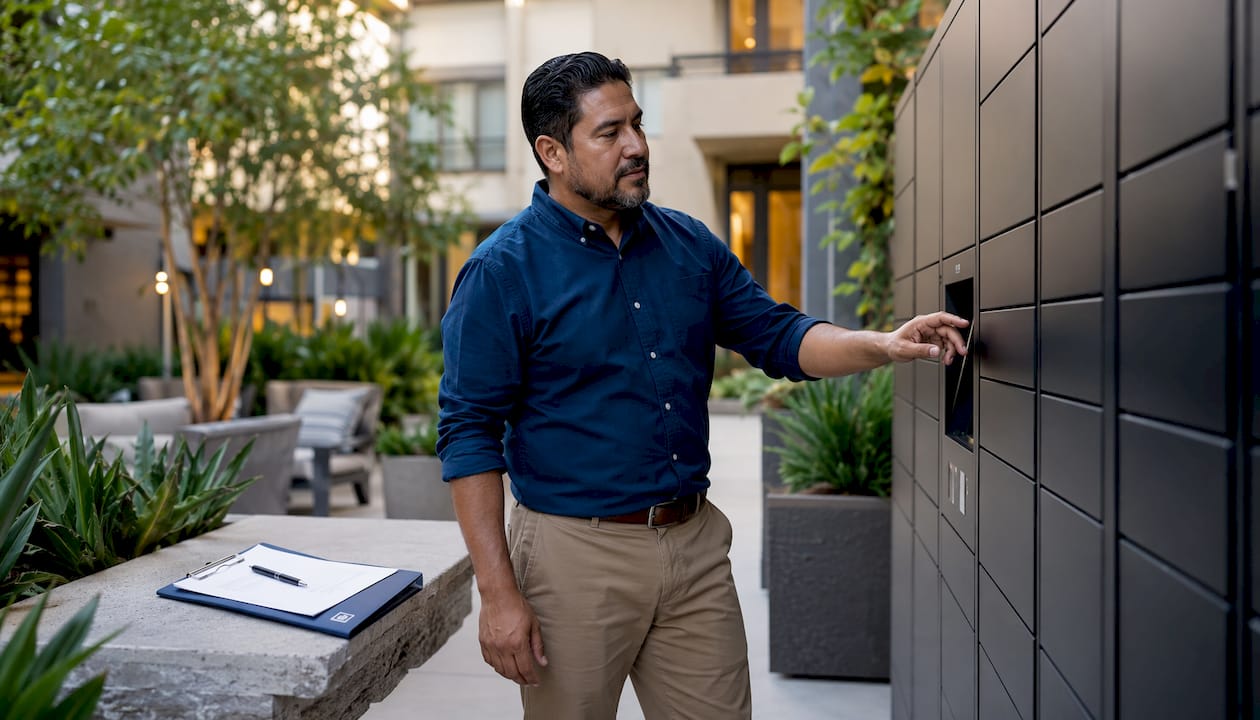
The five strongest smart locker alternatives for US multifamily and workplace properties are Luxer One, Parcel Pending by Quadient, Smartbox USA, Inc., Smiota, and American Locker. Each takes a different approach to secure package handling, and the right fit depends on your property’s size, budget, and resident expectations. Hardware costs for standard locker systems range from $12,000 to $36,000 for a 150–300 unit community, which makes the choice between providers, and between lockers and managed rooms, a real financial decision.
| Provider | At a Glance | Core Features | Pros | Cons | Who It’s For | Rating |
|---|---|---|---|---|---|---|
| Luxer One | Customizable lockers across multiple sectors | Smart lockers, mail center, architect-ready configs | Wide industry reach, deep customization | Pricing not publicly listed | Multifamily, retail, office, university, hospitality | 4.6★ |
| Parcel Pending by Quadient | Global locker network with returns capability | Open locker network, delivery and returns, PMS integrations | Supports 10,000+ properties, open API | Premium pricing tier | Residential, commercial, university | 4.5★ |
| Smartbox USA, Inc. | Unified parcel and asset management | Indoor/outdoor lockers, inventory and asset tracking | Handles both parcels and assets in one system | Smaller install base | Residential, retail, logistics | 4.9★ (44) |
| Smiota | Biometric and mobile-first locker access | RFID, PIN, biometric, cloud dashboard, payment gateway | Advanced security stack, 24/7 access | Fewer reviews, limited public pricing | Multifamily, healthcare, government, enterprise | 3.8★ (13) |
| American Locker | American-made, keyless, configurable lockers | Credit card payment, charging stations, custom locker lines | Made in the US, unique amenity features | Limited public track record | Properties wanting custom, feature-rich lockers | 3★ (2) |
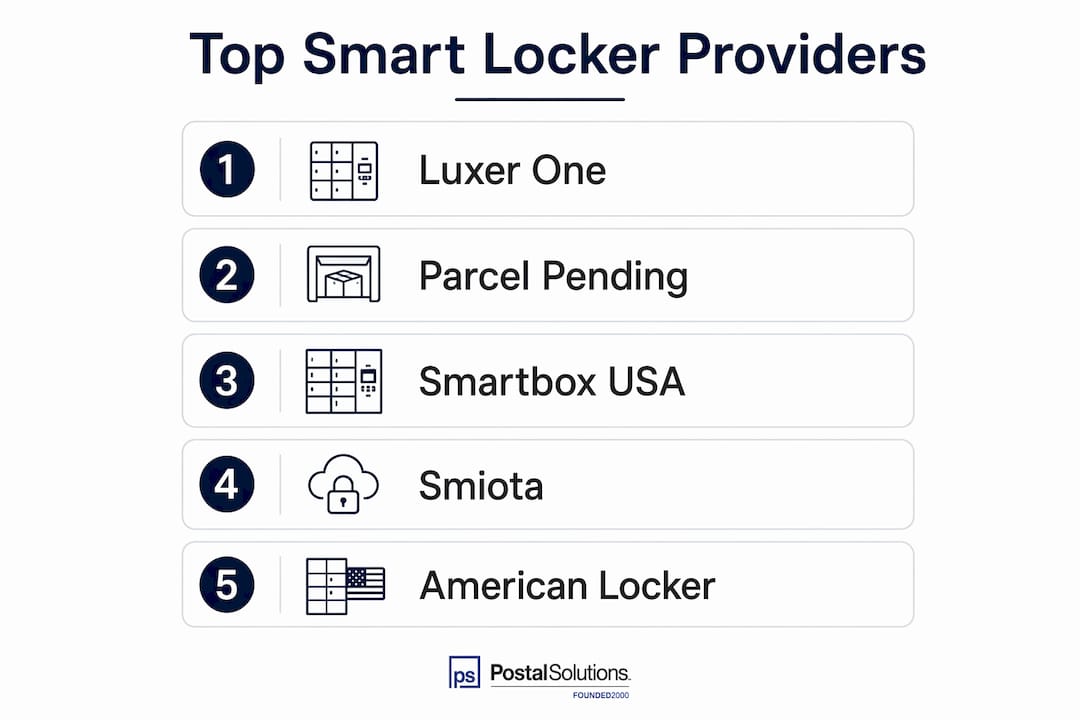
Detailed profiles of leading smart locker alternatives in the US market
1. Luxer One
Luxer One targets multifamily and retail properties that need a locker solution built around their specific layout. The product line covers standard package lockers, mail center configurations, and custom designs developed with architects for new construction. That last point matters more than it sounds: most locker vendors retrofit; Luxer One builds into the design phase, which reduces installation friction considerably.
Pros: Deep customization, broad industry coverage, strong track record in multifamily. Cons: Pricing is not publicly listed; you need a direct quote.
2. Parcel Pending by Quadient
Parcel Pending operates at genuine scale, supporting over 10,000 properties across North America. Its open locker network handles both delivery and returns, which is a differentiator most competitors skip entirely. Integration with Yardi, RealPage, Entrata, AppFolio, and ResMan means resident data syncs automatically, including lease-status checks that cut off access for move-outs without staff involvement.
Pros: Proven at portfolio scale, returns capability, strong PMS integrations. Cons: Positioned at the premium end of the market.
3. Smartbox USA, Inc.
Smartbox USA takes a unified approach: one system manages parcel delivery, asset tracking, and inventory in the same platform. Indoor and outdoor configurations are both available, which suits properties where the package room is not climate-controlled or where outdoor placement is the only option. For logistics-heavy or mixed-use properties, the asset management layer adds real operational value beyond basic package storage.
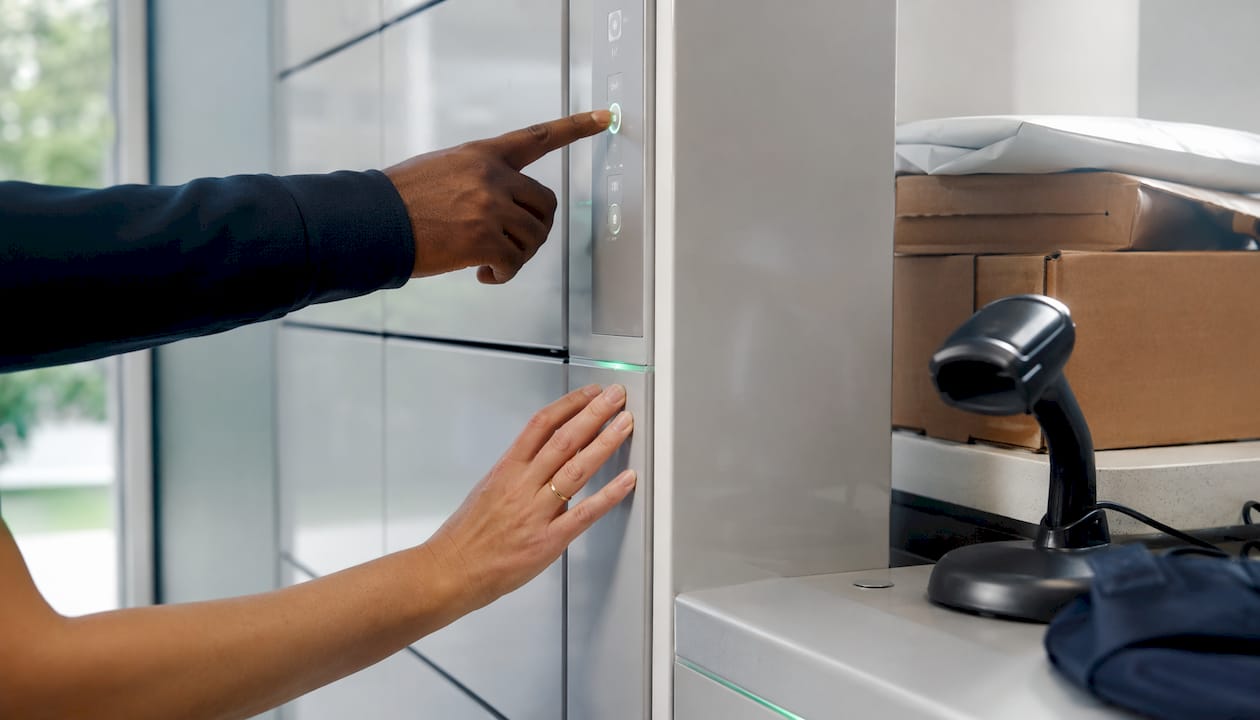
Pros: Parcel and asset management in one system, flexible placement. Cons: Smaller install base means less third-party validation.
4. Smiota
Smiota’s security stack is the most advanced on this list. Biometric access, RFID, PIN, mobile app, and a cloud dashboard all come standard, and the system includes a payment gateway for properties that want to charge for locker use. Healthcare campuses and government facilities appear frequently in Smiota’s customer base, which signals that the platform meets stricter access-control requirements than most residential-only vendors.
Pros: Best-in-class access control, suits regulated environments. Cons: Fewer public case studies; pricing requires direct inquiry.
5. American Locker
American Locker manufactures its systems domestically and offers a genuinely unusual feature set: credit card payment at the locker, integrated device charging stations, and four configurable product lines (Standard, Premium, Advanced, Custom). For properties that want a locker to function as a resident amenity rather than just a storage box, those extras are worth evaluating.
Pros: Made in the US, unique payment and charging features. Cons: Very limited public review history.
How to choose the right secure locker solution for your property
The decision comes down to five factors, and skipping any one of them tends to produce a mismatch between what you buy and what your property actually needs.
- Package volume and unit count. A 50-compartment locker bank serves a 200-unit building poorly when residents average multiple packages per week. Size the system to peak volume, not average.
- Integration with your PMS. If your property runs on Yardi, RealPage, or Entrata, confirm the vendor offers a pre-built integration. Manual data entry defeats the purpose of automation.
- Locker size variety. Fixed compartments struggle with oversized deliveries. Ask vendors specifically about their largest compartment dimensions and how overflow is handled.
- Installation timeline and space. Hardware procurement, permits, and electrical work can stretch deployment to 3–6 months. Factor that into your go-live date.
- Support and maintenance terms. On-site service response time matters more than the SLA document. Ask for references from properties in your region.
Pro Tip: Survey residents before you commit to a locker configuration. Knowing whether your community skews toward frequent small deliveries or occasional large orders shapes the compartment mix more reliably than any vendor recommendation.
A common mistake is treating price as the primary filter. A lower-cost system that fills up during peak season and forces carriers to leave packages in the lobby costs more in staff time and resident complaints than the premium option would have.
Why managed package rooms deserve a place in your evaluation
Smart lockers solve the storage problem. They do not solve the package volume problem when deliveries include furniture, groceries, dry cleaning, or anything that does not fit a fixed compartment. A managed package room with dedicated personnel handles all of that without the compartment ceiling.
Postal Solutions has operated on-site package rooms for apartment and student housing communities for 25 years. A dedicated Package Manager works the property up to six days a week: receiving, sorting, logging the chain of custody, and notifying residents by text and email. The package room or locker hardware you already have stays in place. The service wraps around it.
Operational advantages of a managed package room approach:
- Accepts packages of every size, including oversized and refrigerated deliveries
- Reduces leasing staff time spent on package handling to near zero
- Weekly audits catch lost or unclaimed packages before they become complaints
- Peak periods like move-in and the holiday season are covered without adding headcount
- Can be structured as a paid resident amenity, turning a cost center into ancillary income
Pro Tip: AI-enabled package management paired with human oversight is emerging as the best-practice model for large multifamily properties. The technology handles tracking and notifications; the person handles everything the technology cannot.
Properties that treat package management as a resident amenity rather than a logistics chore tend to see measurable gains in renewal rates.
What installation actually requires
Locker hardware installation is not a weekend project. Beyond the physical footprint, most systems require a dedicated electrical circuit, a network connection, and in many cases a building permit. Outdoor installations add weatherproofing requirements and may trigger additional permitting. Budget 3–6 months from contract to go-live for a standard locker bank.
Space is the constraint most property managers underestimate. A 50-compartment system needs roughly 100–150 square feet of floor space, plus clearance for residents to open doors and carriers to maneuver carts. If your lobby or package room cannot accommodate that footprint, a managed package room with open shelving typically holds three times the package capacity in the same square footage.
What good customer support looks like from a locker vendor
Support quality varies more than feature sets do. The questions worth asking before you sign: Is there a dedicated account manager or a shared support queue? What is the on-site response time for a hardware failure? Does the monthly software fee include support, or is it billed separately?
Parcel Pending by Quadient and Luxer One both have established US support networks given their install base. For newer or smaller vendors, ask specifically for references from properties in your state. A vendor with strong support in California may have limited coverage in the Southeast.
User experience and accessibility features
Residents interact with lockers on their own, often late at night, so the interface has to work without help. PIN-based retrieval is the baseline. Mobile app access, QR codes, and RFID all reduce friction further. Smiota adds biometric options for properties where security requirements are higher.
Accessibility under ADA guidelines requires locker controls to be reachable from a wheelchair and operable without tight grasping or twisting. Confirm ADA compliance in writing before installation, not after. Notification reliability matters too: a system that sends a text when a package arrives but fails to send a reminder when it sits unclaimed for three days creates the same staff burden the locker was supposed to eliminate.
Key Takeaways
The strongest secure package solution for your property depends on volume, budget, and how much staff involvement you want to retain.
| Point | Details |
|---|---|
| Hardware costs vary widely | Locker systems for a 150–300 unit community typically cost $12,000–$36,000 plus annual software fees. |
| Installation takes time | Plan for a 3–6 month timeline from contract to go-live for standard locker hardware. |
| Managed rooms handle what lockers cannot | Open-shelf package rooms accept oversized, refrigerated, and irregular deliveries that fixed compartments reject. |
| PMS integration is non-negotiable | Confirm pre-built connections to Yardi, RealPage, or your specific platform before committing to any vendor. |
| Postal Solutions as an alternative | For properties that want expert daily management without replacing existing hardware, Postal Solutions’ On-Site Package Room Management is worth evaluating. |
The package management gap most properties are not talking about
The conversation about secure locker alternatives tends to focus on hardware specs and price per compartment. That framing misses the real problem. A locker bank that fills up during peak season, or one that cannot accept a mattress or a grocery delivery, has not solved package management. It has just moved the problem from the leasing office to the lobby floor.
The properties that handle this well treat package management as a resident-facing service, not an infrastructure checkbox. That means thinking about what happens when the system is full, who handles the overflow, and whether the resident experience at 10 PM on a Tuesday is as good as it is at 2 PM on a Wednesday. Hardware answers part of that question. People and process answer the rest. The vendors that acknowledge this openly tend to be the ones worth trusting with a long-term contract.
Postal Solutions handles what the hardware cannot
Your leasing team should not be sorting packages. Postal Solutions’ On-Site Package Room Management puts a dedicated Package Manager at your property up to six days a week, handling every delivery from receipt to resident notification, using the locker or package room infrastructure you already have.
Twenty-five years of multifamily experience means the service scales for move-in week, the holiday surge, and every ordinary Tuesday in between. Many communities structure it as a paid resident amenity and retain the margin over the management cost, turning a budget line item into a revenue offset. If your property is evaluating locker vendors and wondering what happens when the lockers are full, that is exactly the gap Postal Solutions fills.
FAQ
What are the main smart locker alternatives for apartments?
The leading options in the US are Luxer One, Parcel Pending by Quadient, Smartbox USA, Smiota, and American Locker, each offering different configurations for multifamily and workplace properties. Managed package rooms with dedicated staff are a complementary alternative for properties that need to handle oversized or irregular deliveries.
How much do smart locker systems cost?
Hardware for a 150–300 unit community typically runs $12,000–$36,000.
Can smart lockers integrate with property management software?
Yes. Leading providers offer pre-built integrations with Yardi, RealPage, Entrata, AppFolio, and ResMan, enabling automated resident sync and lease-status access control.
What happens when lockers are full?
Fixed compartments cannot accept oversized or overflow packages, which forces carriers to leave deliveries in lobbies or common areas. A managed package room or open-shelf system handles all package sizes without a capacity ceiling.
Is a managed package room better than smart lockers?
It depends on your property’s needs. Smart lockers work well for high-volume properties that want fully self-service, 24/7 access. A managed package room, like the service Postal Solutions provides, is better suited for properties handling diverse package types or those that want expert daily oversight without replacing existing hardware.
Recommended
Ready when you are
Fix your package room — start with a free proposal
Daily on-site Package Manager, resident text & email pings*, and a tour-ready amenity. Tell us your unit count and we'll send a right-sized proposal — usually within one business day.
- ✓ 16–30 hours back every week
- ✓ Works with any locker system
- ✓ Faster, friction-free resident pickup
- ✓ An easy ancillary income addition