
July 28, 2026
On-Site Package Management for Apartments: A Manager's Guide
Discover effective on-site package management for apartments. Boost security, save staff time, and enhance resident convenience—all with 24/7 access!
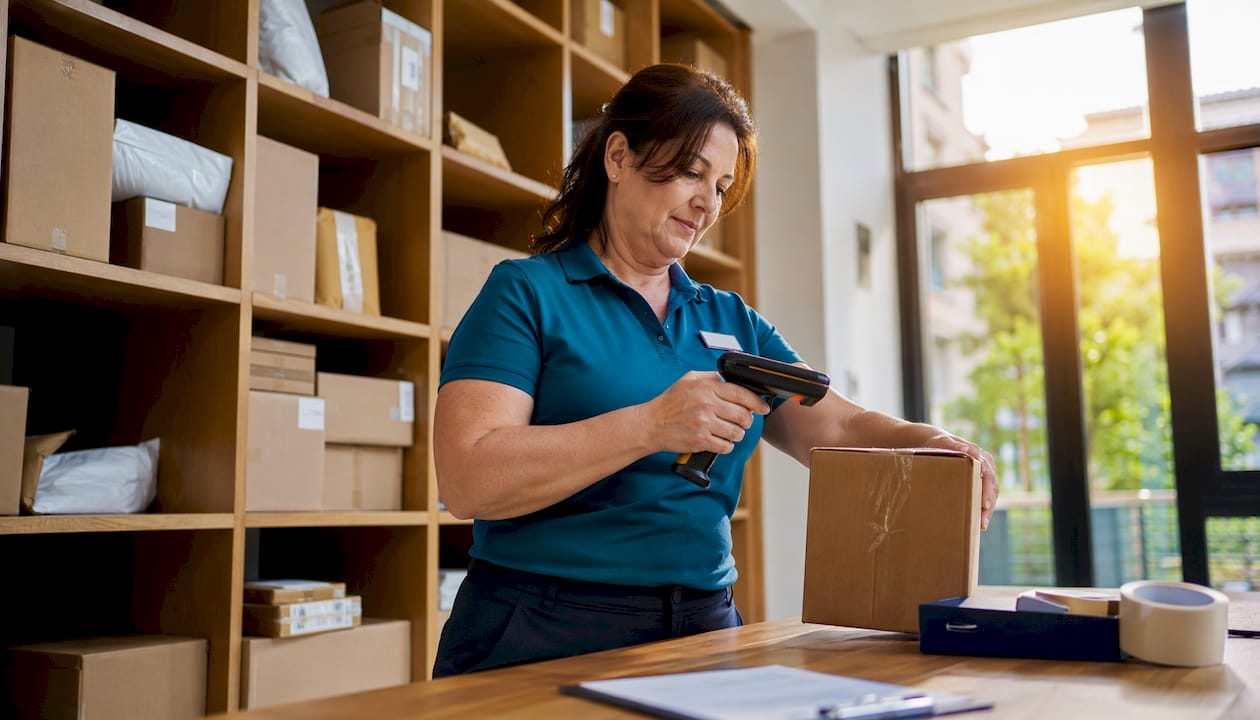
For most apartment communities, managed on-site package room management is the most practical and scalable answer to the daily delivery problem. Three reasons make it the default recommendation: it keeps a documented chain of custody on every package, it pulls your leasing staff out of the sorting-and-logging loop entirely, and residents get consistent, 24/7 access without waiting on office hours.
- Security and chain of custody: Every package is logged, shelved, and tracked from courier drop-off to resident pickup, with audit trails that resolve disputes fast.
- Staff time recovered: Your team stops fielding “where’s my package?” calls and starts focusing on leasing and renewals.
- Resident convenience: Guided retrieval, real-time notifications, and round-the-clock access turn a daily friction point into a visible amenity.
The right sizing and format still depend on your unit count, daily volume, and available footprint. The sections below walk through selection criteria, workflow details, and the vendor questions that separate a solid operation from one that falls apart under holiday surge.
Table of Contents
- What is a package room, and how does it differ from lockers?
- Why package room management pays off for operators
- How the package-room workflow actually runs
- What features should you require from any package-room solution?
- How do you choose between managed, automated, and DIY approaches?
- Does managed on-site package management actually deliver results?
- How should you communicate with residents about package retrieval?
- Key Takeaways
- What operators often get wrong about package room management
- Postal Solutions handles your package operation so your team doesn’t have to
- FAQ
What is a package room, and how does it differ from lockers?
A package room is a dedicated, access-controlled space where all incoming deliveries are received, logged, and held until residents retrieve them. It can be staffed by an on-site package manager, automated with computer-vision open-shelf technology, or run as a hybrid. The defining feature is centralized intake with a documented chain of custody, not just a place to stack boxes.
| Format | Footprint efficiency | Oversized handling | Surge capacity | Staff involvement |
|---|---|---|---|---|
| Staffed/managed package room | High — flexible shelving adapts to volume | Excellent — no fixed compartment limits | High — space scales with shelving, not hardware | Dedicated on-site manager |
| Automated smart package room | High — open-shelf with computer vision | Good — depends on room dimensions | High — no locker-size constraints | Minimal after setup |
| Fixed-compartment locker bank | Moderate — each unit occupies fixed floor space | Poor — oversized items need overflow staging | Limited — compartments fill; overflow requires manual handling | Low for standard deliveries |
| Off-site consolidation | None on property | Varies by third-party provider | Flexible but adds resident friction | Carrier and third-party staff |
Fixed-compartment lockers are the most common starting point, but they hit a ceiling fast. When a resident orders a bicycle or a case of wine, the locker bank has no answer. A package room, staffed or automated, handles those edge cases without a separate overflow policy.
Why package room management pays off for operators
The operational case for a well-run apartment package management service is straightforward: it converts a daily time drain into a measurable line item with a return.
- Chain-of-custody protection: Logged intake and weekly audits mean you have evidence when a resident claims a package was lost. That alone reduces liability exposure significantly.
- Staff hours recovered: Staff-time reductions from deploying managed or automated package systems have been documented across large portfolios, with teams reporting meaningful drops in weekly package-handling hours.
- Reduced lobby congestion: Centralized intake keeps carriers out of hallways and common areas, which residents notice.
- Faster pickup times: Immediate text and email notifications, combined with 24/7 access, cut the average time a package sits unclaimed. In 2018, residents picked up packages 43% more quickly after communities introduced automated notification and anytime access.
- Ancillary income potential: Many communities structure the service as a paid amenity, retaining the margin over management cost. Ancillary income strategies built around package services have become a real line item for operators who previously absorbed the cost entirely.
- Leasing and retention value: A professionally run package room is something your leasing team can show on a tour. Resident satisfaction with delivery services correlates directly with renewal rates at communities where the experience is consistent.
By the numbers: One large-portfolio deployment reported a 3.4% annual improvement in resident satisfaction scores year over year after adopting an automated package room, alongside a 4.75% higher package delivery satisfaction score than the Kingsley Index benchmark.
For smaller communities (under 100 units), even a part-time on-site attendant paired with modest shelving and a notification system produces measurable gains. High-volume student and urban properties typically need daily, full-coverage operations or a fully automated smart room to keep pace.
How the package-room workflow actually runs
The workflow has six stages, and the risk lives in the gaps between them.
Courier arrival and secure entry. Carriers enter through a controlled access point, either via PIN, QR code, or a dedicated carrier credential. Non-regular drivers (Amazon Flex, DoorDash, etc.) need a clear protocol, because they often lack the key-fob access that regular route drivers carry. How packages get delivered to apartments varies by carrier, and your intake process has to account for all of them.
Intake logging. Every package gets scanned or photographed at intake, assigned to a unit, and placed in a designated location. This is where chain-of-custody begins. A manual logbook works, but it creates gaps; automated scan-and-log systems or an on-site manager using dedicated HOA violation letter software for property managers are more reliable.
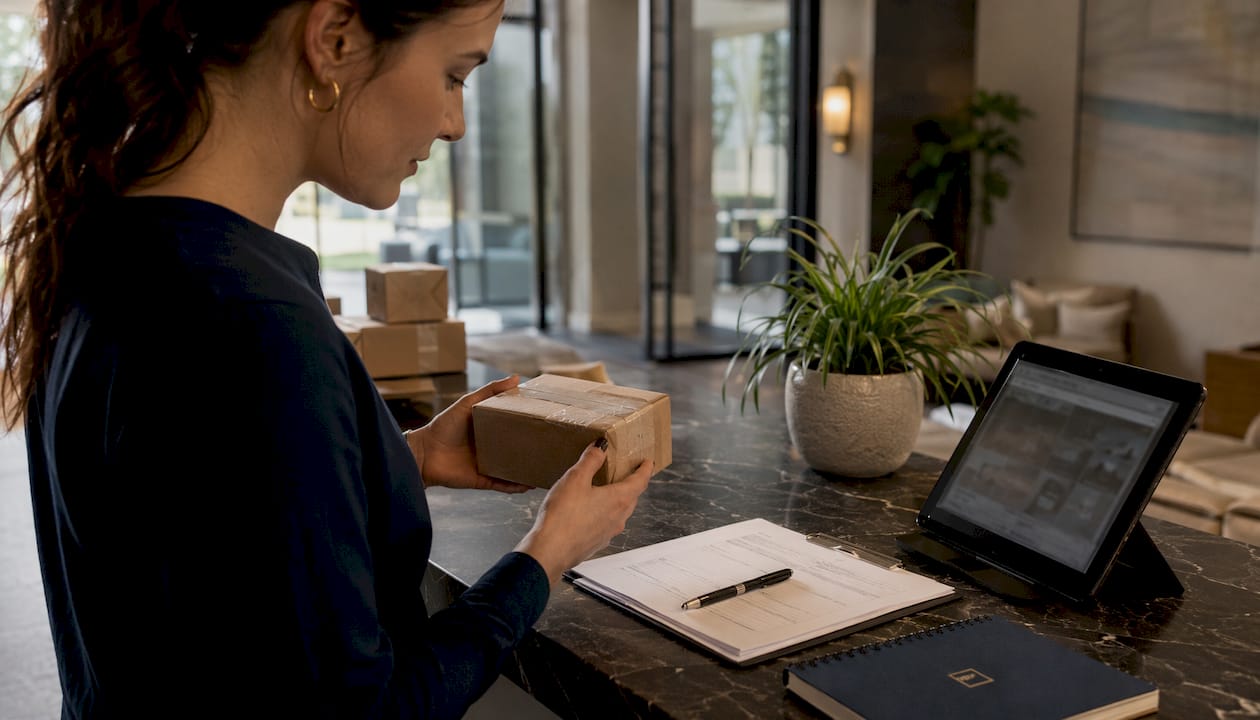
Storage and chain-of-custody logging. Packages are shelved by unit number or zone. Oversized items go to a designated overflow area; refrigerated deliveries (medications, meal kits, groceries) go to temperature-controlled storage. The location of every package is recorded.
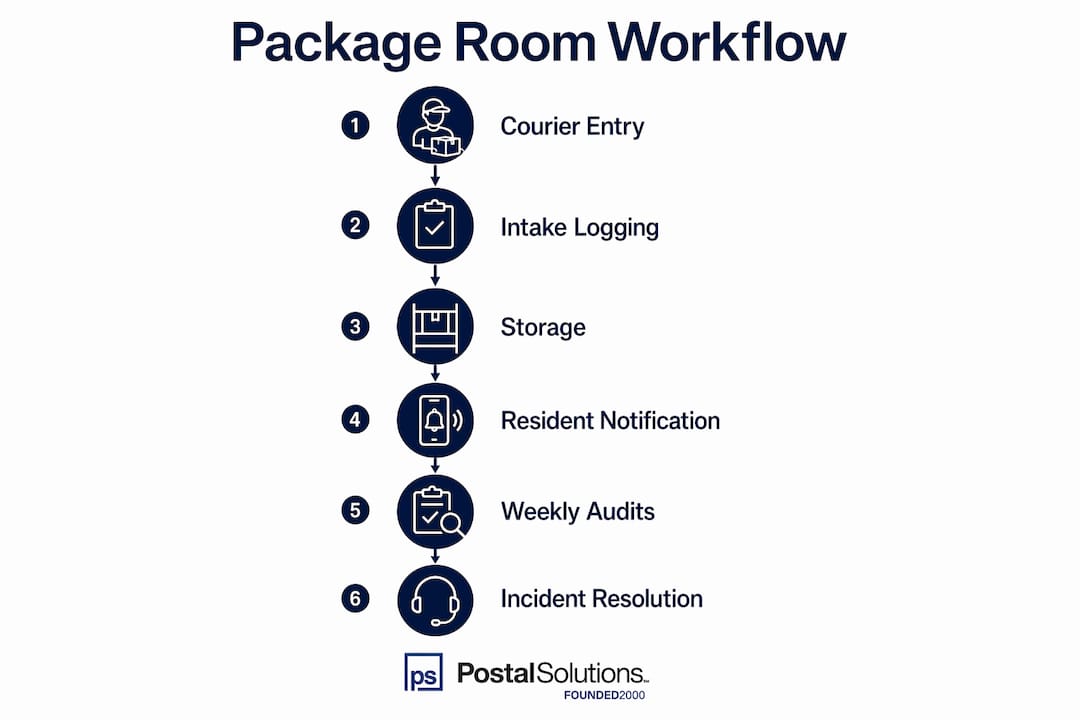
Resident notification and retrieval. The resident gets a text and email with pickup instructions. They access the room via their credential, retrieve the package, and the system logs the pickup. No staff involvement required at this stage.

Weekly audits. Weekly audits and chain-of-custody logs are the operational control that prevents loss and gives you the evidence to resolve disputes. An audit catches packages that were logged but never retrieved, misplaced items, and carrier errors before they become complaints.
Incident resolution. When something goes wrong — a misdelivery, a damaged package, a carrier who bypassed the intake workflow — the audit trail is what makes resolution fast. Without it, every dispute becomes a he-said-she-said.
When staff are overwhelmed by package deliveries, the breakdown almost always traces back to one of these stages being skipped or underdocumented.
What features should you require from any package-room solution?
Scalability, secure design, software integrations, and ease of use are the top selection criteria in industry guidance, and they map directly to a practical checklist.
- Access control: Residents and carriers each need separate, auditable credentials. No shared codes.
- Audit logs and chain-of-custody records: Every intake, move, and pickup logged with timestamp and user ID.
- Courier authentication: PIN or QR-based entry for regular carriers; a clear protocol for non-regular drivers.
- Real-time resident notifications: Text and email at minimum; photo confirmation of intake is a strong differentiator.
- Camera coverage: Cameras deter theft and provide evidence for disputes. Package security best practices treat camera coverage as non-optional.
- Flexible shelving for oversized items: Fixed-compartment systems fail here; open shelving or dedicated overflow staging is required.
- Refrigerated capability: Meal kits and medications are now a significant share of residential deliveries. Temperature-controlled storage is no longer a luxury for mid-size and larger properties.
- Overflow procedures: A documented policy for what happens when the room is at capacity, including resident communication and staging.
- Clear SLA terms: Response time for support, uptime guarantees, and escalation paths in writing.
On integrations: require compatibility with your property management software (Yardi, Entrata, RealPage), your access control platform, and carrier scanning APIs. Scalable package management systems should also include reporting dashboards so you can track utilization, identify peak patterns, and make staffing decisions at the portfolio level.
Pro Tip: Require open APIs and explicit carrier compliance tools in your contract. If a vendor can’t show you how they measure driver participation and escalate non-compliance, that’s a gap that will cost you packages.
How do you choose between managed, automated, and DIY approaches?
The right multifamily package handling service depends on four variables: unit count, average daily volume, available footprint, and your budget model preference (capital expenditure vs. operating expenditure).
Matching solution type to property tier is the recommended starting framework, and carrier compliance should be treated as a primary evaluation criterion, not an afterthought.
| Solution type | Best fit | Security/chain of custody | Footprint/capacity | Staff-time impact | Resident UX | Oversized handling | Cost model |
|---|---|---|---|---|---|---|---|
| Entry-level locker bank | Under 100 units, low volume | Moderate | Fixed, limited | Low | Good for standard parcels | Poor | Capex + maintenance |
| Smart package room (automated) | — | High | Flexible, scalable | Very low | Excellent, 24/7 | Good | Capex or SaaS |
| Staffed on-site package room | Any size with existing room/lockers | Highest | Flexible | Eliminated for leasing staff | Excellent, 24/7 | Excellent | Opex (per-unit/month) |
| Off-site consolidation | Properties with no on-site space | Variable | None on property | Moderate (coordination) | Adds friction | Varies | Variable |
Converting underused amenity space to a staffed package center often produces favorable economics compared to off-site consolidation, especially when the operator can structure the service as a resident amenity fee. For student housing operations, high daily volume and move-in surge periods make daily on-site coverage nearly mandatory.
Vendor questions to ask during RFP or demo:
- How do you detect and document carrier non-compliance?
- What does your audit log capture, and how is it accessible to property staff?
- Which property management platforms do you integrate with natively?
- What are your SLA hours and support response commitments?
- How does pricing scale as unit count or volume grows?
- What does onboarding and carrier training look like, and who owns it?
Red flags: No carrier compliance plan, closed or proprietary APIs with no integration roadmap, and SLA terms that are vague about response time.
Implementation typically runs in three phases: a baseline assessment (package volume, staff hours, footprint), a pilot period, and full rollout. Timeline varies by property size and hardware requirements, but most managed-service deployments can be operational within a few weeks of contract execution.
Does managed on-site package management actually deliver results?
The evidence from deployed systems is consistent in direction, if not uniform in scale.
One large urban property reported that resident wait times dropped dramatically after deploying a smart package room, with package-dedicated staff counts falling sharply at that site. A national multifamily portfolio documented a 3.4% annual improvement in resident satisfaction scores and used the package room as a marketing amenity in leasing materials.
The operational lesson from practitioners is consistent: process-first, then technology. Many operators add more hardware when the real problem is carrier non-compliance or an undocumented intake workflow. A carrier who bypasses the intake station makes any system fail, regardless of how sophisticated the hardware is.
| Best practice | Why it matters |
|---|---|
| Carrier training with pictorial SOPs | Single-page visual guides and QR/PIN codes for regular drivers reduce bypass incidents |
| Weekly audits | Catch misplaced packages before they become disputes |
| Phased implementation | Baseline data first; pilot before full rollout |
| Staff reallocation plan | Define what leasing staff do with recovered hours before go-live |
| Segmentation by property type | High-volume urban/student properties need daily coverage; smaller communities can succeed with hybrid models |
A mid-size urban apartment community (approximately 200 units) that shifted from manual office-based package handling to a staffed on-site model reported that leasing staff recovered meaningful hours per week, resident complaint volume around packages dropped, and the package room became a standard stop on prospect tours. Results like these are directionally consistent across the case materials available, though specific figures vary by property type and prior baseline.
How should you communicate with residents about package retrieval?
Resident frustration with package delivery almost always traces back to inconsistency, not technology failure. When the pickup experience changes from week to week, or when residents don’t know what to expect after a notification, confidence in the system erodes fast.
A clear communication plan has three components. First, set expectations at move-in: explain how the package room works, what the pickup window policy is, and how residents will be notified. Second, enforce pickup windows consistently. Industry guidance recommends encouraging pickup within 3–5 days under normal conditions, with shorter windows during peak periods like the winter holidays to prevent backlogs. Third, send escalating reminders as deadlines approach, from a friendly first alert to an urgent final notice before a package is flagged for return or overflow staging.
For residents with accessibility needs or travel schedules, build flexibility into the policy and communicate clearly how exceptions are requested. A resident portal or property management app is the right channel for exception requests, not the leasing office phone line.
When a retrieval issue does arise, a documented chain-of-custody log is what makes resolution fast. The resident says the package was delivered; the log shows exactly when it was received, where it was shelved, and whether it was picked up. That evidence closes disputes in minutes rather than days. Preventing package theft and resolving retrieval disputes both depend on the same underlying data: a complete, timestamped intake-to-pickup record.
Key Takeaways
Managed on-site package room management is the most complete solution for apartment communities that want staff time back, documented chain of custody, and a package experience residents notice on tours.
| Point | Details |
|---|---|
| Process before hardware | Carrier compliance and weekly audits prevent more failures than additional lockers do. |
| Match solution to property tier | Staffed on-site management fits any property with existing hardware; smart rooms suit high-volume urban sites. |
| Pickup windows reduce congestion | Enforce 3–5 day pickup windows normally, shorter during peak periods, to keep capacity available. |
| Audits protect operators | Weekly chain-of-custody logs resolve resident disputes fast and reduce liability exposure. |
| Postal Solutions | Provides dedicated on-site Package Managers up to six days a week, integrating with your existing room or locker hardware. |
What operators often get wrong about package room management
The conventional wisdom in multifamily operations is that a package problem is a hardware problem. Buy more lockers, add a smart room, and the complaints stop. That framing is wrong often enough to be worth saying plainly.
Hardware solves the storage and access side of the equation. It does not solve carrier non-compliance, which is where most package losses actually originate. A driver who drops packages in the lobby instead of scanning them into the system defeats any technology you’ve installed. The properties that run the cleanest package operations are the ones that treat carrier training and weekly audits as operational standards, not optional add-ons.
The second thing operators underestimate is the staff reallocation question. Recovering hours from package handling only pays off if those hours are redirected deliberately. The communities that see the clearest ROI are the ones that defined what their leasing team would do with recovered time before the new system went live, not after.
Postal Solutions handles your package operation so your team doesn’t have to
Your leasing staff are good at leasing. Package sorting, carrier coordination, and “where’s my delivery?” calls are not the best use of their time, and they know it.
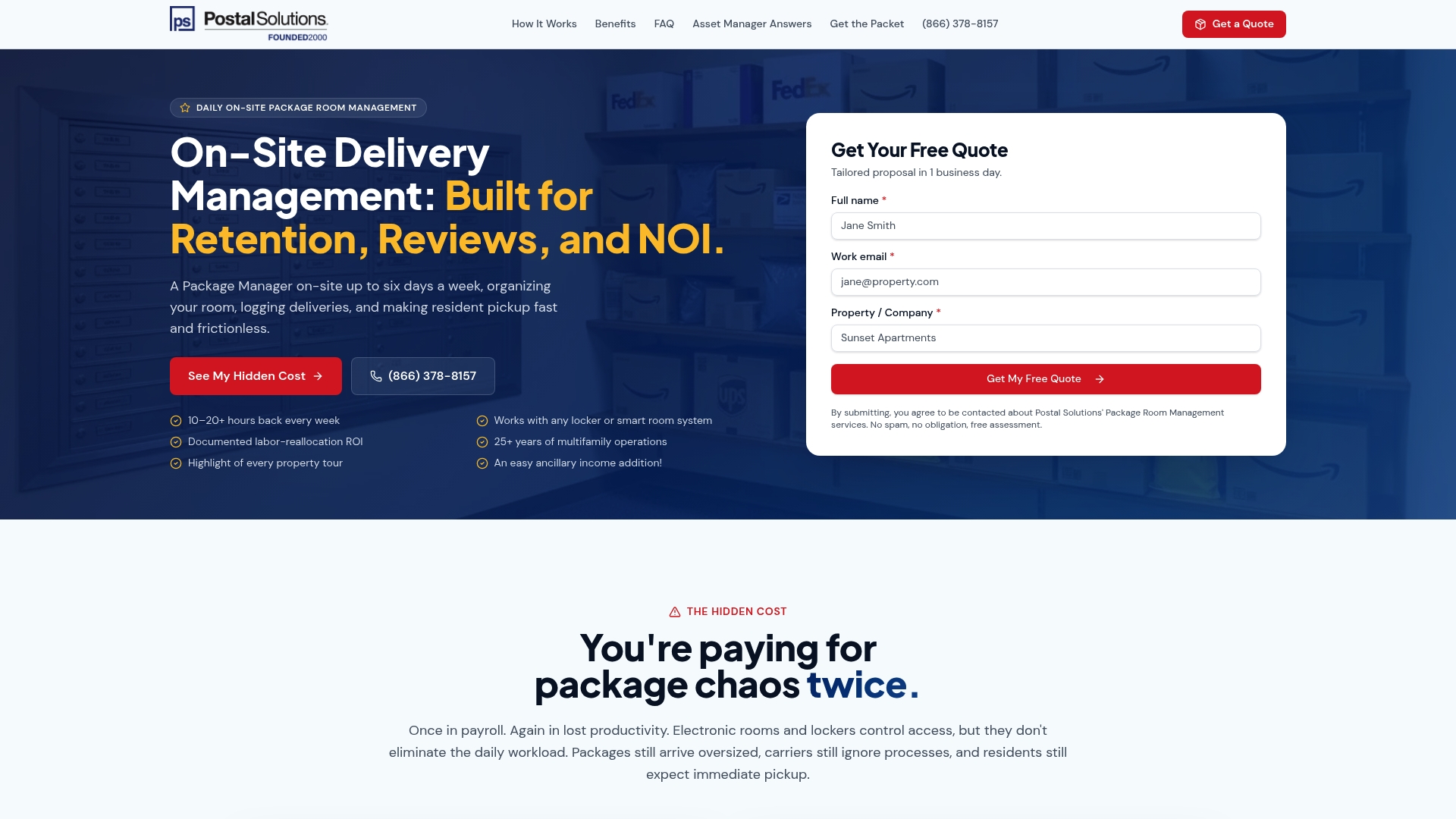
Postal Solutions provides dedicated on-site Package Managers who work your community up to six days a week: receiving, sorting, shelving, logging chain of custody, sending resident notifications, running weekly audits, and handling overflow, oversized, and refrigerated deliveries. The service integrates with whatever package room or locker hardware you already have. No rip-and-replace required.
What’s included:
- Daily on-site package acceptance, sorting, and shelving
- Chain-of-custody logging and weekly audits
- Resident text and email notifications
- Overflow and oversized package handling
- Refrigerated and special delivery management
- Carrier onboarding and compliance support
- Dashboard reporting for utilization and ROI tracking
- Optional bundled hardware for integrated service contracts
Many communities structure the service as a resident amenity fee, turning a budget line item into one that helps pay for itself. Twenty-five years of on-site package operations back every engagement.
See how Postal Solutions compares to other package concierge options, or go straight to the primary service page to request a site assessment.
FAQ
What is the difference between a package room and package lockers?
A package room is a flexible, access-controlled space that handles any delivery size, including oversized and refrigerated items, with a documented chain of custody. Lockers use fixed compartments that limit parcel size and surge capacity.
How much staff time does on-site package management actually save?
Results vary by property size and prior process, but documented case studies show meaningful reductions in weekly package-handling hours after deploying managed or automated systems, freeing leasing staff for core responsibilities.
What pickup window policy should apartment communities enforce?
Industry guidance recommends a 3–5 day pickup window under normal conditions, shortened during peak periods like the winter holidays to prevent backlogs and keep capacity available for incoming deliveries.
How does Postal Solutions integrate with existing hardware?
Postal Solutions works with whatever package room or locker system a property already has, including major platforms, so there is no requirement to replace existing hardware to start the service.
What should I ask a vendor about carrier compliance?
Ask specifically how they detect and document carrier non-compliance, what happens when a driver bypasses the intake workflow, and whether they provide carrier training materials such as pictorial SOPs and PIN/QR access credentials.
Recommended
Ready when you are
Fix your package room — start with a free proposal
Daily on-site Package Manager, resident text & email pings*, and a tour-ready amenity. Tell us your unit count and we'll send a right-sized proposal — usually within one business day.
- ✓ 16–30 hours back every week
- ✓ Works with any locker system
- ✓ Faster, friction-free resident pickup
- ✓ An easy ancillary income addition