
August 16, 2026
Package Management Cost: What Property Managers Actually Pay
Discover how property managers can reduce package management costs by understanding labor expenses, vendor services, and efficiency solutions.

Manual package handling at a 300-unit property typically runs tens of thousands of dollars per year in direct labor alone, once you account for every touch a parcel requires from arrival to pickup. Vendor-managed services price at roughly $2–$4 per unit per month source, which typically translates into several thousand dollars annually for that same property. The gap between those two figures is where most operators leave money on the table.
The single biggest cost driver is staff labor compounded by package dwell time. A community averaging 75 packages per day can burn through more than six staff-hours daily when each parcel requires multiple touches: receiving, scanning, sorting, shelving, and retrieval. At an estimated $20/hour wage rate, labor costs may reach several thousands of dollars per month and tens of thousands annually before counting disputes, theft investigations, or the leasing hours you never got back.
The sections below give you the formulas, worked scenarios, and a decision checklist to calculate your own number and choose the right model.
Key Takeaways
The fully loaded package management cost at a 200-unit property commonly exceeds $69,000 per year in direct labor alone, making vendor-managed or staffed-room alternatives worth a rigorous side-by-side comparison.
| Point | Details |
|---|---|
| Labor dominates the cost | At 4–5 touches per package, a 200-unit property can consume 9.5 staff-hours daily at $20/hr. |
| Vendor services offer predictability | Third-party managed services typically price at $2–$4 per unit per month, or $7,200–$14,400/yr for 300 units. |
| Pickup delay drives inventory | Every extra day of dwell time adds one day’s worth of arrivals to your on-hand inventory and overflow risk. |
| Indirect costs are real | Resident churn from package disputes and lost leasing hours often exceed the direct labor line in the budget. |
| Surge planning is non-optional | A 2× holiday multiplier on a property already at 80% capacity guarantees overflow without a documented mitigation plan. |
Table of Contents
- What package management cost actually includes, line by line
- How to calculate your labor and operational cost
- Storage capacity, pickup delay, and surge planning
- Common package-management models and their cost profiles
- Decision checklist: how to choose the right approach
- What the numbers look like when a staffed model takes over
- What to do next: your action plan
- The cost conversation most operators are having too late
- Sources
- FAQ
What package management cost actually includes, line by line
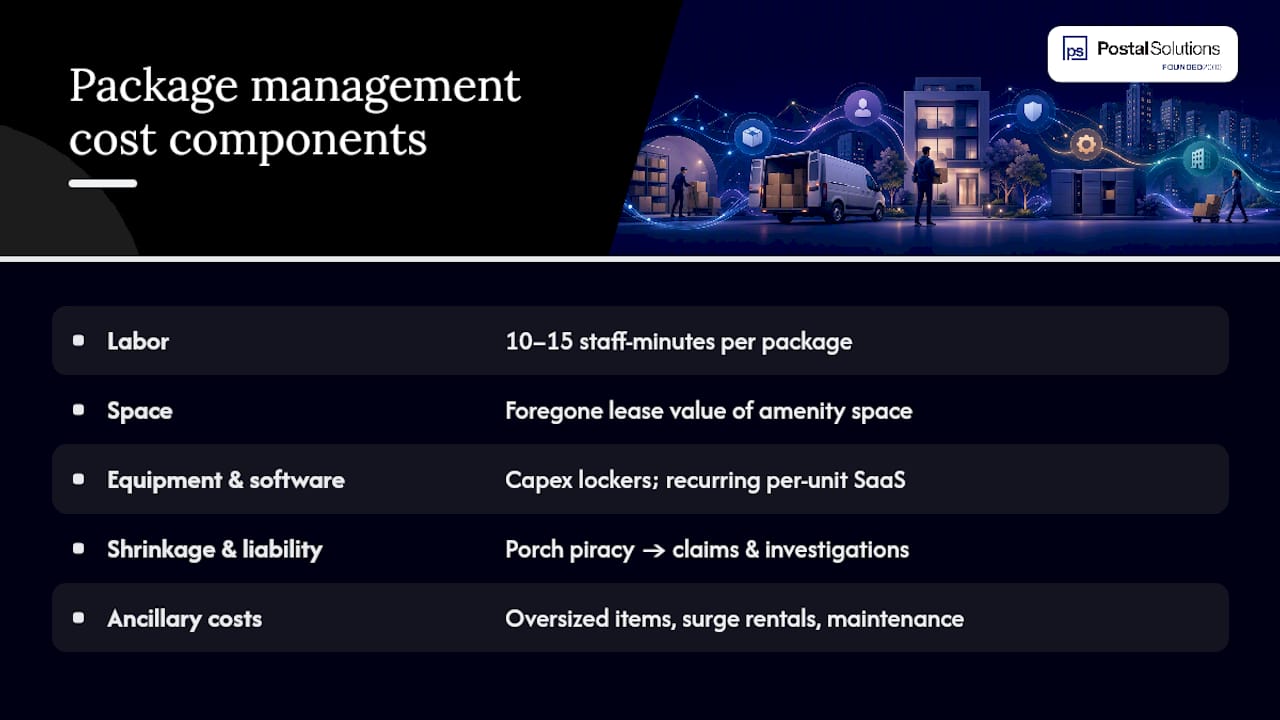
Most operators undercount because they only see the wage line. The real cost model has six components.
Labor is the largest and most variable. Receiving a package, logging it, shelving it, notifying the resident, retrieving it on demand, and resolving a dispute each add minutes. At 4–5 touches per parcel and 2–3 minutes per touch, a single package can consume 10–15 staff-minutes before it leaves the building. Multiply that across typical daily deliveries and the labor drain becomes substantial annually source.
Space and storage carry a real dollar cost even when the room is “free.” A dedicated package room that displaces a rentable amenity space costs you the foregone lease value of that square footage. Lockers consume lobby or corridor space that affects first impressions on tours. Ad hoc overflow stacked in hallways creates liability and a poor resident experience simultaneously.
Equipment and infrastructure include locker banks, shelving units, access-control hardware, barcode scanners, and installation labor. Locker banks are a capex purchase with fixed capacity, meaning a surge or an oversized item immediately exposes their limits. Shelving and flexible racking are cheaper upfront but require a staffed workflow to function.
Software, notifications, and integrations add a recurring SaaS layer. Most modern package-room platforms charge per unit per month for resident notifications, carrier integrations, and chain-of-custody logging. SMS and email delivery costs are usually bundled, but API integrations with property management systems can carry setup fees. A proactive notification system that reduces pickup delay pays for itself by cutting average inventory on hand.
Shrinkage, liability, and insurance are the costs operators most consistently underestimate. Porch piracy and holiday theft spikes translate directly into resident disputes, replacement claims, and staff time spent on investigations. Properties without a documented chain of custody face the greatest exposure when a resident claims a package was lost or stolen on-site.
Ancillary costs round out the model: oversized item handling (which often requires a separate staging area), refrigerated delivery coordination, seasonal surge rentals for temporary racks, and ongoing equipment maintenance.
Pro Tip: Add a resident churn line to your NOI model. A single resident who leaves over a package dispute costs you one to two months of lost rent plus turnover expenses. That indirect cost often exceeds the annual software fee for a managed solution.
How to calculate your labor and operational cost
The math is straightforward once you have five inputs. Collect them before you run any scenario.
- Units — total occupied units at the property
- Packages per unit per week — industry average is roughly 1.5–2.5 for a typical multifamily community
- Pickup delay — average days a package sits before a resident retrieves it (commonly 2–4 days)
- Staff wage — fully loaded hourly rate including benefits
- Peak multiplier — how much volume spikes during holidays or move-in (typically 1.5–2.5×)
Core formulas
The AgentCalc overflow planner uses a Little’s Law flow model to calculate average inventory on hand:
Daily arrivals come from:
Staff cost follows from throughput:
Scenario A: Small property (80 units)
- Daily arrivals: (80 × 2) ÷ 7 = 22.9 packages/day
- Average inventory: 22.9 × 3 days = 68.6 packages on hand
- Daily staff minutes: 22.9 × 4 touches × 2.5 min = 229 minutes (3.8 hours)
- Daily labor cost: 3.8 × $20 = $76/day
- Annual labor cost: $76 × 365 = $27,740
Scenario B: Medium property (200 units)
- Daily arrivals: (200 × 2) ÷ 7 = 57.1 packages/day
- Average inventory: 57.1 × 3 days = 171.4 packages on hand
- Daily staff minutes: 57.1 × 4 touches × 2.5 min = 571 minutes (9.5 hours)
- Daily labor cost: 9.5 × $20 = $190/day
- Annual labor cost: $190 × 365 = $69,350
That 200-unit scenario assumes staff are dedicated to package handling. In reality, front-desk staff split their attention, so real throughput per hour is lower than isolated benchmarks suggest. A conservative packages-per-hour figure of 12–15 is more realistic than the 20–25 you might see in vendor demos.
A note on oversized items: a single oversized package can occupy the space of four standard parcels and require two staff members to move. Track cubic-foot outliers separately. If more than 5–8% of your daily volume is oversized, your capacity math changes materially and you may need a dedicated staging area or a separate handling policy.

| Input | Scenario A (80 units) | Scenario B (200 units) |
|---|---|---|
| Daily arrivals | 22.9 packages | 57.1 packages |
| Avg. inventory on hand | 68.6 packages | 171.4 packages |
| Daily staff hours | 3.8 hours | 9.5 hours |
| Daily labor cost ($20/hr) | $76 | $190 |
| Annual labor cost | $27,740 | $69,350 |
Storage capacity, pickup delay, and surge planning
Average inventory on hand is the number that determines whether your room overflows. The overflow planner formula makes this concrete: if your 200-unit property averages 171 packages on hand and your room holds 120, you are already operating in overflow territory on a normal week, before any holiday spike.
Overflow risk bands give you a quick read on where you stand:
- Low risk: average inventory is below 70% of room capacity, and your peak multiplier keeps the surge below 90%
- Medium risk: average inventory is 70–90% of capacity, or the peak multiplier pushes you above 100% at least once per quarter
- High risk: average inventory already exceeds room capacity, or any seasonal surge creates a guaranteed overflow event
The most common surge triggers are the November–December holiday window, move-in weekends, and back-to-school periods at student housing properties.
Practical mitigations, roughly in order of cost:
- Notification campaigns — SMS and email reminders that push residents to pick up within 24–48 hours; this alone can cut average pickup delay by 0.5–1 day, which reduces average inventory meaningfully without any capex
- Temporary racks or pop-up cages — rented or purchased for peak periods; low cost, flexible, but require a staffed workflow to function
- Scheduled pickup windows — designated hours that concentrate retrieval traffic and reduce the number of staff interruptions per day
- Overflow staging area — a secondary room or secured cage for oversized or unclaimed packages beyond a defined dwell threshold
A quick operational checklist before peak season: confirm your room’s actual usable capacity (not theoretical), verify your notification system is sending reliably, test whether your staff can process your peak daily volume within their scheduled hours, and identify where oversized items will go when the main room is full.
Common package-management models and their cost profiles
Four models dominate the market. Each has a different capex/opex split and a different failure mode.
Manual / front-desk handling has zero upfront cost and maximum flexibility, which is why most properties default to it. The failure mode is that it scales badly. Every additional package adds staff minutes, and the labor drain compounds as volume grows. There is no chain of custody, which creates liability exposure, and front-desk staff interrupted by package tasks are not leasing or building resident relationships.
Locker banks shift the model to capex. Installation costs vary by locker count and configuration, and the fixed-capacity problem is real: locker banks cannot handle oversized packages or surge volume without overflow. Drivers who bypass the locker and leave packages in the lobby undermine the entire system. Maintenance contracts add recurring opex on top of the initial purchase.
Third-party vendor-managed services convert the cost to a predictable monthly fee, typically $2–$4 per unit per month. For a 300-unit property, that’s $600–$1,200/month. The trade-off is that service quality varies, and many vendor contracts do not include explicit surge-handling SLAs or oversized-item protocols. Read the fine print on what “managed” actually covers.
Hybrid staffed package rooms combine a dedicated on-site attendant with the package room or locker infrastructure you already have. This is the model Postal Solutions operates: a dedicated Package Manager works the community up to six days a week, handling receiving, sorting, shelving, chain-of-custody logging, and resident notifications, while integrating with whatever hardware is already in place. The opex is predictable, the workflow is documented, and the package room becomes a showable amenity rather than a liability. Some communities structure the service as a paid resident amenity and retain the margin over the management fee, turning a cost center into a partial revenue offset.
Some operators convert underused amenity space into access-controlled package rooms and staff them part time, spreading labor costs across multiple responsibilities. This works when layout allows and when volume is moderate. It breaks down at high volume or during surges.
For a broader look at service model options, the range of approaches and their operational trade-offs is worth reviewing before you commit to any capex.
Decision checklist: how to choose the right approach
Before you request a proposal from any vendor, run through these questions with your team.
Capacity and volume:
- What is your current daily arrival rate, and what will it be in three years if e-commerce volume continues growing?
- Does your average inventory on hand already exceed 70% of room capacity on a normal week?
- What is your realistic peak multiplier, and does your current setup survive it without overflow?
Staff impact: 4. How many staff-hours per week are currently consumed by package tasks? 5. Are those hours coming from leasing staff, maintenance, or dedicated personnel? 6. What is the fully loaded hourly cost of those staff?
Budget and model fit: 7. Do you have capital budget for a locker installation, or does opex fit your budget structure better? 8. Is there an opportunity to structure package management as a resident amenity fee to offset cost? 9. Does your property have the physical space for a dedicated room, or are you constrained to lockers?
Vendor questions that surface true total cost:
- What is included in the monthly fee, and what triggers an overage charge?
- How does the service handle oversized packages and refrigerated deliveries?
- What is the SLA for surge periods (holidays, move-in)?
- What software fees, integration costs, or hardware requirements are separate from the service fee?
- How is driver compliance enforced when carriers bypass the designated drop point?
Red flags in proposals:
- A fixed locker count with no overflow protocol
- Monthly fees that exclude notification software or carrier integrations
- No documented chain-of-custody process
- Surge handling described as “we’ll figure it out” rather than a contractual SLA
- No reference to how the service handles resident disputes or theft claims
A simple scoring framework: rate each proposal on five criteria (cost predictability, surge handling, resident experience, staff hours reclaimed, and contract flexibility) on a 1–5 scale. Weight staff hours reclaimed and surge handling at 2× if your property is already at medium or high overflow risk. The proposal with the highest weighted score is usually the right choice, and the math is transparent enough to show ownership.
For a checklist-style vendor review, running proposals through a structured format before you sign makes the comparison apples-to-apples.
What the numbers look like when a staffed model takes over
Take a 150-unit property where leasing staff currently handle all package tasks. Using the formulas above:
- Daily arrivals: (150 × 2) ÷ 7 = 42.9 packages/day
- Daily staff minutes: 42.9 × 4 touches × 2.5 min = 429 minutes (7.1 hours)
- Annual labor cost at $20/hr: 7.1 × $20 × 365 = $51,830
That 7.1 hours per day is not coming from a dedicated package employee. It’s coming from your leasing team in fragments: a few minutes here when a carrier buzzes in, a few more when a resident calls about a missing parcel, another stretch during the evening rush. Fragmented time is worth less than consolidated time, and it costs you leasing conversations you never had.
Postal Solutions On-Site Package Room Management replaces that fragmented workflow with a dedicated Package Manager on-site up to six days a week. Every package gets received, scanned, shelved, and logged with a documented chain of custody. Residents receive text and email notifications automatically. The package room stays organized and accessible 24/7. Weekly audits catch discrepancies before they become disputes.
The direct labor savings depend on your current wage structure, but reclaiming 5–7 hours of leasing-staff time per day is a consistent outcome. At $20/hour, that’s $36,500–$51,100 per year in recovered productive time, before you count reduced dispute handling, fewer theft claims, and the leasing lift from showing a professionally run package amenity on tours.
Communities that structure the service as a resident amenity fee can offset a meaningful share of the management cost directly, turning what was a pure expense into a partial revenue line. For a detailed look at how that model works, the package room management guide walks through the setup and economics.
What to do next: your action plan
- Collect your five calculator inputs (units, packages/unit/week, pickup delay, staff wage, peak multiplier) and run the worked scenarios for your property before any vendor conversation.
- Check your overflow risk band using the average inventory formula; if you are already above 70% of room capacity on a normal week, a notification campaign is the fastest and cheapest first move.
- Include indirect costs in your NOI model: resident churn from package disputes and the opportunity cost of leasing-staff hours diverted to package tasks often exceed the direct labor line.
- Request proposals with explicit SLAs for surge handling, oversized items, and chain-of-custody documentation; proposals that omit these are hiding cost.
- Run a weighted scorecard across cost predictability, surge handling, resident experience, staff hours reclaimed, and contract flexibility before you commit to any capex or service contract.
The cost conversation most operators are having too late
The conventional advice on package management cost is to benchmark against what other properties pay per unit per month. That number is useful, but it answers the wrong question. The right question is: what is the fully loaded cost of your current approach, including the leasing hours you are not getting, the disputes you are spending time on, and the residents who leave because the package experience is bad?
Most operators only run the math after a theft incident, a resident complaint that escalates, or a leasing manager who quits partly because they spent half their day sorting boxes. By then, the cost has already been paid in ways that don’t show up on a single line in the budget.
The operators who get this right treat package management the same way they treat any other amenity: they set a performance standard, measure against it, and make a deliberate choice about whether to staff it internally or contract it out. The math in this article gives you the inputs to have that conversation with ownership before the problem forces it.
One more thing worth saying plainly: the per-unit monthly fee for a managed service is not the cost. The cost is what you are spending now, fully loaded, versus what you would spend under the new model. Run both numbers. The gap is usually larger than the fee.
Sources
- A Framework for Solving Multifamily’s Package Management Problem | Insights by Blueprint
- Apartment Package Room Overflow Planner | Forecast Mailroom Capacity & Staffing | AgentCalc
FAQ
What does package management cost per unit per month?
Vendor-managed services typically price at $2–$4 per unit per month. Manual handling costs more in labor once you account for all staff touches, often running tens of thousands of dollars annually at a fully loaded wage rate.
How many staff-hours does package handling consume daily?
A community averaging 75 packages per day can consume more than six staff-hours daily when each package requires 4–5 touches. Smaller properties with daily deliveries in the low twenties typically see several hours of daily staff time absorbed by package tasks.
What is the purpose of an on-site package manager?
An on-site package manager handles receiving, scanning, sorting, shelving, chain-of-custody logging, and resident notifications so leasing and maintenance staff can focus on their primary responsibilities. The role also manages oversized items, refrigerated deliveries, and surge periods.
How does pickup delay affect package management cost?
Pickup delay directly determines how many packages are on hand at any given time. Using the arrival rate × pickup delay formula, cutting average dwell time from 4 days to 2 days roughly halves your average inventory, which reduces overflow risk and the staff time spent managing a crowded room.
When does a staffed package room make more financial sense than lockers?
A staffed room typically wins when daily volume is high, when oversized packages represent more than 5–8% of deliveries, or when the property already has the physical space. Lockers are better suited to lower-volume properties where residents value 24/7 self-service access and the fixed capacity matches the property’s realistic peak volume.
Recommended
- Package Notification System for Apartments: A Manager’s Guide — Postal Solutions Blog
- Resident Package Management for Property Managers: A Practical Guide — Postal Solutions Blog
- Package Room Reviews: What Property Managers Should Check — Postal Solutions Blog
- Package Room Management for Apartments: A Manager’s Guide — Postal Solutions Blog
Ready when you are
Fix your package room — start with a free proposal
Daily on-site Package Manager, resident text & email pings*, and a tour-ready amenity. Tell us your unit count and we'll send a right-sized proposal — usually within one business day.
- ✓ 10–20+ hours back every week
- ✓ Works with any locker system
- ✓ Faster, friction-free resident pickup
- ✓ An easy ancillary income addition