
August 15, 2026
How to Handle Special Deliveries in Multifamily Housing
Master how to efficiently handle special deliveries in multifamily housing, reducing complaints and improving resident satisfaction with streamlined...

Standardize your intake→logging→notification→pickup→overflow workflow now, target a pickup dwell time under 48 hours, and you will cut resident complaints, recover leasing hours, and survive the holiday surge without a front-desk meltdown. NAAHQ guidance recommends planning for refrigerated storage, overflow space, and carrier-access controls before volume spikes hit. The multifamily package management best practices framework confirms that posting a simple one-pager flow at the delivery entrance, front desk, and inside the package area cuts “Where’s my package?” tickets faster than any technology upgrade alone.
Your immediate next step: print that one-pager today and schedule a 30-minute tabletop pre-peak exercise with whoever owns carrier onboarding at your property.
- Post the intake→logging→notification→pickup flow in three locations.
- Assign one point person for carrier onboarding and driver SOP compliance.
- Confirm your refrigerated storage and overflow space before November.
Key Takeaways
Effective special deliveries handling in multifamily housing requires a standardized five-stage workflow, a sub-48-hour dwell-time target, and a written plan for refrigerated, oversized, and peak-season volume before the surge arrives.
| Point | Details |
|---|---|
| Five-stage workflow | Intake, logging, notification, pickup, and overflow rules must be written and posted in three locations. |
| 48-hour dwell-time target | Send arrival notice immediately, then nudge at 48 and 96 hours to keep packages moving. |
| Holiday volume spike | Plan for 2–3x normal daily volume in November and December; reserve overflow space by October 31. |
| Special categories need written rules | Refrigerated, medical, and oversized items each require a separate labeled zone and escalation path. |
| Postal Solutions | On-Site Package Room Management provides a daily on-site Package Manager, weekly audits, and chain-of-custody logging for properties ready to exit the package business. |
Table of Contents
- How does special deliveries handling work end to end?
- What rules apply to perishables, medical items, and oversized packages?
- Package room vs. smart lockers vs. hybrid: which model fits your property?
- What technology does a secure package room actually need?
- Staffing, SOPs, and documentation that protect your operation
- Holiday and peak-season playbook for November and December
- What does special deliveries management actually cost, and what can it earn?
- How do you evaluate a package room management partner?
- What running a package operation at scale actually looks like
- Postal Solutions handles what your leasing team should not
- Sources
- FAQ
How does special deliveries handling work end to end?
A clean operational flow is the foundation of every well-run package room. Here is how each stage should work.
Intake. Carriers enter using a time-limited QR code or PIN issued per route. The on-site Package Manager or attendant receives the item, scans or photographs the label, and logs it in under 30 seconds. Pictorial SOPs posted at the staging area keep drivers on track even without staff present.
Logging. Every package entry needs six fields: unit number, recipient name, carrier, timestamp, photo of label, and condition note. That record is your audit trail. A simple Sample Package Log template works fine in a spreadsheet or dedicated software.
Resident notification. Send an “arrived” notice the moment the package is logged. Follow up at 48 hours if uncollected, then again at 96 hours. SMS reaches residents fastest; email and app push are solid backups. This cadence alone accelerates pickups and reduces inbound calls.
Pickup. Residents access the room via mobile credential, PIN, or staff-assisted entry. For high-value or medical items, require a credential check before handoff. Keep staff present for signed pickups.
Overflow and returns. Define a dedicated overflow staging area before you need it. Packages uncollected past your hold period go to a labeled returns shelf, then back to sender on a set schedule.
Pro Tip: Issue carrier QR codes per route, not per driver. When a route changes hands, the old credential expires automatically and you maintain an unbroken audit trail.
What rules apply to perishables, medical items, and oversized packages?
Special categories need written rules, not improvised judgment calls.
Perishables and refrigerated items. Move cold items to a refrigerated bin within 15 minutes of arrival. Log the intake temperature range per the vendor’s label. Notify the resident immediately, not on the standard cadence. Refrigerated delivery management at the property level requires a labeled cold zone, a dedicated bin or mini-fridge, and a policy on how long you hold perishables before disposal (24–48 hours is a common standard). NAAHQ guidance specifically calls out refrigerated storage as a planning requirement for holiday months, when meal-kit and grocery delivery volume spikes.
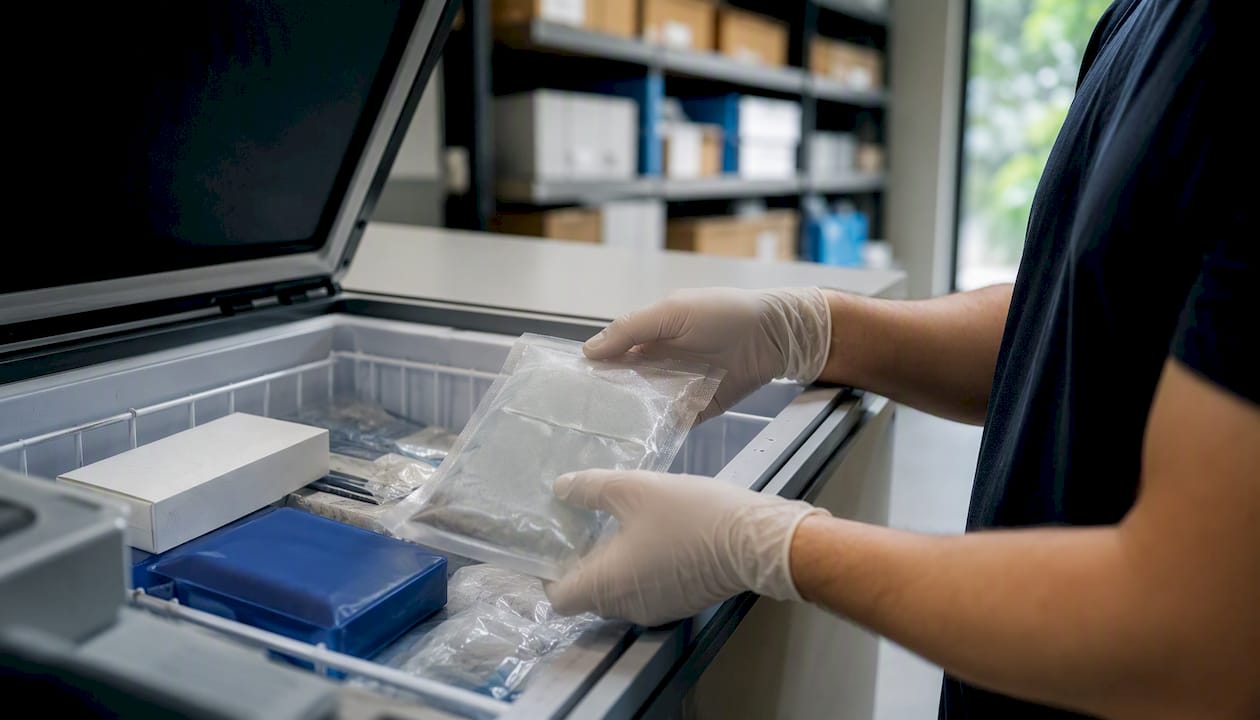
Medical and controlled items. Staff-only handling from intake to handoff. Require resident ID verification at pickup. Log every touch in the chain-of-custody record. Notify the resident immediately on arrival.
Dry cleaning and nonstandard items. Assign a separate labeled zone. Include carrier placement instructions on the zone signage so drivers know exactly where to leave garment bags. Residents pick up from that zone only.
Oversized packages. Stage near the entrance in a designated zone with a dolly or cart available. Define “oversized” in your SOP (anything over 36 inches on one side is a common threshold). If the overflow zone fills, escalate to a pre-approved secondary staging area before blocking the corridor.
Labeling checklist for every special item:
- Unit number and recipient contact
- Special-handling note (refrigerated, fragile, medical)
- Date and time of intake
- Staff initials
Pro Tip: Print a laminated “Special Handling” card in three colors: blue for refrigerated, red for medical, yellow for oversized. Attach it to the package on intake. Staff and residents both know at a glance what they are dealing with.
Package room vs. smart lockers vs. hybrid: which model fits your property?
The right model depends on your unit count, package mix, and peak-season volume, not on which option looks best in a brochure.
Package rooms cost significantly less to install than locker banks, handle oversized and perishable items without fixed-compartment limits, and are the practical default for most properties. Open-shelving systems can hold roughly 2–3x more packages per linear foot than lockers, which matters enormously during a holiday surge.
Lockers win on per-package auditability and 24/7 self-service without staff. Every compartment is a discrete, logged transaction. The tradeoff: a 36-inch box will not fit, and perishables need a separate cold solution regardless.
Hybrid setups, a monitored room plus a locker bank, are the recommended configuration for properties over roughly 200 units. Lockers handle the daily commodity flow; the room absorbs oversized, refrigerated, and overflow volume.
Capacity planning rules:
- Plan for 2–3x normal daily volume during November and December.
- Reserve overflow space that can absorb 2–3 days of peak intake without spilling into corridors.
- For high-rise properties, prioritize spatial efficiency: vertical shelving and labeled zones beat floor-stacked boxes every time.
Decision triggers:
- Under 100 units with low oversized volume: lockers alone may suffice.
- High oversized or perishable share: package room is the better fit.
- 200+ units with mixed needs: go hybrid.
What technology does a secure package room actually need?
Access control and automation are not optional extras. Advisory council findings show carrier non-compliance is the most common cause of package system failures, and technology that cannot detect driver bypass behavior is not solving the real problem.
Access methods. Time-limited PINs and carrier QR codes are the baseline. Mobile credentials add a layer of auditability. Video intercoms let staff verify identity remotely. Shared physical keys are an audit-trail dead end.
Notification cadence. Arrived notice on logging. 48-hour reminder if uncollected. 96-hour final notice before the return-to-sender clock starts. Keep message text short: package carrier, unit number, pickup instructions, and a direct link to access hours.
Cameras and presence sensors. Cameras deter theft and provide footage for incident review. Presence sensors can trigger an alert when a carrier enters without scanning, which is exactly the driver bypass behavior that breaks data integrity. Package theft estimates reached 58 million incidents in 2024, making cameras a straightforward liability tool, not a luxury.
Integration checklist before you buy anything:
- Confirm internet connectivity and PoE availability in the package room.
- Verify API compatibility between your locker software and property management system.
- Test network segmentation so the package room does not share a subnet with resident Wi-Fi.
Pro Tip: Ask every technology vendor one question before signing: “How does your system detect when a driver bypasses the intake workflow?” If they cannot answer specifically, the system will not hold up during peak season.
Staffing, SOPs, and documentation that protect your operation
The staffing model you choose determines how much liability you carry and how many leasing hours you recover.
A full-time on-site Package Manager is the highest-coverage option. Part-time attendants work for lower-volume properties. Contracted on-site management through a service like Postal Solutions’ On-Site Package Room Management removes the hiring, training, and scheduling burden entirely while keeping a daily physical presence on-site.
Sample driver intake SOP:
- Enter via QR/PIN at the designated staging entrance.
- Place packages on the intake counter, labels facing up.
- Do not place packages in resident corridors or lobbies.
- Scan or photograph each label before leaving.
- Oversized items go to the marked staging zone, not the main room.
Documentation requirements. Maintain a signed waiver of acceptance for any package received with visible damage. Log every incident (missing item, damaged package, carrier non-compliance) in a weekly incident report. Run a weekly inventory and dwell-time audit; share a monthly summary with asset managers.
Audit schedule:
- Daily: intake count vs. logged count reconciliation.
- Weekly: dwell-time report flagging any package over 48 hours.
- Monthly: incident summary and carrier compliance review.
Pro Tip: Keep staff present when residents sign for pickups. It protects your team from “I never got it” disputes and creates a second data point in the chain-of-custody log.
Holiday and peak-season playbook for November and December
Holiday months can account for nearly 20% of annual package volume. That is not a surprise you manage in real time; it is a predictable surge you plan for in September.
Pre-peak checklist:
- Inventory supplies: labels, carts, dollies, bin liners for refrigerated zone.
- Reserve overflow space and confirm it is clear by October 31.
- Test carrier QR/PIN credentials and update expired codes.
- Set temporary pickup windows and publish them to residents two weeks early.
- Brief any temp runner staff on the driver intake SOP.
During-peak tactics. Convert an underused amenity or utility room to temporary package staging. Add a dedicated runner shift during carrier rush hours (typically 10 AM–2 PM) to move packages from the intake counter into lockers or shelving before the next wave arrives. A single temp runner shift during carrier rush hours often prevents the need for incremental full-time headcount.
Post-peak cleanup. Reconcile logs against physical inventory. Reclaim overflow space by January 7. Update your capacity assumptions for next year based on actual peak-day volume.
| Timeline | Task |
|---|---|
| 6 weeks out | Reserve overflow space, audit carrier credentials |
| 3 weeks out | Brief staff, publish resident pickup windows |
| 1 week out | Stock supplies, confirm temp runner schedule |
| Peak week | Daily log reconciliation, enforce 48-hr pickup policy |
What does special deliveries management actually cost, and what can it earn?
Cost drivers:
- Hardware: locker banks run significantly higher upfront than open-shelving rooms.
- Software and subscriptions: notification platforms, access control, and audit tools.
- Staff labor: the largest ongoing line item for most properties.
- Refrigerated bins: low unit cost, high operational value.
- Maintenance: lock hardware, camera systems, and shelving.
Staffing economics. A leasing agent spending two hours a day on packages loses roughly 10 hours a week that could go to tours and renewals. A managed on-site service converts that cost into a fixed, predictable fee and typically recovers more leasing hours than the fee costs in lost productivity.
Simple ROI illustration. If a leasing agent earns $22/hour and spends 10 hours weekly on packages, that is $220/week in redirected labor, or roughly $940/month. A managed on-site service at a comparable monthly fee pays for itself before the first renewal it helps close.
Ancillary income options:
- Resident amenity fee for package room access (common in student housing).
- Premium handling fee for refrigerated or oversized items.
- Vendor partnerships with dry-cleaning or meal-kit services for preferred delivery access.
How do you evaluate a package room management partner?
Selection checklist:
- Capacity fit for your unit count and daily volume.
- Carrier compliance tooling: how does the vendor detect driver bypass?
- Audit and logging features: chain-of-custody records, weekly reports.
- Cold-storage handling: refrigerated bin policy and escalation path.
- Overflow plan: defined secondary staging, not improvised.
- 24/7 resident access capability without requiring staff presence.
Vendor questionnaire (ask every bidder):
- How do you detect and respond to carrier non-compliance at intake?
- What is your incident resolution SLA for a missing or damaged package?
- Which property management systems does your platform integrate with?
- What training do you provide to on-site staff and carriers?
- Who is responsible for hardware maintenance and what is the response time?
- How do you handle refrigerated and oversized items outside standard hours?
- What does your weekly audit report include, and who receives it?
Advisory council research identifies carrier non-compliance detection as the single most important differentiator between package management vendors. A vendor who cannot answer question one specifically is not ready for your property.
Postal Solutions’ On-Site Package Room Management checks every item on that list: a daily on-site Package Manager, weekly audits, chain-of-custody logging, refrigerated handling, and 25 years of operational experience across apartment and student housing communities. For properties that want to get leasing staff out of the package business permanently, it is the managed option worth evaluating first.
What running a package operation at scale actually looks like
The properties that handle special deliveries well share one habit: they treat the package room like a leasing amenity, not a back-office chore. Daily routines matter more than technology. A Package Manager who shows up every morning, reconciles the overnight intake, flags the 48-hour stragglers, and briefs the first carrier of the day creates a rhythm that technology alone cannot replicate.
During a holiday surge, the difference between a property that holds together and one that collapses into lobby chaos usually comes down to one decision made six weeks earlier: did someone reserve the overflow space and schedule the temp runner shift, or did they assume last year’s setup would hold? It never does.
Fewer resident complaints, faster leasing tours, and reclaimed staff hours are measurable outcomes, not aspirational ones. Postal Solutions brings 25-plus years of on-site package room experience to that daily routine, and the operational difference shows up in the numbers within the first month.
Postal Solutions handles what your leasing team should not
Postal Solutions’ On-Site Package Room Management puts a dedicated Package Manager at your property up to six days a week: receiving, logging, sorting, and handling refrigerated and oversized items so your leasing staff never touch a box. With 25-plus years of operational experience, weekly audits, and full chain-of-custody documentation built in, the service covers every stage of the workflow this guide describes, including cold-storage handling and holiday surge coverage.
Properties that contract with Postal Solutions typically recover 10-plus leasing hours per week and can structure the service as a resident amenity fee, turning a cost center into ancillary income. Download the free Package Room Management guide to see the full operational checklist, or contact Postal Solutions to schedule a site assessment and get a cost estimate tailored to your unit count and package mix.
Sources
- Package Management (NAAHQ guidance)
- Boxes to Competitive Edge: Best Practices for Multifamily Package Management
- A Framework for Solving Multifamily’s Package Management Problem | Insights by Blueprint
- How To Set Up A Package Room In 2026 | Swiftlane
- Guide to Improving Mail Room Service | Smart Package Room
FAQ
What is the recommended pickup dwell-time target for multifamily package rooms?
The standard target is under 48 hours. Send an arrival notice immediately on logging, a reminder at 48 hours, and a final notice at 96 hours before initiating the return-to-sender process.
How should property managers handle refrigerated deliveries?
Move refrigerated items to a cold bin within 15 minutes of arrival, log the intake condition, and notify the resident immediately rather than waiting for the standard notification cadence. A 24–48-hour hold limit before disposal is a common policy.
When does a hybrid package room and locker setup make sense?
Hybrid configurations are recommended for properties over roughly 200 units. Lockers handle standard daily volume with 24/7 self-service; the monitored room absorbs oversized, refrigerated, and overflow packages that lockers cannot accommodate.
How do you prevent carrier non-compliance from breaking the intake workflow?
Issue time-limited QR or PIN credentials per carrier route, post pictorial SOPs at the staging entrance, and use cameras or presence sensors to flag entries without a corresponding scan. Evaluating vendors on their carrier non-compliance detection is the single most important step before purchasing any package management technology.
Can a package room generate ancillary income for a multifamily property?
Yes. Many communities charge a resident amenity fee for package room access, add premium handling fees for refrigerated or oversized items, and pursue vendor partnerships with meal-kit or dry-cleaning services for preferred delivery access.
Recommended
Ready when you are
Fix your package room — start with a free proposal
Daily on-site Package Manager, resident text & email pings*, and a tour-ready amenity. Tell us your unit count and we'll send a right-sized proposal — usually within one business day.
- ✓ 10–20+ hours back every week
- ✓ Works with any locker system
- ✓ Faster, friction-free resident pickup
- ✓ An easy ancillary income addition