
September 30, 2026
25 Years' Insight: Price Multifamily Package Rooms by Measured Hours
Use NMHC benchmarks and a labor audit to convert measured staff hours and package volume into defensible package room pricing for multifamily.

Package room pricing refers to the fees charged for on-site package room management services, and quotes typically fall into five models: per-unit per month, per-property flat fee, per-package or transaction, resident subscription, and hybrid arrangements that blend a base fee with usage charges. The right model depends on package volume, exception rates, and whether labor, software, hardware, or peak surcharges are bundled in.
TL;DR:
- Per-unit per month pricing may undercharge high-volume properties, making a labor audit essential to accurately reflect staffing needs.
- Flat fee models work best for properties with high exception rates, such as oversized or refrigerated deliveries, when staffing needs are stable.
- Low-volume sites benefit from per-package or transaction-based pricing, while resident subscriptions can help offset management costs if residents value guaranteed pickup.
- Hardware, software, and future upgrades typically incur additional costs outside the base management fee, so detailed budgeting is necessary.
- Contracts should include clear details on service scope, fees, escalation clauses, and technology choices, with vendor input based on measured property data.
Table of Contents
- Which pricing model fits your property?
- Building a site-specific quote: labor audit and RFP checklist
- What your contract should cover, and what it often leaves out
- Turning your audit into a monthly cost estimate
- Outsourcing versus in-house staff versus lockers alone
- Total cost of ownership beyond the monthly fee
- Typical contract length and how pricing escalates over time
- How technology choices change the price
- Pricing for growth: what scale does to your rate
- Setup fees and hardware deposits to expect
- What 25 years of on-site package management has taught us
- Get a pricing estimate built on your own numbers
- Sources
- FAQ
Which pricing model fits your property?
Each pricing model shifts risk differently between you and the vendor. A per-unit per month rate is the most common structure for portfolio budgeting because it scales predictably as unit count changes, though it can undercharge properties with high package volume relative to unit count. A per-property flat fee works best when staffing needs are stable and exception volume is high, since the vendor absorbs the cost of extra handling rather than passing it through line by line.
Per-package or transaction pricing suits low-volume properties, such as smaller communities or those with limited delivery traffic, where a flat monthly fee would overpay for the actual work performed. Resident subscription models charge residents directly for premium access to the package room or locker system, and this fee can offset part of the owner’s monthly cost, effectively lowering the net price of the service. Hybrid models combine a base management fee with variable charges for oversized items, refrigerated deliveries, or peak-season surges.
- Per-unit/month: predictable for budgeting, but may not reflect actual labor if package volume runs high.
- Per-property flat fee: best for high-exception properties where oversized or refrigerated handling is frequent.
- Per-package/transaction: fits low-volume or seasonal properties where a flat fee would overpay.
- Resident subscription: shifts part of the cost to residents who value guaranteed pickup access.
- Hybrid: blends a base fee with surcharges for peak periods or unusual handling needs.
The Resident subscription model, when structured as an amenity fee, can turn what used to be a pure cost center into a line item that partially pays for itself.
Building a site-specific quote: labor audit and RFP checklist
A defensible quote starts with measured data, not assumptions based on unit count. NMHC’s 2018 package delivery survey found that staff at 68% of properties spent between one and four hours a week on package handling, with smaller shares reporting far more. That range shows why a rule-of-thumb formula tied only to unit count misses the real labor picture at your property.
- Count staff touches over a representative two-week period, including sorting, shelving, notifications, and resident hand-offs.
- Log package volume by day, flagging peak days such as Mondays after weekend deliveries or the week before major holidays.
- Record oversized and refrigerated item counts separately, since these drive most exception handling.
- Note carrier access issues, such as gate codes or delivery windows that slow drop-off.
- Audit existing hardware and space, including locker bank capacity, shelving, and room square footage.
Once you have this data, build an RFP checklist that asks vendors to specify required service days, whether staffing is dedicated or shared across properties, how holidays and exceptions are handled, whether software or reporting carries a separate fee, and how often audits occur after onboarding.
Pro Tip: Ask any vendor to walk through their pricing using your measured hours and volume, not a generic per-unit formula, before you compare quotes side by side.
What your contract should cover, and what it often leaves out
A well-scoped contract spells out inclusions clearly so nothing gets billed as a surprise later. Standard inclusions typically cover staffing hours, resident text and e-mail notifications, chain-of-custody logging, weekly audits, and basic supplies like shelving labels or scan equipment.
Exclusions are where effective price often diverges from the headline rate. Watch for these add-ons before signing:
- Hardware purchase or lease, which is frequently billed separately from the management fee.
- Software subscription fees for locker or notification systems, sometimes charged per unit per month.
- Peak or holiday surcharges during high-volume weeks like late November through December.
- Oversized or refrigerated item fees, since these require extra space and handling time.
- Onboarding or setup fees covering initial training and system integration.
Ask for specific service-level language on response times, audit frequency, staff training standards, and insurance coverage. Vague phrases like “as-needed” charges or undefined exception handling are red flags. A properly scoped package room management agreement should name every fee category up front, not leave room for interpretation later.
Turning your audit into a monthly cost estimate
Start by converting measured staff hours into a wage-burdened in-house cost: multiply weekly hours by an hourly wage plus payroll burden, then compare that figure to an outsourced base fee covering the same scope.
A community measuring 3 hours per week of package handling falls within the range that 68% of properties reported, a useful cross-check against a vendor’s proposed staffing hours for a similarly sized property. If a vendor proposes significantly fewer hours than your audit shows, ask what is being cut.
Three illustrative scenarios show how inputs translate into budget lines:
Small, low-volume property: say daily volume averages 15 packages, staff time runs about 1.5 hours a day, and the property has no oversized or refrigerated traffic. A per-package or low flat-fee model likely fits best here.
Medium hybrid property: say daily volume runs 40 packages with occasional oversized items during holiday weeks. A base fee plus a peak surcharge clause covers routine work while pricing in the seasonal spike separately.
High-volume flat-fee property: say daily volume exceeds 100 packages with regular refrigerated deliveries. A flat monthly fee that bundles exception handling avoids a growing list of add-on charges.
If residents pay a monthly amenity fee for guaranteed pickup access, that revenue can be netted against the management fee, lowering the effective monthly cost to the owner without changing the contracted rate itself.

Outsourcing versus in-house staff versus lockers alone
The right choice depends on how much of your package volume is routine versus exceptional. Lockers and software reduce handling for standard-sized packages but leave oversized items, refrigerated deliveries, and holiday surges unresolved, since hardware alone does not process an exception. A dedicated on-site manager absorbs that overflow directly.
At the portfolio level, a single managed provider across properties simplifies budgeting and vendor relationships compared to negotiating separate hardware and staffing contracts at each site. Beyond dollars, weigh non-monetary factors: time recovered for leasing staff, resident satisfaction with pickup reliability, and whether the package room becomes a visible leasing amenity prospects notice on tours.

Total cost of ownership beyond the monthly fee
The quoted monthly rate is only part of what a package room actually costs over its contract life. Installation costs for locker banks or room build-outs are typically separate from ongoing management fees, and an example cited in industry discussion put a 7-foot by 7-foot locker bank at roughly $18,000, plus software fees of up to about $2 per unit per month.
Maintenance is the next layer: locker hardware needs periodic repair, firmware updates, and occasional part replacement, all of which can appear as separate line items if not addressed in the initial contract. Ask whether maintenance is included in the management fee or billed as incurred.
Upgrade fees are the piece most often missed during initial budgeting. If a property later adds locker capacity, integrates a new notification system, or expands refrigerated storage, those changes typically carry their own cost outside the base contract. Before signing, ask vendors to state clearly whether maintenance, firmware updates, and future hardware upgrades are covered under the existing fee or billed separately, since the answer changes the real multi-year cost of the service far more than the headline monthly rate suggests.
Typical contract length and how pricing escalates over time
Package room management contracts commonly run one to three years, with automatic renewal clauses unless either party gives notice within a specified window. Shorter terms give you flexibility to renegotiate as package volume changes, while longer terms sometimes come with a modestly lower starting rate in exchange for commitment.
Escalation clauses matter more than the initial rate in a multi-year agreement. Ask whether the contract ties annual increases to a fixed percentage, a published cost-of-living index, or vendor discretion. A fixed percentage cap, even a few points a year, is easier to budget against than an open-ended escalation clause with no ceiling.
Also confirm what triggers a rate change outside the normal renewal cycle: a jump in package volume, added service days, or an expanded scope like refrigerated handling. Contracts should specify how volume growth is measured and at what threshold a rate adjustment kicks in, so you are not renegotiating from scratch every time deliveries increase.
How technology choices change the price
The technology mix you choose shapes both the upfront and ongoing cost structure. NMHC’s 2022 technology benchmarking report shows that properties commonly run a mix of software, physical lockers or rooms, and multiple solutions layered together rather than relying on a single system.
Smart lockers carry higher upfront hardware costs and a recurring software fee, often billed per unit per month, but they can reduce the routine handling time staff spend on standard-sized packages. Manual systems, meaning a staffed package room without electronic lockers, avoid that software fee entirely but depend more heavily on labor hours to sort, log, and hand off deliveries.
Neither approach eliminates the need for a person to manage exceptions. A locker-only system still requires someone to handle oversized items that will not fit a locker bank, refrigerated deliveries, and holiday surges when volume outpaces available compartments. When comparing quotes, ask whether the vendor’s price already assumes a certain percentage of packages will bypass the lockers and require manual handling, since that assumption directly affects the labor hours built into the fee.
Pricing for growth: what scale does to your rate
A pricing model that works today may not hold up as package volume grows. Per-unit per month pricing scales in a straightforward way as your unit count changes, but package volume per unit can rise independently of occupancy, particularly as e-commerce delivery habits shift, and a flat per-unit rate does not always capture that growth.
Before locking in a multi-year rate, ask how the vendor handles volume growth that outpaces the original labor audit. Some contracts include a built-in review point, such as an annual volume check, that triggers a rate conversation if package counts rise past an agreed threshold. Others leave the base rate fixed regardless of volume changes, which can undercharge the vendor and create friction later, or overcharge you if volume actually declines.
Portfolio-level operators should also ask whether pricing can flex across properties as some communities grow faster than others. A single managed provider serving multiple properties in a portfolio is often better positioned to reallocate staffing across sites as volume shifts, compared to site-by-site contracts that each need separate renegotiation.
Setup fees and hardware deposits to expect
Most package room contracts include a one-time onboarding or setup fee separate from the recurring management charge. This typically covers initial staff training, integration with existing notification systems, and setting up chain-of-custody logging procedures specific to your property.
If the contract includes hardware, whether purchased, leased, or provided as part of a bundled arrangement, expect a separate cost structure for that equipment. Some vendors require a deposit against locker hardware to cover potential damage or early contract termination, distinct from the monthly service fee. Ask specifically whether a deposit is refundable at contract end and under what conditions it would be withheld.
Because setup and hardware costs vary by property size, existing infrastructure, and scope of service, request an itemized breakdown rather than a single bundled number. That breakdown lets you compare the true first-year cost, not just the ongoing monthly rate, across competing quotes.
What 25 years of on-site package management has taught us
A company with many years of experience has spent decades managing on-site package rooms for apartment and student housing communities. A dedicated on-site Package Manager, working your community up to six days a week, absorbs the exception handling, oversized items, and peak surges that drive most hidden costs in a pricing model built only around unit count or package volume.
— Postal Solutions
Get a pricing estimate built on your own numbers
A quote based on your actual staff hours and package volume beats a generic per-unit rate every time, and that is exactly what a labor audit gives you before you sign anything.
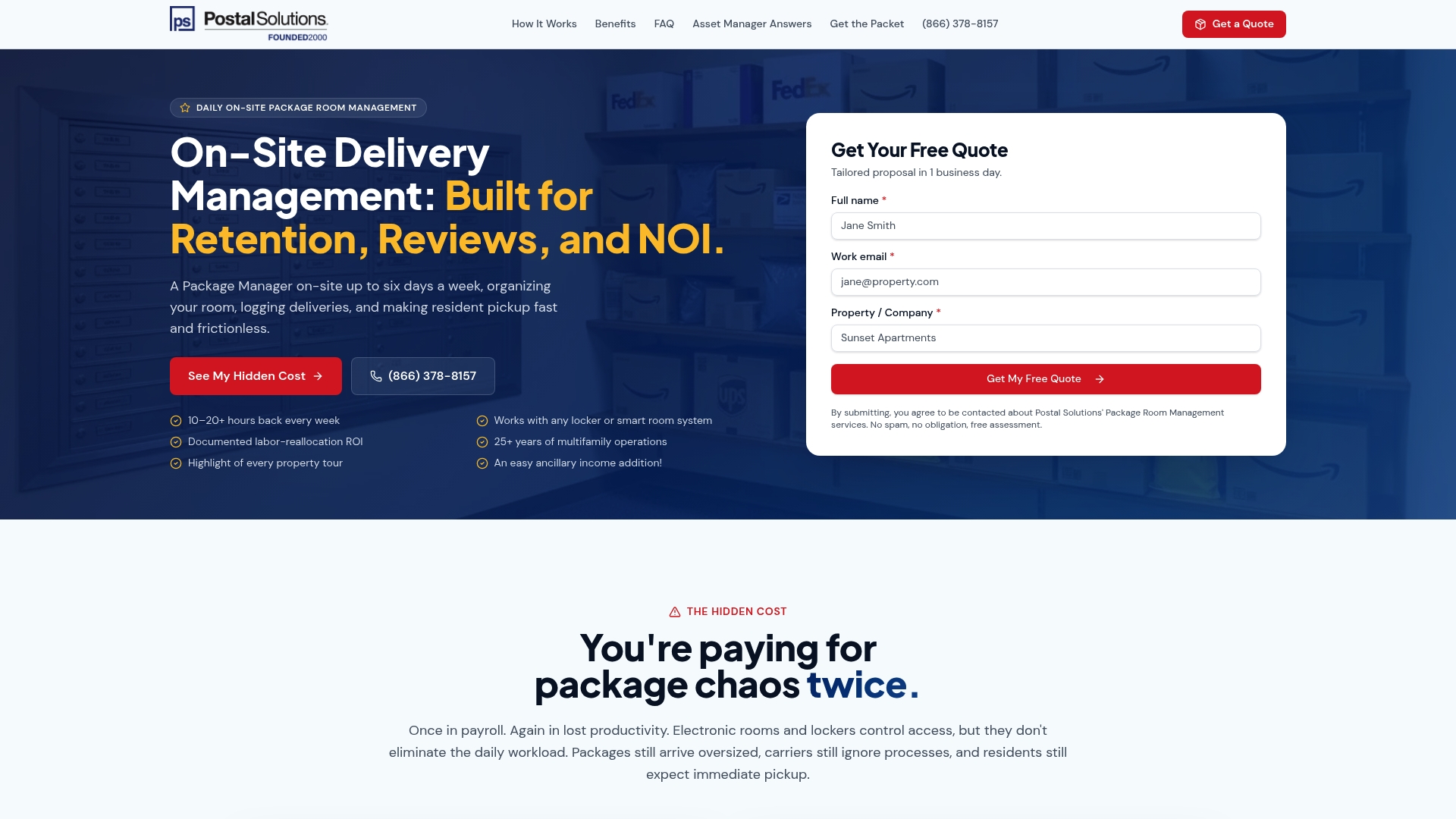
On-Site Package Room Management services can be structured around a labor audit process, so the fee quoted reflects a property’s real volume and exception rate, not a portfolio average. Request a tailored estimate and you get:
- A staffing recommendation based on your measured package volume and peak periods.
- A clear breakdown of what’s included versus billed separately, so there are no surprise line items later.
- A look at whether a resident subscription model could offset part of your monthly cost.
Visit the Postal Solutions service page to request a pricing estimate, or check the FAQ for details on onboarding and contract scope before you talk to a vendor.
FAQ
What is package room pricing?
Package room pricing refers to the fees charged for on-site package room management, covering staffing, resident notifications, and handling of standard and exception deliveries. Common models include per-unit per month, per-property flat fee, per-package, resident subscription, and hybrid structures that combine a base fee with surcharges.
How do I calculate a fair rate for my property?
The most reliable method is a labor audit that measures actual staff hours, package volume by day, and oversized or refrigerated item counts, cross-checked against benchmarks like NMHC’s 2018 survey showing most properties spend one to four hours a week on package work. Ask any vendor to price against your measured data rather than a generic per-unit formula.
Can resident fees offset the cost of package room management?
Yes, some properties structure package pickup as a paid resident amenity, and Postal Solutions’ Resident subscription option runs $5 to $15 a month, which can net against the owner’s monthly management fee. The exact offset depends on resident adoption of the paid tier.
Does locker hardware cost less than a managed on-site service?
Hardware alone often costs less upfront but does not resolve oversized items, refrigerated deliveries, or holiday surges, which industry examples show can require significant added handling capacity beyond what a locker bank provides. A managed on-site service absorbs those exceptions as part of the contracted fee rather than as a separate cost each time they occur.
What should I ask for in a package room management RFP?
Request specifics on required service days, whether staffing is dedicated or shared, how peak periods and exceptions are handled, whether software or reporting carries a separate fee, and how often audits occur. A vendor unwilling to itemize these terms in writing is a sign to keep comparing options.
Recommended
Ready when you are
Fix your package room — start with a free proposal
Daily on-site Package Manager, resident text & email pings*, and a tour-ready amenity. Tell us your unit count and we'll send a right-sized proposal — usually within one business day.
- ✓ 16–30 hours back every week
- ✓ Works with any locker system
- ✓ Faster, friction-free resident pickup
- ✓ An easy ancillary income addition