
August 19, 2026
Are Package Fees Legal for Multifamily Properties?
Discover whether package fees are legal for multifamily properties. Understand the requirements to avoid legal issues and ensure compliance.

Package fees are legal in most U.S. apartment communities, but only when three conditions line up: state and local law allows it, the fee is disclosed and consented to in the lease or a signed addendum, and the property keeps auditable records proving the charge is reasonable and tied to a real cost. Miss any one of those three, and a fee that looked fine on paper turns into a fair housing complaint, a small-claims judgment, or a renewal you lose over $5 a month.
That’s the whole legal question in one sentence. Everything else is execution.
- State/local law check. Some cities and states regulate rental fee practices directly; others leave it to general contract law.
- Lease disclosure and consent. A fee that changes lease terms mid-term without signed consent is far weaker legally than one disclosed at move-in.
- Auditable policy and notice. Time-stamped records showing what was charged, when, and why are what actually holds up in a dispute.
The strongest package-fee policies aren’t the cheapest ones or the most generous ones. They’re the ones with a paper trail.
This is general information, not legal advice specific to your property or market. Talk to local counsel before you change lease terms, and check HUD fair housing guidance and your municipal code before rolling out any fee portfolio-wide.
Key Takeaways
Package fees hold up legally when they’re allowed under state and local law, disclosed through signed lease terms, and backed by time-stamped, auditable records.
| Point | Details |
|---|---|
| Legal permissibility varies by location | Check state landlord-tenant statutes and city consumer-protection ordinances before pricing any fee. |
| Consent beats unilateral changes | Mid-lease fees need signed addenda; move-in disclosure is the safer path. |
| Recordkeeping is the real defense | Time-stamped acceptance, notification, and pickup logs matter more than the fee amount itself. |
| Recurring fees draw more pushback | Only 9% of residents favor paid monthly subscriptions, versus 76% who accept lockers generally. |
| Managed service reduces enforcement risk | Postal Solutions’ On-Site Package Room Management provides the auditable logs and daily staffing that make resident fees defensible. |
Where to Verify Local Package-Fee Rules
- The Federal Register’s rule on unfair or deceptive rental housing fee practices
- NAA’s package acceptance management guidance
- NMHC’s package delivery research report
Always confirm binding rules with local counsel before finalizing any fee policy.
This article is general information, not a substitute for advice from a qualified lawyer. Consult a qualified legal professional about your own circumstances before acting on anything here.
Table of Contents
- What Determines Whether a Package Fee Is Legal Where You Operate?
- How Do You Build a Legally Defensible Package-Fee Policy?
- What Fee Models Do U.S. Multifamily Properties Actually Use?
- Do Fair Housing and ADA Rules Affect Package Fees?
- What Happens When Residents Push Back on Package Fees?
- Should You Charge Residents, Absorb the Cost, or Bring in a Manager?
- What I’ve Learned Running Compliant Package Programs
- How Postal Solutions Makes Package Fees Safer to Charge
- Sources
- FAQ
What Determines Whether a Package Fee Is Legal Where You Operate?
There’s no single federal law that says “package fees are legal” or “package fees are banned.” Permissibility runs through three layers: what your state’s landlord-tenant statute allows, what your city’s consumer-protection ordinance says about fee disclosure, and what your own lease actually authorizes. Some states and municipalities have started scrutinizing rental fee practices more closely, and the Federal Register’s 2026 rule on unfair or deceptive rental housing fee practices signals that regulators are paying closer attention to fee transparency, including how fees get disclosed and enforced.
The contract layer matters just as much as the statutory one. If a fee changes an existing lease term, most states require tenant consent or a newly executed addendum before it takes effect. Rolling out a $5 monthly locker fee to residents six months into a twelve-month lease, with a memo taped to the mailroom door, is the kind of move that gets challenged. Legal-practice guidance on this exact issue is blunt: fees need to be contractually disclosed and demonstrably reasonable, and unilateral mid-lease changes carry real legal risk.
Before you draft anything, check these four sources in order:
- Your state’s landlord-tenant statute (search “[state] residential landlord tenant act fees”)
- Your city’s consumer-protection ordinance or municipal code on rental fees
- Your own lease form’s amendment and fee-disclosure clauses
- Any local rent-control or fee-cap rules that apply to your specific property type
Pro Tip: Call your city’s consumer protection office or housing department directly and ask, in writing, whether ancillary amenity fees for package handling are treated differently from rent. Save the response. Regulators change interpretations, and a dated email from the department that enforces the rule is worth more than any blog post, including this one.
How Do You Build a Legally Defensible Package-Fee Policy?
A defensible policy isn’t about picking the right price. It’s about building a paper trail that survives a complaint. Here’s the sequence:
- Run the legal check first. Confirm state, city, and lease-level rules before you price anything.
- Draft the clause or addendum. Spell out the fee amount, what it covers, and how residents get notified.
- Set the fee type and grace period. Decide if it’s per-package, monthly, or overage-based, and give residents a buffer before charges kick in.
- Notify residents twice. Once at move-in through the lease, and again through a signed addendum if you’re adding the fee to existing residents.
- Track everything with time stamps. Acceptance, notification, grace-period expiration, and pickup all need a logged timestamp.
- Enforce consistently. Document every exception you grant, because inconsistent enforcement is what turns one complaint into a pattern-of-practice claim.
The recordkeeping step is where most policies fall apart, usually because they were never built to survive a dispute in the first place.
| What to Log | Why It Matters in a Dispute |
|---|---|
| Package acceptance time | Establishes when the clock starts on any grace period or storage fee |
| Resident notification time | Proves the resident was told, not just that a package existed |
| Grace-period expiration | Shows the fee didn’t accrue before the resident had fair warning |
| Pickup time | Confirms how long the package actually sat and what was actually charged |
A sample policy addendum should spell out the fee amount, the grace period, the notification method (SMS, email, or both), a maximum monthly cap, what happens to abandoned packages, and a clear appeals contact. Include an accommodation-request line item too, since that becomes relevant fast in the fair housing section below.
Pro Tip: Manual log books are the weakest possible evidence in a dispute. Time-stamped SMS or email alerts, barcode scans at intake, and locker access logs create the kind of automatic, third-party-verifiable record that actually holds up when a resident disputes a charge. One locker vendor’s revenue guidance confirms that registration and overage fees only work long-term when the tracking behind them is solid. If your current setup can’t produce those logs, a package sorting system built for auditability is worth evaluating before you charge anyone anything.
What Fee Models Do U.S. Multifamily Properties Actually Use?
Operators tend to gravitate toward five structures, and the right one depends more on package volume than on property size.
- Per-package storage fee. A flat charge per delivery, often paired with a grace period before it applies.
- Daily late fee after a grace window. Common structure: $1 per package plus $1.50 per day after 48 hours, according to National Apartment Association reporting.
- Monthly amenity fee for unlimited locker access. Typically runs $3.50 to $5 per month for unlimited pickups.
- Move-in registration fee. A one-time charge, often $20, to activate locker or package-room access.
- Capped free allotment with overage fees. Residents get a set number of free pickups monthly, then pay per package after that.
High-volume urban properties with heavy delivery traffic tend to do better with monthly unlimited-access fees, since per-package charges there just generate complaint volume. Lower-volume suburban communities often do better absorbing costs entirely or charging a small move-in fee instead. One caution worth taking seriously: resident sentiment research on locker amenities found that 76% of residents accept on-site lockers, but only 9% favored a paid monthly subscription model. Recurring fees draw more resistance than one-time or usage-based charges.
Do Fair Housing and ADA Rules Affect Package Fees?
This is the part most fee policies skip entirely, and it’s the part that generates the most expensive complaints. A fee or pickup rule that seems neutral on paper can still create a disparate-impact problem if it disproportionately burdens residents in a protected class, including older residents, residents with disabilities, or households with mobility limitations who rely more heavily on delivered goods.

ADA and reasonable-accommodation obligations layer on top of that. A resident with a disability-related need for grocery delivery, medical supplies, or mobility equipment may need a fee waiver or an alternative pickup arrangement rather than a flat charge applied uniformly. Refusing to consider that request isn’t a pricing decision; it’s a compliance exposure.
Build in these safeguards before you launch anything:
- A documented carve-out process for medically essential deliveries and service-animal-related equipment.
- A clear, written accommodation-request procedure that residents can actually find and use.
- A log of every accommodation request and how it was resolved, kept separate from routine fee records.
- Periodic review of who’s actually paying overage or late fees, to catch disparate-impact patterns early.
Pro Tip: Keep the accommodation-review log even if you never get a single request in your first year. Regulators and plaintiff’s attorneys care less about outcomes than about whether a process existed at all. HUD’s fair housing guidance is the right starting reference here, and it’s worth a policy-level read before your first lease renewal cycle under a new fee.
What Happens When Residents Push Back on Package Fees?
Most enforcement problems trace back to the same handful of triggers: a resident says they never got notice, a resident calls the fee excessive, or the fee got added mid-lease without consent. Each of those is preventable, and each is exactly why the recordkeeping matters more than the pricing.
- Keep grace periods generous enough that “I didn’t see the notice” rarely holds up.
- Cap fees at a level that won’t read as punitive if a resident or regulator ever reviews them.
- Give residents a real appeal channel, not just a suggestion box.
- Document carrier interactions too. Unclear carrier-access rules generate their own disputes, separate from resident billing.
Unresolved disputes escalate through local housing department complaints, small-claims suits, or in jurisdictions with fee caps, regulatory fines. Beyond the legal exposure, a resident who feels nickel-and-dimed over packages is a resident who doesn’t renew. That’s often the more expensive outcome.
Should You Charge Residents, Absorb the Cost, or Bring in a Manager?
Three paths exist, and they’re not equally risky. You can absorb the cost entirely and treat package handling as a standard operating expense. You can fold it into rent as a building amenity with no separate line item. Or you can charge residents directly, which is where every compliance requirement above kicks in.
- Absorb the cost: Zero legal exposure on fee disputes, but no cost recovery and no separate revenue line.
- Build into rent: Simple to communicate, avoids fee-disclosure fights, but loses the ancillary income opportunity entirely.
- Resident-billed fee: Highest revenue potential, but only as safe as your recordkeeping and lease language make it.
A third-party on-site package manager changes the math on that third option. Professional daily staffing produces the chain-of-custody logs that make a fee defensible, takes the enforcement burden off your leasing team, and turns package handling from a liability into a documented, audit-ready operation. NMHC’s research on package delivery operations points to the same cost drivers, package volume, staff time, and delivery policy, that determine whether a fee model or a managed service makes more financial sense for your property.
What I’ve Learned Running Compliant Package Programs
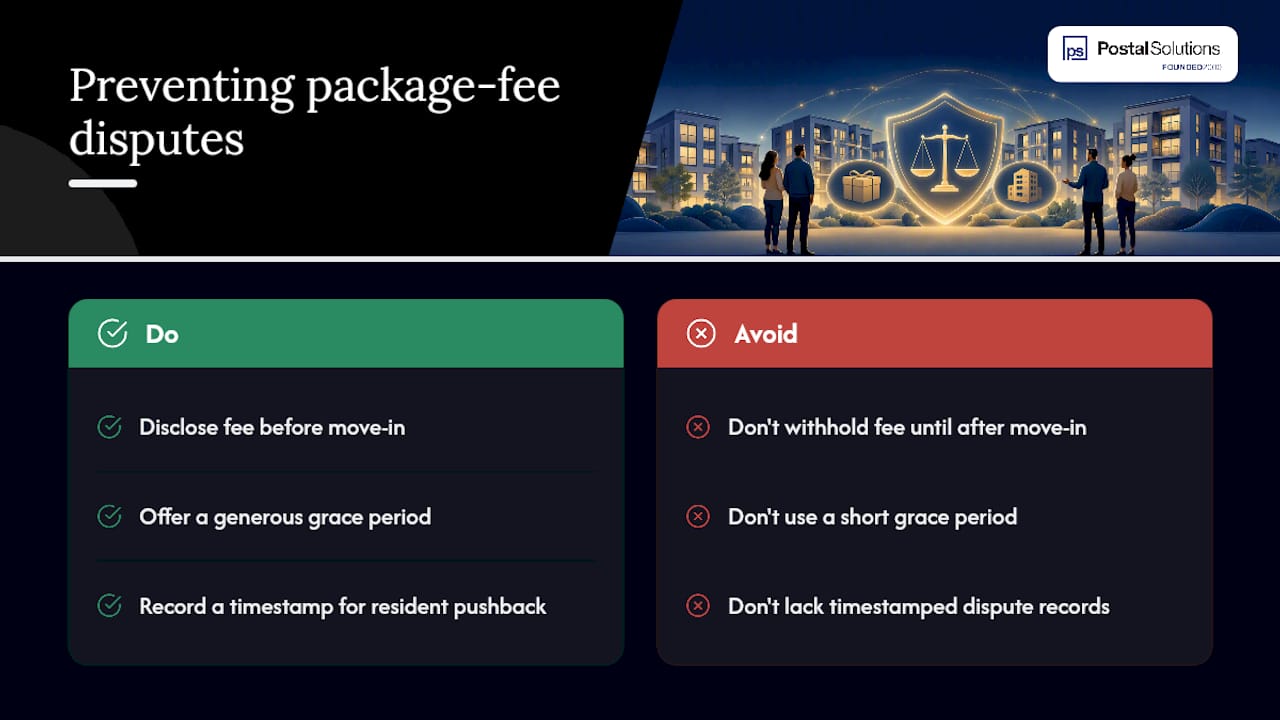
The properties that avoid disputes aren’t the ones with the cheapest fees. They’re the ones that disclosed the fee before move-in, kept the grace period generous, and could produce a timestamp the moment a resident pushed back.
Every property I’ve seen struggle with package fees skipped one of those three. Fix the disclosure and the tracking, and the price itself rarely becomes the fight.
How Postal Solutions Makes Package Fees Safer to Charge
If you’re weighing whether to charge residents at all, the real question isn’t the price point. It’s whether you can produce a clean, time-stamped record the moment someone disputes a charge. Postal Solutions is the difference between a fee policy that survives a complaint and one that doesn’t. Our on-site Package Manager works your community up to six days a week, logging every acceptance, notification, and pickup so you have the chain-of-custody documentation that makes a resident amenity fee defensible instead of risky.
That’s hours back for your leasing team, and it’s the auditable backbone this entire compliance framework depends on. Properties running On-Site Package Room Management get daily acceptance, sorting, weekly audits, and resident notifications handled by someone whose only job is getting packages logged and out the door correctly. Request a free package room management guide to see the policy checklist and operational framework we use with communities across the country, and get a proposal for what compliant, professionally managed package handling looks like at your property.
Sources
- Rule on unfair or deceptive rental housing fee practices
- How to Effectively Manage Package Acceptance
- Communities set up package-delivery programs | National Apartment Association
- Can mailrooms charge residents a fee for uncollected packages?
- NMHC package delivery research report
FAQ
Are Package Fees Legal in Apartment Communities?
Yes, in most jurisdictions, provided the fee is allowed under state and local law, disclosed in the lease or a signed addendum, and backed by auditable records showing the charge is reasonable.
Can a Property Add a Package Fee Mid-Lease?
Only with tenant consent or a newly executed addendum. Unilateral mid-lease fee changes are legally risky and far more likely to be successfully disputed.
What’s a Typical Package Fee Range?
Common models include roughly $1 per package plus $1.50 per day after 48 hours, or a flat $3.50 to $5 monthly fee for unlimited locker access.
Do Fair Housing Rules Apply to Package Fees?
Yes. A fee or pickup policy that disproportionately burdens residents in a protected class can trigger disparate-impact liability, and disability-related delivery needs may require an accommodation or fee waiver.
Is There a Safer Alternative to Charging Residents Directly?
Many operators absorb the cost or use a third-party on-site manager like Postal Solutions, which provides auditable logs and professional staffing that reduce enforcement risk compared to a self-managed resident fee.
Recommended
- Blog — Package Room Management Insights for Multifamily
- Package Security for Multifamily Communities: 2026 Guide — Postal Solutions Blog
- Package Sorting System for Multifamily Properties: Pick the Right Solution — Postal Solutions Blog
- Ancillary Income Property Management: 2026 Guide — Postal Solutions Blog
Ready when you are
Fix your package room — start with a free proposal
Daily on-site Package Manager, resident text & email pings*, and a tour-ready amenity. Tell us your unit count and we'll send a right-sized proposal — usually within one business day.
- ✓ 10–20+ hours back every week
- ✓ Works with any locker system
- ✓ Faster, friction-free resident pickup
- ✓ An easy ancillary income addition