
August 2, 2026
Package Sorting System for Multifamily Properties: Pick the Right Solution
Discover the ideal package sorting system for multifamily properties. Streamline operations, enhance resident satisfaction, and improve efficiency!
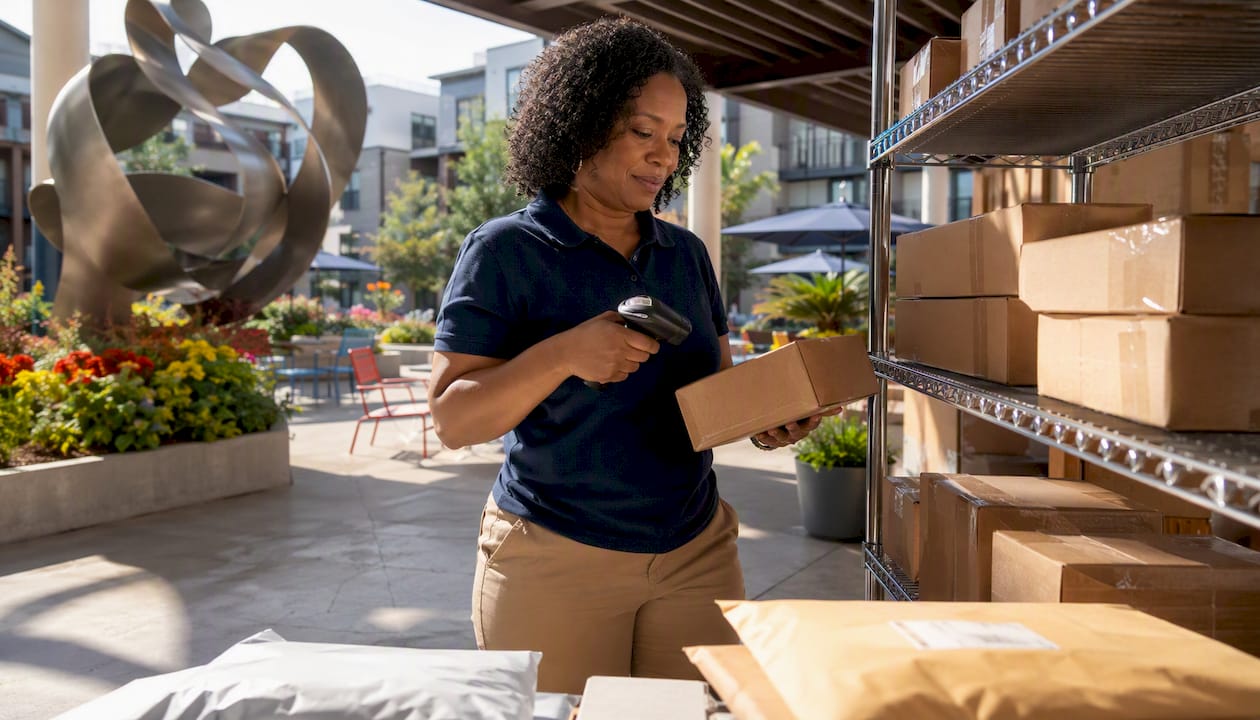
For most multifamily properties, the right package sorting system is an on-site, managed package room with dedicated staffing and integrated chain-of-custody workflows. Hardware alone won’t solve the problem. The properties that get this right pair physical space with process, and they stop asking leasing staff to run a mini logistics operation.
TL;DR:
- Manual package handling can consume 300+ staff hours per year at a mid-size community, hours your leasing team should spend on renewals and tours.
- Resident experience and occupancy both improve when packages are organized, secure, and retrievable at any hour.
- Oversized and overflow packages break every fixed-locker system eventually; a managed room with flexible shelving handles what lockers cannot.
- Carrier non-compliance is the most common failure point. Any system without active driver management will underperform.
For cost breakdowns and an implementation checklist, jump to those sections below.
Table of Contents
- What does a package sorting system actually look like in multifamily?
- How do you choose the right package sorting system for your property?
- What does a package sorting system cost, and what’s the ROI?
- How do you implement a package sorting system step by step?
- What outcomes can you expect from a well-run package room?
- Key Takeaways
- The part most operators get wrong
- Postal Solutions’ on-site package room management
- Useful sources
- FAQ
What does a package sorting system actually look like in multifamily?
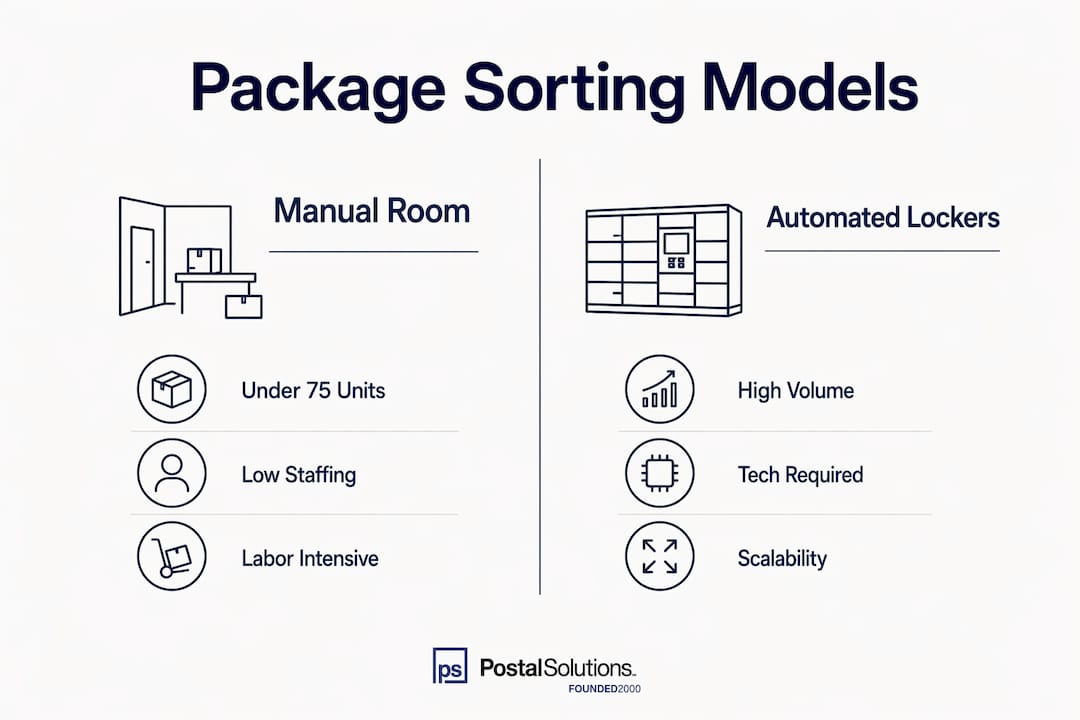
The phrase “package sorting system” covers a wide range of approaches, and the right model depends on your building’s density, staffing, and layout. Below are the five main categories:
- Manual/staffed package room. A dedicated room where leasing staff or a property-assigned person accepts, sorts, and shelves packages. Low capital cost, but every package requires 4–5 staff touches, and the labor adds up fast.
- Parcel bins. Open, numbered cubbies or bins assigned by unit. Simple and cheap, but zero security and no chain-of-custody logging.
- Smart lockers. Carrier-accessible locker banks with automated notifications and PIN/QR pickup. Work well at low-to-mid volume, but fixed compartment sizes create overflow during surges. Shelving-based smart rooms increase storage density over fixed lockers by placing packages adjacent to one another.
- AI-powered smart package rooms. Sensor- and camera-based rooms where carriers deliver independently, software logs every action, and residents retrieve packages 24/7. High upfront cost, but dramatic capacity and efficiency gains at scale.
- Managed on-site service. A third-party provider places a dedicated Package Manager at your property to handle all intake, sorting, logging, and resident notifications using your existing room or locker hardware. No new capital required if infrastructure is already in place.
| Model | Best for | Staffing required | Main trade-off |
|---|---|---|---|
| Manual/staffed room | Under 75 units, low volume | Leasing staff | High labor cost, no scalability |
| Parcel bins | Very small properties | None | No security, no tracking |
| Smart lockers | 150–400 units, moderate volume | Minimal | Overflow during surges, fixed capacity |
| AI-powered smart room | 300+ units, high volume | Minimal on-site | High capex, carrier training required |
| Managed on-site service | Any size with existing hardware | Dedicated Package Manager | Monthly service fee |
Seasonal surges like Black Friday and move-in week expose the limits of fixed locker banks. Properties without a flexible overflow plan end up with packages stacked in the leasing office, which is exactly the outcome every system is supposed to prevent.
How do you choose the right package sorting system for your property?
There is no universal answer. Experts consistently recommend matching the solution to your property’s specific variables rather than defaulting to whatever a vendor is pushing hardest. Work through this checklist before you talk to anyone.
Decision checklist:
- Count your units and estimate daily volume. Under 75 units with low volume? Parcel bins or a basic staffed room may be enough. 150–400 units with growing e-commerce volume? You need a locker bank, a smart room, or a managed service.
- Assess your current staffing model. If leasing staff are already stretched, any system that adds to their workload will fail. A managed service removes them from the equation entirely.
- Measure your available footprint. Fixed lockers need dedicated square footage sized to peak volume, not average volume. A shelving-based room uses space more efficiently.
- Define your security and chain-of-custody requirements. High-rise communities and student housing typically need full logging, timestamped records, and audit trails. Parcel bins offer none of that.
- Check your existing hardware. If you already have a locker system or a dedicated package room, a managed service can layer on top without new capital spend.
- Map your resident access preferences. 24/7 access is now a baseline expectation. Any system that limits pickup to office hours will generate complaints.
Questions to ask every vendor:
- How do you handle carrier non-compliance when a driver bypasses the intake workflow?
- What is your overflow procedure during peak periods?
- Which property management platforms does your software integrate with?
- How is resident data stored, who has access, and what is your breach notification policy?
- What are your SLA terms for response time and issue resolution?
- What does your audit and chain-of-custody reporting look like, and how often do you run it?
Red flags to watch for: vague answers on carrier compliance, no documented audit process, surge plans that amount to “we’ll figure it out,” and pricing that changes significantly after contract signing. A vendor who cannot explain their carrier compliance monitoring in plain terms is a vendor whose system will break down the first time a driver decides to skip the workflow. For a deeper vendor evaluation checklist, the package room reviews guide covers what property managers should verify before signing.
What does a package sorting system cost, and what’s the ROI?
Costs vary significantly by model. Here is a practical breakdown:
- Installation/capex: Smart locker banks typically run several thousand dollars per unit of capacity. AI-powered smart rooms carry higher upfront costs for sensors, cameras, and software licensing. Managed services using existing hardware carry near-zero capex.
- Software/subscription: Most technology-based systems charge a monthly or annual software fee on top of hardware.
- Labor: A managed on-site service charges a monthly fee that covers the Package Manager’s time. Self-managed systems push labor cost onto your existing payroll, often invisibly.
- Maintenance and repairs: Hardware systems require ongoing maintenance contracts. Managed services typically include this in the service agreement.
The ROI case is straightforward once you run the numbers. Manual handling at a mid-size community can consume 300+ staff hours per year. At a fully-burdened leasing associate wage, that is real money sitting in a package room instead of driving renewals. Add reduced resident turnover from a better package experience, fewer complaints, and the potential to structure the service as a paid resident amenity, and the math shifts quickly.
Treating package management as a labor and NOI issue, rather than just an amenity, is what separates operators who recover those hours from ones who keep absorbing the cost.

Pro Tip: Always request a customized labor-cost analysis using your actual unit count and local wage rates before comparing pricing models. A flat monthly fee that looks high in isolation often costs less than the hidden payroll you are already spending.
How do you implement a package sorting system step by step?
A realistic timeline from decision to go-live runs 8–14 weeks for most properties.
- Site assessment (1–2 weeks). Measure available space, document current daily package volume, map carrier entry points, and identify any access control gaps.
- Vendor selection and contract (2–6 weeks). Issue an RFP or request proposals from shortlisted providers. Negotiate SLA terms, audit schedules, and data security provisions before signing.
- Space prep and hardware installation (2–4 weeks). Build out or reconfigure the package room, install any required hardware, and test carrier access workflows.
- Carrier coordination and staff training (1–2 weeks). Brief all regular carriers on the new intake workflow. Train on-site staff or onboard the managed service provider’s Package Manager.
- Pilot week. Run a limited-scope pilot. Track pickup time, staff hours saved, and carrier compliance rate. Define rollback triggers in advance so the team knows when to escalate.
- Go-live and ongoing governance. Launch fully. Schedule weekly chain-of-custody audits for the first 90 days, monthly performance reviews, and quarterly carrier retraining sessions.
Pilot success metrics to track: average resident pickup time, staff hours per week spent on packages, carrier compliance rate (percentage of deliveries following the intake workflow), and resident complaint volume. For resident-facing communication during rollout, the resident package management guide covers notification templates and pickup instructions.
What outcomes can you expect from a well-run package room?
The evidence from real deployments is consistent. At large communities using AI-powered smart rooms, pickup wait times dropped from 30 minutes to seconds, and the staff headcount dedicated to packages shrank from 12 to two. Those are outlier numbers from high-volume deployments, but the directional pattern holds across property sizes.
The NAA has flagged that operators who fail to move from manual handling to software-integrated logistics risk sub-optimized rental revenues and lower property valuations. That is not a warning about amenities. It is a warning about NOI.
| Outcome | What drives it |
|---|---|
| Recovered leasing hours | Removing staff from intake and sorting workflow |
| Faster resident pickup | 24/7 access, organized shelving, automated notifications |
| Fewer lost-package disputes | Chain-of-custody logging and timestamped records |
| Reduced resident turnover | Better package experience tied to renewal satisfaction |
| Ancillary income potential | Structuring service as a paid resident amenity |
For deeper case studies and implementation examples, Postal Solutions publishes a free downloadable guide on package room management for apartments.
Key Takeaways
An on-site managed package room with integrated sorting workflows and dedicated staffing is the most practical choice for most multifamily properties, because it recovers leasing hours, handles overflow, and requires no new capital when hardware already exists.
| Point | Details |
|---|---|
| Match system to property size | No single model fits all; density, volume, and staffing determine the right tier. |
| Hidden labor is the real cost | Mid-size communities can lose 300+ staff hours per year to manual package handling. |
| Carrier compliance is the failure point | Any system without active driver management and compliance monitoring will underperform. |
| Surge planning is non-negotiable | Fixed locker banks overflow during peak periods; flexible shelving or managed overflow is required. |
| Postal Solutions on-site management | Postal Solutions places a dedicated Package Manager at your property, using your existing hardware, up to six days a week. |
The part most operators get wrong
Property managers tend to evaluate package systems as a technology purchase. They compare locker specs, software dashboards, and hardware warranties. What they underestimate is that the technology is almost never the failure point. The failure point is process.
Carrier non-compliance breaks automated notification chains. Drivers who skip the intake workflow mean residents never get a text, packages sit unclaimed, and your leasing team ends up back in the loop. No locker bank or smart room solves that without active driver management baked into the service model.
The other underestimated cost is governance. Weekly audits, chain-of-custody logs, and quarterly carrier retraining are not optional extras. They are the difference between a system that works on day one and one that still works on day 365. Package volume keeps growing. Scalable logistics require process controls, not just hardware upgrades.
Treating the package room as core operational infrastructure, not an amenity checkbox, is what separates properties that protect NOI from ones that keep absorbing the cost.
Postal Solutions’ on-site package room management
Your leasing team is not a logistics crew. Postal Solutions places a dedicated on-site Package Manager at your property, working up to six days a week, to handle every step: daily acceptance, sorting, shelving, chain-of-custody logging, resident text and email notifications, overflow and oversized package handling, and weekly audits. The service works with the package room or locker hardware you already have, so there is no capital spend to get started.
With 25+ years of industry experience, Postal Solutions has built the operational model that keeps package rooms running through peak seasons, carrier turnover, and volume spikes. Many communities structure the service as a paid resident amenity and retain the margin over the management cost, turning a budget drain into a line item that helps pay for itself.
Request a site assessment and a tailored labor-cost analysis at fixmypackages.com. Bring your unit count and current daily package estimate, and Postal Solutions will show you exactly what the numbers look like for your property. Or download the free guide to review implementation details before you reach out.
Useful sources
- National Apartment Association: Package Management and Logistics Technology
- Insights by Blueprint: A Framework for Solving Multifamily’s Package Management Problem
- Multifamily & Affordable Housing Business: What Package Wrangling Is Really Costing Your Team
- The Real Math: Package Deliveries Are Already Hidden in Your Payroll
- Postal Solutions: Free Guide to Package Room Management for Apartments
FAQ
What is a package sorting system for multifamily properties?
A package sorting system is any combination of space, staffing, and technology used to accept, organize, and distribute resident deliveries. Options range from a staffed manual room to AI-powered smart rooms with automated logging and 24/7 resident access.
How many staff hours does package handling typically consume?
Manual package handling can consume 300+ staff hours per year at a mid-size community, based on an estimated 4–5 staff touches per package across intake, sorting, storage, and retrieval.
What is the biggest reason package sorting systems fail?
Carrier non-compliance is the most common failure point. When drivers bypass the intake workflow, automated notifications break down and packages go untracked, pulling staff back into the process regardless of the hardware in place.
Can Postal Solutions work with my existing locker or package room hardware?
Yes. Postal Solutions’ on-site package room management is designed for properties that already have an electronic locker or package room system, layering dedicated staffing and process governance on top of existing infrastructure.
How do I handle package overflow during peak seasons?
Fixed locker banks frequently overflow during Black Friday and move-in periods. The most reliable mitigation is either flexible shelving-based storage or a managed service with an on-site Package Manager who can adapt to surge volume in real time.
Recommended
Ready when you are
Fix your package room — start with a free proposal
Daily on-site Package Manager, resident text & email pings*, and a tour-ready amenity. Tell us your unit count and we'll send a right-sized proposal — usually within one business day.
- ✓ 16–30 hours back every week
- ✓ Works with any locker system
- ✓ Faster, friction-free resident pickup
- ✓ An easy ancillary income addition