
August 1, 2026
Move-In Packages: A Property Manager's Operations Plan
Streamline your operations for move-in packages with proven strategies. Reduce chaos, keep residents happy, and manage intake efficiently.

Treat move-in package surges as a short, high-intensity operation: run a staffed, time-boxed intake with overflow pre-staging, carrier coordination starting 14 days out, chain-of-custody logging, and a 72-hour pickup cadence. That single operational stance separates properties that sail through move-in week from those that spend it fielding angry texts and hunting lost boxes. Move-in package surges typically keep volume elevated for three to five days after the first move-in date, with packages ordered in the two weeks before a move often arriving within the first 72 hours of occupancy, doubling or tripling daily volume. Postal Solutions has spent 25 years building exactly this kind of operation for apartment and student housing communities, and the five elements that consistently work are: pre-staging, carrier coordination, staffed intake, overflow handling, and automated resident notifications.
Key stat: U.S. parcel volume hit 22.37 billion in 2024, up 3.4% year over year. Move-in season concentrates a meaningful slice of that volume into a 72-hour window at your property.
Table of Contents
- What should you do 2–4 weeks before move-in packages arrive?
- How does day-of package intake actually work during a surge?
- When does it make sense to hire an on-site package manager?
- How should you staff move-in peaks and ongoing coverage?
- What do package management contracts and ancillary income look like?
- What liability and audit practices protect your property?
- How do you communicate with residents during move-in week?
- Six-week implementation timeline for move-in readiness
- Key Takeaways
- What 25 years in package operations actually teaches you
- Your leasing team deserves to be done with packages
- FAQ
What should you do 2–4 weeks before move-in packages arrive?
-
Confirm move-in windows with leasing. Get the exact dates, unit count, and expected simultaneous move-ins. Identify your two or three peak days.
-
Reserve and pre-stage overflow zones. Storage rooms, lobby corners, and utility spaces all work. Order temporary shelving or rolling carts before the first truck arrives.
-
Contact FedEx, UPS, USPS, and Amazon 14 days out. Request morning-only delivery windows and share a one-page pictorial SOP. Proactive carrier outreach reduces chaos and increases delivery compliance during surges.
-
Schedule supplemental staff or a dedicated on-site Package Manager for the 72-hour surge window. Do not rely on leasing agents to absorb the volume.
-
Prepare resident communications. Draft arrival notices, pickup instructions, and ID requirements. Automate the initial arrival notification so staff are not manually texting residents.
Pro Tip: Post a single-page pictorial SOP at three locations: the delivery entrance, the front desk, and inside the package area. When carriers, residents, and staff all see the same simple flow, “Where’s my package?” tickets drop fast.
How does day-of package intake actually work during a surge?
The operational flow runs in one direction: courier arrival → intake station → scan and log → shelving or staging → resident notification → pickup or overflow rotation. Every step that gets skipped creates a problem two steps later.
Required data fields for every package:
- Timestamp of receipt
- Carrier name
- Tracking number
- Unit number and resident name
- Shelf or bin location
- Staff initials or intake photo
Chain-of-custody checkpoints matter most when something goes wrong. A time-stamped log, a delivery photo, and an access record are the minimum audit items. Computer vision and automated notifications can handle much of this automatically, sending residents immediate pickup notices with photos and supporting 24/7 access without front-desk involvement.
Oversized items need a dedicated zone, clearly labeled, separate from standard parcels. Perishables go into a refrigerated bin with a same-day pickup policy. For overflow, the rotation rule is simple: any package sitting in the overflow zone longer than 24 hours moves into the primary room on the next daily cycle. Pickup nudges go out at arrival, 48 hours, and 96 hours.

When does it make sense to hire an on-site package manager?
The clearest signal is staff time. When daily parcel intake consumes more than two hours of leasing or maintenance staff time, or when your property hits 400+ units, manual management becomes a direct drag on financial performance. At that scale, staff pulled into the package room are not on tours, not processing renewals, and not building resident relationships.
A simple time-cost comparison: if two leasing agents each spend 90 minutes daily on packages at $22/hour, that’s $66/day in direct labor, plus overtime during surges, plus temp staff costs. A contracted on-site Package Manager typically runs on a per-unit, per-month fee structure that, at scale, often costs less than the labor it replaces.
Non-financial signals that favor outsourcing: repeated carrier non-compliance with your SOP, theft incidents in the past 12 months, or overflow that regularly extends beyond two days. Any one of those is a liability signal, not just an inconvenience.
Pro Tip: Run a staff-hours audit for one full week before deciding. Count every minute leasing and maintenance staff spend on packages. The number usually surprises operators.
How should you staff move-in peaks and ongoing coverage?
| Property Size | Surge Intensity | Recommended Coverage |
|---|---|---|
| — | Low | 1 part-time intake attendant, 4-hour shift |
| — | Medium | 1 full-time Package Manager |
| — | High | 1 Package Manager + 1 overflow runner, split shifts |
| 400+ units | Very high | Dedicated on-site Package Manager, up to six days/week |
Role responsibilities during the 72-hour surge window:
- Intake attendant: Receives, scans, logs, and shelves every parcel. Handles carrier handoffs at the delivery entrance.
- Package Manager (supervisory): Oversees chain-of-custody, manages overflow rotation, escalates carrier non-compliance, and runs nightly reconciliation.
- Overflow runner: Moves packages between staging zones and primary room, handles oversized items, and supports evening pickup hours.
For ongoing operations outside of surge windows, coverage up to six days per week keeps the room organized and residents from experiencing the slow-burn frustration of a package that sat unclaimed for a week because nobody noticed.
A practical scaling rule: when daily package count exceeds the intake capacity of one attendant working at a steady pace, add a second resource before the backlog builds. Backlogs during move-in week are almost impossible to clear without disrupting leasing operations.
What do package management contracts and ancillary income look like?
Common contract structures run from per-property flat fees to per-unit, per-month fees, with optional surge-rate add-ons for move-in and holiday peaks. A blended model, covering a base monthly fee plus a defined surge rate, gives operators predictable costs while compensating the vendor for peak intensity.
Negotiation checklist items worth locking in: guaranteed coverage windows, SLA on logging and audit frequency, carrier compliance enforcement language, and a defined dispute-handling procedure. Vague contracts create gaps exactly when you need clarity most.
The ancillary income opportunity is real and increasingly common. Many communities structure package room management as a paid amenity, charging residents a modest monthly fee and retaining the margin over the management cost. Done correctly, the service shifts from a budget line item to a modest revenue contributor.
Pro Tip: Before setting a resident amenity fee, confirm your lease addendum language covers the service scope. A fee without a defined service level creates disputes.
What liability and audit practices protect your property?
Package theft is not theoretical: a government oversight synthesis cited that package theft remains a substantial issue in recent years. Access-controlled rooms, camera coverage on entry points, auditable logs, and consistent handoffs are the operational controls that protect residents and limit your exposure.
Weekly audit checklist:
- Chain-of-custody log review (timestamps, staff initials, delivery photos)
- Inventory reconciliation against carrier scan records
- Complaint log review and open-item resolution
- Carrier non-compliance incidents documented and escalated
Staff policy bullets:
- Package hold period: 10 days maximum before resident notification escalates to return-to-sender
- ID verification required for all pickups; no exceptions during surge windows
- Perishables: same-day pickup required; resident notified immediately on arrival
- Fragile or oversized items: staff-assisted pickup only, logged separately
- Claims escalation: resident submits written notice; staff pulls intake photo and log within 24 hours
For dispute resolution, the documentation chain is everything. A time-stamped intake photo plus a signed pickup log resolves most resident claims in one conversation. Without it, you are guessing.
How do you communicate with residents during move-in week?
The notification cadence that works: arrival notice sent immediately (automated), 48-hour nudge if unclaimed, 96-hour final notice before overflow policy applies. Short SMS for arrival with package location and photo. Email for the full pickup instructions. Lobby signage for carrier routing so drivers do not walk past the intake station.
Sample policy snippets:
- Pickup windows: Package room accessible 8 AM–8 PM daily; after-hours access via locker or key fob.
- ID verification: Government-issued ID or lease-linked app credential required at pickup.
- Guest pickup: Written authorization from resident required; staff logs the authorization.
- Oversized items: Resident schedules a pickup appointment; staff assists with removal.
For perishables, the arrival SMS should include an explicit same-day pickup instruction. Residents who miss it get a phone call, not just a second text.
Pro Tip: For student move-in packages specifically, send the pickup policy in the pre-arrival welcome email. Students ordering furniture and appliances before move-in day create the largest single-day oversized item surges.
Six-week implementation timeline for move-in readiness
| Week | Milestone | Owner |
|---|---|---|
| Week | Site assessment: measure package room, map overflow zones, audit existing hardware | Property Manager |
| Week 5 | Carrier outreach: contact FedEx, UPS, USPS, Amazon route managers; draft SOP | Property Manager + Leasing | | Week 4 | Overflow staging: order shelving, rolling carts, refrigerated bin; set up intake station | Maintenance | | Week 3 | Staff scheduling: confirm Package Manager or temp staff for 72-hour surge window | Property Manager | | Week 2 | Resident comms: finalize arrival notice templates, pickup policy, ID requirements | Leasing | | Week 1 | Dry run: test notification workflow, walk carriers through SOP, confirm overflow triggers | On-site Package Manager | | Move-in week | Live operations: intake hours posted, overflow triggers active, nightly reconciliation | On-site Package Manager |
Daily surge checklist (72-hour window): Open intake station by 7 AM. Log every parcel within 15 minutes of receipt. Trigger overflow rotation at 5 PM. Send nightly reconciliation report to property manager.
Post-surge review: Compile three KPIs: parcel volume, dwell time (target under 48 hours during peak), and complaints per 100 packages. Identify one corrective action before the next surge.
Key Takeaways
A professionally staffed, time-boxed intake operation is the single most reliable way to get through move-in week without losing packages, staff hours, or resident goodwill.
| Point | Details |
|---|---|
| Start carrier outreach 14 days out | Contact FedEx, UPS, USPS, and Amazon with a one-page SOP to reduce non-compliance during the surge. |
| Staff the 72-hour window | Properties with 400+ units need a dedicated on-site Package Manager; smaller properties need at minimum one dedicated intake attendant. |
| Log every package with a photo | Timestamp, carrier, tracking number, unit, location, and staff initials create the audit trail that resolves disputes fast. |
| Automate notifications at arrival, 48 hours, and 96 hours | Automated nudges keep dwell time under 48 hours during peak and free staff from chasing residents manually. |
| Postal Solutions as a turnkey option | Postal Solutions provides dedicated on-site Package Manager coverage up to six days per week, with chain-of-custody logging, weekly audits, and ancillary income structuring. |
What 25 years in package operations actually teaches you
The failure mode that repeats most often is not a technology gap. It is an assumption: that carriers will follow your SOP without enforcement, that residents will pick up packages without nudges, and that overflow will stay manageable without a rotation policy. None of those assumptions hold during a move-in surge.
Carrier non-compliance is the most common cause of package system failures. Drivers who bypass intake workflows create chain-of-custody gaps that are nearly impossible to close after the fact. A pictorial SOP posted at the delivery entrance, combined with driver QR or PIN codes, is a low-cost control that consistently reduces bypasses.
The second failure mode is underestimating oversized items. Student move-in packages in particular skew large: mattresses, mini-fridges, and furniture orders that arrive before the resident does. A dedicated oversized zone with a staff-assisted pickup policy is not optional at 200+ unit properties.
Vendor evaluation checklist when considering an on-site package management partner:
- Guaranteed coverage days per week (Postal Solutions covers up to six)
- SLA on logging and audit frequency (weekly audits are the standard)
- Carrier compliance enforcement: does the vendor actively manage driver behavior?
- Integration with your existing locker or package room hardware
- Ancillary income model: can the service be structured as a resident amenity fee?
Postal Solutions brings 25 years of on-site package room experience, chain-of-custody logging, and weekly audits to every property. The vendor comparison page walks through how that translates in practice.
Your leasing team deserves to be done with packages
When move-in week hits and the lobby fills with boxes, the question is not whether you have a package problem. It is whether your leasing team is solving it or your package operation is.
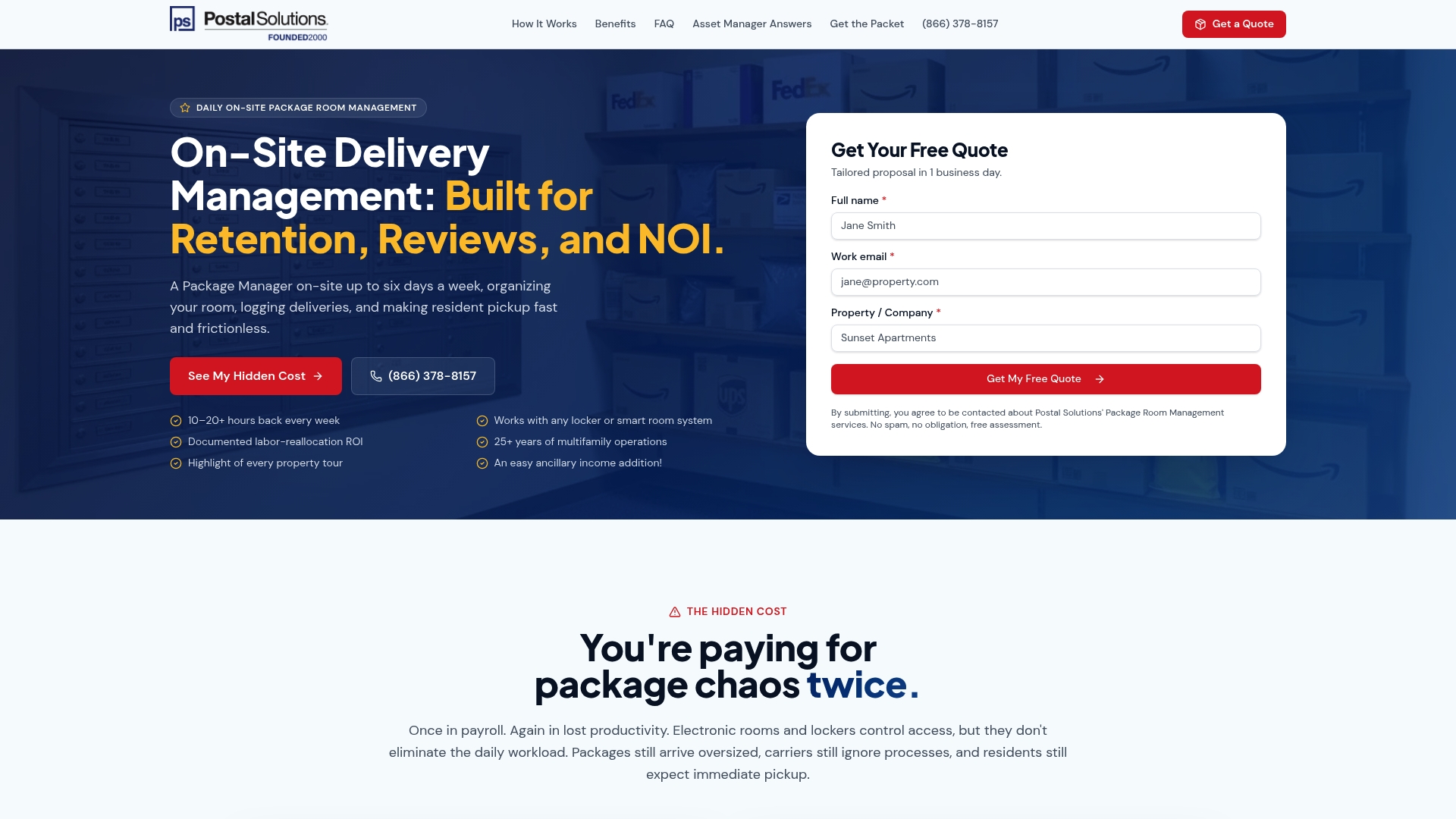
Postal Solutions puts a dedicated on-site Package Manager at your property up to six days a week: receiving, sorting, logging, and keeping packages organized and available to residents around the clock through the room or lockers you already have. The service covers the full move-in surge, from carrier coordination and overflow handling to oversized and perishable management, weekly audits, and resident notifications. Many communities structure it as a paid amenity and retain the margin, turning a cost center into a contributor.
Ready to hand move-in packages off for good? Get your leasing team back to leasing.
FAQ
What is a move-in package surge?
A move-in package surge is the spike in parcel deliveries that occurs when new residents move in and their pre-ordered items arrive simultaneously. Volume typically doubles or triples daily intake for three to five days after the first move-in date.
When should a property outsource package management?
Properties with 400+ units or those where staff spend more than two hours daily on packages should consider a dedicated on-site Package Manager. Repeated carrier non-compliance or chronic overflow beyond two days are also strong signals.
How do you handle oversized packages during move-in week?
Designate a clearly labeled oversized zone separate from standard parcels, require staff-assisted pickup, and notify the resident immediately on arrival. Student move-in packages frequently include furniture and appliances that need this treatment.
What KPIs should you track for move-in package operations?
Track three metrics: daily parcel volume, dwell time (target under 48 hours during peak), and complaints per 100 packages. These three catch operational problems early enough to adjust staffing or overflow capacity before they escalate.
Can package room management generate ancillary income?
Yes. Many communities charge residents a monthly amenity fee for on-site package management and retain the margin over the management cost, converting a budget expense into a modest revenue line.
Recommended
Ready when you are
Fix your package room — start with a free proposal
Daily on-site Package Manager, resident text & email pings*, and a tour-ready amenity. Tell us your unit count and we'll send a right-sized proposal — usually within one business day.
- ✓ 16–30 hours back every week
- ✓ Works with any locker system
- ✓ Faster, friction-free resident pickup
- ✓ An easy ancillary income addition