
September 7, 2026
Recover 4–6 Hours: Match Package Rooms to Your Multifamily Property
Match package-room solutions to your property's unit count, layout, and volume. Professionally run on site management can recover 4–6 staff hours daily...
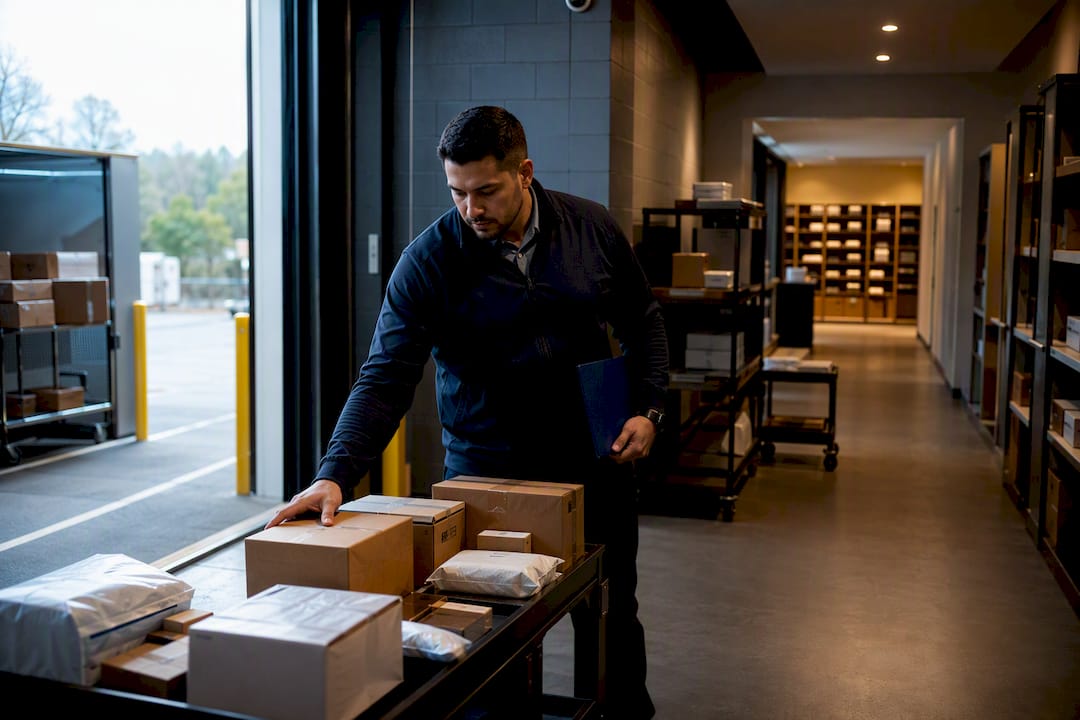
The right approach to short term rentals packages at multifamily properties is professionally run on-site package room management, matched to your property’s unit count, volume, and layout. Most operators are choosing among four solution families: smart lockers, AI-powered package rooms, off-site third-party handling, and hybrid staffed models. In this article, “short term rentals packages” refers to how apartment and student housing communities receive, sort, secure, and distribute resident deliveries. It is not about vacation rental bookings.
TL;DR:
- Properties with 330 to 370 units typically receive 68 to 75 packages daily, which may strain locker walls and favor AI-powered or hybrid solutions.
- Large urban communities processing over 187 to 208 packages per day benefit from AI-driven logistics to optimize space and efficiency.
- Staff time spent on manual sorting for communities with 75 packages daily can exceed six hours each day, impacting leasing and renewal efforts.
- Proper carrier SOPs and clear delivery instructions are key to preventing system failures during high-volume surges like holidays.
- Managed on-site package rooms can recover multiple staff hours daily, boost resident satisfaction, and potentially generate ancillary revenue through amenities.
Table of Contents
- Which Package Solution Fits Your Property Type?
- Why Package Volume Now Drives Leasing and NOI
- What Should You Ask Vendors Before Signing?
- How Do You Roll Out a New Package System?
- What’s the Real ROI of On-Site Package Management?
- What 25 Years in Package Operations Actually Teaches You
- Get a Package Room Audit From Postal Solutions
- Sources
- FAQ
Which Package Solution Fits Your Property Type?
Property profile determines the right solution more than any brand preference or budget line item. A 120-unit garden-style community with a spare leasing office and a 900-bed student housing tower with one loading dock are not solving the same problem, even though both call it “the package issue.”
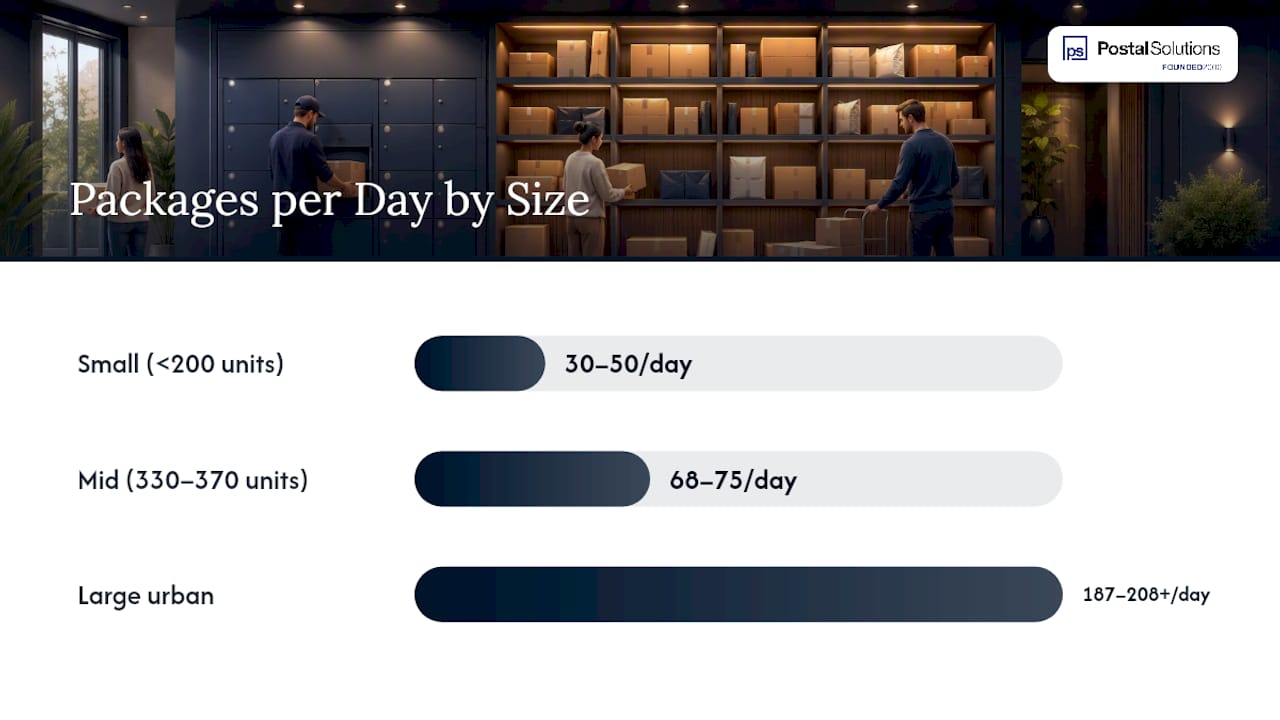
Unit count and daily volume set the floor. Communities under roughly 200 units with moderate volume, in the range of 30 to 50 packages a day, usually do fine with smart lockers or a modest package room. Mid-size properties in the 330 to 370 unit range often see 68 to 75 packages daily, which starts to strain a locker wall’s finite compartments. Large urban properties can exceed 187 to 208 packages a day, and student housing with 800 to 1,000 beds can process tens of thousands of packages a year. At that scale, AI-powered package rooms and software-driven logistics tend to outperform locker walls because they use shelving space adjacently rather than in fixed-size cubbies.
Available square footage and staffing budget matter just as much as unit count. A property with underused leasing or amenity space can often convert it into a staffed or hybrid package center more affordably than retrofitting lockers into a cramped mailroom.
- Smart lockers: best for mid-size communities with predictable, moderate volume and space for a locker bank.
- AI-powered package rooms: best for high-density urban or student properties needing maximum storage in minimal footprint.
- Off-site third-party handling: best for properties with zero spare space, though it trades resident convenience for offload.
- Hybrid staffed models: best when volume is high but budget won’t support full automation yet.
Pro Tip: If you’re not sure which tier you fall into, run a two-week package count before evaluating any vendor. Guessing at volume is the single most common reason properties buy the wrong-size solution.
Why Package Volume Now Drives Leasing and NOI
Package volume has climbed nearly 150% at some properties since 2015, and the operational strain shows up fastest at mid-size and large communities where staff never budgeted for delivery management as a daily task.
The resident-experience data makes the stakes clear.
Eighty-five percent of renters say package handling affects where they choose to lease, and roughly one in five point to it as a reason they renew or don’t. That single statistic reframes package management from a maintenance nuisance into a leasing and retention lever.
The hidden cost lives in staff time, not just resident complaints.
- A 370-unit community processing 75 packages a day can burn more than six hours of staff time daily on manual sorting and resident lookups.
- Poor package handling drives negative reviews that translate into measurable turnover costs at renewal time.
- Every hour a leasing agent spends chasing a missing box is an hour not spent on a tour or a renewal call.
Treat package management as core infrastructure, not an ancillary chore. A property that pushes overflow back onto leasing staff during peak weeks is quietly eroding the same occupancy numbers it’s trying to protect.
What Should You Ask Vendors Before Signing?
Procurement conversations tend to focus on hardware specs and miss the operational questions that actually predict whether a system holds up during a holiday surge. Carrier non-compliance is the leading cause of package system failures, so that’s where the vetting should start.
- How do you handle carrier non-compliance? A vendor should have a concrete answer involving standardized SOPs, pictorial instructions for drivers, and simple access methods like QR codes or PINs for regular delivery drivers, since these mitigations measurably reduce failures during peak periods.
- What’s your process for oversized or refrigerated deliveries? Vague answers here mean the vendor hasn’t actually run a property through a holiday season.
- Can your system integrate with our property management software? Ask for a live demo of the integration, not a slide.
- What reporting and audit trail do we get? You want timestamped chain-of-custody logs, not a verbal assurance that “packages get scanned.”
Red flags to watch for during a pilot:
- Vendors who can’t name a specific carrier SOP they’ve implemented elsewhere.
- No answer for what happens when a locker bank fills up mid-week.
- Reluctance to share reporting samples from an existing client.
Test claims by requesting references from properties of similar size and volume, then call them. A detailed operational guide on package room best practices is worth reviewing before you sit down with any vendor.
How Do You Roll Out a New Package System?
Deployment fails most often when a property skips the audit phase and jumps straight to hardware installation. The sequence matters more than the specific product chosen.
- Run a volume snapshot. Count actual daily packages for two weeks, including a Monday after a weekend surge.
- Audit available space. Measure the room or wall you’re considering, then compare it against the vendor’s minimum footprint.
- Get stakeholder sign-off. Loop in the leasing team, maintenance, and ownership before ordering hardware.
- Prep the site and install hardware. Coordinate electrical and network needs early since these often cause delays.
- Set carrier SOPs. Notify FedEx, UPS, USPS, and Amazon logistics teams directly with clear pickup and drop-off instructions.
- Train staff and onboard residents. Send notification instructions before go-live, not after the first missed pickup.
- Validate through a peak period. Move-in week or the December holiday surge is the real stress test, not the first quiet month.
Major cost drivers include hardware size, integration complexity with your existing package notification system, and whether you’re staffing the room or running it tech only.
Pro Tip: Pilot on one building or one wing before a portfolio-wide rollout. A 30-day pilot exposes carrier compliance gaps you won’t catch on paper.
What’s the Real ROI of On-Site Package Management?
The math starts with hours recovered, not packages processed. Properties running efficient on-site systems often regain 4 to 6 or more staff hours per day that were previously lost to manual sorting and resident lookups.
Those hours convert directly to measurable value:
- Recovered payroll hours redirected to leasing tours, renewal calls, and resident retention work.
- Fewer negative reviews tied to lost or delayed packages, which protects lease-up velocity.
- Ancillary income potential through a resident amenity fee, where the property retains the margin over management cost.
The staffing decision usually comes down to volume and consistency. A tech-only locker system works when volume is predictable and moderate. Once daily counts climb past the mid-size threshold, managed on-site labor tends to outperform hardware alone because a dedicated Package Manager catches carrier errors, oversized deliveries, and resident disputes before they become leasing-office fires. For a fuller breakdown of how managed service pricing compares to hardware-only investment, this guide to apartment package management services walks through the tradeoffs. Ownership groups tracking asset performance across a portfolio may also find useful benchmarking context in broader rental and leasing industry data.
What 25 Years in Package Operations Actually Teaches You
Similar failure patterns often repeat across communities: the hardware works fine, but sometimes delivery drivers or new hires are not trained on the standard operating procedures. Carrier compliance breaks systems more often than volume does. The properties that treat their package room as a leasing amenity, showing it off on tours the same way they show off a fitness center, consistently get more value from the investment than those that hide it in a back hallway. A six-day-a-week on-site Package Manager isn’t overhead. It’s the difference between a package room that runs itself and one that quietly drains staff hours every single week.
— Postal Solutions
Get a Package Room Audit From Postal Solutions
Postal Solutions is the alternative to buying hardware and hoping your leasing team can manage it on top of everything else. A dedicated on-site Package Manager works your community up to six days a week, handling receiving, sorting, chain-of-custody logging, and resident notifications directly through whatever locker or package room system you already own.
That means your leasing staff stops chasing lost boxes and starts focusing on tours and renewals again, while the package room itself becomes a visible amenity you can point to on every property tour. If your property doesn’t have locker hardware yet, on-site management still works without one. Ready to see what it looks like for your community? Compare the operational tradeoffs in this breakdown of on-site versus off-site package management, or grab the free package room management guide and start planning your rollout this week.
Sources
- Multifamily properties face flood of packages — Multifamily Executive
- Apartment delivery management challenges — Swiftlane blog
- A framework for solving multifamily’s package management problem — Insights by Blueprint
- What package wrangling is really costing your team — Multifamily & Affordable Housing Business
FAQ
What Does “Short Term Rentals Packages” Mean for Apartment Communities?
In this context, it refers to on-site package room and parcel management, meaning how a multifamily or student housing community receives, sorts, secures, and distributes resident deliveries, not vacation rental bookings.
How Many Packages Does a Typical Apartment Community Receive Daily?
Mid-size communities of 330 to 370 units commonly see 68 to 75 packages a day, while large urban properties can exceed 187 to 208 daily.
Should I Choose Smart Lockers or an AI-Powered Package Room?
Smart lockers work well for mid-size communities with moderate, predictable volume, while AI-powered package rooms suit high-density or student properties that need more storage in less space.
How Much Staff Time Does Manual Package Handling Cost?
A 370-unit property processing 75 packages daily can lose more than six hours of staff time each day to manual sorting and resident lookups.
Can a Package Room Actually Generate Revenue?
Yes. Many communities structure professionally managed package rooms as a paid resident amenity, retaining the margin over the cost of management, which turns what used to be a cost center into a revenue-supporting feature.
What’s the Biggest Cause of Package System Failures?
Carrier non-compliance is the most common cause, and standardized SOPs with clear driver instructions significantly reduce failures during peak delivery periods.
Recommended
Ready when you are
Fix your package room — start with a free proposal
Daily on-site Package Manager, resident text & email pings*, and a tour-ready amenity. Tell us your unit count and we'll send a right-sized proposal — usually within one business day.
- ✓ 16–30 hours back every week
- ✓ Works with any locker system
- ✓ Faster, friction-free resident pickup
- ✓ An easy ancillary income addition