
September 5, 2026
Cut Complaints With 24/7 Package Pickup for Property Managers
Property managers: make 24/7 package pickup dependable by pairing lockers with managed package rooms, audit logs, and staffing to cut complaints.
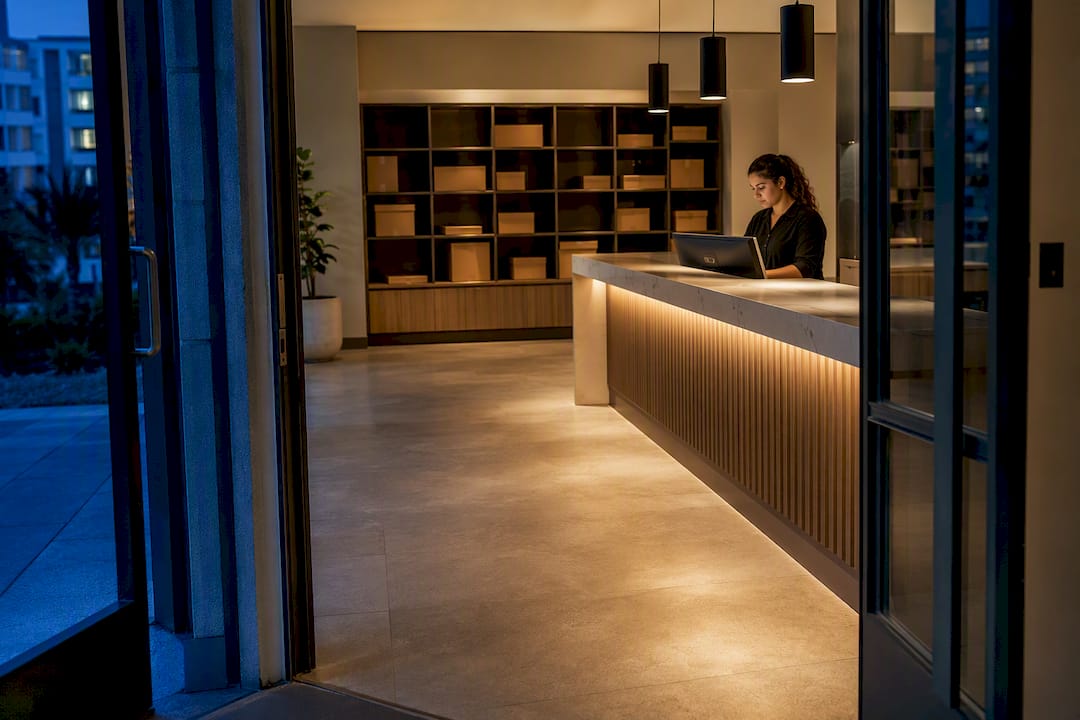
For most apartment and student housing properties, the best setup is a hybrid one: smart lockers for after-hours pickup, backed by a managed on-site package room or a daily Package Manager. Lockers give residents anytime access; a managed room handles the oversized boxes, the chain-of-custody logging, and the exceptions lockers can’t. Below is how the two models compare, how the mechanics actually work, and how to pick the right mix for your property.
TL;DR:
- Properties with high-volume deliveries or oversized items benefit most from a hybrid system combining lockers for routine pickups and a managed room for irregular and large packages.
- Lockers enable 24/7 self-service pickup and improve resident convenience, but capacity limits and oversized items require backup from on-site staff or overflow storage.
- Accurate, real-time audit logs and efficient notification systems are crucial for security, dispute resolution, and reducing resident complaints.
- Implementation costs vary based on hardware, management services, and staffing, with ROI driven by staff time savings, theft reduction, and amenity value.
- Testing carrier workflows 30 to 60 days before peak periods ensures system reliability and avoids delays during busy move-in or holiday seasons.
Table of Contents
- Smart Lockers vs. Staffed Package Rooms: Which One Fits Your Property?
- How 24/7 Package Pickup Actually Works
- What 24/7 Pickup Actually Saves You (Beyond Convenience)
- What to Ask Before You Sign a Vendor Contract
- What This Actually Costs (and How It Pays for Itself)
- Why a Managed Package Room Changes the Math on Lockers
- How Postal Solutions Makes 24/7 Pickup Actually Work
- Sources
- FAQ
Smart Lockers vs. Staffed Package Rooms: Which One Fits Your Property?
Smart lockers are self-service banks where carriers deposit packages into an assigned compartment that only opens with a PIN, QR code, or app tap. A staffed on-site package room is a secured space where a dedicated Package Manager receives, sorts, and logs every parcel by hand, then hands it off or shelves it for pickup.
Each model solves a different problem.
- Smart lockers excel at after-hours convenience. A resident coming home at 11 p.m. doesn’t need anyone on-site to grab their package. The tradeoff is capacity: lockers max out fast during move-in season or holiday shipping surges, and they can’t hold a mini fridge or a set of patio furniture.
- Staffed rooms handle volume and irregular shapes well, but they’re only as available as the person running them. A package room with no after-hours coverage leaves residents locked out until the next shift.
- Hybrid setups cover both gaps. Lockers absorb the routine, small-to-medium volume around the clock; the package room or Package Manager handles oversized items, refrigerated deliveries, and the overflow that inevitably shows up during peak weeks.
A small self-managed site with light package volume might run fine on lockers alone. A staffed mid-size community usually needs the room as the backbone, with lockers as a convenience layer. High-volume properties, think 300+ units or student housing near a campus, tend to need both running in parallel, because neither model alone survives a heavy delivery week without becoming a bottleneck.
How 24/7 Package Pickup Actually Works
The flow starts the moment a carrier arrives. The driver scans the package barcode, deposits it into an assigned locker, and the system fires off an automatic notification to the resident, according to Pitney Bowes.
- Carrier scan and deposit — the driver logs the parcel into the system and places it in an open compartment.
- Instant notification — the resident gets a text or app alert with a single-use PIN or QR code, a workflow Smiota documents as standard across smart locker deployments.
- Self-service pickup — the resident scans or enters the code at any hour; the locker unlocks only for that one transaction.
- Audit logging — every scan, deposit, and pickup event gets timestamped and recorded.
That audit trail matters more than most people realize. Rate-limited login attempts and logged door openings are standard security features for locker systems built for round-the-clock access, per ReadyLockers. When a resident claims a package never arrived, the log settles the dispute in seconds instead of triggering a week of back-and-forth with the leasing office.
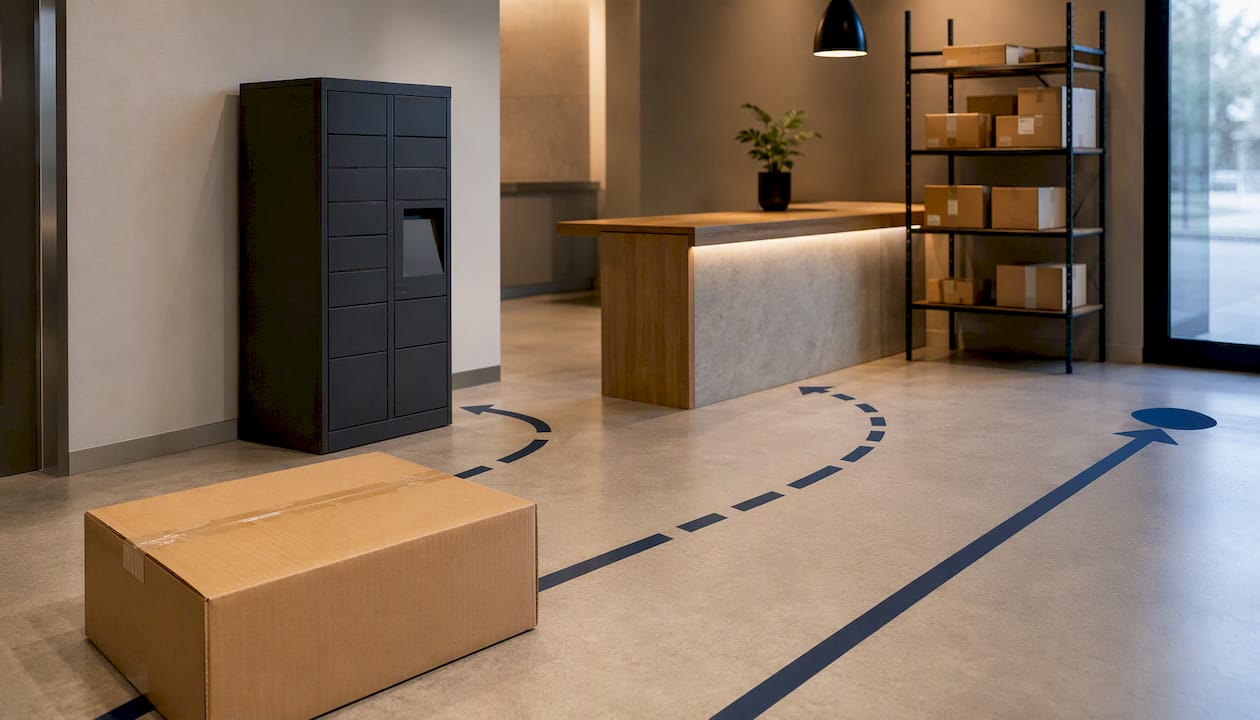
Oversized items skip the locker entirely and go to a staffed counter or overflow shelf, with pickup scheduled directly with the Package Manager.
What 24/7 Pickup Actually Saves You (Beyond Convenience)
Residents get shorter wait times, fewer missed deliveries, and pickup whenever their schedule allows, not just during office hours. That alone reduces the single biggest source of package complaints: the mismatch between delivery windows and resident availability.
Operators see the flip side of that same coin.
- Staff spend less time playing detective on “where’s my package” tickets.
- Leasing tours get a tangible amenity to point to, one prospects can compare against the property down the street.
- Documented chain-of-custody cuts theft-related liability and resident disputes.
Smart lockers reduce theft and staff bottlenecks while enabling true 24/7 self-service, a pattern Smiota has tracked across multifamily, retail, and campus deployments. Pairing that locker access with clear notifications and intake rules also supports amenity-driven rent premiums in competitive markets, according to Techscribe. Fewer complaints, better retention, and a leasing amenity that actually shows up on tour, that’s a rare combination in property operations.
What to Ask Before You Sign a Vendor Contract
Choosing a system comes down to matching capacity to your actual delivery volume, not the vendor’s sales pitch.
- Estimate your volume — count average daily packages per unit, then double it for peak weeks (move-in, November through December).
- Ask about notification latency — how fast does a resident get alerted after a carrier deposit? Delays over a few minutes create pickup bottlenecks.
- Confirm audit log access — can your team pull a full history of scans, deposits, and pickups on demand, or does that require a support ticket?
- Clarify oversized workflows — where do large packages go, who logs them, and how does the resident get notified?
- Check carrier integration — does the system work with UPS, FedEx, and USPS scan formats without manual workarounds?
Red flags worth walking away from: no audit logging at all, vague answers about oversized package handling, or pricing that’s “custom quote only” with no ballpark range offered upfront.
Pro Tip: Ask a vendor to show you a live audit log, not a demo screenshot. If they can’t pull one in real time, that tells you how mature the system actually is.
As a rough sizing guideline, most mid-size communities run one locker bank per 75 to 100 units, supplemented by a Package Manager on-site several days a week rather than daily, scaling up as delivery volume grows.
What This Actually Costs (and How It Pays for Itself)
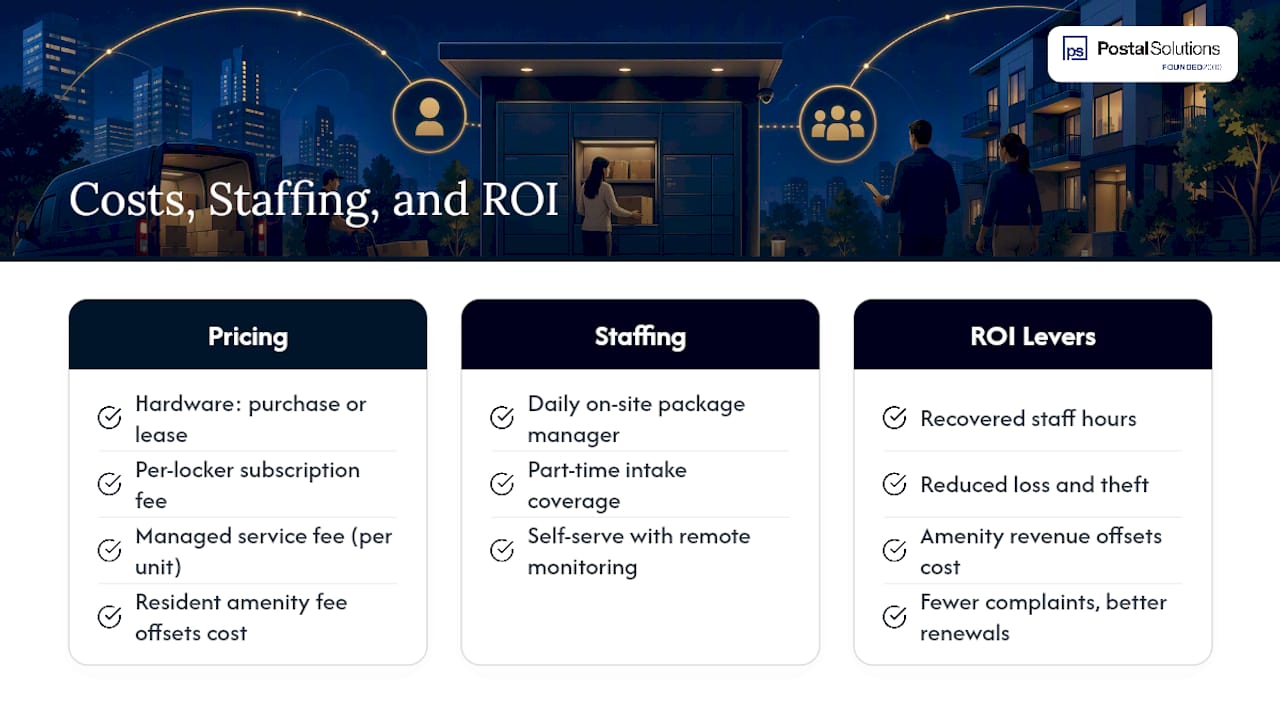
Pricing shows up in a few common shapes: locker hardware leased or purchased outright, a per-locker subscription fee, a managed service fee billed per property or per unit, or a resident-facing amenity fee that offsets the cost entirely.
Staffing follows a similar spectrum. Some properties run a daily on-site Package Manager, others use part-time intake coverage a few days a week, and some go fully self-serve with remote monitoring and no daily staff presence at all.
The ROI case usually comes down to a few levers, including staff hours recovered from not sorting, tracking, and answering “where’s my package” emails, reduced loss and theft costs from documented chain-of-custody, amenity fee revenue potentially offsetting the service cost, and fewer complaints translating into better renewal rates.
Implementation timelines vary by property size, but the smart move is testing carrier workflows well before a peak period hits, not during move-in week when there’s no room for error. Running a trial cycle 30 to 60 days ahead of your busiest season catches integration issues while there’s still time to fix them.
Why a Managed Package Room Changes the Math on Lockers
Twenty-five years of running on-site package operations has shown us that lockers alone rarely solve the whole problem. A locker bank without someone managing overflow, logging oversized deliveries, and keeping the space organized turns into a mess by the second peak season.
A daily on-site Package Manager changes that. Properties that pair lockers with dedicated management see staff time reclaimed for leasing and renewals instead of package triage, and residents notice the difference in fewer missed-delivery complaints. The lockers handle the routine; the Package Manager handles everything that doesn’t fit neatly into a compartment.
— Postal Solutions
How Postal Solutions Makes 24/7 Pickup Actually Work
Their on-site package operation service means a dedicated Package Manager can work the community several days a week, receiving, sorting, and securing packages while keeping existing lockers or package rooms stocked and organized for residents around the clock.
Onboarding typically starts with a walkthrough of the current setup and a labor-cost analysis tailored to unit count and delivery volume. Pricing generally follows a per-property or per-unit monthly structure, with many communities structuring the service as a paid amenity that offsets the cost. This service integrates with existing locker hardware, handles overflow and oversized deliveries, and manages peak periods like move-in and holidays without requiring leasing staff involvement.
If you’re evaluating whether your property needs lockers, a managed room, or both, the free package room management guide walks through the tradeoffs in detail. If you’re ready to see what it looks like for your specific property, request a property assessment and get a direct comparison of on-site versus off-site options.
Sources
For deeper technical detail, see how smart lockers work, after-hours locker security practices, and package pickup workflows that cut wait times.
- How do smart lockers work? | Smiota
- Multifamily package management solutions impact resident retention | Techscribe
- 24/7 Package Pickup — After-Hours Locker Access | ReadyLockers
FAQ
Is There a Service That Picks Up Packages for Residents?
Yes. Smart lockers give residents self-service pickup any time of day, while a managed on-site package room, run by a Package Manager, handles intake, sorting, and oversized items that lockers can’t accommodate.
Where Can I Have a Package Delivered if I Don’t Have an Address?
Some virtual mailbox and storefront operators offer 24/7 locker pickup with account-based PIN access, functioning as an alternate delivery address for people without a permanent one, as seen with services like In Out Parcel.
Can I Send an Overnight Package on a Sunday?
Carrier availability on Sundays varies by service level and location, so check directly with your carrier. Some 24/7 locker locations, including certain UPS Store locker services, extend pickup and drop-off access beyond standard business hours.
What’s the Cheapest Place to Send a Package?
Rates depend on carrier, package weight, and delivery speed, so comparing USPS, UPS, and FedEx directly for your specific shipment is the only reliable way to find the lowest price.
How Do I Know if My Property Needs Lockers, a Package Room, or Both?
If your delivery volume includes frequent oversized items or exceeds what a locker bank can hold during peak weeks, a hybrid approach with a managed package room typically handles both routine and exception cases better than lockers alone.
Recommended
Ready when you are
Fix your package room — start with a free proposal
Daily on-site Package Manager, resident text & email pings*, and a tour-ready amenity. Tell us your unit count and we'll send a right-sized proposal — usually within one business day.
- ✓ 16–30 hours back every week
- ✓ Works with any locker system
- ✓ Faster, friction-free resident pickup
- ✓ An easy ancillary income addition