
August 26, 2026
A Package Pickup Workflow That Actually Cuts Wait Times
Discover how an efficient package pickup line reduces wait times and complaints, ensuring a smooth experience for residents and staff.
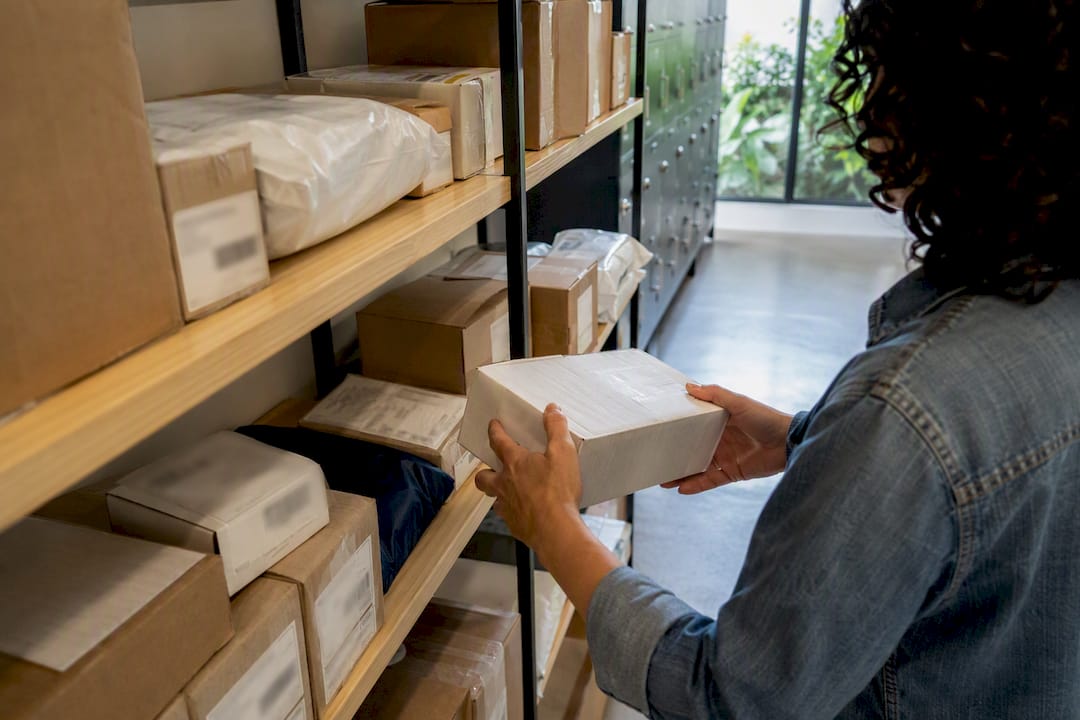
A reliable package pickup line runs on a fixed workflow: intake and log, stage by unit, notify the resident, authenticate, then release. Run that sequence the same way every time and average pickup time drops under 48 hours, resident complaints fall, and staff stop losing hours hunting for missing boxes. The workflow only holds together if you build in the right checkpoints.
- Reduced wait times and fewer “where’s my package” calls to the front office
- Written SOPs for carriers and staff that make the process repeatable across shifts
- Weekly audits that catch unclaimed items before they pile up
- Operational KPIs (pickup time, dwell rate, carrier compliance) that tell you when the system is breaking down
Key Takeaways
A reliable package pickup line depends on immediate intake logging, fast resident notification, and weekly audits working together as one system, not three separate tasks.
| Point | Details |
|---|---|
| Intake is the failure point | Log carrier, tracking number, unit, and exception flags the moment a package arrives. |
| Notify fast and specifically | Include location, code, and deadline in every resident alert to cut dwell time. |
| Separate exceptions immediately | Give oversized, perishable, and signature items their own staging zone and rules. |
| Audit weekly, without exception | Reconcile logs to physical inventory to stop unclaimed parcels from piling up. |
| Postal Solutions handles execution | A dedicated on-site Package Manager runs intake, notifications, and audits daily so staff don’t have to. |
Table of Contents
- A Step-by-Step Resident Package Pickup Workflow
- Design Intake and Logging So Packages Never Slip Through the Cracks
- Notifications and Access: Cut Dwell Time With Faster Alerts
- Handling Oversized, Perishable, and Signature-Required Exceptions
- Choosing Between Lockers, a Package Room, or a Hybrid Setup
- Tracking the KPIs That Keep the Pickup Line Healthy
- Why a Managed On-Site Package Room Solves the Bottleneck
- Tailoring Pickup Communication to Different Resident Groups
- Common Mistakes That Undermine a Package Pickup Line
- The Psychology Behind Why Certain Pickup Processes Work
- Package Pickup Is a Resident Amenity, Not Just a Chore
- How Postal Solutions Eliminates Pickup Bottlenecks for Good
- Primary Sources and Internal Guides
- Sources
- FAQ
A Step-by-Step Resident Package Pickup Workflow
Most package backups trace back to a broken step in an otherwise simple chain. Fix the sequence and the backlog usually disappears without buying new hardware.
- Intake and log immediately. The moment a carrier drops off a package, scan or manually log the tracking number, carrier, and unit number. Skipping this step, even for “just a minute,” is how packages vanish into a pile that nobody can account for.
- Stage by unit number and flag exceptions. Shelve items in unit-number order so retrieval takes seconds, not minutes. Tag oversized boxes, perishables, and signature-required items with a distinct marker the moment they’re staged.
- Trigger the resident notification. Send an automated text or email with the pickup location, any access code, and a deadline if one applies. The faster the alert goes out, the faster the package leaves the shelf.
- Authenticate and release. Use a PIN, QR code, or ID check depending on your access setup, then log the release time. This closes the loop and gives you the data for your KPIs.
- Handle exceptions and reconcile. Perishables, oversized freight, and guest deliveries get pulled out of the standard flow and logged separately so they don’t distort your regular pickup-time numbers.
Pro Tip: Assign one staff member per shift as the “intake lead” whose only job during carrier drop-off windows is logging packages. Splitting that responsibility across whoever’s at the desk is how items get missed.
This sequence works whether you’re running a locker wall, a staffed package room, or a hybrid. What changes property to property is who executes each step and how much of it gets automated.
Design Intake and Logging So Packages Never Slip Through the Cracks
Intake is the single most failure-prone moment in the entire pickup line. Get it wrong and every downstream step, staging, notification, authentication, inherits the error.
At the point of drop-off, capture four things every time: carrier name, tracking number, unit number, and any exception flag (oversized, perishable, signature-required). A barcode scanner speeds this up for high-volume communities; a clipboard or tablet entry works fine for smaller ones, as long as someone actually uses it consistently.
- Post pictorial, easy-to-follow SOPs at the delivery entrance so carriers know exactly where to scan and stage
- Use QR codes carriers can scan to confirm drop-off location and time
- Assign an intake lead every shift, not just during peak hours
- Track which carriers or routes skip the logging step and follow up directly with their dispatch
Carrier non-compliance at the intake stage is consistently identified as the leading cause of downstream package failures because unlogged packages simply don’t exist in your system until a resident complains. The problem compounds during peak season: NAA guidance puts the average community at roughly 150 packages a week, climbing to about 270 during the holidays, with staff already spending more than four hours weekly just handling package tasks even at baseline volume.
Notifications and Access: Cut Dwell Time With Faster Alerts
The gap between “package arrives” and “resident picks it up” is where most communities lose the most time, and it’s the easiest gap to close. A vague or delayed notification sends residents to the office empty-handed, which creates the exact foot traffic you’re trying to eliminate.
Every notification should include the unit number, the exact pickup location, a code or authentication method, and a deadline if the package needs to move for space reasons. Vague alerts like “your package has arrived” without a location or code generate the most follow-up calls.
- PIN codes and QR access work fastest for locker systems with no staff involved
- App push notifications tend to get read faster than plain email
- Staff verification adds a security layer but slows throughput during busy hours
- Clear signage at the pickup point reduces first-time confusion for new residents
Immediate notification paired with anytime access made a measurable difference in one operator analysis: residents picked up packages 43% faster once alerts went out the moment a package was staged instead of on a batch schedule.
Handling Oversized, Perishable, and Signature-Required Exceptions
Exceptions are where a smooth pickup line usually breaks down, because staff try to force odd-shaped problems into a standard-size process. Give exceptions their own lane instead.
Flag anything unusual at intake with a visible tag and move it to a dedicated staging zone rather than mixing it in with standard mail. Perishables need refrigeration and a tight pickup window. Oversized freight typically needs floor space instead of shelving, plus a resident notification that specifies it can’t fit in a locker.
- Guest packages get verified against the leaseholder before release, with the chain-of-custody logged
- Signature-required deliveries stay with the carrier’s own process but get logged the same as everything else
- Set a firm retention window and enforce return-to-sender consistently to keep the room from filling up
- Publish the retention policy at move-in so disputes over “my package got sent back” don’t land on your desk
Choosing Between Lockers, a Package Room, or a Hybrid Setup
The right hardware depends on volume, not preference. Communities that pick a locker wall because it looks modern, then discover it can’t handle a holiday spike, end up with the exact bottleneck they were trying to avoid.
Segment your property by daily package volume and available storage footage before choosing equipment. One framework for matching solution type to property profile puts lockers as the better fit for mid-size properties, smart package rooms for high-volume urban sites, and hybrid setups for properties juggling both diverse parcel sizes and sharp seasonal spikes.
- Lockers offer 24/7 self-service access but come in fixed sizes, which is a problem for oversized freight
- A staffed room flexes to any package size but needs labor and a defined SOP to stay organized
- Plan overflow space for move-in weeks and the holiday season specifically, not just average-week volume
- Confirm ADA-accessible units and reliable connectivity for any electronic locker system before signing a hardware contract
Communities managing seasonal turn cycles, particularly student housing, should build this planning into the broader move-in calendar rather than treating package capacity as a separate decision; see this calendar-based turn planning playbook for how that scheduling typically works.
Tracking the KPIs That Keep the Pickup Line Healthy
Numbers tell you whether the workflow is actually working or just looks fine on the surface. Four metrics matter more than the rest.
| Point | Details |
|---|---|
| Average pickup time | Target under 48 hours from notification to resident release. |
| Dwell rate | Keep unclaimed packages past 7 days under 10% of total volume. |
| Carrier compliance | Aim for 95% or higher intake logging compliance across all carriers. |
| Lost or missing incidents | Target zero; any incident should trigger an immediate log review. |
Run a weekly audit that reconciles the log against physical inventory, flags unclaimed items, and checks that exception tags were applied correctly. Auditing internal reports from student housing operations consistently show that skipping this weekly reconciliation is how package rooms turn into unmanageable storage closets within a matter of months.
Pro Tip: Log every audit finding in writing, even a “no issues found” week. When a pattern emerges, three weeks of documented dwell-rate creep is a far stronger case for adding staff or hardware than a single bad week.
Why a Managed On-Site Package Room Solves the Bottleneck
A written SOP and a KPI dashboard only work if someone executes them consistently, every shift, every carrier drop-off. That’s the gap a dedicated on-site Package Manager closes.
Postal Solutions places a Package Manager on-site up to six days a week to handle receiving, sorting, staging, resident notifications, and weekly audits as their full-time job rather than a task squeezed between leasing calls. That includes exception handling for oversized freight and refrigerated deliveries, and integration with whatever locker or package room hardware the property already has installed.
- Reclaimed staff hours redirected to leasing and renewals instead of sorting boxes
- Faster pickup times because intake and notification happen the moment a carrier arrives
- A professionally run package room becomes a tour-ready amenity, not a back-office liability
- Consistent audits and logs that hold up when ownership or residents ask questions
Tailoring Pickup Communication to Different Resident Groups
A single notification template rarely fits every resident population. Student housing, workforce housing, and luxury communities each respond to different cues, and matching your language and access method to the group in front of you cuts follow-up calls significantly.
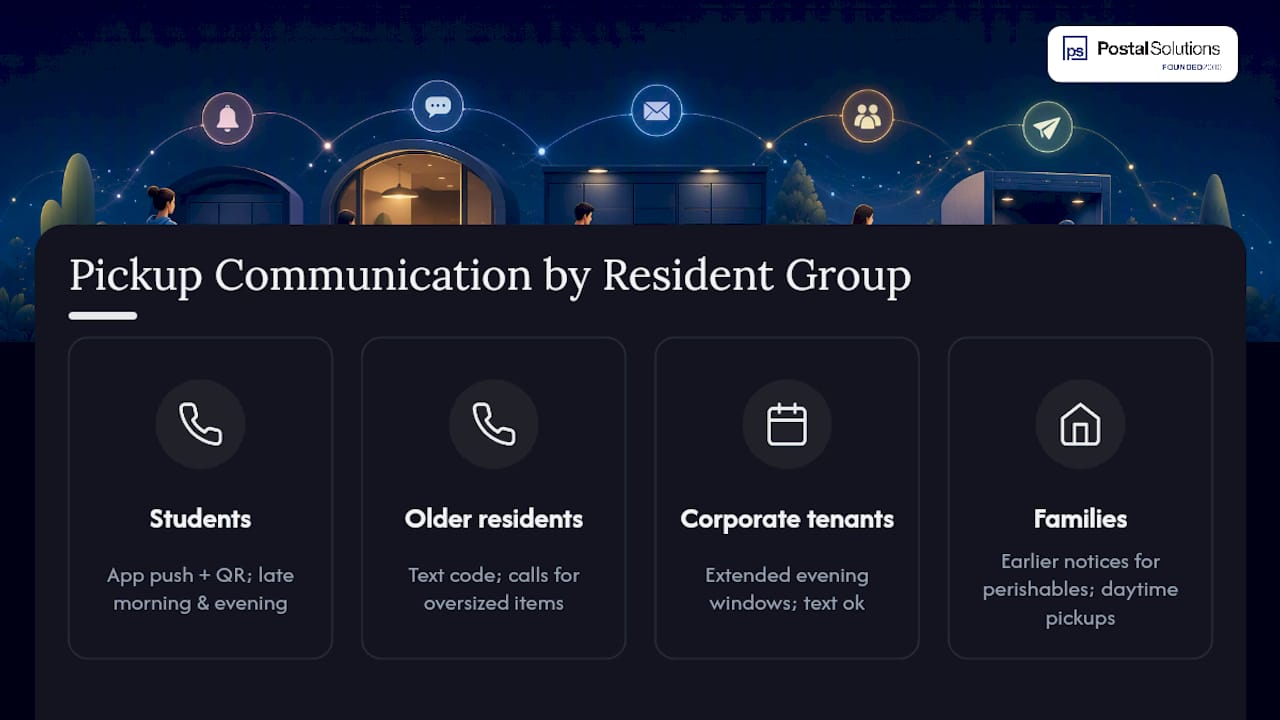
Student residents tend to respond fastest to app push notifications and QR-code access, since most already manage their lives through a phone. They also tend to cluster pickups around class schedules, so staging by unit number matters less than having flexible pickup windows around common gaps in the day, late morning and early evening.
Older residents and those less comfortable with app-based systems often prefer a text message with a plain-language pickup code, or even a phone call for anything oversized. Forcing a resident who doesn’t use smartphone apps through a QR-only locker system creates the exact friction the workflow is supposed to eliminate.
Corporate and business-traveler-heavy properties benefit from pickup windows that extend into evening hours, since standard 9 to 5 office coverage misses a chunk of that population entirely. Family households with children often need earlier notification for perishable or oversized deliveries, since coordinating pickup around school runs and work schedules adds a layer of scheduling complexity single residents don’t face.
The common thread: don’t assume one notification format or one access method serves everyone. A brief resident survey at move-in, “how do you prefer to be notified?”, takes five minutes and pays off in fewer missed pickups down the line.
Common Mistakes That Undermine a Package Pickup Line
Most pickup line failures come from a handful of repeatable mistakes rather than bad luck or bad hardware.
The most common one is treating intake as optional during busy periods. Staff under pressure skip the scan-and-log step “just this once,” and that’s exactly when a package goes missing and a resident escalates a complaint. The second is batching notifications instead of sending them immediately. Holding alerts until end of shift feels efficient on paper, but it directly inflates your dwell rate and stacks up foot traffic at the office all at once instead of spreading it out.
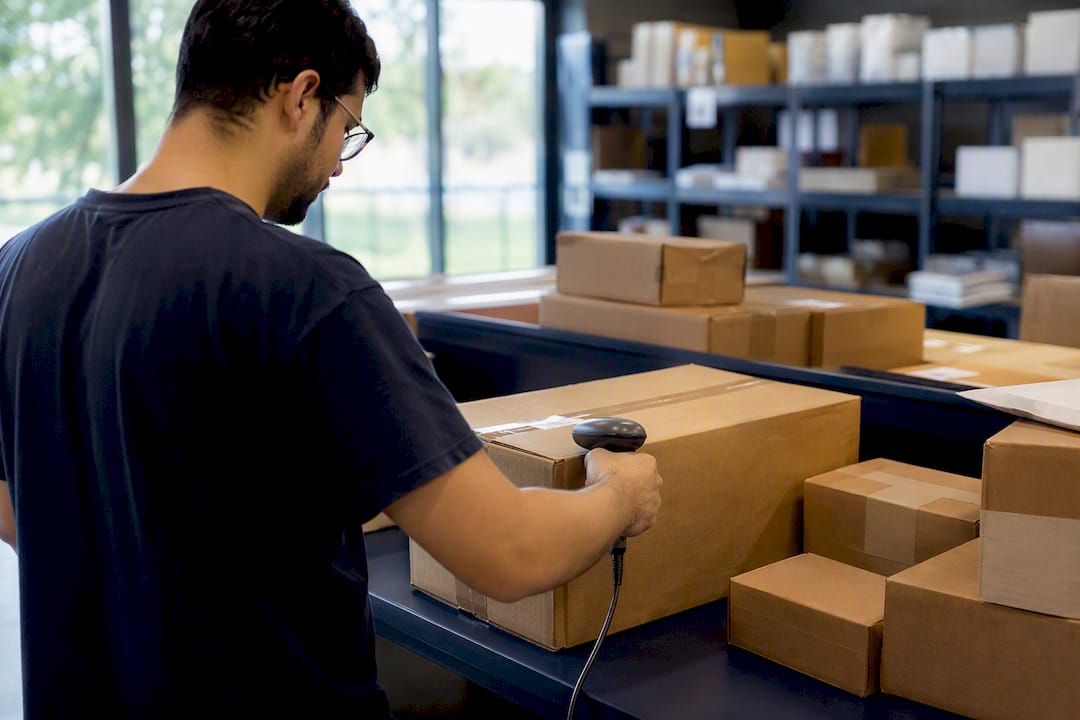
A third mistake is mixing exceptions into standard staging. An oversized box or a perishable item stored with everything else either takes up shelf space it doesn’t fit or spoils before anyone notices it needs refrigeration. Fourth, many properties skip the weekly audit once things seem to be running smoothly, which is precisely when unclaimed items start accumulating unnoticed.
Fifth, and easy to overlook, is inconsistent authentication. Verifying one resident’s ID rigorously and waving another through without checking anything at all creates both a security gap and a fairness complaint. Pick one authentication method per access type and stick to it for every resident, every time.
Finally, don’t confuse buying new hardware with fixing the process. A brand-new locker wall installed on top of a broken intake habit will produce the same backlog in a new box.
The Psychology Behind Why Certain Pickup Processes Work
Residents don’t just want their package faster. They want to feel certain about when and how they’ll get it, and that certainty is what actually drives satisfaction more than raw speed.
Clear, specific notifications reduce what behavioral researchers call decision fatigue. A message that says “package in Locker 14B, code 4471, available until Friday” requires zero mental effort to act on. A vague “you have a package” forces the resident to guess, call, or show up and hope, and that uncertainty is what generates complaints even when the actual pickup process takes less time than they expect.
Consistency also builds trust faster than speed alone. A resident who gets the same notification format, the same access method, and the same response every single time learns to trust the system and stops double-checking with the office. Break that pattern even once, a delayed alert, a locker that’s mysteriously empty, a code that doesn’t work, and residents revert to calling the front desk for every future delivery, undoing months of smooth operation in a single bad experience.
There’s also a simple loss-aversion effect at play with perishables and signature-required items. Residents worry more about losing something valuable than they appreciate gaining speed on routine packages, which is why clear communication about refrigerated or high-value deliveries matters disproportionately more than shaving a few hours off a standard box’s pickup time.
Package Pickup Is a Resident Amenity, Not Just a Chore
Show the package room or lockers on every tour and explain the pickup steps out loud. Prospects notice when a process feels organized. Framed well, it supports ancillary income and resident retention, not just staff convenience. That only works if you commit to ongoing process and audits, not a one-time equipment purchase.
— Postal Solutions
How Postal Solutions Eliminates Pickup Bottlenecks for Good
Postal Solutions is the alternative to buying hardware and hoping staff keep up with it. Where lockers or a package room alone still require someone consistently executing intake, staging, notifications, and audits, a dedicated on-site Package Manager does that work as their actual job, up to six days a week, so your leasing team never has to own it.
That shift usually shows up in three places worth discussing with ownership: hours your leasing staff get back for renewals and tours, a measurable improvement in pickup times and resident complaints, and a package room that becomes a visible, sellable amenity instead of a back-office liability. Because residents already value secure, well-run package handling, many communities structure it as an ancillary income line that helps offset its own cost.
If your property doesn’t even have locker hardware yet, that’s not a blocker. Postal Solutions runs daily on-site package management for properties without a locker system using the space you already have. Download the free package room management guide to see the full SOP, or reach out to get a labor-cost analysis for your specific property.
Primary Sources and Internal Guides
For further reading, consult NAA’s package management guidance, the UH student housing package room audit report, and Postal Solutions’ own manager’s guide to package room operations and ready-to-adopt package room policy templates.
Sources
- NAA guidance on package management for multifamily housing
- Resident package pick-up workflow for multifamily teams - Postal Solutions
- UH student housing internal audit report (package room audits)
- A framework for solving multifamily’s package management problem | Insights by Blueprint
FAQ
What is the ideal average package pickup time?
Under 48 hours from notification to resident release is the benchmark most well-run communities target, backed by faster pickup outcomes from immediate notification systems.
How often should we audit the package room?
Weekly, at minimum, to reconcile logs against physical inventory and catch unclaimed items before they accumulate into a storage problem.
What causes most package pickup delays?
Carrier non-compliance at intake, meaning packages that never get scanned or logged, is consistently the leading cause of downstream pickup failures.
Should we choose lockers or a staffed package room?
It depends on daily volume and storage space: lockers suit mid-size properties with steady volume, while high-volume or space-constrained sites often need a staffed room or hybrid setup.
Can a managed service replace a locker system entirely?
Yes. Postal Solutions runs full on-site package management for properties without any locker hardware, handling intake, staging, and notifications manually with a dedicated on-site Package Manager.
Recommended
Ready when you are
Fix your package room — start with a free proposal
Daily on-site Package Manager, resident text & email pings*, and a tour-ready amenity. Tell us your unit count and we'll send a right-sized proposal — usually within one business day.
- ✓ 16–30 hours back every week
- ✓ Works with any locker system
- ✓ Faster, friction-free resident pickup
- ✓ An easy ancillary income addition