
August 24, 2026
SMS Package Alerts: A Property Manager's Guide to Setup
Discover how SMS package alerts simplify communication for property managers. Enhance resident satisfaction with real-time notifications.

SMS package alerts are short, event-driven texts that notify residents the moment a package arrives, sits unclaimed, or hits an exception. For property managers, the right approach is simple: use SMS for arrival, day of, and exception alerts, and pair it with email for receipts and durable records. That combination cuts status-check calls to the leasing office and gets packages off the shelf faster.
- SMS alerts residents in real time when a package arrives or needs pickup.
- Email backs it up with a permanent, searchable record.
- Reserve texts for urgent, action required moments. Nobody needs a text for every scan.
Key Takeaways
Property teams that pair milestone-based SMS alerts with documented consent and a staffed or well-integrated package process see fewer support calls and faster resident pickups.
| Point | Details |
|---|---|
| Use SMS for urgent events only | Reserve texts for arrival, ready-for-pickup, and exceptions; use email for receipts and records. |
| Document consent every time | Log the timestamp and method for every opt-in to avoid TCPA and FCC exposure. |
| Cap reminders at two | More than two automated nudges per package tends to push residents toward opting out. |
| Pilot before scaling | Test on one or two buildings for 30 days and compare WISMO call volume and pickup time. |
| Log every alert to a custody record | Tying SMS triggers to a logged handoff prevents disputes over missed notifications. |
Table of Contents
- Why SMS Package Alerts Matter for Property Operations
- When to Use SMS vs. Email vs. App Push
- Triggers and Templates Worth Copying
- Staying Compliant: Consent, TCPA, and FCC Basics
- Setting Up Reliable SMS Alerts: A Rollout Checklist
- Measuring Whether SMS Alerts Are Actually Working
- What 25 Years of Package Rooms Taught Us About Texting Residents
- The Real Bottleneck Isn’t the Text, It’s the Process Behind It
- Sources
- FAQ
Why SMS Package Alerts Matter for Property Operations
The clearest case for SMS package alerts is arithmetic: fewer phone calls, fewer emails, fewer residents wandering into the leasing office asking “where’s my box?” Front desk staff at busy communities can lose hours a week to WISMO (where is my order) questions when notifications don’t exist or arrive late.
The data backs the shift. Automating alerts moves teams from reactive to proactive, which is exactly the kind of change that shows up in customer satisfaction metrics after Property Brokers deployed SMS notifications. Residents also want this channel: Millennials and Gen X show the highest reported opt-in likelihood for SMS delivery notifications, with a majority of Baby Boomers willing to sign up too.
Statistic Callout: SMS messages get read. Roughly 98% of texts get opened, and 90% get read within three minutes — a response speed email simply can’t match.
- Fewer support tickets tied to package status.
- Faster first-attempt pickup, which means fewer overflow shelves.
- A timestamped digital trail if a resident disputes when they were notified.
When to Use SMS vs. Email vs. App Push
Every channel has a job. Email is the paper trail: confirmations, receipts, weekly summaries, anything a resident might need to reference later. SMS is the tap on the shoulder: something needs attention now. App push sits in between, useful for residents who already have a portal open but useless for anyone who doesn’t check the app daily.
Milestone-based triggers keep this manageable. Alerting on every scan (label created, in transit, at local facility) trains residents to ignore your texts entirely. Practitioner guidance consistently recommends limiting SMS to a handful of milestones rather than mirroring a carrier’s full tracking feed.
- Accepted at property: internal log entry, no alert needed yet.
- Out for pickup / ready in locker: SMS, since this requires action.
- Delivered / picked up: email receipt for the record.
- Exception (damaged, oversized, refrigerated): SMS immediately.
The default that works for most communities: SMS for day-of and exception events, email for everything else. Our own breakdown of when to use text versus email goes deeper on the tradeoffs if you’re building a policy from scratch.
Triggers and Templates Worth Copying
Six moments cover nearly every scenario a property team faces. Build around these and skip the noise.
- Package accepted (optional, internal log only, no resident text required).
- Arrived at property / logged into system.
- Ready for pickup (locker assigned or shelved in package room).
- Reminder if unclaimed after 48 to 72 hours.
- Exception (oversized, refrigerated, or requires signature).
- Final notice before return-to-sender or relocation to overflow storage.
Keep templates short and boring. A text is not the place for personality:
“Hi [First Name], you have a package ready for pickup at [Property Name]. Locker #[unit]. Available 24/7.”
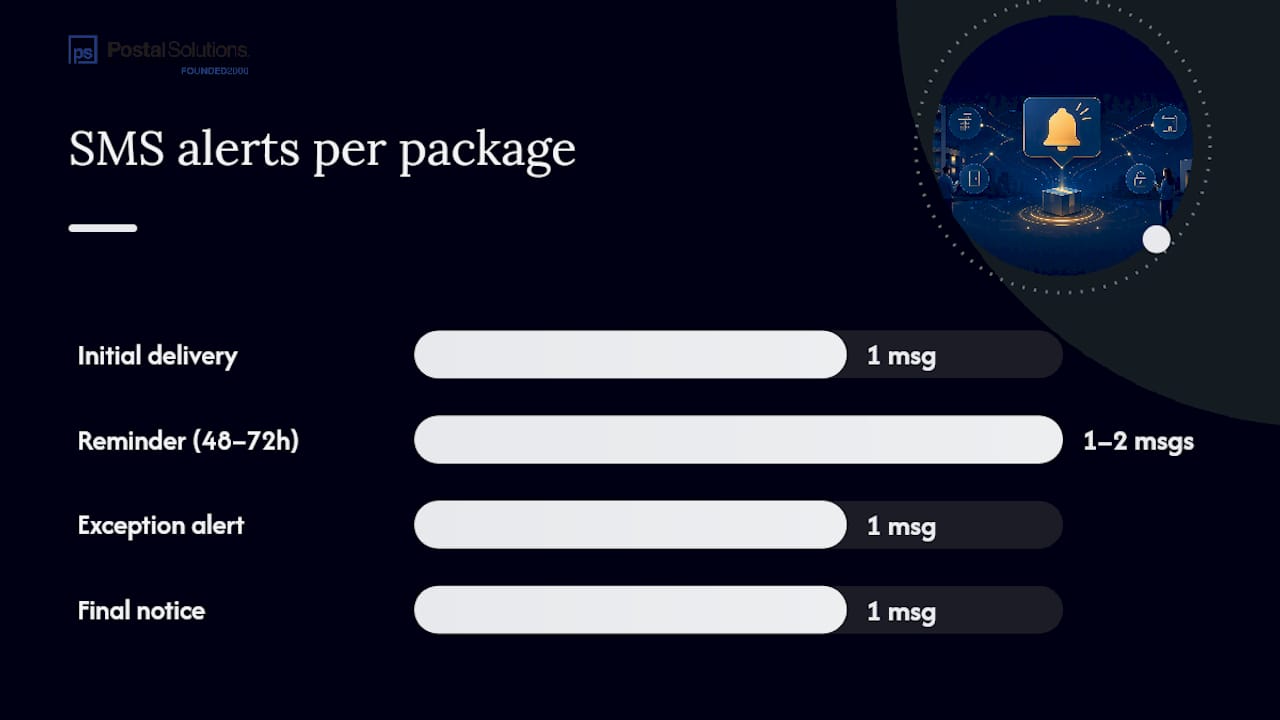
“Reminder: a package for Unit [#] has been waiting 3 days. Please pick up by Friday to avoid return shipping.”
“Your delivery needs signature/refrigeration and is being held at the office. Please contact us to arrange pickup.”
Personalize with a unit number rather than a full last name; it’s enough for identification without putting private information in plain text on a lock screen.
Pro Tip: Cap automated reminders at two per package. A third nudge reads as nagging and drives opt-outs faster than it drives pickups.
Staying Compliant: Consent, TCPA, and FCC Basics
The FCC treats delivery-event messages differently from marketing texts, and that distinction matters for every property manager sending SMS. FCC guidance under the Second Report and Order allows delivery notifications as expected, limited communications. Marketing content, including promotional property messages or renewal upsells, needs prior express written consent, a separate and stricter bar.
Get consent the easy ways first: a lease clause residents initial at move-in, an opt-in checkbox in the resident portal, or a simple signup form at the leasing office. Document the timestamp and method every time. Regulatory enforcement has tightened, and undocumented consent is the single biggest liability gap most communities carry without knowing it.
Statistic Callout: The FCC’s rules now include mandatory blocking requirements for unwanted texts, which raises the operational cost of sloppy consent practices industrywide.
- Never bundle delivery alerts with marketing content in the same opt-in.
- Honor STOP requests immediately and keep a log of who opted out and when.
- Re-confirm consent when a resident’s phone number changes on file.
Setting Up Reliable SMS Alerts: A Rollout Checklist
Getting SMS alerts running without breaking anything takes more than flipping a switch on your property management software. Treat it like any other system rollout: data first, integration second, testing third.
- Audit your resident data. You need a verified phone number, a consent timestamp, and a clean unit mapping for every resident. Build a process for numbers that get reassigned when someone moves out.
- Pick your integration path. Most PMS platforms offer native SMS modules. Locker vendors typically expose webhooks that fire on a scan event. If neither fits, a standalone SMS gateway tied to a carrier tracking API can bridge the gap.
- Choose a sender type deliberately. Short codes handle high volume better and build stronger deliverability across multiple properties, while a long code or 10DLC number works fine for a single, smaller community.
- Build retry logic. A failed send should retry once, then fall back to email so no resident misses a notice entirely.
- Run a 30-day pilot on one or two buildings before rolling out portfolio-wide. Watch for carrier filtering issues and unclear message wording during this window.
Pro Tip: Send yourself and a coworker every alert type during the pilot. Typos and broken merge fields (a text that reads “Hi [First Name]” because the field didn’t populate) get caught in minutes this way, not after fifty residents complain.
Our guide to package notification systems for apartments covers the data-mapping piece in more detail if your resident database needs cleanup first.
Measuring Whether SMS Alerts Are Actually Working
Five numbers tell you whether the rollout is paying off. Track them before you launch and again 30 days in.
- WISMO call volume: total calls or visits asking about package status.
- First-attempt pickup rate: percentage of packages claimed without a reminder.
- Time-to-pickup: average hours between “ready” alert and resident pickup.
- Opt-out rate: percentage of residents who text STOP after enrollment.
- Resident satisfaction: survey score or informal feedback tied to the package process.
Baseline these numbers for two weeks before turning on alerts, then compare against the same window after launch. A pilot on one or two buildings is enough to show a trend without risking a portfolio-wide misstep. Published case results from SMS deployments in property management show the kind of satisfaction gains that justify scaling past the pilot once your own numbers move in the same direction.
What 25 Years of Package Rooms Taught Us About Texting Residents
Staffed package rooms live or die on communication timing, and SMS is the piece that makes an on-site operation feel effortless to residents instead of like a chore for staff. When a dedicated package manager logs an arrival and the system fires a text within minutes, the leasing office stops fielding “did my package come” questions almost entirely.
The properties that get this right treat SMS as part of chain-of-custody, not just convenience. Every text ties to a logged event: who received the package, when, and where it’s stored. That log is what settles disputes before they start.
- Pickup-window cadence (reminders at 48 and 72 hours) keeps shelves from becoming overflow storage.
- Chain-of-custody logging tied to each SMS trigger gives staff and residents a shared record.
- A well-run package room, backed by consistent alerts, becomes a tour amenity leasing teams actively show off.
The Real Bottleneck Isn’t the Text, It’s the Process Behind It
Most advice on SMS package alerts treats the text itself as the hard part: what to write, when to send it, how to sound friendly without sounding spammy. That’s the easy 20%. The actual failure point, in nearly every property we’ve worked with, is what happens before the text fires: who logged the package, whether the data is accurate, and whether anyone is accountable when a resident says they never got notified.
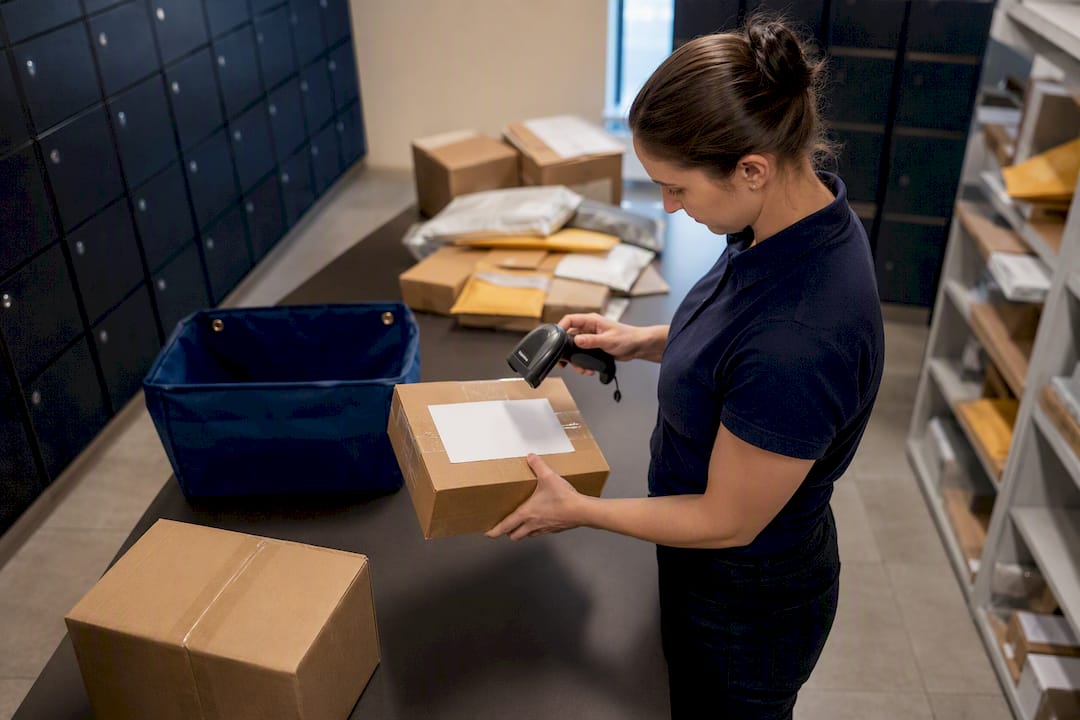
A perfectly worded SMS sent off a sloppy intake process just automates the confusion faster. If your team doesn’t have a consistent chain-of-custody process, adding texting on top of that gap creates a false sense of control. Residents get a notification, then can’t find the package, then call anyway. You’ve added a system without fixing the underlying operation.
Prioritize the intake and logging discipline first. The messaging layer works best once someone (staff or a managed service) is reliably scanning, sorting, and shelving packages the same way every day. A tool like Postal Solutions’ on-site package management exists specifically because texting alone doesn’t solve a broken handoff.
Sources
Sources cited above include the FCC’s Second Report and Order on TCPA implementation and our own package room management guide for managers building a full policy.
- FCC Second Report and Order: Targeting and eliminating unlawful text messages; TCPA implementation (Second Report and Order)
- Upper Inc (blog): SMS vs email delivery notifications
FAQ
What Is an SMS Package Alert?
An SMS package alert is a short automated text notifying a resident that a package has arrived, is ready for pickup, or needs attention due to an exception like damage or oversized dimensions.
Why Am I Getting SMS Text Messages About a Package?
You’re likely enrolled in a property’s or carrier’s delivery notification program, either through a lease agreement, resident portal opt-in, or signup form, which sends automated updates as your package moves through key delivery milestones.
How Do I Stop Unwanted SMS Package Alerts?
Reply STOP to the number sending the alerts. FCC guidance requires senders to honor opt-out requests immediately, and a compliant property or carrier system will remove you from future texts right away.
Are SMS Package Alerts Free for Residents?
Most property-run SMS alert programs don’t charge residents directly, though standard carrier text and data rates from a resident’s own mobile plan may still apply depending on their service.
How Fast Do Residents Actually Read SMS Package Alerts?
Text messages get opened almost immediately. About 98% of SMS messages get opened, and 90% get read within three minutes, far faster than typical email open rates for the same content.
Recommended
Ready when you are
Fix your package room — start with a free proposal
Daily on-site Package Manager, resident text & email pings*, and a tour-ready amenity. Tell us your unit count and we'll send a right-sized proposal — usually within one business day.
- ✓ 10–20+ hours back every week
- ✓ Works with any locker system
- ✓ Faster, friction-free resident pickup
- ✓ An easy ancillary income addition