
August 23, 2026
After Hours Deliveries at Apartments: A 24/7 Access Solution
Enhance your apartment's after hours deliveries with secure 24/7 access. Let professional managers handle packages while you reclaim staff hours.
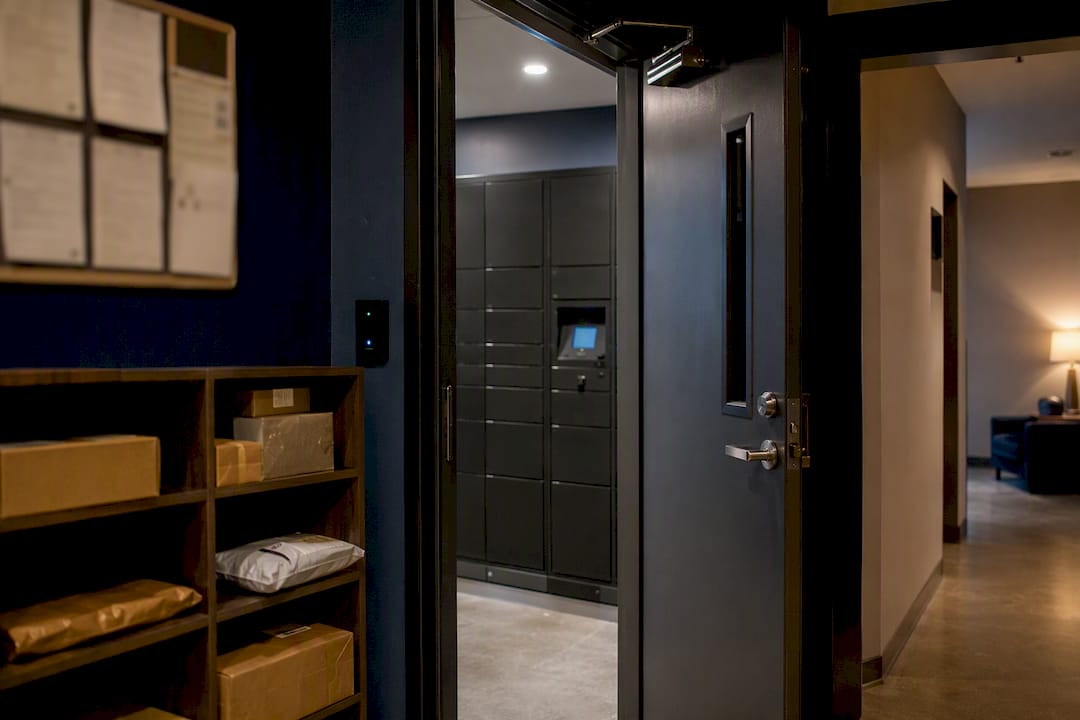
Professional on-site package room management is the most reliable way to handle after hours deliveries at apartments, giving residents secure 24/7 access while freeing leasing staff from box duty entirely. A dedicated on-site Package Manager receives, scans, and shelves every delivery, then residents retrieve their own packages any time, day or night, through the lockers or package room the property already owns.
Two facts back this up. Properties using managed package rooms with immediate notifications have seen residents pick up packages far faster than under staff-dependent systems, and outsourced Package Managers routinely hand staff hours back every week that would otherwise go to sorting boxes.
- Staff hours reclaimed for leasing, renewals, and resident relationships
- Secure 24/7 retrieval through existing lockers or access-controlled rooms
- A downloadable next step: Postal Solutions’ Free Guide to Package Room Management for Apartments covers the full operational model
Key Takeaways
Outsourced, on-site package room management combines immediate notification with 24/7 resident access to cut pickup dwell time and return staff hours to leasing.
| Point | Details |
|---|---|
| Notification speed drives dwell time | Immediate alerts paired with anytime access cut pickup dwell time by 43% in one industry report. |
| Holiday volume needs a plan | Roughly 20% of annual package volume lands in November and December, so peak drills matter. |
| Hybrid capacity beats fixed lockers alone | Open-shelf rooms offer two to three times locker capacity for oversized and overflow items. |
| Security depends on process, not just hardware | Kiosk authentication, cameras, and audit logs work together to protect 24/7 access. |
| Package Room Management professionalizes the operation | Postal Solutions places a dedicated on-site Package Manager up to six days a week to run intake, notifications, and pickup within your existing hardware. |
Table of Contents
- Why Outsourcing After-Hours Package Handling Pays Off
- How Does After-Hours Package Intake Actually Work?
- What Security Measures Protect 24/7 Package Access?
- Handling Oversized, Perishable, and Overflow Deliveries
- How Do You Size Capacity and Staffing for Peak Volume?
- Implementation Checklist and Contract Questions to Ask
- What the Data Actually Tells Us About After-Hours Delivery
- Let a Dedicated Package Manager Run Your After-Hours Operation
- Sources
- FAQ
Why Outsourcing After-Hours Package Handling Pays Off
The math on outsourcing is not close. A leasing team spending an hour or two a day chasing missing boxes, buzzing in drivers, or fielding “where’s my package” calls is an hour or two not spent showing units or renewing leases. Handing that work to a dedicated Package Manager who works the property up to six days a week converts wasted labor into revenue-facing time.
The knock-on effects show up fast. Lobbies stop looking like a FedEx warehouse. Complaint tickets drop because residents stop guessing whether a delivery actually arrived. Prospective renters touring the property see an organized, secure package room instead of a pile of boxes stacked against a wall, and that visual difference closes leases.
Holiday months alone typically account for roughly 20% of a property’s annual package volume, a spike that overwhelms untrained staff but barely dents a professionally run operation built for surges.
- Reclaimed staff hours redirect to leasing and renewals
- Fewer lost-package claims and lobby complaints
- A visibly managed package room becomes a tour amenity
- Ancillary income potential when the service is positioned as a paid resident amenity
Outsourced providers also bring scalable technology and trained labor that most on-site teams never have the bandwidth to build themselves. This is a big part of why the arrangement pays for itself rather than just shifting cost around.
How Does After-Hours Package Intake Actually Work?
A working after-hours system runs on a fixed sequence, not improvisation. Every step exists to answer one question fast: where is a resident’s package right now, and can they get it without waking anyone up?
- Carrier entry. Drivers use a posted PIN, QR code, or designated staging door so after-hours deliveries land in one controlled spot instead of scattered hallways.
- Scan and log. Every parcel gets barcode or QR scanned into a chain-of-custody system the moment it arrives, tying it to a unit number and timestamp.
- Shelve and secure. Packages go into the room or locker bank in a location that matches the log entry, so retrieval never becomes a scavenger hunt.
- Notify. The resident gets an automatic text or email the moment their package is logged, with retrieval instructions.
- Retrieve. Residents use a kiosk PIN, QR scan, or locker code to open the exact compartment holding their delivery, any hour of the day.
- Follow up. Automated nudges go out at 48 and 96 hours for anything still sitting unclaimed.
This isn’t a nice-to-have workflow. Immediate notification paired with anytime access cut pickup dwell time by 43% in one industry report, which matters because every hour a package sits unclaimed is an hour it’s taking up shelf space someone else needs.
Pro Tip: Post carrier instructions right at the delivery entrance, not buried in an email. Clear on-site SOPs cut down on drivers leaving packages in random spots because they couldn’t find the right drop point.
What Security Measures Protect 24/7 Package Access?
Giving residents round-the-clock access only works if the system knows exactly who opened what and when. That accountability is what separates a secure package room from a pile of boxes with a lock on the door.
Kiosks that require a unique PIN or QR code tie every retrieval to a specific resident, and access-controlled lockers and rooms log that action automatically. Cameras covering the intake and pickup zones, combined with motion or presence sensors, create a visual record that backs up the digital log if a dispute ever comes up.
- Kiosk authentication (PIN, QR, or app-based code) tied to each resident
- Camera coverage over intake and retrieval zones
- Auditable logs linking every scan to a timestamp and unit
- Defined rules for guest or visitor pickup authorization
- Escalation steps for carriers who bypass posted procedures
Reduced dwell time isn’t just a convenience metric. Faster pickup after immediate notification means fewer packages sitting exposed in a shared space overnight, which is where most theft and mishandling disputes originate.
Integration with the building’s existing access control system matters too. If the package room shares credentials with the main entry system, residents don’t need a separate fob just to grab a delivery, and staff aren’t managing two disconnected security platforms.
Handling Oversized, Perishable, and Overflow Deliveries
Standard lockers were never built for a mattress topper, a case of wine, or a grocery delivery that needs refrigeration. A working system sets rules for these exceptions before they happen, not after a driver is stuck holding a box with nowhere to put it.
- Designate a labeled oversized zone near the package room for anything too big for standard compartments
- Set a refrigerated bin policy with strict time limits and immediate resident notification for perishables
- Convert an adjoining amenity or storage room into temporary overflow space during predictable surges
- Notify carriers immediately on any return-to-sender or misdelivery situation so it doesn’t sit unresolved
Open-shelf package rooms generally offer significantly higher capacity than a locker bank in the same footprint, which is exactly why many properties run a hybrid model. Lockers handle routine daily volume; the room absorbs everything odd-shaped, cold, or oversized that a fixed compartment can’t. For a deeper look at what qualifies as a special delivery and how to route it, see how to handle special deliveries in multifamily housing.
How Do You Size Capacity and Staffing for Peak Volume?
Right-sizing a package operation means planning for the worst week of the year, not the average one. A property that builds capacity only for a typical Tuesday in March will drown every December.
- Estimate shelf or locker capacity against unit count, then multiply by a peak factor for November and December volume.
- Choose a staffing model: a dedicated on-site Package Manager, shared leasing staff pulling double duty, or a vendor-managed daily service.
- Run a one-hour holiday peak drill before the surge hits, walking staff through intake, sorting, and escalation roles in real time.
- Add temporary runner shifts or vendor support during the two to three weeks of heaviest volume rather than year-round.
- Track three numbers weekly: parcel count, pickup dwell time (target under 48 hours during peak), and complaints per 100 packages.
Running a live-flow drill before the holiday rush exposes bottlenecks while there’s still time to fix them, instead of discovering the intake process breaks down on the one day 300 packages show up at once.
Pro Tip: Watch dwell time, not just parcel count. A property receiving fewer packages but taking twice as long to clear them has a bigger operational problem than one drowning in volume but turning shelf space over daily.
Implementation Checklist and Contract Questions to Ask
Before signing any service agreement, or building the program in-house, run it against a short list of non-negotiables. Missing one of these is usually what turns a good idea into a support headache six months later.
- Service days and hours the Package Manager or vendor is on-site
- Defined service levels for notification speed and pickup handling
- Liability and insurance coverage terms for lost or damaged parcels
- Scanning technology, audit logs, and PMS or access-control integration
- Daily parcel counts and weekly audit reporting
- Staff training requirements and documented holiday surge support
- Reporting cadence and remedies if service levels are missed
A multifamily property management guide is worth reviewing alongside this checklist if you’re also revisiting broader staffing roles and KPI structures across the property.
| Requirement | Why It Matters |
|---|---|
| Defined service days/hours | Confirms after-hours coverage matches actual delivery patterns. |
| Notification and pickup SLAs | Sets a measurable standard for how fast residents get access. |
| Insurance and liability terms | Protects the property if a package is lost or damaged on-site. |
| Audit logs and PMS integration | Creates a traceable record tied to your existing systems. |
What the Data Actually Tells Us About After-Hours Delivery
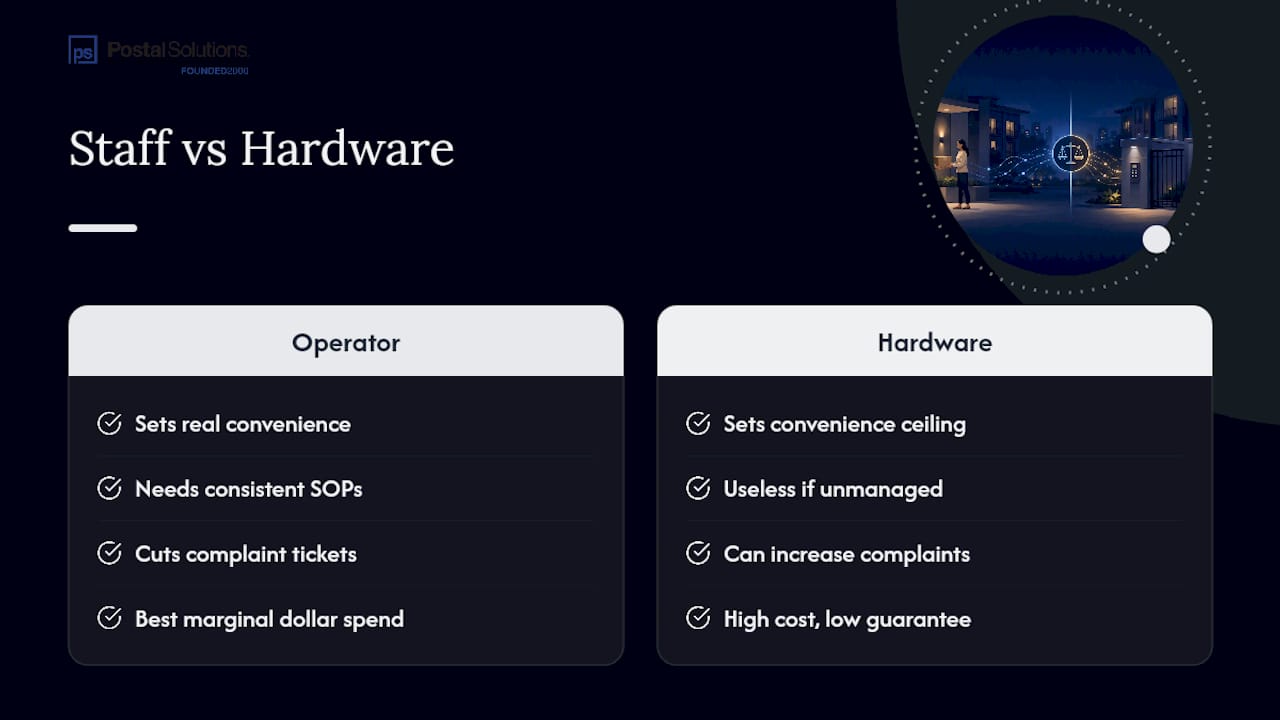
Most advice on this topic treats package handling as a hardware problem: buy better lockers, add more compartments, solve it with equipment. That’s backwards. The data points toward a staffing and process problem wearing a hardware costume.
Faster pickup times don’t come from bigger lockers. They come from immediate notification and a resident who trusts the log is accurate enough to walk over without calling the office first. A property can install the most expensive smart locker bank on the market and still generate complaint tickets if nobody scans packages consistently or if carriers routinely dump deliveries in the wrong spot.
The conventional wisdom oversells the equipment and undersells the operator. Hardware sets the ceiling on convenience; a trained Package Manager running consistent SOPs is what determines whether a property actually hits that ceiling. If you’re deciding where to spend the next dollar, spend it on the person running the room before the room itself. Fix the process first, and the locker or room you already have will outperform a bigger investment in equipment nobody is managing well.
Let a Dedicated Package Manager Run Your After-Hours Operation
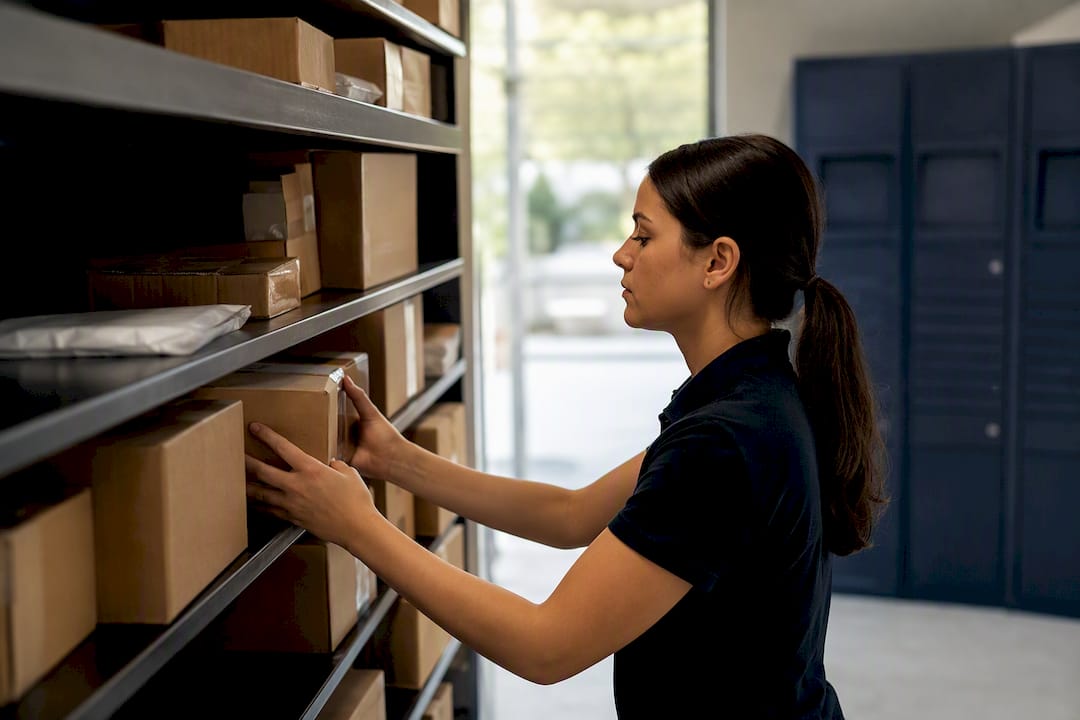
Postal Solutions puts a dedicated on-site Package Manager on your property up to six days a week, running the intake, scanning, and notification process so your leasing team never has to touch a box again. The service works with the lockers or package room you already have installed, no rip-and-replace hardware required.
Twenty-five years of running on-site package operations has shown us the same thing over and over: properties that treat package handling as a staffed service, not a piece of equipment, get faster pickup times and fewer complaints. That experience shapes how each Package Manager is trained, and it’s why the model integrates cleanly whether your property runs smart lockers, an open-shelf room, or a hybrid of both.
Requesting a site assessment gets you a proposal built around your unit count, current hardware, and delivery volume, not a generic quote. Start by downloading the Free Guide to Package Room Management for Apartments to see exactly how the daily operation runs before you request that assessment.
Sources
- Package Management (NAAHQ)
- Overcoming the Fear of Outsourcing - The Multifamily Journal
- From Boxes to Competitive Edge: Best Practices for Multifamily Package Management
- Smart Package Room — Multifamily solution
FAQ
What Counts as an After-Hours Delivery at an Apartment?
Any package a carrier drops off outside the leasing office’s staffed hours counts as an after-hours delivery, and it needs a secure landing spot, whether a locker bank or an access-controlled package room, so residents can retrieve it without staff present.
How Fast Should Residents Get Notified After a Package Arrives?
Notification should happen the moment a package is scanned into the system. Immediate notification tied to anytime access has been shown to cut pickup dwell time by 43% compared to delayed or manual alerts.
Can Package Room Management Handle Oversized or Perishable Items?
Yes. A managed package room sets aside a labeled oversized zone and a refrigerated bin policy with strict time limits, which is something fixed lockers generally can’t accommodate on their own.
Does Outsourcing Package Handling Actually Save Staff Time?
It does. Outsourcing reduces overhead and frees on-site teams to focus on leasing and resident relationships instead of sorting and tracking deliveries, and Package Room Management structures that time recovery around a dedicated on-site Package Manager rather than shared staff picking up the slack.
What Should Go Into a Package Management Contract?
At minimum, the contract needs defined service days, notification and pickup service levels, insurance terms, audit reporting, and integration requirements with your existing locker or access-control hardware.
Recommended
Ready when you are
Fix your package room — start with a free proposal
Daily on-site Package Manager, resident text & email pings*, and a tour-ready amenity. Tell us your unit count and we'll send a right-sized proposal — usually within one business day.
- ✓ 10–20+ hours back every week
- ✓ Works with any locker system
- ✓ Faster, friction-free resident pickup
- ✓ An easy ancillary income addition