
August 25, 2026
Package Room Staffing: What It Delivers and What It Costs
Discover how effective package room staffing transforms your leasing operations, enhances resident satisfaction, and reduces missing-package complaints.
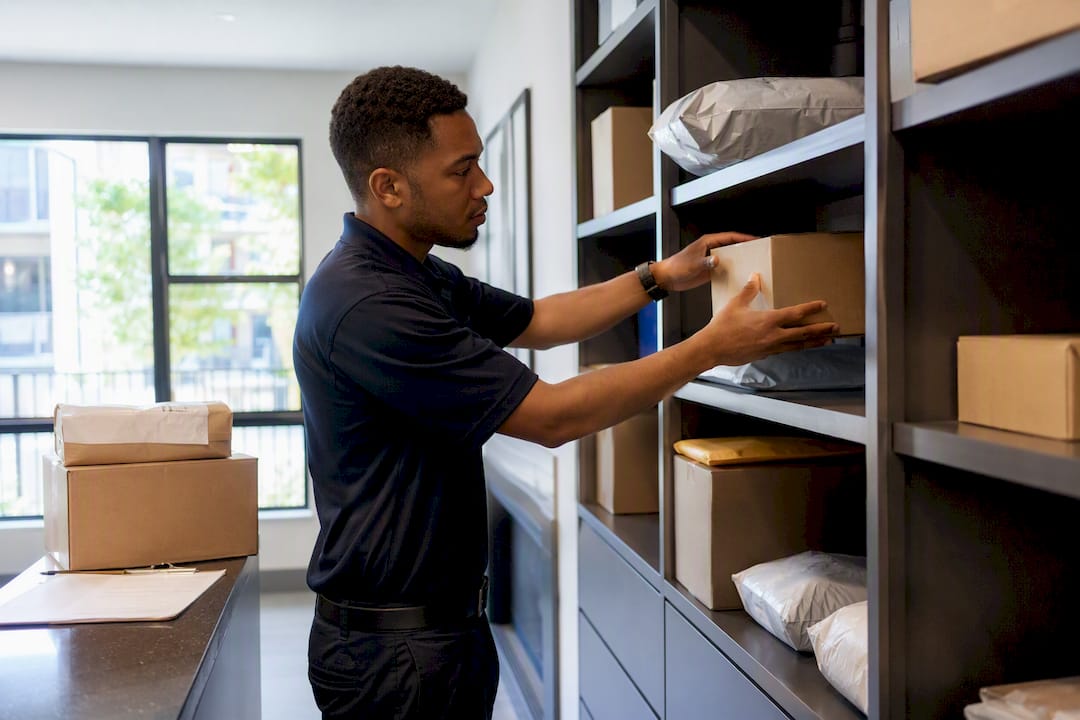
For apartment and student housing communities that want packages off the leasing desk, staffed on-site package room management, a dedicated Package Manager plus daily operations is the fastest, lowest-risk path. It hands leasing staff back their week, turns a cluttered lobby into a selling point on tours, and cuts the missing-package complaints that eat into renewals.
- Track your weekly package count for two weeks before you call anyone.
- If your team is spending more than a few hours a week sorting boxes, you already have your answer.
- Next step: schedule a scoping call and bring that number with you.
Key Takeaways
Staffed on-site package room management recovers leasing staff hours, cuts resident complaints, and turns package handling into a visible amenity instead of a clerical burden.
| Point | Details |
|---|---|
| Check your volume first | Track weekly package counts for two weeks before evaluating any staffing solution. |
| Define the SOW clearly | Require coverage hours, notification SLA, audit schedule, and carrier compliance terms in writing. |
| Watch dwell time | Keep pickup time under 48 hours during peak periods to catch problems early. |
| Match hardware to volume | Use lockers for routine parcels and a staffed room for oversized, refrigerated, or overflow items. |
| Contract Package Room Management | Postal Solutions provides a dedicated Package Manager, ready-made SOPs, and a monthly operations readout. |
Table of Contents
- Which Properties Actually Need Package Room Staffing?
- What Does a Dedicated Package Manager Actually Do?
- How Do You Evaluate Pricing and Set the Right Staffing Level?
- Lockers, Package Rooms, or Both?
- What SOPs and KPIs Should You Track?
- Why Package Room Staffing Is an Amenity Play, Not a Cost Center
- How Postal Solutions Runs Your Package Room for You
- Sources
- FAQ
Which Properties Actually Need Package Room Staffing?
Not every property needs a dedicated Package Manager on day one, but the signs are easy to spot once you look for them. The average community now receives close to 150 packages a week, and a third of leasing teams report spending more than four hours weekly just managing deliveries. That’s nearly a full workday lost to sorting boxes instead of touring prospects.
Run this triage before you decide anything:
- Fit now: 100+ units, no dedicated package staff, frequent oversized or refrigerated deliveries, or after-hours access complaints.
- Maybe soon: 50 to 100 units, seasonal spikes during move-in or holidays that overwhelm a system that’s otherwise fine.
- Not yet: Under 50 units, low package mix, existing staff absorbing the load without visible strain.
Pro Tip: If you’re not sure which bucket you’re in, count packages for one week including a Monday, since parcel volume compounds hard after weekends.
What Does a Dedicated Package Manager Actually Do?
A staffed package room isn’t just someone standing near a shelf. It’s a defined workflow that starts the moment a carrier walks in and doesn’t end until the resident has their item in hand.
The intake process typically includes:
- Carrier staging and a logged handoff at a designated intake zone
- Chain-of-custody logging for every parcel, including who received it and when
- Sorting and shelving by unit, with separate handling for oversized freight and refrigerated or perishable deliveries
- Resident notification by text or email the moment a package arrives
- Signature-required pickup handoffs and weekly audits to catch discrepancies before they become disputes
Without a staffed process, the math turns brutal. At properties running 75 packages a day with no system, each parcel can require four to five separate staff touches. At five minutes per touch, that’s over six hours of staff time lost daily, just from re-handling, re-sorting, and answering “where’s my package” emails.
A properly staffed operation also absorbs holiday surges without falling apart, integrates with whatever locker or room hardware the property already owns, and manages overflow when volume spikes past normal capacity.
How Do You Evaluate Pricing and Set the Right Staffing Level?
Most vendors price on one of a few models: a flat per-property fee, a per-unit per-month rate, or a base fee plus surcharges during holiday and move-in peaks. Ancillary services like resident amenity fees can offset part of the cost, sometimes fully.
Before signing anything, your scope of work should spell out:
- Coverage hours and days per week the Package Manager is on-site.
- Notification SLA, meaning how fast residents get alerted after a delivery lands.
- Audit schedule, ideally weekly, with a documented discrepancy process.
- Liability and insurance clauses covering lost, damaged, or misdelivered packages.
- Carrier compliance terms that state exactly how the vendor detects and responds to drivers who skip the intake procedure, since non-compliant carriers are the most common failure point in package operations.
For a rough ROI check, multiply the hours your leasing staff currently loses to packages by their hourly wage, then compare that to the monthly service fee. Layer in softer benefits, fewer lost-package claims, better tour optics, and reduced turnover friction from residents who’ve had a bad delivery experience, and the math usually favors staffing over doing nothing.
Pro Tip: Ask any vendor for a sample SOP and a monthly reporting template before you sign. If they can’t produce one, that’s a red flag, not a formality.
Lockers, Package Rooms, or Both?
The right physical setup depends on your building’s capital budget, staffing reality, and package mix. There’s no universal winner here, only trade-offs.
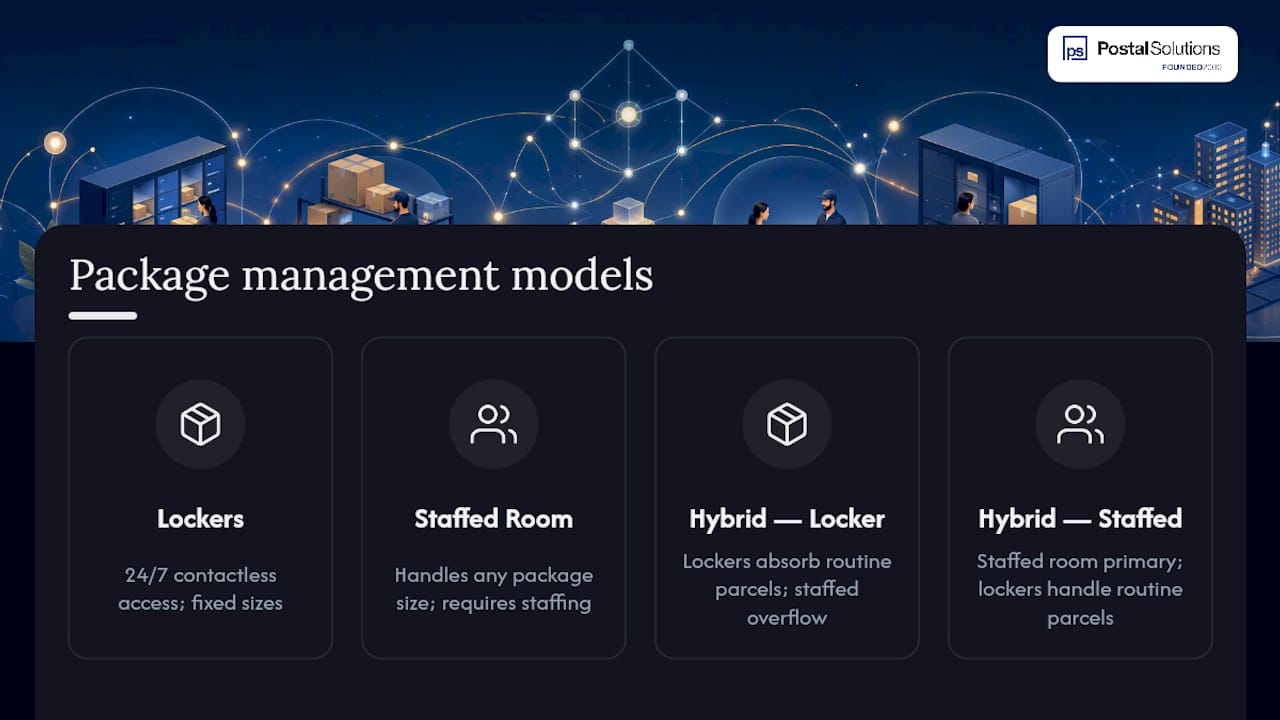
Lockers give residents 24/7 contactless access and a clean digital audit trail, but they come with fixed compartment sizes and real capital expense. Locker deliveries spike hard during peak shopping weeks, and oversized or perishable items simply don’t fit.
Staffed package rooms flex to any package size, handle refrigerated deliveries, and adapt footprint as volume grows. They require ongoing staffing, which is exactly what a contracted Package Manager solves.

Hybrid setups split the difference: lockers absorb routine parcels, while a staffed room handles overflow, oversized freight, and exceptions lockers can’t process. A framework for matching solution type to property type suggests four common models, ranging from smart lockers alone to fully staffed rooms with hybrid coverage.
Before integrating any staffing solution with existing hardware, confirm access control compatibility, camera coverage of the intake zone, a defined carrier workflow, and notification system integration so residents get one consistent alert, not three.
What SOPs and KPIs Should You Track?
A workable SOP is short enough to post on a wall: intake, log, notify, pick-up, overflow. Print it, laminate it, and put it where the courier can see it.
Three KPIs matter more than any others:
- Daily parcel count, which tells you when you’re approaching capacity.
- Dwell time, the gap between arrival and pickup. Keep it under 48 hours during peak periods.
- Complaints per 100 packages, your cleanest signal for whether the system is actually working.
Run a one-hour holiday drill before the surge hits: confirm overflow space, line up temporary runner shifts, and walk the team through what happens if volume triples in a single week. A monthly operations readout, parcel count, dwell time, complaint rate, sent to owners and asset managers keeps everyone looking at the same numbers instead of guessing.
Why Package Room Staffing Is an Amenity Play, Not a Cost Center
Most owners still think about package handling as a problem to minimize. That’s backward. The properties getting real value out of staffing treat it as a resident-facing amenity with a line on the tour script, not a clerical function buried behind the leasing desk.
The conventional advice, “just add more shelving” or “buy more lockers”, misses the actual bottleneck. Hardware doesn’t log chain-of-custody, doesn’t catch carrier non-compliance, and doesn’t call a resident when their refrigerated delivery needs to move fast. People do that. Twenty-five years of running package operations for multifamily and student housing communities makes one thing obvious: the properties that struggle aren’t under-equipped, they’re under-staffed on the one function residents interact with every single week.
If you take one thing from this, prioritize the notification and dwell-time discipline before you spend a dollar on new hardware. A staffed process with a sample SOP and a monthly readout will outperform a locker wall with no accountability behind it, every time. Fix the process first. Hardware decisions get easier after that.
— Postal Solutions
How Postal Solutions Runs Your Package Room for You
Postal Solutions has spent 25 years doing exactly what this article describes: putting a dedicated Package Manager on-site, up to six days a week, running the full intake-to-pickup workflow so your leasing team never touches another box.
That’s the practical difference versus handling packages internally or hoping a locker wall solves everything on its own: no hiring, no training, no covering shifts when someone calls out, just a trained professional who logs, sorts, notifies, and audits every day. We work with whatever locker or package room hardware you already have, and we bring ready-to-adopt SOPs and a sample guide so you’re not building a process from scratch.
A scoping conversation covers your weekly volume, available space, current staffing pain points, and which pricing model fits your property, per-unit, per-property, or a hybrid with ancillary resident fees. Download the free package room management guide to see the SOPs firsthand, or request a property scoping call to get a number for your building this week.
Sources
- NAAHQ — Package management guidance
- Apartment List — Best practices for multifamily package management
- Insights by Blueprint — Framework for solving multifamily package management
- Multifamily & Affordable Housing — What package wrangling is costing your team
FAQ
What Is On-Site Package Room Management?
It’s a staffed service where a dedicated Package Manager handles carrier intake, sorting, logging, resident notifications, and audits for a property’s package room or lockers, typically up to six days a week.
How Much Does Package Room Staffing Cost?
Pricing usually runs on a per-property flat fee or per-unit per-month rate, sometimes with peak-season surcharges, and can be partly offset through resident amenity fees.
Do I Need Lockers Before I Can Add Staffing?
No. Staffed package room management works with existing lockers, a dedicated room, or no hardware at all, and Package Room Management integrates with whatever system a property already has in place.
What KPIs Should I Ask a Vendor to Report?
Ask for daily parcel volume, dwell time (targeting under 48 hours at peak), and complaints per 100 packages, delivered through a monthly operations readout.
What’s the Biggest Risk in a Package Staffing Contract?
Carrier non-compliance, drivers skipping intake procedures, is the most common failure mode, so your contract should specify exactly how the vendor detects and handles it.
Recommended
- Package Management Cost: What Property Managers Actually Pay — Postal Solutions Blog
- Package Room Management for Apartments: A Manager’s Guide — Postal Solutions Blog
- Package Room Reviews: What Property Managers Should Check — Postal Solutions Blog
- Package Notification System for Apartments: A Manager’s Guide — Postal Solutions Blog
Ready when you are
Fix your package room — start with a free proposal
Daily on-site Package Manager, resident text & email pings*, and a tour-ready amenity. Tell us your unit count and we'll send a right-sized proposal — usually within one business day.
- ✓ 10–20+ hours back every week
- ✓ Works with any locker system
- ✓ Faster, friction-free resident pickup
- ✓ An easy ancillary income addition