
August 9, 2026
Package Room Policy for Property Managers: Ready-to-Adopt Rules
Discover essential rules for an effective package room policy that streamline deliveries and enhance resident satisfaction. Adopt these guidelines today!
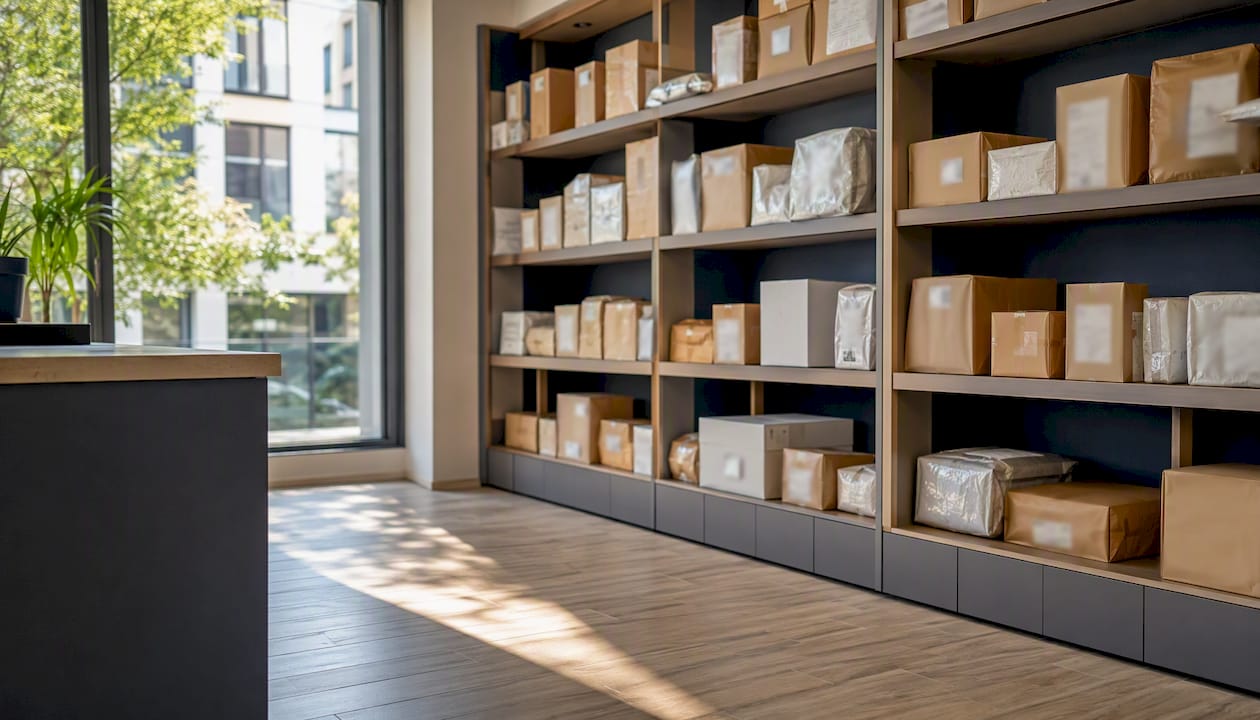
A solid package room policy comes down to six enforceable rules: packages must be addressed with the resident’s full name and unit number; only designated staff or automated lockers accept deliveries; residents must show photo ID and sign at pickup; unclaimed packages are held 3–5 business days before a return-to-sender notice is issued; no perishables, hazardous materials, or food delivery is accepted on behalf of residents; and a signed waiver addendum at move-in limits property liability. That’s the core. Everything below gives you the clauses, templates, and operational steps to put it into practice today.
Your package room policy must include:
- Addressing format requirement (resident full name + unit number on every package)
- Designated acceptance points (package room, smart lockers, or leasing office only)
- Photo ID verification and resident signature at every pickup
- Storage window of 3–5 business days with escalating reminders at 48 and 96 hours
- Return-to-sender or disposal procedure after the storage window closes
- Waiver-of-liability addendum signed at move-in
- Clear exclusions: no perishables, no hazardous items, no food or same-day delivery acceptance
Post the acceptance rules and pickup window at the package room entrance today. Install the package log template and waiver addendum this week.
Key Takeaways
A defensible package room policy requires clear acceptance rules, a 3–5 business day storage window, photo ID verification at pickup, a signed waiver addendum at move-in, and a dedicated Package Manager to keep the operation running consistently.
| Point | Details |
|---|---|
| Address format is non-negotiable | Every package must show resident full name and unit number; misaddressed items go to a 24-hour pending hold. |
| 3–5 day storage window | Hold packages a few business days under normal conditions; extend the window somewhat during peak periods with additional reminders. |
| Unit-number labeling at intake | Organizing shelves by unit number, not arrival date, is the single highest-leverage operational change for retrieval speed and audit accuracy. |
| Hybrid locker + staffed room | Smart lockers handle standard deliveries; a staffed room manages oversized, perishable, and exception items, per NAA guidance. |
| Postal Solutions | Postal Solutions’ On-Site Package Room Management provides a dedicated Package Manager, chain-of-custody logging, and resident notifications, freeing leasing staff for higher-value work. |
Table of Contents
- What does a package room policy require?
- Step-by-step intake, logging, notification, and pickup
- How long should you hold packages before returning them?
- Handling oversized, refrigerated, and hazardous items
- What technology does a package room actually need?
- Staff roles, training, and auditing
- Copy-ready templates for your package room
- Peak season and capacity planning
- Legal considerations for U.S. residential communities
- Your 30/60/90-day rollout plan
- What most properties get wrong about package management
- Postal Solutions handles the package room so your team doesn’t have to
- Sources
- FAQ
What does a package room policy require?
A defensible apartment package policy starts with clear acceptance and addressing rules written into the lease addendum, not just posted on a sign.
Acceptance clause
Staff accepts packages only when the item is addressed to a current resident with a matching unit number. Carriers who arrive outside staffed hours must leave items in the designated locker bank or return the parcel. The property does not accept packages addressed to former residents, businesses operating from a residential unit, or third parties not listed on the lease.
Same-day vendors and food delivery services (DoorDash, Instacart, Amazon Fresh) are explicitly excluded from staff acceptance. Residents must receive those deliveries in person at the lobby or building entrance.
Address format requirements
Require residents to use this format on all incoming parcels:
- Multifamily: Resident Full Name / Unit [Number] / [Property Street Address] / City, State, ZIP
- Student housing: Resident Full Name / Building [Name or Letter] / Room [Number] / [Campus Mailing Address]
Publish this format in the resident portal, the welcome packet, and on signage at the package room entrance. Misaddressed packages that arrive without a unit number are held in a “pending” section for 24 hours; if the resident cannot be identified, the item is refused or returned.
Who may accept packages
| Acceptance point | Eligible items | Notes |
|---|---|---|
| Smart locker bank | Standard parcels within locker dimensions | Resident retrieves via PIN or app |
| Staffed package room | All standard parcels, oversized items | Staff logs and notifies resident |
| Leasing office | Overflow only, during staffed hours | Not a permanent acceptance point |
The front desk package policy should state explicitly that the leasing office is a backup, not a primary intake point. Keeping boxes off the front desk preserves lobby optics and protects leasing staff time.
Carrier access and staging rules
Post a carrier instruction placard at the delivery entrance specifying the staging zone, the locker bank location, and the staffed room hours. Carriers should not stage packages in the lobby, elevator, or mail room. Oversized items that exceed locker dimensions go to the designated overflow staging area; drivers must knock or ring the package room doorbell rather than leaving items unattended in a hallway. The NAA guidance notes that properties declining package acceptance risk marketability damage, so a clear intake zone is preferable to a blanket refusal policy.
Step-by-step intake, logging, notification, and pickup
Intake procedure
When a carrier arrives, staff directs them to the designated staging area and verifies the delivery address matches a current resident. Staff scans or manually records the tracking number before the carrier leaves. Each package gets a unit-number label applied at intake, organized on shelving by unit rather than by arrival order. Organizing by unit number is the single highest-leverage change most properties can make: retrieval time drops, audits take minutes instead of an hour, and misdeliveries surface immediately.

Package log fields
Notification cadence
Send the first notification within 15 minutes of logging. Residents pick up packages 43% faster when they receive an immediate arrival notice combined with anytime access. A practical three-touch cadence:
- Arrival notice (within 15 minutes): “A package for Unit [X] arrived today. Pick up by [hold-until date] during [hours].”
- 48-hour reminder: “Your package is still waiting. Please pick up by [hold-until date] to avoid return to sender.”
- Final notice (96 hours): “Your package will be returned to sender on [date] if not picked up. Contact [staff contact] with questions.”
Carrier facility holds commonly run 12–48 hours before a parcel reaches the property, so build that context into your arrival notice language when residents ask why a package is “late.”
Pickup verification
Residents present a government-issued photo ID or their resident portal credential. Staff confirms the unit number matches the log, retrieves the item, and captures a signature. For guest or authorized-representative pickup, the resident must submit written authorization (email or portal message) in advance; the authorized person still shows photo ID, and staff notes the authorization in the log.
Pro Tip: Set up a simple digital signature pad or a free e-signature link in your notification email so residents can pre-authorize a guest pickup without a phone call to the office.
Exception handling
- Perishables: Notify the resident immediately by phone, not just text. Hold no longer than 4 hours; if unclaimed, document and dispose.
- Hazardous or suspicious items: Do not open. Isolate the item, contact building management and local authorities if warranted, and document the incident.
- Oversized items: Log normally, place in the overflow staging area, and note dimensions in the log.
- Misdelivered packages: Do not open. Mark “misdelivered,” attempt carrier contact within 24 hours, and document in the log.
How long should you hold packages before returning them?
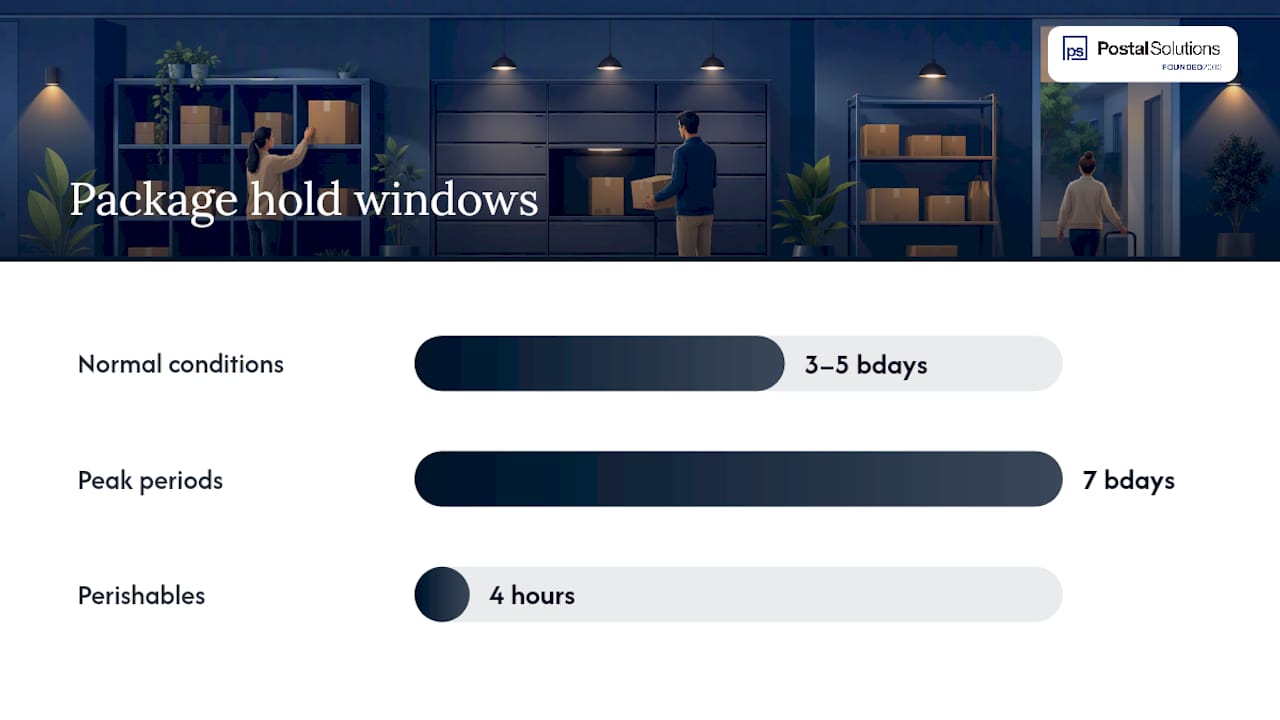
Best-practice mailroom guidance recommends a 3–5 business day pickup window under normal conditions, with escalating reminders before any return-to-sender action. That window is short enough to prevent storage overflow and long enough to give working residents a fair chance to collect.
Standard storage windows:
- Normal conditions: 3–5 business days from the date of the arrival notice
- Peak periods (November–January, move-in weeks): extend to 7 business days with an additional reminder at day 5
- Perishables: 4 hours maximum from arrival notice
Overflow rules:
When the package room reaches capacity, overflow items move to a designated secondary staging area (a locked closet, a leasing office back room, or an adjacent storage unit). Never stage overflow in the lobby, hallways, or mail room. Document the secondary location in the package log.
Fee options:
Charging a storage fee after the standard window is reasonable and increasingly common in larger communities. If you implement fees, the notice language must be transparent: state the daily rate, the start date, and the payment method in the 96-hour final notice. Many communities skip fees entirely and rely on the return-to-sender policy as the enforcement mechanism.
Return-to-sender workflow:
- Send the final notice at 96 hours.
- Wait the full hold period.
- Document the return in the log (date, carrier contact method, tracking number).
- Affix a “Return to Sender — Unclaimed” label and hand off to the outgoing carrier or schedule a pickup.
- Retain the log entry for 90 days minimum.
Handling oversized, refrigerated, and hazardous items
Most package rooms are designed around standard parcel dimensions. Items outside those dimensions need a separate decision tree, and staff should be able to apply it without calling a manager.
Oversized thresholds (suggested):
- Any single dimension exceeding 36 inches
- Combined girth + length exceeding 130 inches (the USPS standard for oversized parcels)
- Weight exceeding 70 lbs
Items meeting these thresholds go to the overflow staging area, not on standard shelving. Log them normally and add “OVERSIZED” to the description field. Notify the resident by phone in addition to the standard text or email.
Perishable policy snippet:
Hazardous items:
Staff should not accept packages labeled with hazardous material indicators (flammable, corrosive, explosive, biohazard). If a delivered item is suspected to be hazardous after arrival, isolate it, do not open it, and follow the property’s emergency protocol. Document the incident and notify building management immediately.
Same-day and third-party delivery exceptions:
Food delivery and same-day courier services (Amazon Flex, Instacart, local couriers) are not accepted by staff. Post this exclusion at the delivery entrance and in the resident portal. If a resident requests an exception for a medical supply or prescription delivery, document the request, obtain written resident authorization, and log the item as a special acceptance with a 4-hour hold limit. For more on smart locker alternatives that handle perishable-compatible compartments, see the linked guide.
What technology does a package room actually need?
The answer depends on volume, but most communities above 100 units benefit from a hybrid setup: smart lockers handle the bulk of standard deliveries, and a staffed room manages the exceptions lockers can’t. The NAA white paper recommends this hybrid model specifically because it balances security, convenience, and the reality that a meaningful share of deliveries will always be oversized, perishable, or otherwise locker-incompatible.
What the hybrid model looks like day-to-day
Carriers scan into the locker bank first. Standard parcels drop into an available compartment, and the resident gets an automated PIN or QR code. Oversized, refrigerated, or flagged items go to the staffed room, where a Package Manager logs them and sends a manual notification. Residents who miss the locker pickup window (typically 3 days) get a reminder; unclaimed items transfer to the staffed room for the final hold period.
Locker selection checklist
- Size mix: at least 30% large compartments (for shoe boxes, apparel, and small appliances)
- Access control: PIN, mobile app, or QR code with audit trail
- Maintenance: clarify whether the vendor or the property handles hardware service
- Connectivity: confirm cellular or Wi-Fi backup so outages don’t lock residents out
- Integration: confirm the locker system exports a log compatible with your property management software
Integrations that reduce staff hours
A package notification system that connects locker events, manual log entries, and resident contact data into a single dashboard cuts the notification workload to near zero. The minimum viable stack: carrier barcode scanning at intake, automated SMS/email on locker assignment or manual log entry, and a camera covering the intake zone and locker bank for audit purposes.
KPIs to track:
- Average dwell time (target: under 24 hours for locker items, under 48 hours for staffed-room items)
- Pickup rate within the standard window (target: 90%+)
- Complaints per 100 packages received (target: under 2)
Staff roles, training, and auditing
Role definitions
Intake staff receive carriers, verify addresses, scan or log tracking numbers, apply unit-number labels, and place items on shelving or in the overflow area. The Package Manager (or designated lead) owns the daily log, sends manual notifications, handles exception escalations, and conducts the weekly audit. At properties using Postal Solutions’ On-Site Package Room Management, a dedicated Package Manager fills this role up to six days a week. The overflow runner moves items between the primary room and secondary staging during peak periods. The carrier point of contact is the staff member carriers call when they have a delivery question; post this person’s name and a direct number at the delivery entrance.
Shift coverage
Package intake peaks between 10 AM and 3 PM on weekdays. Schedule at least one trained staff member during that window every day. During peak seasons (November through January, August move-in), add a second intake person for the 11 AM–2 PM window. ACMO’s concierge guidance recommends auditing parcels at every shift change, a practice that catches misplaced items before they become complaints.
Training checklist (numbered for onboarding use)
- Review the property’s package room policy and lease addendum language
- Practice the intake labeling standard: unit number on every package before shelving
- Walk through the package log fields and demonstrate a complete entry
- Practice the three-touch notification cadence using the property’s SMS/email platform
- Review resident verification: photo ID check, signature capture, authorized-representative protocol
- Walk the overflow staging area and confirm secondary location is documented
- Review the exception decision tree: perishables, hazardous items, oversized, misdelivered
- Complete a mock shift-change audit: count packages on hand, verify against the log
Audit schedule
- Daily: Count packages on hand at shift change; flag any item whose hold-until date has passed.
- Weekly: Full reconciliation of the log against physical inventory; document discrepancies.
- Monthly: Review complaint log, dwell time averages, and pickup rate; adjust notification cadence if pickup rate falls below 90%.
Safety protocols: Staff should use a hand truck or dolly for any item over 30 lbs. Suspicious packages (unusual odor, leaking, no return address combined with excessive postage) are isolated and reported immediately; staff do not attempt to open or move them further.
Copy-ready templates for your package room
Resident-facing policy text (for lease addendum or resident portal)
Package log template
Waiver-of-liability language (move-in addendum)
The NAA guidance recommends including this waiver at move-in to set expectations and limit property exposure. Have residents sign it as part of the lease addendum, not as a separate standalone document.
Package room signage text
Delivery entrance sign: Pickup window sign: For resident-facing templates and a downloadable policy pack, the linked guide includes print-ready versions of these notices.
Peak season and capacity planning
Holiday volume is not a surprise. Smart locker deliveries spike 75% in the week after Black Friday compared with the prior week, and August move-in weeks at student housing communities can match or exceed that volume. Plan for it in October and July, not the week it hits.
Peak planning checklist:
- Confirm overflow staging capacity at least 30 days before peak season
- Schedule a second intake staff member for the 11 AM–2 PM window on weekdays
- Extend the standard pickup window to 7 business days during peak periods
- Add a weekend pickup window if the property is normally closed on Saturdays
- Pre-order additional unit-number labels and log sheets (or confirm digital log capacity)
- Notify residents two weeks before peak season: expected volume, extended hours, and pickup reminders
Capacity triggers:
When daily parcel count exceeds 1.5× the property’s average daily volume, activate the overflow staging area and add the second intake staff member. When average dwell time exceeds 48 hours for locker items or 72 hours for staffed-room items, send an additional community-wide pickup reminder.
Resident communication template for peak delays:
Legal considerations for U.S. residential communities
Liability and waivers
A waiver addendum limits but does not eliminate property liability. Courts in several states have found that a property accepting packages on a resident’s behalf creates a bailment relationship, which carries a duty of reasonable care. The waiver reduces exposure; it does not create immunity. Keep the package log, maintain camera coverage of the intake zone, and document every exception. Those records are your defense if a resident files a claim.
USPS rules
USPS centralized delivery regulations require that mail receptacles (including parcel lockers) meet USPS standards for new construction. Mail and packages are legally distinct: USPS mail goes to individual mailboxes or a centralized mail facility; packages may go to a separate package room or locker bank. Do not co-locate the mail room and the package room in a way that gives staff access to individual mail receptacles, which would violate federal mail privacy rules.
ADA and accessibility
Package pickup locations must be accessible to residents with disabilities. Locker banks should include at least one row of compartments reachable from a wheelchair (no higher than 48 inches from the floor per ADA reach-range standards). Staffed room counters should include a lowered section. If a resident cannot physically access the pickup location, staff must provide a reasonable accommodation, such as delivering the package to the resident’s unit or designating a ground-floor pickup point.
Record-keeping
Retain package logs for a minimum of 90 days. Retain incident reports (lost, damaged, suspicious items) for at least one year. If a resident files a formal complaint or legal claim, preserve all related records until the matter is resolved. Document every waiver addendum as part of the lease file.
Your 30/60/90-day rollout plan
Days 1–30: Quick wins
- Draft and post the resident-facing policy text on the resident portal and at the package room entrance. Owner: Property manager. Success metric: Policy live and visible within 5 business days.
- Install the package log template (digital or paper) and brief all intake staff on the fields. Owner: Package Manager or leasing lead. Success metric: 100% of packages logged within the first week.
- Add the waiver-of-liability addendum to the move-in packet for all new leases. Owner: Leasing team. Success metric: All new move-ins sign the addendum.
- Apply unit-number labels at intake for every package. Owner: Intake staff. Success metric: Zero packages shelved without a unit-number label.
- Post carrier instruction signage at the delivery entrance. Owner: Maintenance or property manager. Success metric: Signage installed within 10 business days.
Days 31–60: Systems and training
- Implement the three-touch notification cadence using the property’s SMS/email platform. Owner: Package Manager. Success metric: Arrival notices sent within 15 minutes of logging for 95%+ of packages.
- Complete staff training on the exception decision tree (perishables, hazardous, oversized, misdelivered). Owner: Property manager. Success metric: All intake staff trained and signed off.
- Install package room signage (pickup window, ID requirement, overflow instructions). Owner: Maintenance. Success metric: All signage installed and legible.
- Conduct the first weekly audit and document results. Owner: Package Manager. Success metric: Audit completed with zero unresolved discrepancies.
Days 61–90: Technology and long-term operations
- Evaluate locker procurement or integration with existing hardware. Owner: Asset manager or property manager. Success metric: Vendor shortlist and cost comparison complete.
- Integrate locker events with the notification platform for automated alerts. Owner: IT or vendor. Success metric: Automated notifications firing on locker assignment.
- Establish the monthly KPI review: dwell time, pickup rate, complaints per 100 packages. Owner: Property manager. Success metric: First monthly report produced and reviewed.
- Review and update the package room policy based on the first 90 days of data. Owner: Property manager. Success metric: Updated policy distributed to all residents.
What most properties get wrong about package management
The policy document is rarely the problem. Most communities have something written down. The gap is almost always operational: packages organized by arrival date instead of unit number, notifications sent hours after intake instead of minutes, and staff who treat the package room as a secondary task rather than a defined role.
The unit-number labeling change is the one most managers underestimate. A package room organized by arrival date forces staff to scan every shelf to find a resident’s item. Organized by unit, retrieval takes seconds. That difference compounds across hundreds of pickups a week, and it’s the reason ApartmentList’s best-practices research calls it the highest-leverage operational change a property can make.
The second underestimated issue is the waiver. Many properties have residents sign a general liability waiver at move-in that doesn’t specifically address packages. A package-specific waiver addendum, signed separately and filed with the lease, is a materially stronger protection because it sets explicit expectations about the pickup window, the exclusions (perishables, hazardous items), and the limits of the property’s responsibility. A general waiver leaves room for a resident to argue they didn’t understand it covered their packages.
The third: staffing the package room as a part-time add-on to another role. When intake is a secondary task, packages get logged late, notifications go out hours after arrival, and dwell time climbs. A dedicated Package Manager, even part-time, produces measurably better outcomes than a leasing agent who handles packages between tours.
Postal Solutions handles the package room so your team doesn’t have to
Hours spent sorting packages, chasing tracking numbers, and fielding “where’s my package?” calls are hours your leasing team isn’t spending on tours, renewals, or resident relationships. Postal Solutions’ On-Site Package Room Management puts a dedicated Package Manager at your community up to six days a week, handling every step from carrier intake and chain-of-custody logging to resident notifications and weekly audits.
The service works with the package room or locker hardware you already have, and it’s built around the same policy framework this article outlines: unit-number organization, three-touch notification, pickup verification, and documented exception handling. With 25 years of on-site package operations behind it, Postal Solutions has the templates, the training, and the staffing model to get your community running cleanly within the first 30 days. Many communities structure the service as a resident amenity fee, turning a budget line item into a margin contributor.
Download the free Package Room Management guide to get the full policy template pack, or contact Postal Solutions to discuss a site engagement for your community.
Sources
- From Boxes to Competitive Edge: Best Practices for Multifamily Package Management | ApartmentList
- Multifamily Mailroom Best Practices | Parcel Pending
- 6 Tips to Handle Packages | ACMO
- What Is a Carrier Facility and Why Do Packages Get Stuck? | Carriyo
- How to Effectively Manage Package Acceptance | National Apartment Association
FAQ
What does “package room policy” mean?
A package room policy is the set of written rules governing how a residential property accepts, stores, and releases packages on behalf of residents, including addressing requirements, pickup windows, and liability terms.
Can an apartment community refuse to accept packages?
Yes, but the NAA guidance cautions that a blanket refusal can hurt marketability and resident satisfaction; most properties benefit more from a structured acceptance policy than from refusing deliveries entirely.
How long should a property hold a package before returning it?
Best practice is 3–5 business days under normal conditions, with escalating reminders at 48 and 96 hours; during peak periods, extending the window to 7 business days is reasonable.
Can a hotel or property accept packages for guests?
Hotels routinely accept packages for guests, typically holding them at the front desk for the duration of the stay; residential communities may apply a similar guest package storage policy for short-term guests with written resident authorization on file.
What happens if a package sits at a carrier facility before reaching the property?
Carrier facilities typically hold packages 12–48 hours before forwarding; build that context into your resident notification language so residents understand delays may originate with the carrier, not the property.
Recommended
- Free Guide: Package Room Management for Apartments (PDF)
- Package Room Management for Apartments: A Manager’s Guide — Postal Solutions Blog
- Package Room Reviews: What Property Managers Should Check — Postal Solutions Blog
- Package Notification System for Apartments: A Manager’s Guide — Postal Solutions Blog
Ready when you are
Fix your package room — start with a free proposal
Daily on-site Package Manager, resident text & email pings*, and a tour-ready amenity. Tell us your unit count and we'll send a right-sized proposal — usually within one business day.
- ✓ 10–20+ hours back every week
- ✓ Works with any locker system
- ✓ Faster, friction-free resident pickup
- ✓ An easy ancillary income addition