
August 6, 2026
Student Housing Package Room: Reduce Liability and Protect Renewals
Enhance your student housing package room operations. Reduce liability, increase leasing velocity, and boost renewals with professional management!
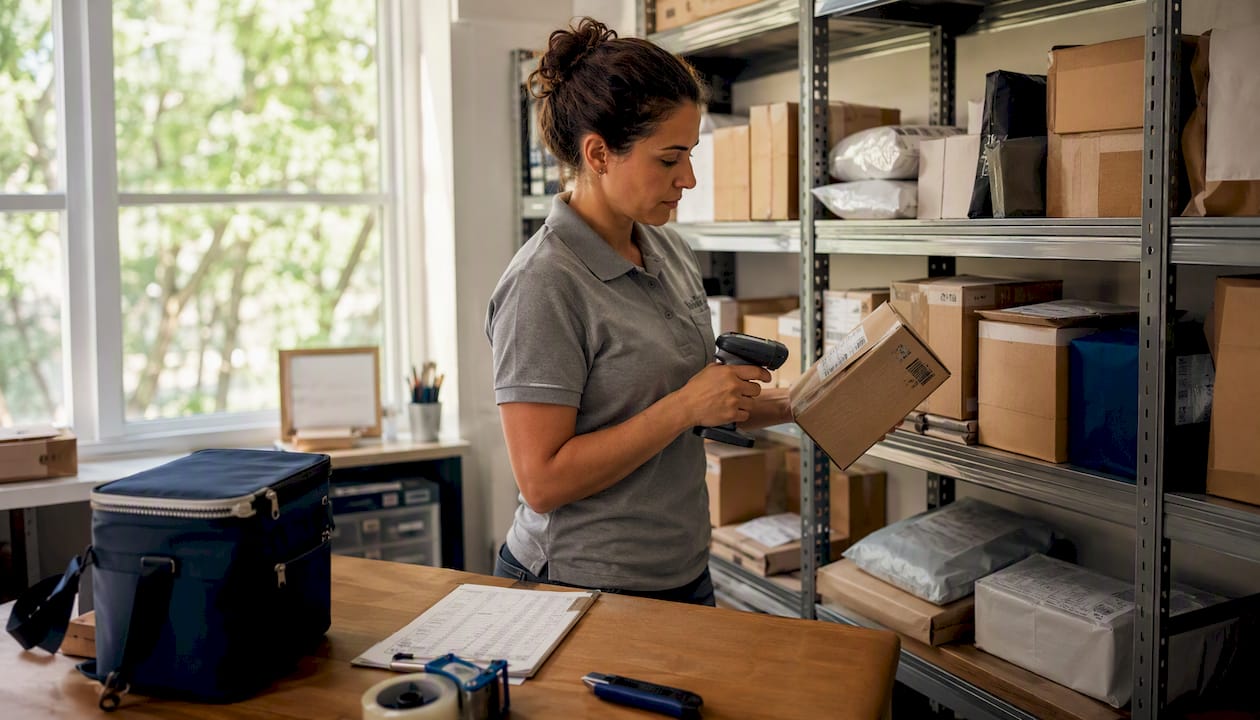
Outsource your student housing package-room operations to a professional on-site Package Manager through Postal Solutions, and your leasing team stops sorting boxes for good. Research shows 67% of residents expect secure, 24/7 self-service package pickup, making on-site package management a baseline amenity that directly affects lease-ups and renewals. The National Apartment Association confirms that student housing communities face higher per-bed delivery rates and concentrated move-in surges that overwhelm standard intake processes. Postal Solutions’ On-Site Package Room Management solves both problems with a dedicated, staffed model that works six days a week.
The immediate benefits:
- Leasing velocity protected by a showable, professional amenity
- Liability reduced through chain-of-custody logging and weekly audits
- Staff hours redirected from package handling to leasing and retention
- Ancillary income potential through resident amenity-fee structures
Table of Contents
- Why does outsourcing your student housing package room protect your bottom line?
- What does a professional on-site package-room service actually include?
- How does an on-site Package Manager run the daily operation?
- What do pricing models look like, and how do you calculate ROI?
- What KPIs and SLA clauses should you require in the contract?
- How do you implement on-site package management from survey to go-live?
- Where has Postal Solutions operated in student housing markets?
- Should you outsource or keep package management in-house?
- Key Takeaways
- Why on-site management is the only model that actually holds up
- Postal Solutions On-Site Package Room Management
- Useful sources
- FAQ
Why does outsourcing your student housing package room protect your bottom line?
Student housing is not market-rate multifamily with a few extra Amazon boxes. Student properties receive substantially more packages per unit than conventional communities, and semester starts hit like a holiday-season surge compressed into 72 hours. Your leasing team did not sign up to run a receiving dock.
The business case is straightforward. Every hour a leasing agent spends sorting packages is an hour not spent on tours, follow-ups, or renewal conversations. Package handling has become a baseline expectation comparable to high-speed internet, and failing to meet that expectation is a documented driver of resident turnover, particularly in student housing where residents make annual renewal decisions.
Industry operators consistently report that outsourcing removes liability and operational friction by centralizing intake and enforcing standardized workflows. A lost package at a student property is not just a resident complaint; it is a potential claim, a social-media post, and a renewal risk rolled into one.
Top operators also treat package management as a revenue line, not just a cost. Many structure it as a resident-paid amenity and retain the margin over management cost, converting what used to be a budget drain into a partial or full offset.
Five operator-facing benefits of outsourcing:
- Liability reduction through documented chain-of-custody and audit trails
- Predictable workflows that do not depend on leasing-staff availability
- Peak-volume scalability during move-in and semester starts
- Resident experience improvement that supports renewals and referrals
- Ancillary income through resident amenity-fee programs
What does a professional on-site package-room service actually include?
The scope matters because not every vendor delivers the same thing. A credible on-site package room management contract should cover all of the following:
- Daily receiving and intake from all common carriers (UPS, FedEx, USPS, Amazon Logistics)
- Sorting and shelving by unit number with photo documentation at intake
- Chain-of-custody logging with timestamped records for every package received and released
- Resident notifications via text and email at the moment of intake
- Weekly audits to reconcile inventory, flag unclaimed packages, and catch discrepancies early
- Electronic locker and package-room hardware integration with existing systems
- Oversized and refrigerated package handling with designated staging areas
- Peak-event surge support for move-in days, semester starts, and holidays
Optional add-ons worth asking about: direct-to-door delivery within the community, concierge-style scheduled drops, and resident-facing amenity-fee programs that generate ancillary income.
Pro Tip: Most operators audit monthly at best. Weekly audits are the standard that actually catches discrepancies before they become claims. Ask any vendor candidate how often they reconcile their chain-of-custody log against physical inventory, and require that cadence in the contract.
How does an on-site Package Manager run the daily operation?
The staffing model is the core differentiator between a managed service and a locker system left to run itself. Postal Solutions deploys a dedicated on-site Package Manager up to six days a week, working within your existing package room or locker setup.
Intake-to-pickup workflow:
- Carrier delivers to the designated receiving area
- Package Manager scans, photographs, and logs each item with a timestamp
- Package is sorted and shelved or loaded into the appropriate locker compartment
- Resident receives an automated text and email notification
- Resident retrieves the package; release is logged to close the chain-of-custody record
- Unclaimed packages are flagged at the next audit cycle
| Workflow touchpoint | Typical staff time |
|---|---|
| Intake scan and photo log | 1–2 minutes per package |
| Sort and shelve | 30–60 seconds per package |
| Resident notification (automated) | Near zero with integrated system |
| Pickup release and log | 1 minute per package |
| Weekly audit reconciliation | 30–60 minutes per audit cycle |
The Package Manager integrates with your leasing team’s schedule rather than competing with it. They handle carrier coordination, overflow staging, and resident inquiries about deliveries, so your front-desk staff fields leasing calls instead of package questions.

Pro Tip: The single biggest chain-of-custody gap is the handoff between carrier and property. Require your vendor to log every package at the point of physical receipt, not at the point of shelving. That two-minute window is where most disputed losses originate.
What do pricing models look like, and how do you calculate ROI?
Pricing for on-site package room management typically follows one of three structures:
- Per-property flat fee: a fixed monthly cost regardless of volume, best for stable communities
- Per-unit-per-month (PUPM): scales with bed count, common in student housing where unit counts are fixed but volume varies
- Hybrid model: base PUPM plus locker hardware or labor-bundle components for integrated service and equipment contracts
Ancillary income options let operators offset or exceed management costs. Many communities charge residents a monthly package-handling fee, retain the margin over the vendor’s PUPM rate, and effectively run the service at net zero or better.
ROI inputs to gather before requesting a proposal:
- Average daily inbound packages (ask your carrier reps or count for one week)
- Current staff hourly wage plus burden rate (typically 1.25–1.35x base wage)
- Average staff-minutes spent per package today (intake, sort, notification, pickup release)
- Estimated lease/renewal uplift from a professionally managed amenity
- Potential monthly ancillary fee revenue (beds × monthly fee × expected participation rate)
Simple payback example:
| Input | Example figure |
|---|---|
| Staff minutes per package | 4 |
| Weekly labor cost recovered | ~$704 |
At $704 per week in recovered labor, the math on a PUPM contract closes quickly for most student properties. Add ancillary fee revenue and the payback period compresses further.
What KPIs and SLA clauses should you require in the contract?
The goal is simple: measurable reductions in lost packages and staff-hours, with consistent pickup turnaround. Industry guidance from the National Apartment Association recommends defining SLAs for peak support and audit cadence to reduce operational risk during semester starts and move-ins.
Core KPIs to track:
- Pickup turnaround time (target: 95% of packages retrieved within 48 hours)
- Lost-package rate (target: below 0.1% of monthly volume)
- Weekly audit pass rate (target: 100% reconciliation with zero unresolved discrepancies)
- Resident satisfaction score (track via post-pickup survey or annual resident survey)
- Notification deliverability rate (target: 99%+ of intake notifications sent within 15 minutes)
- Chain-of-custody completeness (100% of packages logged at intake and release)
SLA checklist:
- Define peak-surge staffing commitments (move-in days, semester starts, holidays)
- Set escalation paths for missed SLA thresholds (written notice within 24 hours, remedy within 48)
- Require weekly audit reports delivered to the property manager
- Specify data access and ownership (you own the logs, not the vendor)
- Include insurance and indemnity language covering lost or damaged packages
- Define remedies for repeated SLA misses (fee credits, contract termination rights)
How do you implement on-site package management from survey to go-live?
A realistic timeline from first conversation to full operation runs six to ten weeks for most student properties.
Phase 1: Site survey (Week 1–2)
- Measure package room or locker area dimensions and capacity
- Document current carrier delivery schedules and access points
- Identify hardware integration requirements (locker API, notification system)
- Assess peak-volume storage needs based on bed count and semester calendar
Phase 2: Contract and SLA finalization (Week 2–3)
- Confirm pricing model and ancillary-fee structure
- Finalize SLA thresholds, audit cadence, and escalation paths
- Confirm insurance and indemnity language
Phase 3: Onboarding and training (Week 3–5)
- Package Manager onboarded and trained on property-specific workflows
- Hardware and notification system integration tested
- Carrier coordination confirmed (delivery windows, access credentials)
- Resident communication drafted and sent (email, app notification, lobby signage)
Phase 4: Pilot (Weeks 5–10)
- Four to six weeks of live operation with weekly check-ins
- Audit reports reviewed at 30-day mark
- Resident satisfaction surveyed at end of pilot
Phase 5: Go-live and ongoing audits
- Full operation confirmed; 30/60/90-day audit reviews scheduled
- KPI dashboard shared with property manager monthly
Resident messaging at launch matters more than most operators expect. A simple email explaining the new service, pickup hours, and notification format reduces front-desk inquiries by a meaningful margin in the first two weeks.
Where has Postal Solutions operated in student housing markets?
Postal Solutions has active student-housing presence across multiple university markets, with case studies available for operators in Athens, GA; College Station, TX; Auburn, AL; and Eugene, OR.
Athens, GA (University of Georgia market)
- High bed-density community with concentrated semester-start surges
- Chain-of-custody logging reduced disputed-loss claims
- Weekly audits identified and resolved recurring carrier delivery errors
College Station, TX (Texas A&M market)
- Large student property with move-in volumes comparable to holiday-season peaks
- Dedicated Package Manager freed leasing staff for tour and renewal activity
- Ancillary amenity-fee program implemented to offset management cost
Auburn, AL (Auburn University market)
- Seasonal surge planning built into SLA with defined peak-staffing commitments
- Integration with existing electronic locker system maintained 24/7 resident access
- Resident satisfaction scores improved following service launch
Eugene, OR (University of Oregon market)
- Oversized package handling protocols established for textbook and equipment deliveries
- Notification system integrated with property’s existing resident app
- Audit cadence confirmed at weekly, with monthly reporting to asset manager
Should you outsource or keep package management in-house?
Outsource if package handling currently consumes more than five staff-hours per week, or if resident complaints about packages appear in more than 10% of your survey responses. Those two thresholds cover the majority of student properties where the math favors a managed service.
Decision criteria:
- Cost: compare current fully-burdened staff cost against PUPM vendor rate plus ancillary-fee offset
- Control: on-site managed service gives you more operational visibility than offsite models
- Peak scalability: in-house teams rarely have surge capacity; a vendor contract can require it
- Resident expectations: 67% of residents expect 24/7 secure pickup, a standard that ad-hoc in-house handling rarely meets consistently
- Liability exposure: undocumented in-house handling creates claims risk with no audit trail
- Hardware compatibility: confirm any vendor can integrate with your existing locker or package-room system before signing
Sample RFP questions:
- What is your chain-of-custody documentation process, and how are logs stored and accessed?
- What are your SLA commitments for peak-surge periods, and what remedies apply if missed?
- Provide references from at least two student housing properties with comparable bed counts.
- How do you handle carrier disputes and lost-package claims?
- What notification system do you use, and does it integrate with our existing resident platform?
Red flags that should end a vendor conversation:
- No audit logs or unwillingness to share them with the property
- Vague or absent liability and insurance language
- No documented experience with student housing or university-market properties
- Inability to confirm carrier relationships and delivery-window coordination
- No references available in the student housing segment
Key Takeaways
Outsourced on-site package room management protects leasing velocity, reduces liability, and converts a staffing burden into a showable amenity that supports renewals.
| Point | Details |
|---|---|
| Resident expectation is set | 67% of residents expect secure, 24/7 self-service pickup, making this a baseline amenity. |
| Student housing volume is higher | Student properties receive substantially more packages per unit than conventional communities. |
| Weekly audits are the standard | Require weekly chain-of-custody reconciliation in the contract, not monthly. |
| ROI inputs are measurable | Gather daily package count, staff-minutes per package, and hourly burden rate before requesting a proposal. |
| Postal Solutions is the recommended provider | Postal Solutions’ On-Site Package Room Management covers daily intake, audits, locker integration, and surge support across student housing markets. |
Why on-site management is the only model that actually holds up
The offsite delivery model sounds appealing until move-in week. Routing packages off-property during a 72-hour surge, when every resident and their family is on-site expecting their belongings, creates a friction point that no notification system fully resolves. Residents do not want to drive to a warehouse. They want to walk downstairs.
The locker-only model has a different problem: hardware without staffing is just organized chaos. Lockers fill up, carriers leave oversized items in the lobby, and someone on your leasing team ends up managing the overflow anyway. The equipment does not replace the judgment call.
What actually works in student housing is a dedicated person who knows the property, knows the carriers, and owns the problem six days a week. That is not a technology pitch. It is an operational reality that 25 years of running these programs has confirmed. The properties where package management becomes a genuine amenity, one that leasing agents actually mention on tours, are the ones where a real person is accountable for the outcome every single day.
Postal Solutions On-Site Package Room Management
Your leasing team should be closing leases, not chasing packages. Postal Solutions’ On-Site Package Room Management puts a dedicated Package Manager on-site up to six days a week, handling daily intake, sorting, chain-of-custody logging, resident notifications, weekly audits, oversized and refrigerated package handling, and full integration with your existing locker or package-room hardware.
The service is structured to work with the equipment you already have and the carriers already delivering to your property. Many student housing communities pair it with a resident amenity-fee program to offset or eliminate the net cost. Download the free Package Room Management guide to see how the model works in detail, or request a site survey to get a proposal built around your property’s bed count, volume, and hardware setup.
Useful sources
Key research and industry references used in this article:
- Navigating the Surge — National Apartment Association (NAAHQ): NAA guidance on peak-volume planning and SLA requirements for student housing operators.
- Student Housing Outlook — The Multifamily Journal: Industry analysis of on-site vs. offsite package management tradeoffs in student housing.
- Package Room Management for Apartments — Postal Solutions Blog: Practical operator guide covering service scope, workflows, and integration.
- Student Housing Package Room Management — Athens, GA: Postal Solutions case study page for the Athens, GA university market.
FAQ
What is on-site package room management for student housing?
On-site package room management is a contracted service where a dedicated Package Manager handles daily receiving, sorting, chain-of-custody logging, resident notifications, and weekly audits at your property. Postal Solutions provides this service for student housing communities with existing locker or package-room systems.
How many packages does a typical student housing property receive?
Student housing properties receive 30–50% more packages per unit than conventional multifamily communities, with move-in periods generating surges comparable to peak holiday-season volume.
What KPIs should I track for a package room vendor?
Track pickup turnaround time, lost-package rate, weekly audit pass rate, notification deliverability, and resident satisfaction scores. Target a lost-package rate below 0.1% of monthly volume and 99%+ notification delivery within 15 minutes of intake.
Can on-site package management generate ancillary income?
Yes. Many student housing operators structure the service as a resident-paid amenity, charging a monthly fee and retaining the margin over the vendor’s per-unit cost. This can offset or eliminate the net management expense.
How long does implementation take?
Most student housing properties reach full go-live in six to ten weeks, covering site survey, contract finalization, hardware integration, staff onboarding, and a four-to-six-week pilot period.
Recommended
Ready when you are
Fix your package room — start with a free proposal
Daily on-site Package Manager, resident text & email pings*, and a tour-ready amenity. Tell us your unit count and we'll send a right-sized proposal — usually within one business day.
- ✓ 16–30 hours back every week
- ✓ Works with any locker system
- ✓ Faster, friction-free resident pickup
- ✓ An easy ancillary income addition