
September 3, 2026
Cut 6+ Staff Hours: Package Cardboard Management for Operators
On site package cardboard management, intake, custody logs, and resident alerts, cuts complaints and gives leasing staff back their hours.
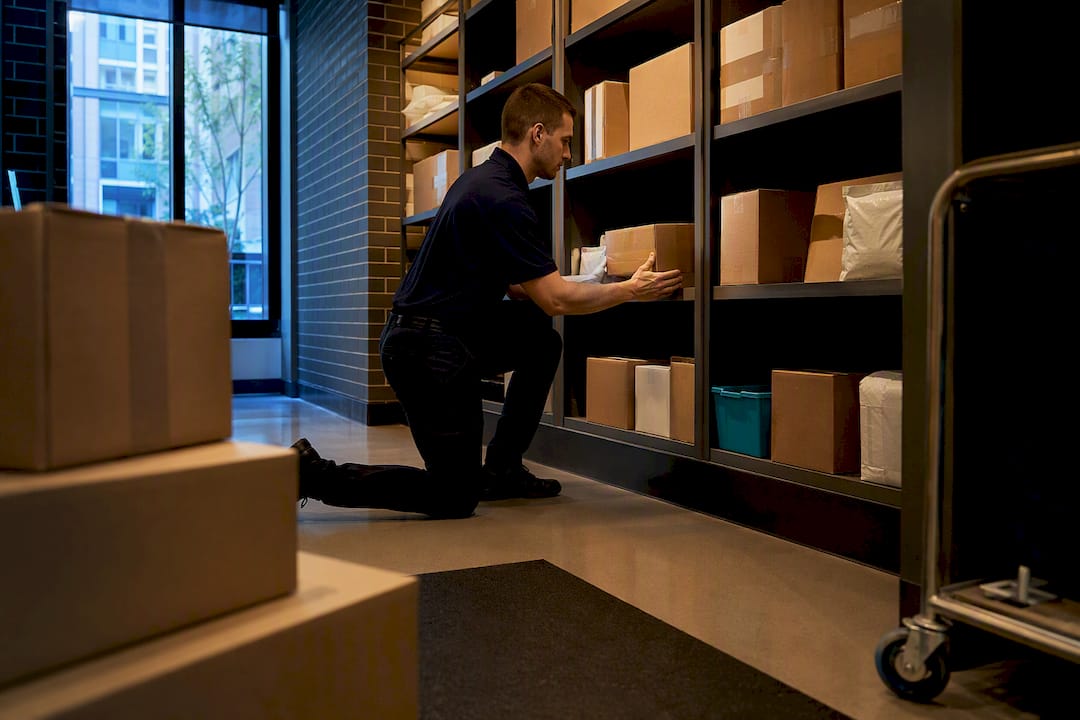
On-site package room management means daily receiving, sorting, chain-of-custody logging, secure storage, and resident notifications for every parcel that hits your property. For any multifamily community with recurring delivery volume, it is generally the operationally superior choice over hardware alone. It reclaims staff hours, cuts complaints, and gives residents the 24/7 pickup experience they now expect as standard.
TL;DR:
- Managing on-site package rooms reduces staff hours spent on parcel handling and significantly cuts resident complaints, improving retention.
- Average resident package volume increased to 10.65 packages monthly in 2023, with handling potentially requiring over six staff hours daily at 75 parcels per day.
- Proper workflows—including carrier compliance, detailed chain-of-custody logging, and surveillance—are essential to prevent package loss and disputes.
- The most effective setup varies by property size and volume, with hybrid models and comprehensive workflows offering the best resilience for high-volume or urban communities.
- Ongoing carrier training, capacity testing before peak seasons, and baseline data collection are critical to a successful, scalable package management operation.
Table of Contents
- Why Package Cardboard Management Matters More Than Ever
- How On-Site Package Management Actually Works
- Which Package Solution Model Fits Your Property?
- How to Choose a Package Room Management Provider
- Your First 90 Days: A Launch Playbook
- Why Trust This Playbook
- Get Your Property Running on Managed Package Room Service
- What Operators Get Wrong About Package Rooms
- Sources
- FAQ
Why Package Cardboard Management Matters More Than Ever
The math has shifted fast. Average packages per resident climbed from 9.41 in 2022 to 10.65 in 2023, and U.S. parcel volume is projected to hit 24.6 billion parcels in 2026. That’s not a blip. It’s a permanent shift in how residents shop, and it means your leasing office is absorbing a logistics operation it never signed up to run.
The labor math is worse than most owners assume. At roughly 75 daily parcels, cumulative handling can eat up 6 or more staff hours a day once you count intake, sorting, notification calls, and repeated resident trips to the front office. That’s nearly a full-time position buried inside your leasing team’s schedule, invisible on an org chart but very real on a time sheet.
The payoff for fixing this shows up in retention, not just efficiency:
- Properties with dedicated package solutions report fewer resident complaints and better renewal outcomes
- Lost or delayed packages are a recurring theme in negative online reviews, and reviews influence lease decisions before a prospect ever tours
- Staff time recovered from sorting boxes converts directly into tours, renewals, and resident retention calls
Pro Tip: Pull your last three months of resident complaint logs and tag every package-related entry. Most operators are shocked to find it’s their top or second-highest complaint category.
How On-Site Package Management Actually Works
The workflow starts before a truck ever pulls up. Carriers need clear drop-off protocols, a designated intake point, and rules for what gets accepted versus refused. This is also where most programs break down: a 250-unit community can receive roughly 1,500 packages a month, and carrier non-compliance, drivers dumping boxes in lobbies, ignoring locker assignments, skipping scans, is one of the most common failure modes, no matter how good your hardware is.
Once a package arrives, chain-of-custody logging takes over: a scan or photo, a timestamp, and a system record tied to the resident’s unit. This is what protects you when a resident claims a package went missing.
Storage architecture depends on your property:
- Shelving package rooms handle high volume but need staff oversight to prevent overflow
- Locker banks give residents self-service access with a digital audit trail, though compartment capacity caps out fast during peak weeks
- Smart rooms combine open shelving with access control and camera coverage for higher-security handling
Cameras matter here too. Properties layering surveillance into their package areas cut disputed-delivery claims significantly, since footage settles most “I never got it” conversations in seconds.
Resident pickup runs on text and email alerts the moment a package is logged, with after-hours access built into the room or locker system so residents aren’t stuck waiting for office hours. A dedicated on-site Package Manager, working up to six days a week, owns intake, logging, shelving, and audits so your leasing staff never touches a box. Learn more about how packages get delivered to apartments and what that daily workflow actually looks like on the ground.
Which Package Solution Model Fits Your Property?
Not every property needs the same setup, and matching the wrong model to your building is the single most common procurement mistake. Operators typically layer more than one intake method rather than betting everything on one system, and successful deployments match the solution type to the property’s actual profile: unit count, daily volume, available space, and staffing capacity.
Here’s how the major models stack up:
- Staffed package room: Best for properties with limited lobby space or where volume is too high for lockers alone; requires dedicated labor but scales with overflow better than any fixed hardware system.
- Locker banks: Strong for mid-volume suburban properties where residents value self-service pickup, but compartment count is fixed, and oversized packages or a holiday surge will blow past capacity fast.
- Hybrid (lockers plus staffed room): The most resilient setup for high-volume or urban assets, lockers absorb routine parcels while a managed room catches oversized, refrigerated, or overflow items.
- Off-site consolidated delivery: Removes on-site space needs entirely but shifts liability and convenience trade-offs onto scheduled pickups or resident coordination, rarely a fit for properties competing on amenity value.
Software and automation matter most in the hybrid model, where routing decisions (locker versus room, standard versus overflow) need to happen without a human making the call every time. Compare package lockers against a staffed package room directly if you’re still weighing which direction fits your building.
How to Choose a Package Room Management Provider
Start by quantifying your baseline: average daily and peak-week package counts, current staff hours spent on package tasks, and available square footage for storage. Without that baseline, you’re guessing at capacity and budget both.
From there, work through these questions with any provider you’re evaluating:
- How do you detect and remediate carrier non-compliance, and what happens when a driver ignores intake protocol?
- What’s your intake auditing process, and how often are shelves and logs reconciled against delivery records?
- What’s the escalation workflow when a resident disputes a missing package?
- Which property management systems and access control platforms do you integrate with?
- What’s your onboarding timeline from signed contract to live operation?
- What metrics do you report monthly, and how are they measured?
Cost models generally run per-property or per-unit, per-month, though some properties structure the service as a resident amenity fee that offsets or exceeds management costs. A carrier compliance framework from NAA recommends standardized SOPs and pictorial driver guides as baseline vendor requirements, not optional extras.
| Property Type | Typical Model | Key Cost Driver |
|---|---|---|
| Small (under one hundred units) | Staffed room or hybrid | Labor hours vs. locker capital |
| Mid-size suburban | Locker banks or hybrid | Compartment count vs. volume |
| High-volume urban | Smart room or hybrid | Peak-week overflow handling |
Your First 90 Days: A Launch Playbook
Pre-launch work sets the tone for everything after. Prep the physical space, install signage carriers can’t miss, notify major carriers of drop-off protocols in writing, and lock in staffing, whether that’s a hire or a contracted on-site Package Manager, before day one.
- Weeks 1 to 2: Finalize space layout, install signage, send carrier notification letters, confirm staffing schedule
- Weeks 3 to 4: Run carrier dry runs, test notification systems, brief residents via email and posted notices
- Month 2: Monitor pickup-time KPIs, track carrier compliance rates, build in overflow contingency for the first volume spike
- Month 3 onward: Shift to steady-state, daily intake routines, weekly shelf audits, monthly reporting cadence
Carrier training doesn’t end at launch. Drivers rotate, routes change, and a compliance rate that looked solid in month one can slip by month four without ongoing reinforcement.
Pro Tip: Schedule your first overflow stress test around a predictable spike, like a Monday after a long weekend, rather than waiting for the holiday season to reveal your capacity gaps for the first time.
For manager-level templates on resident communications and SOPs, the package room management guide for apartment managers covers the operational detail this playbook can only summarize.
Why Trust This Playbook
Postal Solutions has spent more than 25 years managing on-site package operations for apartment and student housing communities, which means the failure modes described above (carrier non-compliance, overflow surges, resident disputes) aren’t theoretical. They’re what a dedicated on-site Package Manager handles up to six days a week, every week.
That work covers the full lifecycle:
- Daily intake, sorting, shelving across package rooms, locker banks, and hybrid setups
- Chain-of-custody logging with scans, timestamps, and photo documentation
- Oversized and refrigerated package handling that most locker systems can’t accommodate
- Weekly audits and monthly performance reporting
- Integration with whatever hardware or access control system a property already has
For operators who want the detail before committing to a conversation, the free package room management guide breaks down staffing models, cost structures, and carrier compliance protocols in one download.
Get Your Property Running on Managed Package Room Service
Postal Solutions gives your leasing team what a locker bank or software subscription alone can’t: a dedicated on-site Package Manager who handles the entire operation, intake, chain-of-custody logging, resident notifications, weekly audits, and peak-season overflow, without pulling your staff off leasing and renewals.
That coverage runs up to six days a week and works with whatever hardware your property already has, whether that’s a shelving room, a locker bank, or a hybrid setup. See exactly how the on-site model compares to off-site alternatives for resident experience and liability, or check compatibility if you’re running HelloPackage or another locker system already installed. If you’re still deciding on hardware, the apartment package locker and room management overview walks through what fits your building. Ready to see what a managed program looks like for your specific unit count and volume? Request a property assessment and get a tailored labor-cost breakdown before you sign anything.
What Operators Get Wrong About Package Rooms
Most operators treat package management as a hardware decision: buy lockers, install cameras, done. That’s backwards. The hardware only works as well as the process enforcing it, carrier compliance checks, audit cadence, escalation rules, and hardware without process is how a 250-unit property ends up with 1,500 packages a month and no reliable way to track half of them.
Two lessons show up again and again. First, carrier non-compliance never fixes itself; it needs active detection and driver retraining, not a one-time signage install. Second, overflow capacity should be tested before a holiday season, not discovered during one.
— Postal Solutions
Sources
- Multifamily data & research: Package delivery pain points
- Package Management: Logistics technology prevents apts from getting boxed in | National Apartment Association
- A framework for solving multifamily’s package management problem | Insights by Blueprint
- The Hidden Cost of Manual Package Management - Smart Package Room
FAQ
What Is On-Site Package Room Management?
It’s the daily operational process of receiving, sorting, securing, and logging resident packages on-site, paired with text and email notifications and chain-of-custody records for every parcel.
How Many Packages Does a Typical Apartment Community Receive?
A 250-unit community can receive roughly 1,500 packages a month, and average resident package volume has risen from 9.41 to 10.65 packages per month between 2022 and 2023.
Should I Choose Lockers, a Package Room, or a Hybrid Setup?
It depends on unit count, space, and staffing. Lockers suit mid-volume properties wanting self-service, staffed rooms suit high-volume or space-limited buildings, and hybrids work best for urban or high-volume assets facing regular overflow.
How Much Staff Time Does Manual Package Handling Consume?
At around 75 daily parcels, manual handling can consume 6 or more staff hours per day, time a managed on-site service redirects back to leasing and renewals.
Does Postal Solutions Work With Existing Locker Systems?
Yes. Postal Solutions integrates its on-site Package Manager service with whatever locker or room hardware a property already has, rather than requiring a hardware replacement.
Recommended
Ready when you are
Fix your package room — start with a free proposal
Daily on-site Package Manager, resident text & email pings*, and a tour-ready amenity. Tell us your unit count and we'll send a right-sized proposal — usually within one business day.
- ✓ 16–30 hours back every week
- ✓ Works with any locker system
- ✓ Faster, friction-free resident pickup
- ✓ An easy ancillary income addition