
September 24, 2026
Avoid $110,000 Penalties: Apartment Medication SOPs for Leasing Teams
Leasing team SOPs to accept, refrigerate, and log medication deliveries in apartments, with CDC, FDA, and USP cold chain and custody steps.
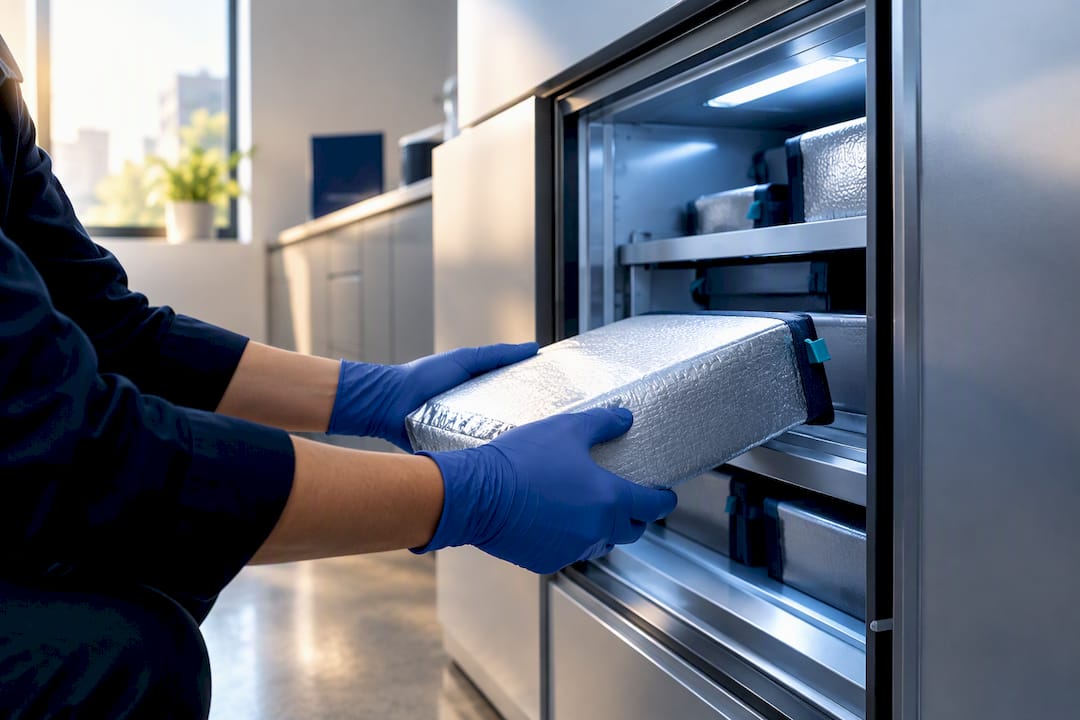
Yes, apartment package rooms can accept medication deliveries when they’re treated as special deliveries under documented procedures. That means chain-of-custody logging, restricted access, and cold-chain controls when the package requires them, plus a clear escalation path when something needs clinical judgment. Staff act as custodians of the package, not as pharmacists deciding what’s safe to use. The SOPs below turn that principle into something you can actually run on a Tuesday afternoon.
TL;DR:
- Staff must log and handle medication packages with documented procedures, including receipt timestamp, carrier details, and storage location, to ensure chain-of-custody.
- Refrigerated medications require immediate temperature monitoring upon arrival, quarantine if excursions occur, and documented corrective actions before use.
- Storage must be in designated, restricted bins or lockboxes, separated from general packages, with access limited to trained staff and privacy maintained through generic resident notifications.
- Personnel handling medication parcels need regular training and audits to maintain adherence to SOPs and legal requirements, especially for controlled substances.
- On-site package managers can oversee daily intake, temperature checks, and recordkeeping, reducing the burden on leasing staff and increasing compliance.
Table of Contents
- Setting Up a Medication Deliveries Apartments Checklist
- How Should Staff Receive a Medication Package?
- What Temperature Rules Apply to Refrigerated Medications?
- Where and How Should Medication Packages Be Stored?
- What Records Should Every Medication Delivery Include?
- How Do You Handle a Leaking or Suspicious Medication Package?
- How Often Should Staff Train on Medication Handling?
- The Gap Between Policy and Practice
- How Postal Solutions Handles the Package Room So You Don’t Have To
- Sources
- FAQ
Setting Up a Medication Deliveries Apartments Checklist
Before you write a single policy line, build the one-page checklist your team will actually use. This is the artifact that turns “handle carefully” into something enforceable during a shift change.
A workable checklist covers seven touchpoints:
- Receipt: timestamp every medication parcel the moment it crosses the threshold, and note the carrier and tracking number.
- Segregation: route it immediately to a labeled, medical-only bin or lockbox, never into a general shelving row.
- Access: limit handling to a named, trained staff list, not “whoever’s at the desk.”
- Notification: alert the resident with a generic “you have a delivery ready” message, never naming the medication or pharmacy.
- Escalation triggers: leaking containers, damaged cold-chain indicators, or anything marked as a controlled substance without proper labeling gets pulled and flagged.
- Recordkeeping: capture carrier, package ID, receipt time, storage location, and staff initials on every entry.
Pro Tip: Print the checklist and laminate it next to the intake desk. A policy buried in a shared drive gets ignored; one taped to the wall gets followed.
How Should Staff Receive a Medication Package?
The first ninety seconds after a medication parcel arrives determine whether your records hold up later. Treat every step as evidence collection, not just sorting.
- Inspect the outside first. Look for leaks, crushing, or a temperature monitoring device (TMD) attached to the label, and note its reading before you move the package anywhere.
- Log it immediately. Record the carrier name, package ID or tracking number, exact receipt timestamp, and any visible damage.
- Keep it sealed. Never open, repackage, or consolidate a medication delivery with other items in the same box.
- Decide fast on refusal. Redirect or refuse a parcel that’s leaking, unlabeled as a controlled substance when it should be, or accompanied by a request for staff to assess its contents.
- Notify without detail. Send the resident a plain “package ready for pickup” text or email. Skip the drug name, the pharmacy, and any health context.
This is the same instinct behind the CDC’s vaccine handling toolkit, which calls for immediate unpacking and documented TMD checks the moment a temperature-sensitive shipment lands.
What Temperature Rules Apply to Refrigerated Medications?
Not every medication needs refrigeration, but the ones that do have narrow tolerances and no room for guesswork. Vaccines, several biologics, and insulin sit in this category, though insulin has more flexibility than most people assume.
The FDA notes that unopened insulin can typically tolerate brief periods at room temperature during emergencies, within specific limits set by the product label. Vaccines and most biologics carry far less tolerance for excursion.
Handling rules that matter most:
- Check the attached TMD or cold-chain monitor the second the package arrives, before anything else happens.
- Move refrigerated items into a qualified unit immediately. A portable cooler with ice packs is a stopgap, never a long-term storage plan.
- Log the temperature reading at intake and at regular intervals afterward.
- If a monitor shows an excursion outside the labeled range, quarantine the item and stop treating it as usable inventory.
The CDC toolkit is explicit that a documented corrective action follows every excursion. Staff don’t decide if the medication is still good. That call goes to the pharmacy or manufacturer named on the label.
Where and How Should Medication Packages Be Stored?
Storage design does most of the work of preventing theft, damage, and privacy leaks before a single policy is even enforced. The goal is separation: medication parcels never sit next to a resident’s grocery order or Amazon return.
Practical controls include:
- A dedicated, clearly labeled bin or lockbox reserved only for medical deliveries, separate from general package shelving.
- Physical barriers, meaning locks or barrier-front bins, on any compartment holding medication, following the access-restriction approach OSHA recommends for hazardous or sensitive drug storage.
- A short, named list of staff authorized to touch medication parcels, with identity verification required at resident pickup.
- Signage that flags the bin as restricted, without describing its contents to passersby.
Resident notifications should never mention the drug name, pharmacy, prescriber, or condition. A generic pickup alert protects privacy and keeps your team out of territory it has no business being in.
What Records Should Every Medication Delivery Include?
A complete custody log is your best defense if a resident disputes a delivery or a regulator asks questions. The fields worth capturing on every medication parcel: receipt timestamp, carrier name, package ID, visible damage or TMD reading at intake, storage location, staff initials, notification timestamp, and the identity check performed at pickup.
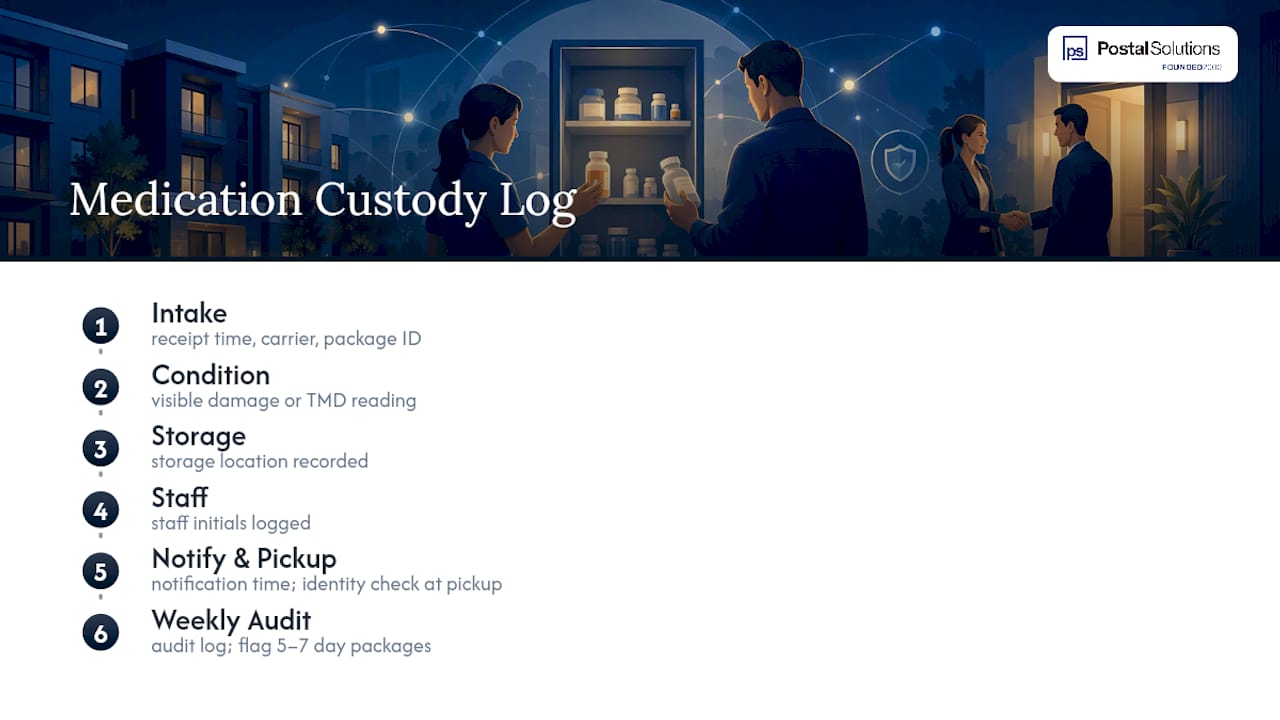
Run a weekly inventory audit against this log and flag any package sitting longer than a set window, say five to seven days, for follow-up. Recent DEA civil-penalty cases show how incomplete recordkeeping around controlled substances can lead to significant enforcement penalties. Package rooms aren’t pharmacies, but the underlying lesson holds: a documented chain of custody is what separates “we handled this correctly” from “we can’t prove anything.”
How Do You Handle a Leaking or Suspicious Medication Package?
Every incident response starts the same way: stop, isolate, don’t improvise.
- Isolate the item. Move it away from other packages and staff traffic immediately.
- Protect yourself. Use gloves if there’s any visible leakage, and never attempt to open or repackage a compromised container.
- Document the excursion. For temperature failures, record the reading, quarantine the item, and follow the FDA’s guidance on medicine handling after disruptions before contacting the pharmacy or manufacturer listed on the label.
- Escalate suspected controlled substances. Preserve the package and its paperwork, refuse to release it, and contact the carrier and your management or legal contact.
- Notify carefully. Tell the resident there’s a delay or issue with their delivery, without disclosing what it contains.
Pro Tip: Keep a small isolation zone, even just a lower shelf with a barrier bin, specifically for flagged packages. Staff shouldn’t have to improvise a quarantine spot under pressure.
How Often Should Staff Train on Medication Handling?
Training only works if it’s scheduled, not assumed. Four modules cover the essentials: intake checks and documentation, cold-chain basics, incident response, and privacy rules around notifications.
A workable cadence:
- Full training during onboarding for anyone touching the package room.
- Quarterly refreshers on the checklist and escalation triggers.
- Weekly storage audits comparing physical bins against the custody log.
- Annual competency checks to confirm staff can still execute the SOP under pressure.
This structure mirrors the layered approach in CDC storage guidance and the custodial framing in USP’s supply-chain guidance, which is explicit that package-room staff preserve conditions and custody. They don’t interpret them.
The Gap Between Policy and Practice
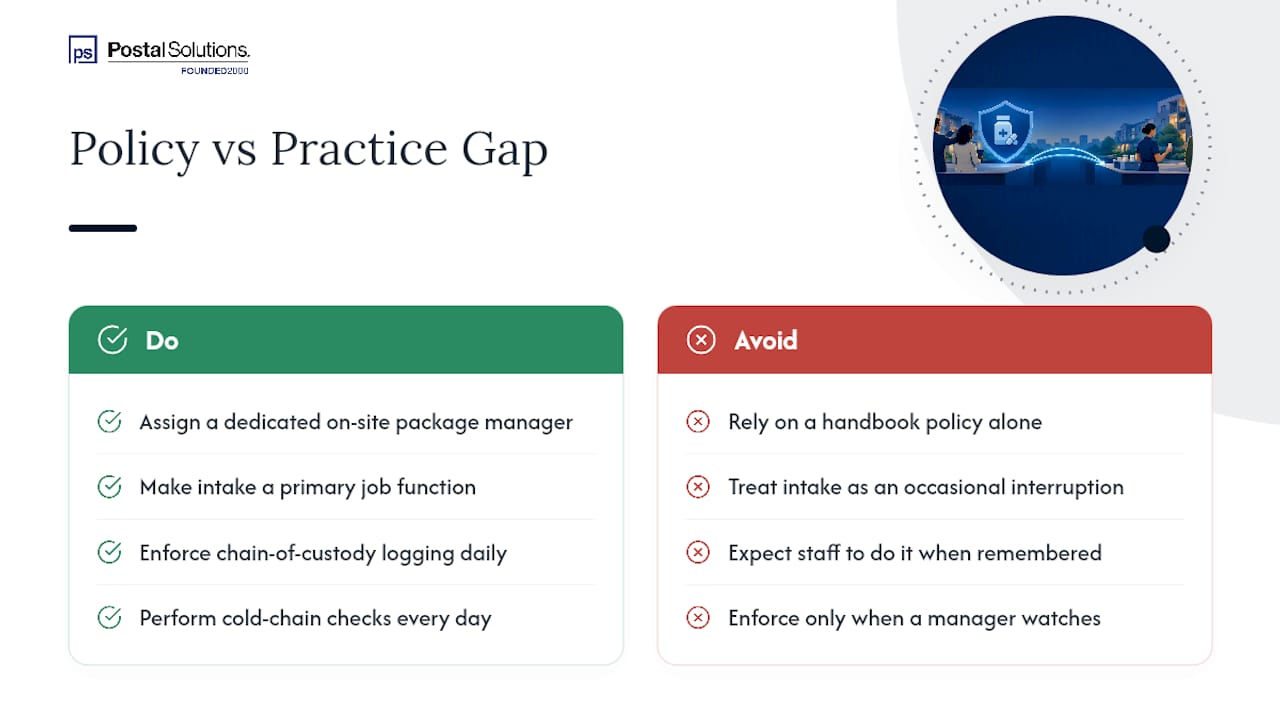
Most properties already have a medication-delivery policy sitting in a resident handbook somewhere. The problem is almost never the policy. It’s that leasing staff, juggling tours, renewals, and a package room that never stops filling up, don’t have the bandwidth to enforce a seven-step intake process on every refrigerated box that shows up mid-afternoon.
That’s the real gap. A dedicated on-site package manager who handles intake as a primary job function, not an interruption, is what actually makes chain-of-custody logging and cold-chain checks happen consistently instead of “when someone remembers.” The clinical guidance from CDC, FDA, and USP tells you what good handling looks like. Whether it happens depends entirely on whether someone has the time to do it right every single day, not just when a manager is watching.
— Postal Solutions
How Postal Solutions Handles the Package Room So You Don’t Have To
Postal Solutions puts a dedicated Package Manager on-site to run daily receipt, segregation, and chain-of-custody logging for every parcel that comes through your community, medication deliveries included.
Instead of a leasing agent stopping mid-tour to sort a suspicious-looking box, a trained on-site manager checks the label, logs the timestamp, and routes it to secure, labeled storage under the SOPs outlined above. Weekly Package Room Audits catch discrepancies before they become disputes, and resident notifications go out without exposing any private health details. For properties handling refrigerated deliveries regularly, that same staff member manages temperature checks and escalation, work most leasing teams simply don’t have hours for.
The service works with whatever apartment community parking management software or package room system your property already owns, so there’s no hardware overhaul required to get consistent, documented handling. If you want to see how this fits your property, request a package room assessment or grab the free implementation guide and compare it against what your team is doing today.
This article is general information, not a substitute for advice from a qualified doctor. Consult a qualified healthcare professional about your own circumstances before acting on anything here.
Sources
- Samson, Alabama pharmacy liable for $110,000 penalty after recordkeeping violations | DEA
- Vaccine Storage and Handling Toolkit - July 2026 | CDC
- USP GC1079.2 — Supply chain / custodial role guidance
FAQ
Can Apartment Package Rooms Legally Accept Medication Deliveries?
Yes, package rooms can accept medication deliveries as long as staff follow documented intake, storage, and custody procedures rather than making clinical decisions. Staff act only as custodians preserving the package’s condition, per USP’s supply-chain guidance, not as pharmacists interpreting whether the contents are still safe to use.
What Should Staff Do if a Refrigerated Medication Package Sits Too Long?
Check the attached temperature monitor immediately and quarantine the item if it shows an excursion outside the labeled range. Follow the corrective-action steps in the CDC’s vaccine handling toolkit and contact the pharmacy or manufacturer before assuming the medication is still usable.
How Should Staff Notify Residents About a Medication Delivery Without Violating Privacy?
Send a generic “your package is ready for pickup” message with no reference to the medication, pharmacy, or prescribing provider. Verify the resident’s identity at pickup rather than including any identifying health details in the notification itself.
Does Postal Solutions Handle Refrigerated or Special Medication Deliveries?
Yes, a dedicated on-site Package Manager can handle refrigerated and special deliveries as part of daily package operations, including temperature checks and documented custody logging. Current pricing details are available on the Postal Solutions site.
What Records Should a Property Keep for Medication Deliveries?
Every medication delivery should have a logged receipt timestamp, carrier name, package ID, visible condition or temperature-monitor reading, storage location, staff initials, and pickup verification. Incomplete records carry real regulatory risk, as recent DEA enforcement actions around recordkeeping failures illustrate.
Recommended
Ready when you are
Fix your package room — start with a free proposal
Daily on-site Package Manager, resident text & email pings*, and a tour-ready amenity. Tell us your unit count and we'll send a right-sized proposal — usually within one business day.
- ✓ 16–30 hours back every week
- ✓ Works with any locker system
- ✓ Faster, friction-free resident pickup
- ✓ An easy ancillary income addition