
September 20, 2026
250 Unit Playbook for Property Managers: Stop Package Room Overflow
Operations playbook for property managers to clear package room overflow now, cut dwell time this week, and set a monthly fix. Onsite staffing can return...
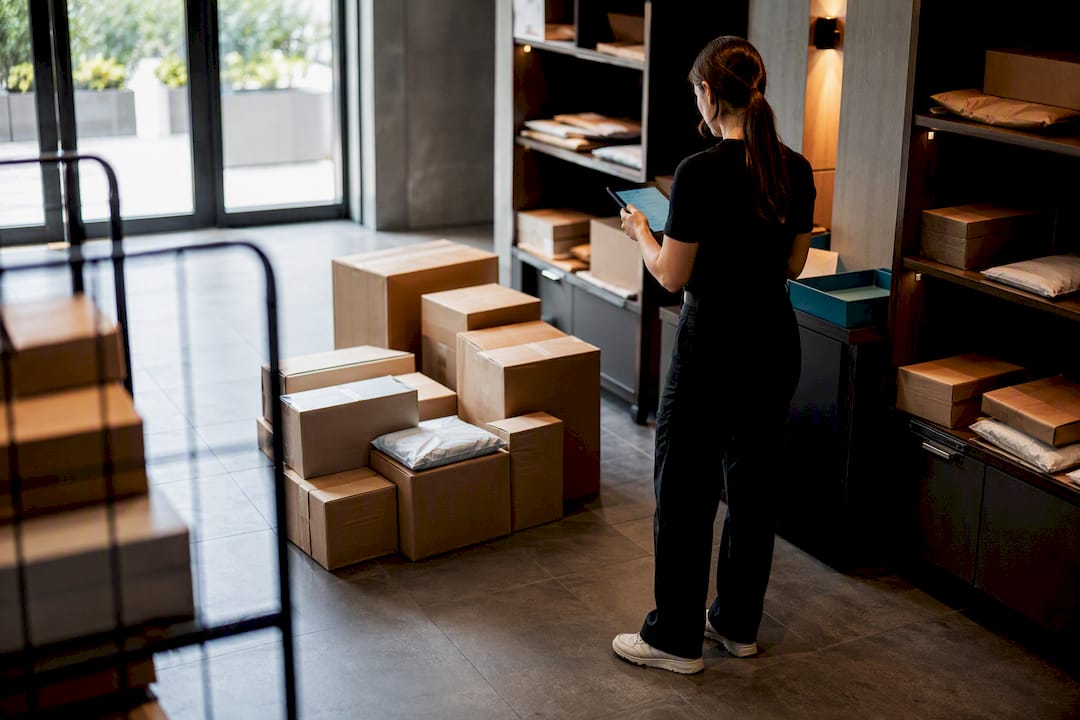
Stabilize an overflowing package room today by clearing the oldest and largest items first, setting up a locked temporary staging area, and enforcing a short hold window backed by immediate resident notifications. Log every item you move before it leaves the shelf. Coordinate with your top carriers to shift non-urgent drop-offs to a slower window while you dig out. Those three moves buy you the breathing room to fix the underlying process this week and this month.
TL;DR:
- Expanding storage capacity alone cannot prevent overflows if staff lack discipline in logging packages and enforcing pickup hold windows.
- Implementing a strict logging system with six key data points and weekly audits significantly reduces search time and backlog recurrence.
- Using a hybrid system of lockers for routine parcels and shelves for oversized or surge packages offers the most flexible and reliable solution for variable volume days.
- Hiring a dedicated on-site package manager ensures daily ownership, sorting, resident notifications, and proactive backlog management to maintain a stable package room.
- Shortening hold windows to three to five days with clear resident communication accelerates turnover and prevents packages from clogging shelves during peak times.
Table of Contents
- What Causes Package Room Overflow, and How Do You Fix It Today?
- Cutting Dwell Time: What to Change This Week
- Shelving, Lockers, or Both: Fixing Capacity for Good
- The Logging and Audit System That Prevents Overflow From Coming Back
- Choosing Between Software, Lockers, and Staffed Management
- How a Staffed Package Room Actually Stops Recurring Overflow
- Why Logistics Discipline Beats Buying More Space
- How Postal Solutions Keeps Package Rooms From Overflowing
- Sources
- FAQ
What Causes Package Room Overflow, and How Do You Fix It Today?
Package room overflow happens when arrivals outpace pickups long enough that shelves, floors, and hallways start absorbing the excess. A 250-unit community can receive roughly 1,500 packages a month, and that volume doesn’t arrive evenly. Holiday weeks, move-in cycles, and grocery or meal-kit surges can double a normal week’s count in a matter of days, and manual systems built for average volume buckle under peak volume.
The fix starts with triage, not shelving. Here’s the sequence that actually clears space fast:
- Photograph and log everything currently unaccounted for. Snap the label, note the tracking number, and record where it’s headed before you touch a single box.
- Sort by priority. Pull perishables and refrigerated items first, then oversized packages that are eating multiple shelf slots, then anything older than your hold window.
- Secure the exceptions immediately. Perishables go into a cooler or get flagged for same-day resident pickup calls. Oversized items move to a marked overflow zone, not wherever there’s floor space.
- Create a staging area with a lock. A closet, a caged section of a garage, or a back office works. Never let residents self-serve in an overflow zone that isn’t logged.
Assign roles before you start: one person intakes and scans, one person stages, and one person works the phones calling residents whose items have been sitting the longest. If you’re short-staffed, this is also the moment to ask carriers directly whether they can consolidate drop-offs or use a secured exterior door instead of dumping everything into an already-full room. Carrier behavior is a bigger driver of overflow than most managers assume. Seventy percent of operators name carrier non-compliance as a top frustration, which makes a five-minute conversation with your regular UPS or Amazon driver worth more than another shelving unit.
Pro Tip: Keep a dedicated bin or shelf just for items flagged during triage. Mixing “already logged today” packages back into general stock is how backlogs quietly rebuild within 48 hours.
Cutting Dwell Time: What to Change This Week
Dwell time (how long a package sits before pickup) is the real enemy, not raw volume. A room handling 400 packages a week with a two-day average dwell time will feel calmer than one handling half that volume with a six-day average. Shrinking dwell time is a communication and enforcement problem more than a space problem.
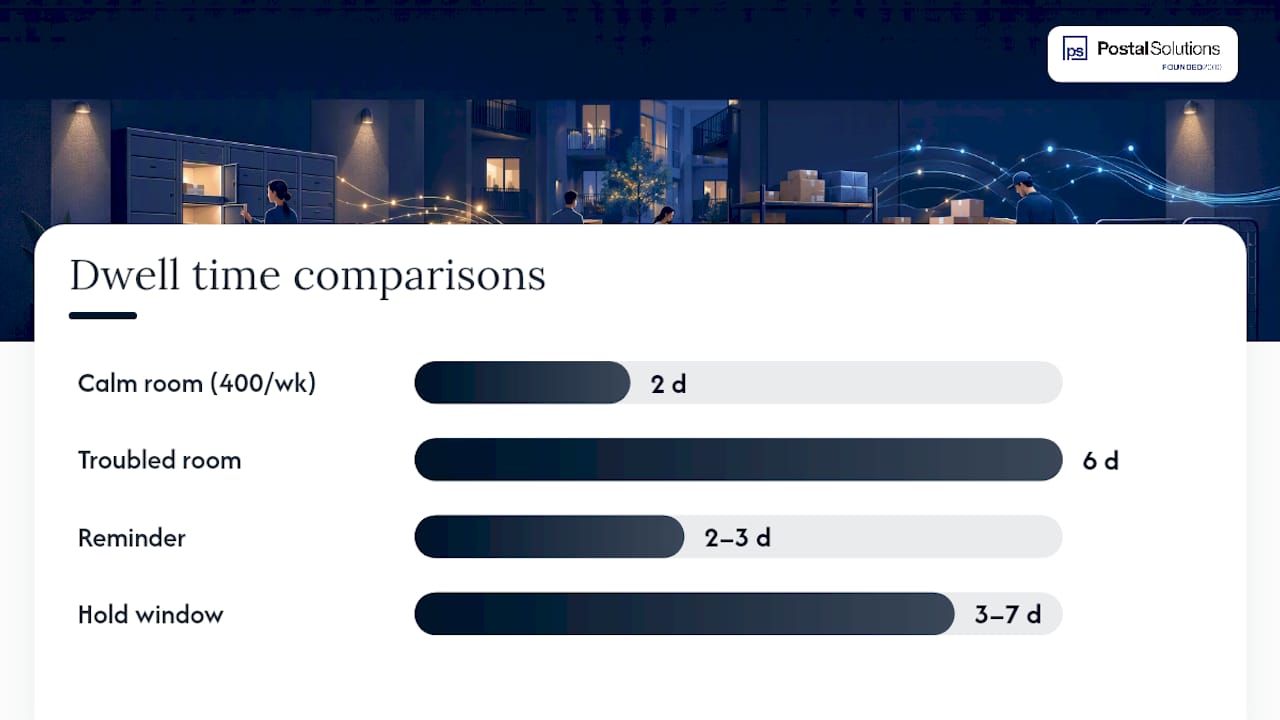
Start with a hold window you can defend. Most communities land somewhere between 3 and 7 days before a package gets escalated for return or resident contact; shorter windows work better for perishables and high-density buildings where shelf space is tight. Whatever number you pick, publish it in your resident handbook and post it in the package room itself.
From there, build an escalation ladder instead of relying on a single notification:
- Immediate SMS or email the moment an item is logged in.
- A 48 to 72 hour reminder if it hasn’t moved.
- A phone call for anything past your published hold window, not another automated ping.
Operators who pair automated alerts with direct phone outreach for items older than three days clear space faster than teams relying on notifications alone. Identify your repeat offenders early. A short list of residents who consistently let packages sit for a week gives your team a target list for proactive calls instead of waiting for the shelf to overflow again. Run a five-minute micro-audit at the end of each shift: count what came in, count what went out, and flag anything that’s been sitting since yesterday. Catching a stalled process on day one is far cheaper than catching it on day ten. A clear notification system built around this ladder does most of the enforcement work automatically.
Shelving, Lockers, or Both: Fixing Capacity for Good
Emergency triage buys you days. Layout changes buy you months. The core decision here is whether to lean on lockers, open shelving, or a hybrid of both, and the answer depends heavily on your package mix.
Lockers excel at routine, self-serve pickup and give residents 24/7 access without staff involvement. They struggle badly with oversized boxes, furniture deliveries, and anything that doesn’t fit a standard cell, which means a locker-only property routinely improvises overflow solutions for exactly the packages that cause the most disruption. Open shelving handles irregular sizes far better and flexes during surges, but it demands more staff discipline to stay organized.
The sizing rule that holds up across property types: build capacity for your 80th percentile daily volume, not your average day. If your average is 50 packages but your busiest regular day hits 90, sizing for 50 guarantees you’ll overflow every time volume spikes above that. Hybrid systems sized this way, with lockers for routine parcels and dedicated shelving for oversized and surge overflow, tend to hold up best under real-world variability.
When you’re evaluating retrofits, prioritize:
- Vertical shelving that adds capacity without expanding the room’s footprint.
- A dedicated, clearly marked zone for oversized and perishable items, separate from standard shelving.
- Rolling ladders or step stools if you go vertical, since inaccessible top shelves quietly become dead space.
- An exterior-access overflow option for peak periods, so surge volume doesn’t have to pass through the main room at all.
A well-organized package area still functions as a visible amenity on tours, so retrofit decisions should preserve that impression, not just cram in more shelving. Layouts built around a proper scan-to-shelf system tend to solve both problems at once.
The Logging and Audit System That Prevents Overflow From Coming Back
Most recurring overflow isn’t a volume problem. It’s a findability problem. If staff can’t locate a package in under a minute, packages get set aside “to deal with later,” and later becomes never. A disciplined intake record fixes this at the source, and it only needs six fields:
- Carrier name
- Tracking number
- Recipient and unit number
- Arrival timestamp
- Shelf or locker location
- A photo of the label
That’s the minimal record that resolves the vast majority of “where’s my package” disputes without requiring specialized software. Proof of pickup matters just as much as proof of intake. A photo of ID at handoff, or a signed acknowledgement attached to the log entry, closes the loop and protects your team when a resident claims a package never arrived.
Weekly audits are where the system either holds or slowly falls apart. Set a recurring time each week to compare your log against actual shelf inventory, flag anything past your hold window, and execute the returns you’ve already committed to enforcing. Skipping this step for even two or three weeks is how a tidy room turns into an overflow crisis again.
During surges, run a first-in, first-out retrieval push: work the oldest logged items first, call residents directly, and clear stale inventory before triaging new arrivals. This manual push consistently clears space faster than waiting on automated alerts alone to do the work.
Package room math worth knowing: e-commerce parcel volumes have climbed steadily for years, and that growth trend means procedural fixes like logging and audits scale a lot better than simply adding square footage every time volume ticks up.
Choosing Between Software, Lockers, and Staffed Management
Software earns its keep first at scan-to-shelf intake and automated notifications. If your team is still writing tracking numbers on a whiteboard, that’s your highest-leverage upgrade before anything else. Automated systems that log intake and trigger notifications cut handling time in ways that manual shelving simply can’t match.
Lockers are best treated as one piece of the system, not the whole solution:
- Best fit: routine parcels, self-serve pickup, properties with moderate and predictable volume.
- Worst fit: oversized boxes, furniture, and anything irregular in shape, since locker cells are fixed-size.
- Sizing guidance: plan locker bank capacity around your 80th percentile daily volume, with overflow shelving to absorb the rest.
Smart package rooms that pair open shelving with a scan or vision-based logging system tend to handle surge volume better than either pure lockers or pure manual shelving, because they combine spatial flexibility with findability.
Daily on-site managed staffing becomes worth evaluating once your property regularly hits volumes where a leasing team member is spending real hours a week just sorting and searching for boxes, especially when oversized or perishable items show up often enough to need judgment calls rather than automated rules. At that point, the math shifts from a software question to a labor allocation question.
How a Staffed Package Room Actually Stops Recurring Overflow
A dedicated on-site Package Manager doesn’t just accept deliveries. The role covers intake, sorting, shelf assignment, resident notification, and the weekly audits that catch backlogs before they become visible problems. That daily discipline is exactly what separates a room that stays organized from one that cycles between clean and chaotic every few weeks.
Properties that shift daily package handling to dedicated on-site staff consistently report leasing hours returned to the team and faster, more consistent pickup enforcement, because someone is accountable for the room every single day rather than whenever staff has a spare ten minutes.
Deciding between a pilot of on-site staffing versus incremental locker or software upgrades usually comes down to one question: is your overflow a volume problem or a discipline problem? If your logs are solid but the room still fills up, you likely need more capacity. If the room fills up because nobody owns the process daily, staffing solves it faster than any hardware purchase.
Why Logistics Discipline Beats Buying More Space
Property teams tend to reach for square footage when packages pile up. Wrong instinct. This is a logistics problem: intake speed, findability, and enforced returns are the actual levers. Data-driven sizing and hybrid layouts protect your amenity space while quietly fixing the workflow that caused the overflow in the first place.
— Postal Solutions
How Postal Solutions Keeps Package Rooms From Overflowing
Most overflow problems trace back to the same gap: nobody on staff owns the package room every single day. Postal Solutions closes that gap with a dedicated on-site Package Manager who works your community up to six days a week, handling intake, sorting, shelf organization, resident notifications, and the weekly audits that catch a backlog before it spills into hallways.
Postal Solutions integrates with whatever locker or room system you already own, so there’s no hardware overhaul required to get a disciplined process in place. The service also absorbs the exceptions that hardware and software alone can’t handle well, including oversized deliveries, refrigerated items, and the dry cleaning or meal-kit handoffs residents increasingly expect. If your property doesn’t have a locker system at all, on-site management still works with a structured manual setup. For teams weighing whether package handling should stay in-house at all, on-site management consistently outperforms off-site alternatives on resident convenience and speed. Beyond recovered leasing hours, a well-run package room becomes a tour-worthy amenity, and some communities structure it as a paid resident perk, listed around $5 to $15 per month, that helps offset its own cost. Visit the Postal Solutions site to request a labor-cost assessment for your property.
Sources
- Package Management: Logistics technology prevents apts from getting boxed
- A framework for solving multifamily’s package management problem | Insights by Blueprint
- What package wrangling is really costing your team
- Mailroom organization tips: streamline multifamily packages - Postal Solutions
FAQ
What Is a Package Room in an Apartment Property?
A package room is a dedicated, typically lockable space where carriers drop off resident deliveries for later pickup, usually organized with shelving or lockers and a logging system. Well-run rooms track every item’s carrier, tracking number, unit, and shelf location so staff and residents can find packages quickly.
What Should a Resident Do if a Package Goes to the Wrong Apartment?
Contact the property office right away with the tracking number and delivery date so staff can check the intake log and correct the shelf assignment. If the property uses a logging process like the minimal six-field record recommended for multifamily package rooms, most misdelivery issues resolve within minutes.
How Often Should a Package Room Be Audited?
Weekly audits are the standard cadence for comparing the intake log against actual shelf inventory and catching aging or misplaced items before they cause overflow. Properties handling higher volumes, such as roughly 1,500 packages a month in a 250-unit community, benefit from tighter audit cycles during peak seasons.
Should a Property Use Lockers, Shelving, or Both?
Most multifamily properties do best with a hybrid: lockers for routine self-serve pickup and open shelving for oversized items and surge overflow. Sizing either system to your 80th percentile daily volume prevents the room from overflowing every time volume spikes above average.
How Much Does On-Site Package Management Cost?
Pricing for Postal Solutions’ daily on-site package management is available directly through the company’s site based on property size and volume. Some communities offset the cost by offering it as a resident amenity subscription, typically $5 to $15 per month.
Recommended
Ready when you are
Fix your package room — start with a free proposal
Daily on-site Package Manager, resident text & email pings*, and a tour-ready amenity. Tell us your unit count and we'll send a right-sized proposal — usually within one business day.
- ✓ 16–30 hours back every week
- ✓ Works with any locker system
- ✓ Faster, friction-free resident pickup
- ✓ An easy ancillary income addition