
September 19, 2026
ROI and Compliance: Carrier Access Apartments for Multifamily Teams
For property managers: evaluate carrier access apartments, calculate true cost per package, stop noncompliance, and use 25 years' package-room experience.
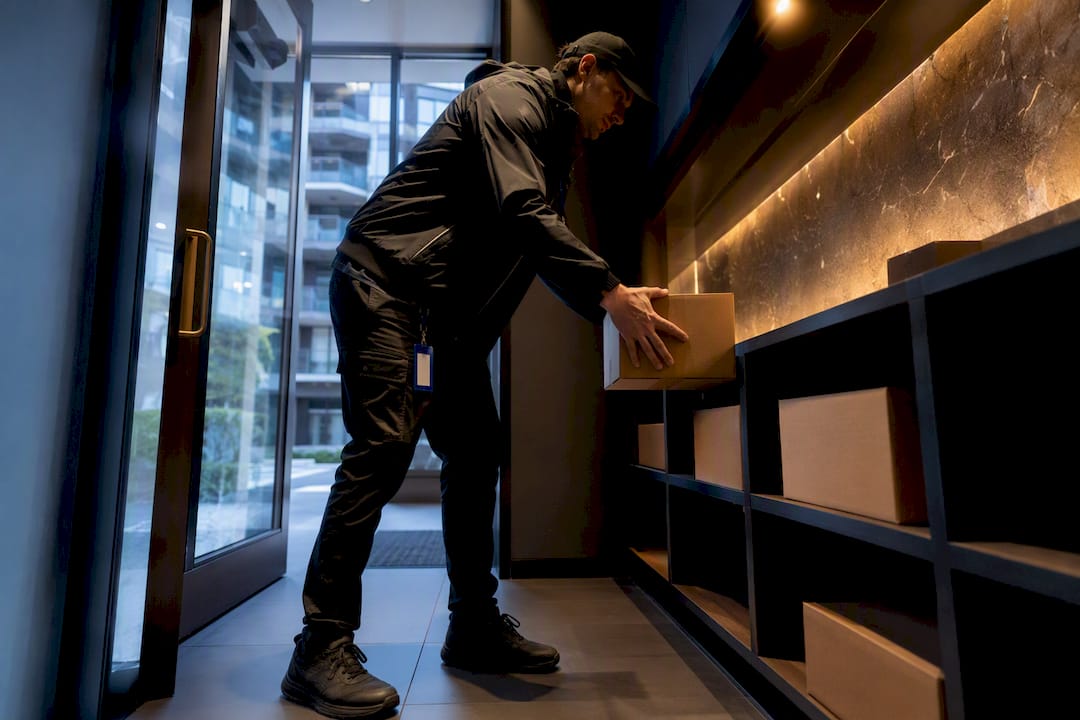
Carrier access apartments comes down to one thing: on-site package room management, meaning a property has a system in place for daily carrier intake, logging, secure storage, and resident pickup. The recommended approach for most communities is professional staffed management once parcel volume or resident expectations outpace what leasing staff can absorb between tours and renewals. Done right, it recovers staff hours, cuts lost-package complaints, and can even generate ancillary income instead of draining the budget.
TL;DR:
- Most properties benefit from a hybrid system combining lockers for standard parcels and a staffed room for oversized or refrigerated deliveries to improve reliability.
- Carrier non-compliance remains the top operational risk, with 70% of operators citing skipping intake steps as the primary cause of resident complaints.
- Running a detailed cost-per-package calculation, accounting for parcel volume, handling time, wages, and soft costs, helps determine if staffing or lockers are more cost-effective.
- Implementing a dedicated on-site package manager can recover staff hours, reduce resident complaints, and potentially generate income through resident subscription fees.
- Proper onboarding, compliance monitoring, and integration with property management software are critical components for an effective carrier access system.
Table of Contents
- What Is Carrier Access at an Apartment Community?
- Why Staffed Package Room Management Pays Off
- How Carrier Access and Package Intake Actually Work
- How to Calculate Your True Cost per Package
- Implementation Checklist for Setting Up Carrier Access
- Operational Mistakes That Undermine Package Room Management
- Criteria for Evaluating Carrier Access Providers
- Questions to Ask Before Signing a Provider Contract
- Red Flags When Choosing a Package Room Solution
- Integration With Existing Property Management Software
- Package Room vs. Lockers: Which Fits Your Property?
- Postal Solutions’ Perspective: What Twenty-Five Years Teaches You
- How Postal Solutions Handles Carrier Access for You
- Sources
- FAQ
What Is Carrier Access at an Apartment Community?
Carrier access, in the context that matters to property owners and asset managers, refers to how delivery drivers get packages into a secure space at your community and how residents get them out again. It covers everything from the intercom code a UPS driver uses to enter the package room to the audit trail that proves a parcel was delivered and picked up.
This is different from a locker vendor’s marketing copy or a standalone access-control app. It is an operational system: people, hardware, and process working together so a package that arrives at 10 a.m. is scanned, shelved, and logged before your leasing team even notices the delivery truck left. When that system breaks down, usually because a driver skips the intake step or an unmanned locker jams during a holiday surge, the failure shows up as resident complaints, not a line item on a spreadsheet.
Whether you already own an electronic locker system or an open package room, the underlying question is the same: who is responsible for making sure every parcel gets logged, stored, and handed off correctly, every day? That question is what separates communities with smooth carrier access apartments from ones stuck fielding lost-package calls during move-in week.
Why Staffed Package Room Management Pays Off
The return on a staffed package room shows up in three places: staff time, resident satisfaction, and revenue.
Every hour your leasing coordinator spends sorting boxes or tracking down a missing delivery is an hour not spent touring a prospect or processing a renewal. A dedicated on-site Package Manager working your community routinely takes that entire function off your team’s plate, which is the core premise behind Postal Solutions’ On-Site Package Room Management model. Communities that make this switch typically see:
- Leasing staff redirected from package sorting to tours, renewals, and resident retention
- Fewer resident complaints about missing or misplaced deliveries, since every parcel is logged at intake
- A package room that becomes a visible, sellable amenity on tours rather than a liability
- Potential ancillary income through a resident subscription model, since residents already expect secure package handling and many communities charge a small monthly fee for priority service
That last point matters more than it might seem. A properly run package room stops being a cost center and starts paying part of its own way, especially at properties with high delivery volume from student housing or senior communities where residents rely heavily on home delivery.
How Carrier Access and Package Intake Actually Work
A functioning package room follows a repeatable sequence, and knowing that sequence is how you evaluate whether a vendor or an internal team is actually doing the job.
- Carrier enters the secure space. This happens through a time-limited PIN, a video intercom call, or a mobile credential issued to a regular driver.
- Package is captured. Staff scan the label, log the carrier and tracking number, and note any exceptions (damaged box, wrong address, refrigerated item).
- Package is shelved. Organized by unit number or resident name, ideally in a layout that supports quick retrieval during peak pickup hours.
- Resident is notified. Text or email alert goes out immediately, not batched at the end of the day.
- Resident picks up or requests handoff. Self-service credential access works best here, since most pickup activity clusters in the evening hours.
- Exceptions get handled. Oversized furniture, grocery deliveries, and refrigerated items follow separate protocols rather than sitting in a hallway.
The weak link in this chain is almost always step one. An advisory industry survey found that 70% of operators flagged carrier non-compliance as their top frustration, and the average respondent relies on 2.4 different intake methods just to keep drivers cooperating. Drivers skip scanning steps when they are rushed, unfamiliar with a property’s system, or working a route they rarely cover.
Pro Tip: Issue a one-page pictorial SOP to every carrier that services your property, and hand a laminated copy to regular drivers along with a dedicated PIN. Visual instructions cut through language barriers and rushed shifts far better than a paragraph of written policy.
How to Calculate Your True Cost per Package
Most budget conversations about package management fail because nobody runs the actual math. The calculation requires four inputs, and skipping any one of them produces a number that looks good on paper and falls apart in practice.
- Unit count or measured annual parcel volume. A 250-unit building generates roughly roughly forty thousand parcels a year once you account for e-commerce delivery rates, not just what staff manually logged.
- Blended minutes per parcel, including exceptions. A clean scan-and-shelve might take under a minute, but a damaged box, a refrigerated grocery delivery, or a resident who cannot find their package pushes the blended average closer to three minutes.
- Loaded hourly rate. This means wages plus payroll taxes and benefits, not just the number on a paycheck.
- Measured soft costs. Time spent on resident complaint calls, re-delivery coordination, and lost-package investigations, which rarely make it into a spreadsheet but absorb real staff hours.
Multiply annual volume by blended minutes, convert to hours, then multiply by the loaded hourly rate. That total, divided by parcel volume, is your true cost per package. Most operators are surprised by how much the exceptions and the loaded wage number move the result. Using current wage data instead of outdated averages can roughly double many published cost estimates.
The break-even pattern: fixed-cost locker systems scale down in cost per package as volume rises, since the hardware is a sunk cost. Staffed management runs flatter, and its cost per package climbs mainly with wage increases, not volume. Date-stamp your calculation and rerun it annually, especially after a minimum wage adjustment.
Before any budget meeting, bring three numbers: unit count or annual parcel volume, who is currently handling parcels (leasing staff, maintenance, nobody consistently), and your best estimate of blended minutes per parcel. Those three figures tell a budget committee more than any vendor brochure. For a deeper walkthrough of what property managers actually pay across staffing models, see this package management cost breakdown.
Implementation Checklist for Setting Up Carrier Access
Rolling out a functioning package room, or fixing a broken one, follows a sequence that most properties skip steps in.
- Assess space and capacity. Measure current volume against room or locker size, and consider a hybrid layout if you handle both small parcels and oversized deliveries. Cold-storage needs for grocery and meal-kit deliveries should factor into the layout decision.
- Select access-control tools. PINs, video intercoms, and cameras with audit logging prevent the bottlenecks that build up during evening pickup hours.
- Decide your staffing model. A dedicated Package Manager makes sense above a certain parcel-per-day threshold; a part-time attendant may cover lower-volume properties; a monitored unmanned model works only where compliance and camera coverage are airtight.
- Onboard carriers properly. Distribute pictorial SOPs, issue time-limited credentials to regular drivers, and set clear rules for overflow and oversized packages before problems start.
- Set your measurement cadence. Track parcel counts, dwell time, and exception rate, and schedule weekly room audits so small problems get caught before they become resident complaints.
Operational Mistakes That Undermine Package Room Management
The biggest failures in carrier access apartments are rarely about hardware. They are about process gaps nobody assigned an owner to.
Carrier compliance should be a top-line question in any vendor evaluation, not an afterthought. Ask directly how a provider handles drivers who skip scanning or bypass intake, since that single failure mode drives the majority of resident complaints about missing packages.
- Standardize carrier communication centrally and push the same pictorial SOP to every site and every driver before launch, not after complaints start.
- Build in capacity buffers and temporary staffing for peak periods like move-in season and the holidays, when parcel volume can spike well beyond normal daily averages.
- Audit compliance specifically during those peak windows, since that is when non-compliant intake habits resurface even at properties that ran smoothly the rest of the year.
- Track cost-per-package and exception rate as ongoing KPIs, and rerun your cost model whenever wages or volume shift meaningfully.
Pro Tip: Run your holiday-season audit a full two weeks before Thanksgiving, not after. Catching a compliance slip before Black Friday volume hits gives staff time to retrain a driver instead of firefighting during the worst week of the year.
Criteria for Evaluating Carrier Access Providers
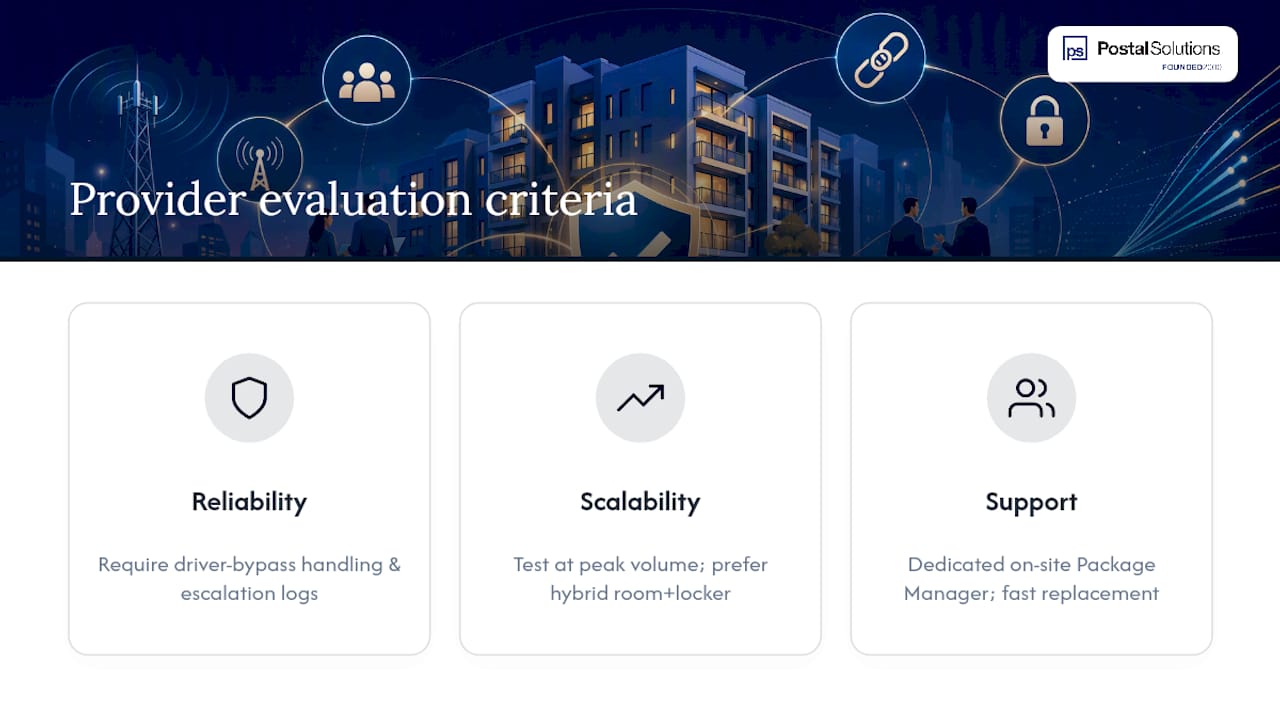
Reliability, scalability, and support are the three filters that separate a provider who can handle your property long term from one who looks good in a sales deck.
Reliability means asking how a provider handles the exact failure mode described above: carrier non-compliance. A provider with no clear answer for driver bypass is telling you they have not solved their hardest problem yet. Ask for specifics on how exceptions, like a damaged parcel or a refrigerated delivery, get logged and escalated, not just how a clean scan works.
Scalability matters more than it seems at signing. A system built for a 150-unit property does not always hold up at 400 units during a holiday surge. Providers should be evaluated on how their model performs at your building’s peak volume, not its average day. Vendor guidance on selection criteria consistently points to hybrid room-and-locker configurations as the most scalable setup for properties with mixed parcel sizes.
Support is the piece most owners underweight. A staffing model with a dedicated on-site Package Manager, rather than a call center handling issues remotely, tends to resolve exceptions faster because the person managing the room knows the residents and the building’s quirks. Ask how quickly a provider replaces a sick or absent staff member, since a package room with no coverage for two days creates the exact backlog that drives complaints.
Questions to Ask Before Signing a Provider Contract
A short, direct set of questions during the sales process will surface more useful information than a full RFP.
Ask how the provider measures and reports carrier compliance, and whether they can show you exception-rate data from a comparable property. Ask what happens during a staffing gap, whether that means illness, vacation, or turnover, and who covers the room in the interim. Ask how pricing is structured: is it per unit, per property, flat monthly, and does it change based on parcel volume or stay fixed regardless of a holiday surge.
Ask specifically how oversized, refrigerated, or perishable deliveries are handled, since this is where most package systems quietly fail. A provider that has a clear answer for grocery and meal-kit handoffs, rather than treating them as an edge case, understands the real workload of a modern package room. Finally, ask for a sample weekly audit report. A provider who cannot produce one is likely not running audits consistently, regardless of what the contract promises.
Red Flags When Choosing a Package Room Solution
Some warning signs show up before you ever sign a contract, if you know where to look.
A provider who cannot explain how they handle carrier non-compliance, beyond a vague “our drivers are trained,” has not actually solved the problem that causes most complaints. Be wary of pricing that looks cheap upfront but excludes software fees or credential management, since entry-level locker hardware alone can run several thousand dollars to tens of thousands of dollars before those add-ons. A provider unwilling to share references from properties of a similar unit count is another signal worth taking seriously.
Watch for vague answers about staffing coverage during vacation or illness, since a package room with inconsistent staffing quickly reverts to the chaos it was supposed to fix. Also be cautious of any system, staffed or automated, that has no audit trail. Without logged intake and pickup records, disputes over missing packages become impossible to resolve fairly for either the resident or the property.
Integration With Existing Property Management Software
A package room system that operates in isolation from your property management software creates duplicate work and blind spots. The best setups sync resident contact information, unit assignments, and move-in and move-out dates directly, so notifications go to the right person without manual entry every time a lease turns over.
Integration also matters for reporting. If your package room data lives separately from your PMS, pulling a monthly report on parcel volume or exception rates becomes a manual export-and-merge exercise instead of a few clicks. Ask any provider, staffed or automated, whether their system integrates with your existing PMS platform or whether resident data has to be entered twice.
This is one area where a staffed model has a practical advantage. A human Package Manager can flag a data mismatch (a resident who moved out but is still getting deliveries logged to their old unit) in real time, something a purely automated locker system may not catch until a resident complains. Integration works best when it is treated as a requirement during vendor selection, not a feature you discover is missing after go-live.
Package Room vs. Lockers: Which Fits Your Property?
Neither option wins outright. Lockers offer a self-service, unmanned experience that works well for standard-sized parcels and lower-touch properties. Package rooms offer flexibility for oversized items, refrigerated deliveries, and the kind of exception handling that rigid locker compartments cannot accommodate.
Most properties end up needing both. Industry data shows most operators use lockers and package rooms together rather than betting on one method exclusively, because parcel sizes vary too widely for a single format to handle everything. A hybrid layout, lockers for standard boxes and a staffed room for oversized or perishable items, tends to be the most practical setup for properties with mixed delivery patterns, according to hybrid deployment guidance from operators who have run both formats side by side.
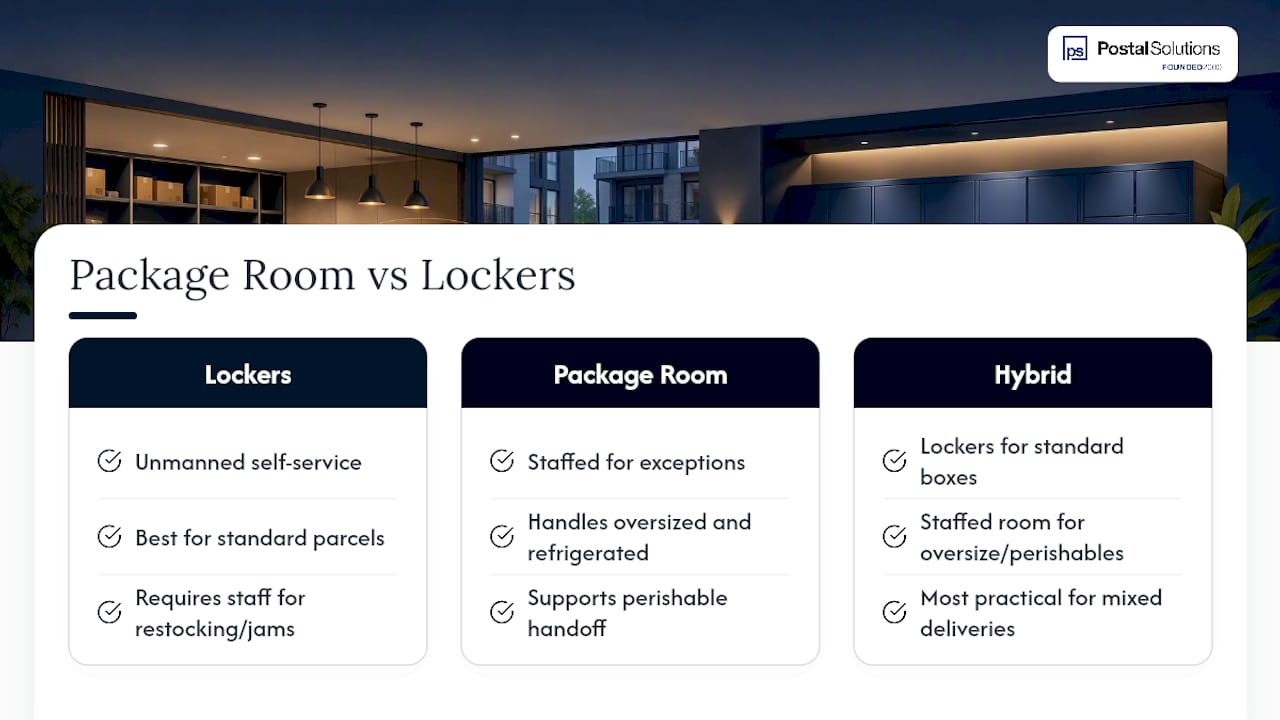
The decision usually comes down to your resident mix. A community with a high volume of grocery and meal-kit deliveries needs cold-storage and staffed handoff. A property with predominantly standard e-commerce packages can lean more heavily on lockers, provided a person is still responsible for restocking, resolving jams, and handling the overflow lockers cannot fit. For a closer look at where lockers alone tend to fall short, see this comparison of package lockers versus package room setups.
Postal Solutions’ Perspective: What Twenty-Five Years Teaches You
Across multifamily portfolios, the same two failures repeat: carriers bypassing intake steps, and staff time fragmented across sorting, resident calls, and lost-package searches instead of leasing work. Neither problem is a hardware issue. Both are process and staffing issues that a dedicated on-site Package Manager is built to solve, freeing up staff hours residents notice and leasing teams can use elsewhere.
A useful trigger for evaluating a change: if your property handles more than a handful of parcels a day, or your team fields repeated complaints about missing deliveries, it is worth running the cost-per-package math before assuming the status quo is cheaper. It usually is not.
— Postal Solutions
How Postal Solutions Handles Carrier Access for You
Postal Solutions is the alternative to piecing together locker software and hoping carriers stay compliant on their own. A dedicated on-site Package Manager works your community up to six days a week, covering daily acceptance, sorting, and chain-of-custody logging, weekly package room audits, resident pickup support, priority handling, and overflow management for oversized or refrigerated deliveries.
If your internal math from the cost-per-package calculation above shows staff time adding up, or if exceptions and complaints are becoming a weekly occurrence, that is the point to bring in a dedicated operator instead of asking leasing staff to absorb more. Postal Solutions works with whatever locker or package room system your property already owns, no rip-and-replace required. Residents can also opt into a paid subscription, priced between $5 and $15 a month, which can help offset the cost of management over time.
Visit the On-Site Package Room Management page to see the full service breakdown, or request a site-specific cost-per-package consultation to find out exactly where your property lands on the staffed-versus-capital tradeoff.
Sources
- A Framework for Solving Multifamily’s Package Management Problem | Insights by Blueprint
- Calculate Your True Cost per Package | Smart Package Room
- How To Set Up A Package Room In 2026 | Swiftlane
- What to Look for in a Multifamily Package Management Solution
FAQ
What Does “Carrier Access Apartments” Actually Mean?
It refers to how delivery drivers get packages into a secure space at an apartment community, and how that intake, storage, and resident pickup process is managed day to day. In practice, this means on-site package room management, whether staffed, automated, or a hybrid of both.
How Much Does On-Site Package Room Management Cost?
Pricing for Postal Solutions’ On-Site Package Room Management is available on the company’s website, while the resident subscription option runs $5 to $15 a month. Overall cost per package depends heavily on parcel volume, blended handling minutes, and loaded wage rates, which is why running your own cost-per-package calculation matters more than any published average.
Should a Property Choose Lockers, a Package Room, or Both?
Most properties benefit from a hybrid approach, since lockers and package rooms are commonly used together rather than as a single exclusive method. Lockers handle standard parcels well; a staffed room handles oversized, refrigerated, or exception items that rigid locker compartments cannot.
What Is the Biggest Operational Risk in Carrier Access Systems?
Carrier non-compliance is the leading failure mode, cited by 70% of operators as their top frustration. Drivers skipping scan or logging steps is what drives the majority of missing-package complaints, which is why compliance should be a primary criterion when evaluating any provider.
Can Package Room Management Generate Revenue Instead of Just Costing Money?
Yes, many communities structure it as a paid resident amenity rather than a pure expense. A resident subscription model, typically $5 to $15 a month, can offset management costs while giving residents priority handling and pickup support.
Recommended
Ready when you are
Fix your package room — start with a free proposal
Daily on-site Package Manager, resident text & email pings*, and a tour-ready amenity. Tell us your unit count and we'll send a right-sized proposal — usually within one business day.
- ✓ 16–30 hours back every week
- ✓ Works with any locker system
- ✓ Faster, friction-free resident pickup
- ✓ An easy ancillary income addition