
September 23, 2026
Clear a 1,500 Package Apartment Backlog With Process, Not Lockers
Operations first plan to clear apartment package backlogs for property managers: triage, KPIs, and how on-site teams cut handling hours.
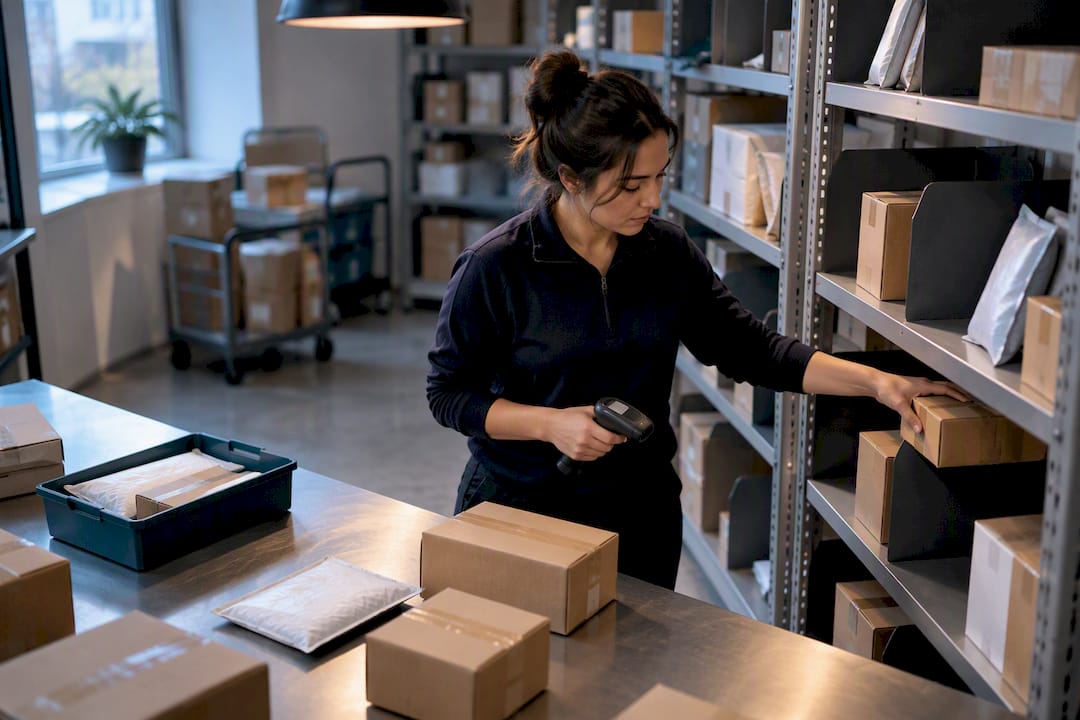
Clearing a package backlog starts with triage, not new hardware: stage overflow in a secure area, run prioritized pickups on refrigerated and oversized items first, and enforce a hold window with documented returns. The fix that keeps it from coming back is process discipline, logging every item at intake, notifying residents on a set schedule, and matching your storage setup to your actual volume, not the other way around.
TL;DR:
- Effective backlog reduction relies on triaging overflow to secure staging areas, prioritizing high-risk packages, and enforcing clear hold windows.
- Consistent logging of arrivals and pickups, combined with scheduled sweeps and resident notifications, prevents recurring package accumulation.
- Using staff-managed package rooms with dedicated personnel can outperform hardware-only solutions in controlling ongoing backlogs.
- Matching storage capacity and technology to weekly package volumes and peak times is crucial for scalable, long-term backlog prevention.
- Tracking key KPIs like packages per unit, dwell time, and pickup rate helps measure improvements and justify ongoing process investments.
Table of Contents
- Why Package Backlogs Form: The Root Causes Property Teams Must Diagnose
- Emergency Backlog Triage: A Practical Checklist To Clear the Room This Week
- Operational Disciplines That Prevent Backlogs From Coming Back
- Which Storage and Technology Options Actually Solve the Problem?
- How Do You Match a Solution to Your Property?
- Measuring Impact: The KPIs That Prove Backlog Reduction Works
- Postal Solutions: Practitioner Evidence for On-Site Package Room Management
- Author Perspective: Process and Measurement Beat Hardware-First Thinking
- On-site package room management is the direct substitute for the sorting, chasing, and shelf triage eating your leasing team’s week. A dedicated on-site Package Manager works the community multiple days a week, handling daily acceptance, sorting, secure storage, resident pickup support, and coverage during move-in or holiday peaks, without requiring you to rip out the lockers or software you already have.
- Sources
- FAQ
Why Package Backlogs Form: The Root Causes Property Teams Must Diagnose
A backlog is rarely one problem. It’s usually two or three failure modes stacking on top of each other until the package room looks like a shipping warehouse.
Volume is the obvious driver. A 250-unit community can receive around 1,500 packages a month, and move-in season or a holiday promotion can push that well past normal. But volume alone rarely explains a full-blown backlog apartment teams can’t clear. The real culprits sit underneath it:
- Carrier noncompliance — drivers skip locker workflows or scanning steps and dump boxes on open shelves, breaking the chain of custody before it starts.
- Physical mismatches — fixed-size lockers reject oversized furniture deliveries and perishable grocery drops, so they pile up wherever there’s floor space.
- Resident pickup delays — no enforced hold window means packages sit for weeks with nobody accountable for moving them.
- Missing process — no intake log, no proof of pickup, and sweeps that happen “whenever someone gets to it” instead of on a schedule.
Diagnose which of these is driving your specific backlog before you spend a dollar on a fix.
Emergency Backlog Triage: A Practical Checklist To Clear the Room This Week
If your package room already looks like a maze of boxes, you don’t have time for a long-term overhaul. You need a clearing sequence that works within days, drawn from the same stabilization steps operators use to fix an overrun package room.
- Stabilize intake first. Brief every carrier on where to leave packages, and if the room is truly overwhelmed, ask your regional USPS or courier contact to pause nonessential drops for 48 hours.
- Create secure overflow staging. Clear a locked closet, office corner, or unused amenity space, and label and log every item the moment it moves there.
- Prioritize by risk, not age. Pull refrigerated, high-value, and oversized items first. They cause the most complaints and the most spoilage.
- Escalate resident outreach. Anything sitting past 48 to 72 hours gets a text and a phone call, not just an email nobody opens.
- Sweep and return. Anything past your posted hold window goes back to the carrier with a recorded return, capping shelf growth instead of letting it compound.
Pro Tip: Take a photo of every shelf before you start the sweep. If a resident disputes a return later, that timestamp is your proof the item sat well past the hold window.
Operational Disciplines That Prevent Backlogs From Coming Back
Clearing the room once is easy compared to keeping it clear. That takes standards your staff can follow without thinking twice, built around six data points captured at the moment a package arrives: carrier, tracking number, recipient, storage location, arrival date, and a photo of the label.
Proof of pickup matters just as much as proof of arrival. A signature or a quick photo of ID at handoff closes the loop and ends most “I never got my package” disputes before they start.
From there, the daily rhythm looks like this:
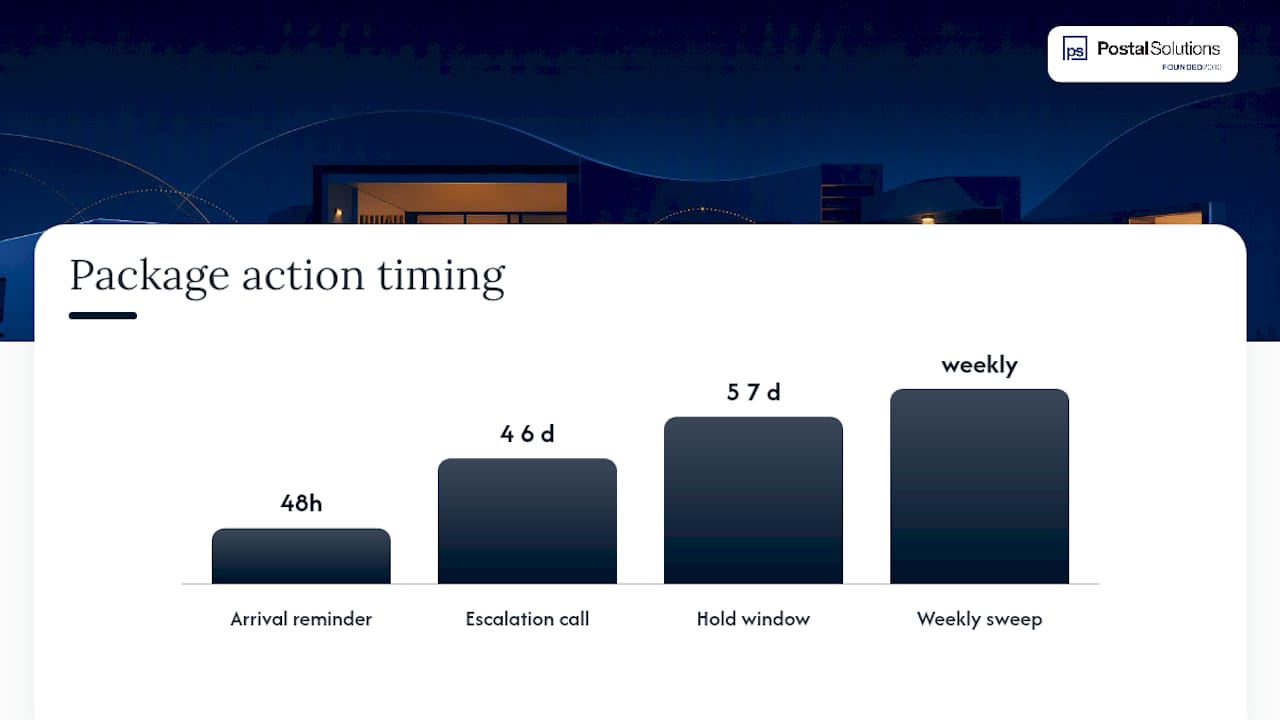
- Publish a hold window (5 to 7 business days is typical) and actually enforce it, not just post it on a flyer.
- Run weekly sweeps and log every return with a timestamp.
- Send an arrival alert immediately, a reminder at 48 hours, and an escalation call or note at 4 to 5 days.
- Give peak-day staff one printed checklist: log it, shelve it, notify it. Nothing else.
Pro Tip: Assign one person as the “sweep owner” each week. Shared responsibility for sweeps is how they quietly stop happening.
Which Storage and Technology Options Actually Solve the Problem?
Every vendor pitch sounds like it solves backlog for good. Most solve one slice of it and leave the rest for your staff to handle manually.
- Smart lockers give residents self-serve pickup and automated notifications, but fixed compartment sizes mean anything oversized still ends up on a shelf somewhere else.
- AI-powered smart package rooms use shelving and computer vision to triple usable capacity within the same footprint compared to lockers, but they depend heavily on drivers actually scanning items correctly.
- Logging and notification software cuts the minutes staff spend searching for a package or typing out texts, but it adds zero physical capacity when the room is already full.
- Off-site or door-delivery models move volume out of the building entirely, though many residents prefer secure on-site pickup over coordinating drop-offs elsewhere.
- Hybrid staffed models convert underused amenity space into overflow storage with a dedicated attendant, giving you flexible capacity that scales with foot traffic instead of shelf count.
Before signing with any vendor, ask directly how they handle carrier noncompliance when drivers bypass the intended workflow. Lockers and software with more information on locker utilization tactics are worth reviewing before you assume more hardware is the answer.
How Do You Match a Solution to Your Property?
Unit count and current volume set the baseline, but sizing for a normal week and ignoring peaks is how backlogs happen every November.
- Start with your packages-per-week baseline, then check it against your unit count. A 150-unit building running 400 packages a week has a different problem than one running 150.
- Build in a peak multiplier. Holiday weeks can run close to 1.8 times normal volume, and the November through December stretch alone can account for nearly 20% of annual volume.
- Walk the physical space. If carriers can’t reach the room easily, no software fixes that access problem.
- Ask every vendor how they handle driver bypass and what fallback labor looks like when volume spikes past their system’s design capacity.
- Time your current process for a week before signing anything, so you have a real baseline to measure ROI against later.
Properties without an existing locker system aren’t stuck choosing between chaos and a costly hardware install. Staffed package management can work as a standalone fix.
Measuring Impact: The KPIs That Prove Backlog Reduction Works
You can’t argue for budget with a feeling. You need numbers, and the ones that matter are simple enough to track with a clipboard for two weeks.
| Metric | What it tells you |
|---|---|
| Packages per unit/week | Your real volume baseline |
| Staff minutes per package | Full cycle: intake to pickup |
| Average dwell time | How long packages sit before pickup |
| Pickup rate within 48 hours | How well your notification cadence works |
Run a two-week count during a normal stretch, then repeat it during a holiday week to capture your peak multiplier. Saving even one minute per package at 400 packages a week adds up to several recovered staff hours, the exact case you bring to ownership when requesting budget for a pilot.
Postal Solutions: Practitioner Evidence for On-Site Package Room Management
Experienced on-site package operations demonstrate that a dedicated on-site Package Manager changes the intake-to-release cadence in ways software alone can’t touch.
- Daily acceptance, sorting, and shelving happen the moment packages arrive, not in a batch at end of day.
- Chain-of-custody logging and resident notifications run automatically as part of the daily routine.
- Weekly audits catch aging packages before they become disputes.
- The service works with whatever locker or room hardware a property already owns.
Author Perspective: Process and Measurement Beat Hardware-First Thinking
Most operators buy lockers first and build process second, and that order is backward. A locker wall with no enforced hold window just becomes a slower-growing backlog. Portfolio managers get further by adopting matching rules, size to volume, measure cycle time, then choose hardware, than by defaulting to whatever vendor pitched the loudest.
— Postal Solutions
On-site package room management is the direct substitute for the sorting, chasing, and shelf triage eating your leasing team’s week. A dedicated on-site Package Manager works the community multiple days a week, handling daily acceptance, sorting, secure storage, resident pickup support, and coverage during move-in or holiday peaks, without requiring you to rip out the lockers or software you already have.
The service integrates directly with existing hardware, whether that’s smart lockers or a system like HelloPackage, and many communities structure it as an ancillary income opportunity, offering it as a paid resident amenity and retaining the margin over the cost of management. That turns a line item that used to drain the budget into one that can help pay for itself.
If you’re ready to see what a matched, right-fit setup looks like for your property, download the free package room guide or request a site audit through Postal Solutions.
Sources
- Package Management: Logistics Technology Prevents Apts From Getting Boxed (NAAHQ)
- Package Management in Multifamily Buildings: Label to Pickup (Scaalr)
- How to fix an overrun Package Room (Smart Package Room)
- A framework for solving multifamily’s package management problem (Blueprint Insights)
FAQ
My package hasn’t moved in 10 days. What should I do?
Contact your leasing office directly. A package sitting past the typical posted hold window has likely missed it and needs a manual check against the intake log to confirm its shelf location or return status.
Where do packages go when you live in an apartment?
Packages typically go to a package room, a bank of electronic lockers, or a staffed front desk, depending on what your property has installed. Some communities also use a dedicated on-site Package Manager, like the model Postal Solutions provides, to receive, log, and hold items until pickup.
Why isn’t the carrier delivering packages to my apartment?
This usually traces back to carrier noncompliance, where a driver skips the building’s intended drop-off workflow, or an access issue like a locked mailroom the carrier can’t reach. Ask your property manager whether they’ve flagged this specific carrier for a workflow review.
How long will a package be delayed?
That depends on your building’s hold window and current backlog, but most well-run properties log and shelve items within hours of arrival. If a package is delayed beyond your community’s posted window, typically 5 to 7 business days, it may be scheduled for return.
Does Package Room Management cost extra for residents?
Pricing depends on the property, and current details are available directly on the Postal Solutions site.
Recommended
Ready when you are
Fix your package room — start with a free proposal
Daily on-site Package Manager, resident text & email pings*, and a tour-ready amenity. Tell us your unit count and we'll send a right-sized proposal — usually within one business day.
- ✓ 16–30 hours back every week
- ✓ Works with any locker system
- ✓ Faster, friction-free resident pickup
- ✓ An easy ancillary income addition