
September 10, 2026
Multifamily Package Management RFP Template: Scope and Vendor Proofs
Get a procurement ready package management RFP template for multifamily operators. Includes copy paste scope, vendor proof checklist, SLAs, scoring, and a...

A package management RFP should secure one thing: a vendor who covers daily acceptance, sorting, secure storage, resident notifications, and locker or package room administration without leaving gaps at nights, weekends, or move-in week. If you manage this yourself instead of drafting a formal request, start with the checklist below, then use the evaluation framework to score whoever responds. Every other decision in this article — model, cost, timeline — flows from that one scope statement.
TL;DR:
- Vendors must demonstrate clear capabilities in daily acceptance, sorting, secure storage, resident notifications, and locker or room management without downtime on nights, weekends, or move-in periods.
- The chosen service model should match property size, package volume, and space constraints, with options including on-site managed, locker plus managed, smart package rooms, or hybrid staffing solutions.
- RFP line items need comprehensive scope, SLA definitions, performance KPIs, carrier onboarding, exception handling, resident adoption, reporting, and liability details to ensure consistent and measurable service.
- Vendors should provide documented proof, references, and KPIs from comparable properties, with realistic pricing based on staff hours, package complexity, and hardware needs, plus a clear contractor renewal and penalty structure.
- The first 30 to 90 days require close monitoring of staffing hours, resident pickup times, and complaint trends, with emphasis on carrier compliance and resident communication to ensure smooth adoption.
Table of Contents
- What Service Models Should a Package Management RFP Cover?
- RFP Checklist: What to Include Line by Line
- How Do You Score and Compare Vendor Proposals?
- What Should You Budget and When Should You Expect Results?
- What Proof Should You Require From a Package Management Vendor?
- What Contract Terms Should You Negotiate Before Signing?
- What Actually Happens in the First 90 Days With a New Vendor
- Where Postal Solutions Fits Your RFP
- Sources
- FAQ
What Service Models Should a Package Management RFP Cover?
Before you write a single line item, decide which service model you’re actually inviting bidders to propose. Most multifamily RFPs default to “vendor with lockers” and miss three other viable structures — which means you get bids that don’t match your building.
- On-site managed service: a dedicated person handles acceptance, sorting, shelving, and resident handoff in a package room, no hardware locker required. Works well for mid-rise and garden-style communities with moderate daily volume and existing storage space.
- Locker plus managed service: a hardware locker bank handles routine pickups while a manager still handles oversized items, refrigerated deliveries, and exceptions carriers won’t scan into a locker. This hybrid covers the volume gap lockers alone can’t close.
- Smart package room: computer vision and position tracking replace fixed locker cells, which can multiply usable storage in the same footprint and cut resident wait times from minutes to seconds in some deployments, according to Multifamily & Affordable Housing Business. It suits high-density, high-turnover properties where floor space is the binding constraint.
- Hybrid staffed model: combines any of the above with rotating labor coverage across a portfolio, useful for owners managing several mid-size properties that individually can’t justify full-time staffing.
Match the model to unit count, daily package volume, and available square footage rather than picking whichever vendor pitches hardest — that’s the operator framework Insights by Blueprint lays out, and it holds up regardless of who you’re evaluating. Some vendors supply the on-site managed model and integrate with existing locker or room hardware, so you’re not forced into a hardware swap just to get staffing coverage.
RFP Checklist: What to Include Line by Line
A comparable RFP needs identical line items across every bidder, or you’ll spend weeks reconciling apples to oranges. Copy these categories directly into your document.
Scope of work. Spell out the full workflow, not just “package handling.” List: acceptance and check-in scanning, sorting by unit, shelving or locker loading, resident notification, pickup verification, and chain-of-custody logging from the moment a carrier drops a box to the moment a resident signs for it.
- Staffing and hours. State required on-site coverage days and hours (many properties need coverage up to six days a week), backup staffing for call-outs, and whether the vendor supplies float labor across a portfolio.
- Service level agreements. Define maximum processing time from delivery to resident notification, maximum time packages sit before escalation, and response time for resident complaints.
- Key performance indicators. Require monthly reporting on volume received, average time-to-notification, exception count, and resident satisfaction scores tied to the package process specifically.
- Carrier onboarding. Ask how the vendor trains UPS, FedEx, Amazon, and regional carriers on your property’s specific drop-off procedure, and how they detect and correct driver non-compliance when it happens.
- Exception handling. Cover oversized furniture deliveries, refrigerated or perishable items, damaged packages, and misdelivered items addressed to former residents.
- Space and technical requirements. Specify power and internet needs for scanning equipment, ADA-compliant access to package storage, and whether the vendor works with an existing locker system or requires a dedicated room.
- Resident adoption plan. Require a documented first-30-day plan covering signage, enrollment communication, and a transition period so residents actually change their delivery behavior instead of defaulting to old habits.
- Reporting cadence and format. Specify whether reports arrive weekly, monthly, or through a live dashboard, and what raw data (timestamps, photos, signatures) backs each report.
- Insurance and liability. Require proof of general liability coverage and clarify who bears responsibility for a lost or damaged package once it’s inside the property’s custody chain.
- Overflow protocol. Ask how the vendor handles a volume spike during move-in weekends or the holiday season when package counts can run several times above baseline.
A 250-unit community can receive roughly 1,500 packages a month, and some properties see more than 400 packages in a single week during peak stretches. Your RFP needs staffing and SLA language that survives that surge, not just an average-week scenario.
Pro Tip: Ask every bidder to submit a sample weekly report using dummy data before you sign anything. If the report they show you doesn’t already include time-to-notification and exception counts, their actual reporting won’t either.
How Do You Score and Compare Vendor Proposals?
Weight your scorecard so no single flashy feature (a slick app, a smart camera system) can outscore a vendor who’s weak on the fundamentals.
Certain items belong on a pass/fail list, not a weighted scale, because a failure on any one of them should eliminate a bidder outright:
- Current, valid general liability insurance covering the proposed service.
- At least two verifiable references from properties of comparable size and unit mix.
- A written SLA with specific numeric commitments, not vague language like “prompt handling.”
- A named carrier onboarding process, not a generic “we work with all carriers” claim.
Sample questions worth asking in the proposal or an interview: “Walk me through what happens when a carrier refuses to scan into your system.” “What’s your actual average time from delivery to resident notification at a comparable property?” “How do you staff for a call-out on a Saturday?” Carrier non-compliance is consistently flagged as a primary cause of package system failure, so any vendor who can’t answer the first question concretely is a red flag. Vague reporting promises, references you can’t reach, and a refusal to commit to numeric SLAs are the three most common warning signs in weak proposals.
What Should You Budget and When Should You Expect Results?
Pricing typically breaks into three components: staff labor hours (the largest driver), package volume and complexity (refrigerated items and oversized deliveries cost more to handle than standard boxes), and any hardware integration or upgrade needs. Ask vendors to quote per-property or per-unit, per-month rates so you can compare across your portfolio on equal footing.
- Site survey and scoping: one to two weeks to assess volume, space, and existing hardware.
- Pilot at one property: four to six weeks to validate SLAs and resident adoption before wider rollout.
- Portfolio rollout: staggered over one to three months depending on property count.
- Peak planning checkpoint: build a seasonal surge plan (move-in periods, November through December holidays) into the contract before you need it, not after volume triples.
Leasing staff often lose meaningful hours weekly just handling packages informally, and outsourcing that work returns those hours to leasing and renewals instead. That’s the real budget offset worth putting in front of ownership: the labor cost of a managed vendor competes directly against the hidden cost of your own staff’s time.
What Proof Should You Require From a Package Management Vendor?
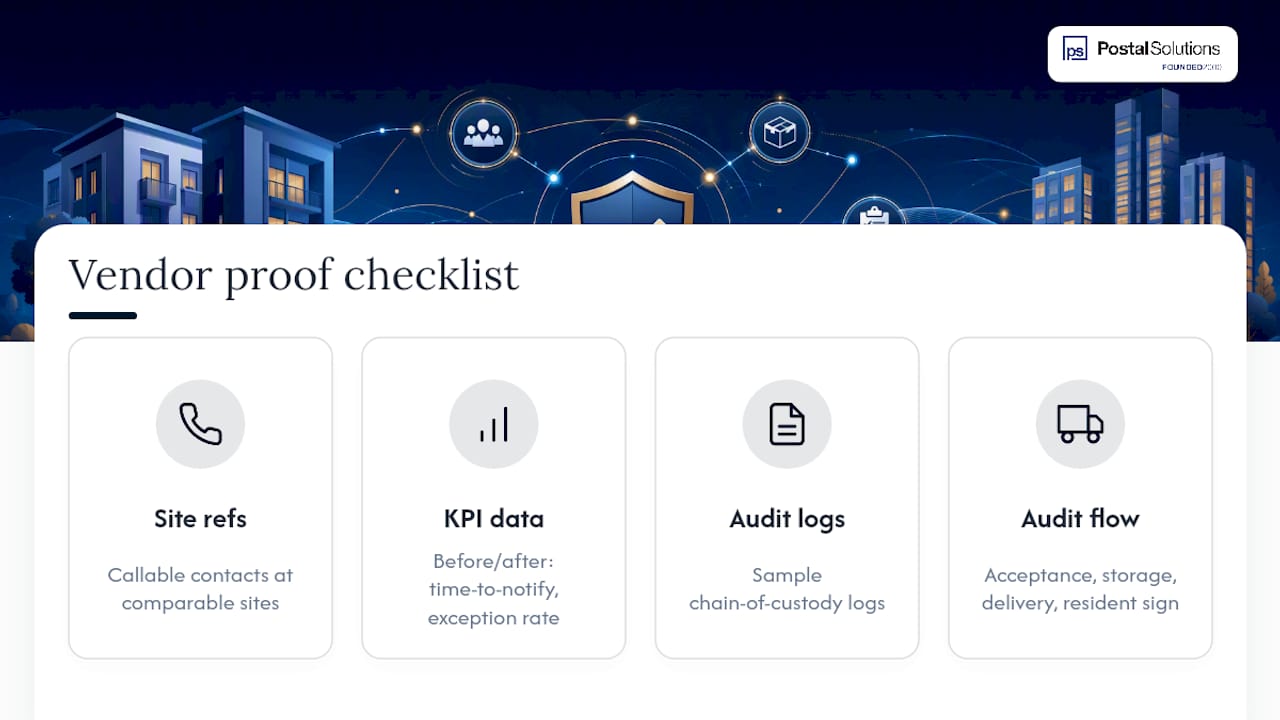
Ask vendors to substantiate claims with documents, not adjectives. Request site references you can actually call, before-and-after KPI data (time-to-notification, exception rates) from a comparable property, and sample chain-of-custody audit logs showing how a package is tracked from acceptance to resident signature.
Some providers run on-site package operations built around a dedicated on-site Package Manager working a property up to six days a week rather than a call-center or app-only model. That structure is worth asking any bidder to match or explain why they don’t: who physically handles a package when a resident calls asking where it is, and how fast do they get an answer? A managed service done well doesn’t just clear the package room. It can hand leasing staff back hours previously lost to sorting boxes, and some communities structure the service as a resident amenity fee that offsets or covers the management cost, turning what used to be a budget drain into something closer to break-even or better.
What Contract Terms Should You Negotiate Before Signing?
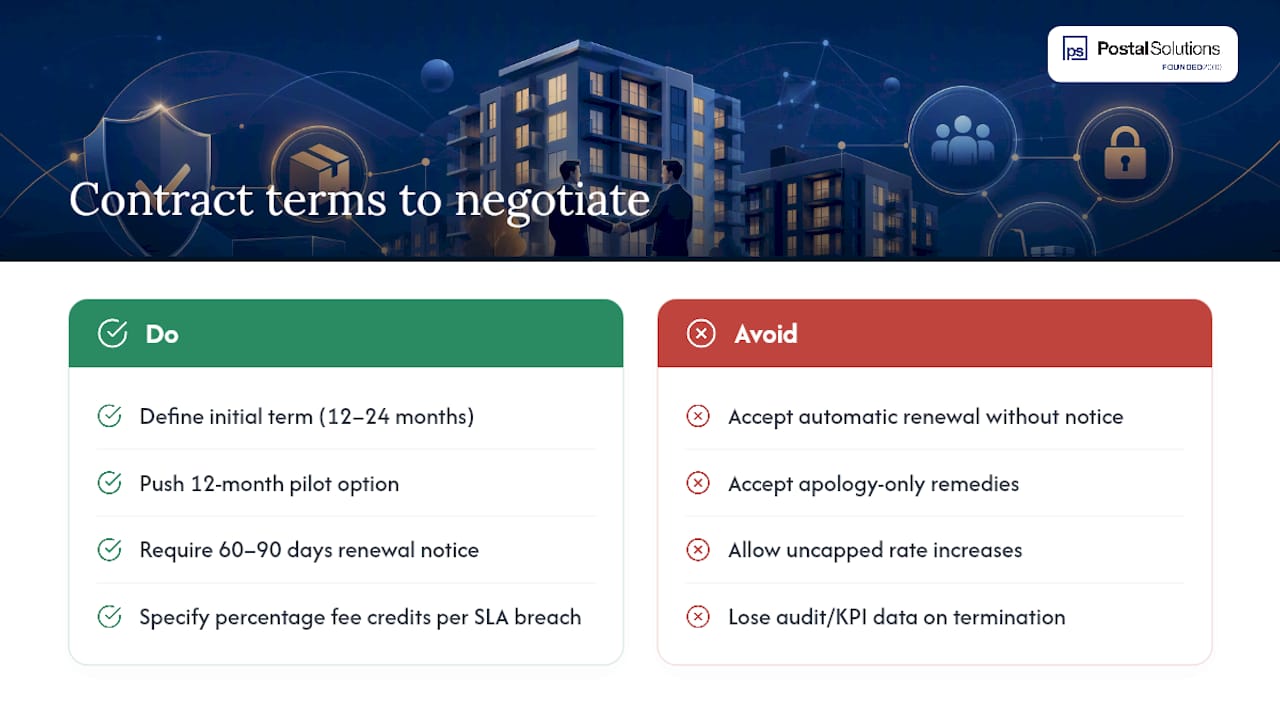
Every package management contract needs three protections written in plain numeric terms: a defined initial term, a renewal mechanism, and remedies if service falls short. Most vendor agreements in this space run 12 to 24 months initially, with automatic renewal unless either party gives 60 to 90 days’ notice. Push for a shorter initial term (12 months) if you’re piloting at a single property before a portfolio-wide commitment.
Penalty clauses should tie directly to the SLAs you negotiated earlier: a missed time-to-notification target, an unstaffed shift with no backup coverage, or a pattern of lost packages should trigger a defined credit against your monthly fee, not just an apology email. Ask for a specific remedy structure in writing, such as a percentage fee credit for each SLA breach in a given month, capped at a reasonable ceiling so the vendor stays financially accountable without the clause becoming unworkable for either side.
Renewal terms deserve equal scrutiny. Some vendors quote an attractive first-year rate, then raise it sharply at renewal once you’re dependent on their staffing and reporting systems. Negotiate a cap on annual rate increases into the initial contract, tied to a clear index or percentage, so renewal doesn’t become a surprise negotiation every year. Also confirm what happens to your data (audit logs, KPI history) if you terminate: you want the right to export your own reporting history, not lose two years of performance data because a relationship ended.
What Actually Happens in the First 90 Days With a New Vendor
The first two weeks look chaotic even with a good vendor. Staff are learning your carrier patterns, residents are still walking to the old pickup spot, and exceptions pile up faster than anyone expects. That’s normal, not a sign the RFP process failed.
Track three numbers starting day one: hours your leasing staff spend on packages (should trend toward zero), average pickup time from notification to resident retrieval, and complaint volume. By day 30, complaint volume should be dropping, not flat. If it isn’t, the resident adoption plan wasn’t executed, not that the model is wrong.
Push carrier compliance hard in week one. A pictorial sign at the delivery entrance and a short note to your regular UPS and FedEx drivers solves more problems than any software update will.
— Postal Solutions
Where Postal Solutions Fits Your RFP
If you’re drafting a package management RFP right now, put a dedicated on-site Package Manager working your property up to six days a week, documented chain-of-custody logs from acceptance to resident signature, and a reporting cadence you actually get to see, not just promises of one.
You don’t have to build that request list from a blank page. Download the free guide to package room management for apartments for a ready-made scope template you can adapt to your property before you send a single RFP. If your community doesn’t have locker hardware yet, Postal Solutions still runs daily on-site package management without a locker system in place. And if security documentation is part of your RFP’s compliance section, a resource like surveillance planning for apartment communities is worth reviewing alongside your access-control requirements. Reach out to Postal Solutions directly to talk through scope for your specific property before your RFP deadline.
Sources
- Package Management: Logistics Technology Prevents Apts From Getting Boxed In | National Apartment Association
- A Framework for Solving Multifamily’s Package Management Problem | Insights by Blueprint
- Scalable Solutions for Multifamily’s Growing Package Problem - Multifamily & Affordable Housing Business
FAQ
What is a package management RFP?
It’s a formal request multifamily owners and managers send to vendors asking them to propose how they’ll handle daily package acceptance, sorting, secure storage, resident notification, and locker or room administration at a property.
Who should respond to a package management RFP?
Managed on-site providers that cover the full workflow from carrier drop-off to resident pickup should respond, not hardware-only locker vendors who leave staffing, exception handling, and carrier onboarding unaddressed.
How much do packages cost properties without a managed system?
Costs show up mostly as lost leasing staff hours and resident complaints rather than a line-item fee; a 250-unit property can receive roughly 1,500 packages a month, and unmanaged volume at that scale consumes real staff time weekly.
Should the RFP require a resident adoption plan?
Yes. Require a documented first-30-day plan covering signage, resident enrollment communication, and a transition period, since adoption failures usually come from missing communication rather than a bad hardware or staffing choice.
Does Postal Solutions provide the on-site staffing model RFPs typically request?
Yes. Some providers offer a dedicated on-site Package Manager working a property up to six days a week, covering acceptance, sorting, secure storage, and resident notification within the package room or locker system a property already has.
Recommended
Ready when you are
Fix your package room — start with a free proposal
Daily on-site Package Manager, resident text & email pings*, and a tour-ready amenity. Tell us your unit count and we'll send a right-sized proposal — usually within one business day.
- ✓ 16–30 hours back every week
- ✓ Works with any locker system
- ✓ Faster, friction-free resident pickup
- ✓ An easy ancillary income addition