
September 8, 2026
Stop Ghost Packages in 72 Hours: Ops First Returns SOP for Apartments
End ghost packages in apartments with an operations first mark and return SOP, a 72 hours triage checklist, and weekly audits that reclaim staff time.

Returns handling in the package room means one thing: managing packages that never reach a resident, whether they’re addressed to someone who moved out, refused at the door, or simply undeliverable. The single most effective fix is a written mark-and-return standard operating procedure paired with a weekly audit enforced without exception. Get those two habits running and lobby clutter drops, chain-of-custody gaps close, and resident complaints about missing or mystery packages become rare instead of routine.
TL;DR:
- Packages for former residents should be marked immediately with a dated sticker to prevent misdelivery and loss, especially during high-volume peaks.
- A five-checkpoints workflow, including intake, logging, notification, hold, and return, is essential for maintaining a clear paper trail and resolving disputes.
- Staff should never open or inspect resident mail, and logs containing personal data must be securely access-controlled to comply with privacy laws.
- Carrier non-compliance, such as bypassing SOPs, is the primary cause of package mishandling and must be addressed with driver check-ins and escalation scripts.
- Outsourcing returns handling becomes justified when volume consistently overflows, staff time is strained, or the package room impacts leasing showings.
Table of Contents
- Quick Action Checklist: Your First 72 Hours
- How Do You Build a Returns Workflow That Actually Holds Up?
- What Policy Language Protects Your Property?
- How Do You Keep Carriers Compliant?
- How Much Package Room Space Do You Actually Need?
- What Should Your Weekly Audit Actually Log?
- When Does Outsourcing Returns Handling Make Sense?
- Handling Damaged or Lost Returned Items
- Legal and Privacy Considerations in Returns Handling
- Technology Solutions for Returns Tracking and Management
- Ready to Hand Off Your Package Room?
- An Operator’s Take on Returns Handling
- Sources
- FAQ
Quick Action Checklist: Your First 72 Hours
Stop the bleeding before you build the full system. Here’s what to do this week, in order:
- Inventory every held item today. Walk the package room and tag anything addressed to a former resident or flagged undeliverable by the carrier.
- Set up temporary overflow staging. Use a cart, shelf, or bin clearly separate from active resident packages.
- Post a one-page pictorial SOP at the delivery entrance. Drivers need to see intake steps at a glance, not read a memo.
- Assign a daily owner. One staff member checks the returns shelf every shift.
- Schedule your first weekly audit now. Put it on the calendar before you forget.
- Mark former-resident packages with a dated sticker the moment you spot them.
- Keep a simple paper log running until your digital system catches up.
- Don’t let “we’ll deal with it later” become the default; overflow left unmarked is how packages get misdelivered or lost.
Properties that skip this triage tend to discover the returns problem only after the shelf overflows into the lobby, which is exactly the optics you don’t want during a tour.
How Do You Build a Returns Workflow That Actually Holds Up?
A returns workflow needs five checkpoints: intake, log, notify, hold, and return. Skip one and you lose the paper trail that protects your property when a resident or a carrier disputes what happened.
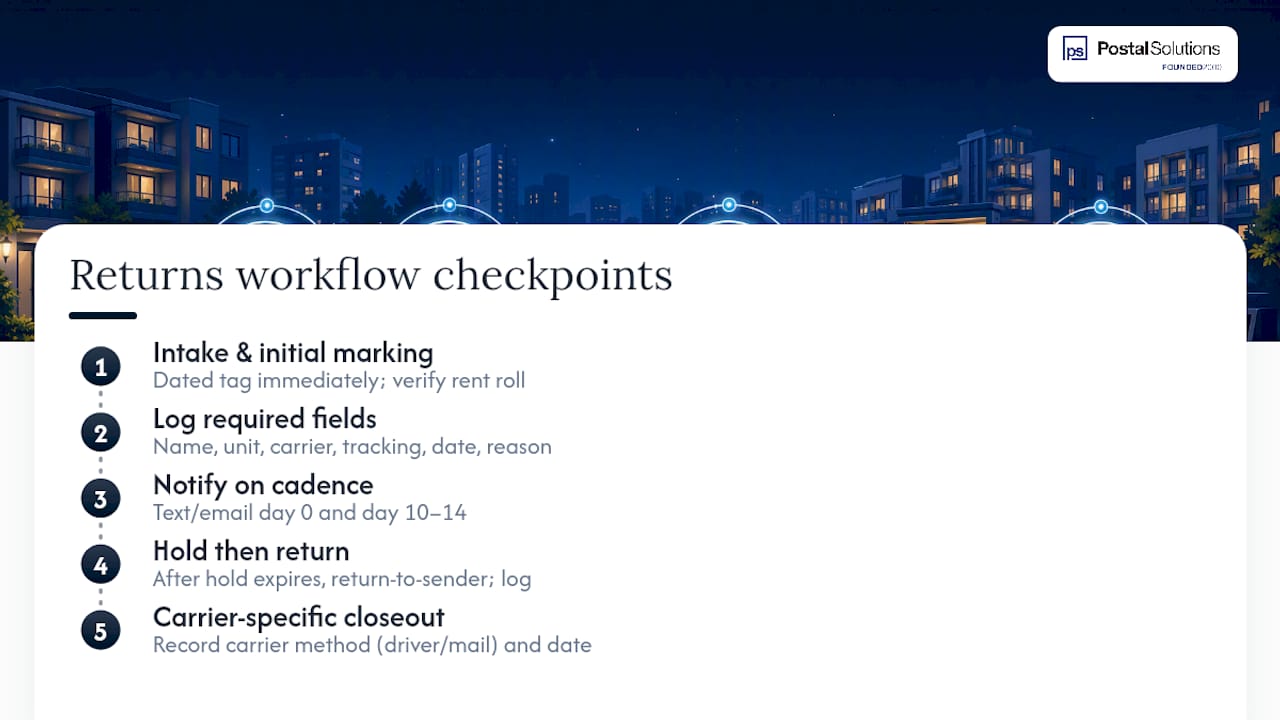
1. Intake and initial marking. The moment a package arrives for someone who’s moved out, or a carrier flags it undeliverable, mark it immediately with a dated tag. Don’t wait until end of shift. If you’re not sure whether a name matches a current resident, check your rent roll before shelving it as active.
2. Log the required fields. At minimum, capture the resident name, unit number (or “former resident, unit ___”), carrier, tracking number, date received, and the reason for the return flag. A spreadsheet works as a fallback, but whatever you use needs a place to log the final disposition too.
3. Notify on a fixed cadence. Send a text or email the day the item arrives, then a second notice around day 10 to 14 if it’s still unclaimed. Keep the message short: item description, deadline to pick up, and what happens if the deadline passes.
4. Hold, then return. Once the hold period expires, the item goes back to the carrier as return-to-sender, with the disposition logged and dated.
5. Carrier-specific closeout. Different carriers have different return procedures. FedEx and UPS typically need the item handed to a driver with the original label intact; USPS mail generally goes back through the mail stream marked “return to sender.” Log which method you used and when.
Pro Tip: Keep a laminated one-page version of this workflow taped inside the package room door. Staff turnover is constant in this industry, and a new hire who can follow five visual steps on day one will make far fewer mistakes than one relying on a training memo they read once.
What Policy Language Protects Your Property?
A common industry standard holds a former resident’s package for roughly 30 days before returning it, though the right period varies by state and should be confirmed with your attorney before you print it into a lease or resident handbook.
Beyond the hold period, a handful of policy lines do most of the protective work:
- Staff never open, inspect, or forward mail addressed to a resident, current or former.
- Every contact attempt (text, email, posted notice) gets logged with a timestamp.
- Return-to-sender happens automatically at the end of the hold period, no exceptions for “maybe they’ll come back.”
- Move-out paperwork should capture a forwarding address and explicit consent for how leftover mail gets handled.
That last point matters more than most managers realize. Ghost packages, deliveries for residents who’ve already left, are almost always the result of a move-out process that never asked where the next round of mail should go.
There’s a real trade-off worth naming: some properties charge a storage or handling fee as ancillary income as ancillary income, but charging residents for package handling can spark dissatisfaction and occasionally carrier pushback, so weigh that revenue against the goodwill cost before rolling it out portfolio-wide.
How Do You Keep Carriers Compliant?
Carrier non-compliance, drivers bypassing intake and dumping packages in a lobby or leaving them outside a locked package room, is the most common cause of package-system failures across multifamily properties. Fixing it starts with what you put in front of drivers, not what you tell residents.
A pictorial SOP for drivers should show, in images rather than paragraphs, exactly where to stage packages, how to scan or log a drop-off, and what to do with anything oversized that won’t fit the usual shelf.
- Give drivers a QR code or PIN-based check-in at the package room door; every scan creates a timestamped record you can pull later.
- Track a simple compliance rate: percentage of deliveries that follow the SOP versus ones staff catch left outside it.
- When a carrier’s regional dispatcher needs a nudge, a documented pattern of bypass incidents (with dates and photos) gets action faster than a phone call.
Pro Tip: Keep a laminated escalation script by the front desk: who to call at each carrier’s local hub when a driver repeatedly ignores the SOP. Most non-compliance gets fixed at the driver level once a supervisor hears about it directly.
How Much Package Room Space Do You Actually Need?
Package volume has outgrown what a spreadsheet and a folding table can manage at most properties, and the right fix depends entirely on how much volume you’re actually moving. Segmenting properties by daily package count categories and matching the solution to that number, rather than buying whatever a vendor is selling, is the difference between a package room that works and one that’s a lobby eyesore by December.
- Low-volume properties (under roughly 30 packages a day) often do fine with a locker bank alone, since lockers offer strong access even if dimensional flexibility is limited.
- Mid-to-high volume properties benefit from a smart package room, which handles oversized items and irregular shapes far better than a locker grid.
- Overflow options for any volume tier: an adjacent storage room, rolling wire racks that can be wheeled in during a surge, and a small refrigerated bin for perishables and meal-kit deliveries.
- Surge readiness should be locked in before October 1 each year, covering temporary staffing, an increased audit cadence, and resident notices about holiday pickup windows.
Track three numbers to know if your setup is working: average dwell time before pickup, overflow incidents per month, and staff hours spent per hundred packages handled.
What Should Your Weekly Audit Actually Log?
Weekly audits aren’t a box to check; they’re the mechanism that catches carrier non-compliance and overflow before either becomes a crisis.
Your audit checklist should confirm:
- Every logged item still on the shelf matches its log entry, no unexplained gaps.
- All former-resident packages are correctly tagged and within their hold window.
- Any incident (suspected theft, misdelivery, damage) is documented with date, description, and who was notified.
- Carrier compliance rate for the week, pulled from your scan or check-in data.
For the log itself, spreadsheets work at low volume, but purpose-built software starts to earn its cost once a property crosses a few dozen packages a day, mainly because it can automatically flag former-resident names against your rent roll instead of relying on staff memory. Whatever system you use, roll up dwell time, incident count, and audit completion rate into a monthly report for asset or portfolio managers. That’s the data that turns “we think it’s fine” into “here’s proof it’s fine.”
When Does Outsourcing Returns Handling Make Sense?
Three signals usually mean it’s time to stop managing this in-house: sustained package volume that eats a measurable chunk of staff hours every week, repeated overflow that spills into the lobby more than once a month, and a leasing team that’s spending tour time apologizing for a messy package room instead of selling the unit.
A managed on-site partner should be held to a clear standard, not a vague promise of “we’ll handle it.” Look for:
- Daily on-site visits, not a drive-by check twice a week.
- Chain-of-custody logging on every package, in and out.
- Weekly audits with a report you actually receive, not just an internal checklist.
- Documented carrier onboarding so drivers follow the same SOP every time.
- A defined workflow for oversized and perishable deliveries.
Commercial terms typically run per-property or per-unit, per month, sometimes with an ancillary income model layered on top so the service can offset its own cost. Postal Solutions has run this exact operation for more than 25 years, placing a dedicated on-site Package Manager at a community up to six days a week to handle intake, sorting, audits, and returns so your leasing staff isn’t doing it between showings.
Pro Tip: Before you sign anything, ask a prospective partner exactly how they log returns and former-resident packages. If they can’t describe a mark-and-return process in specific terms, they haven’t actually run one.
Handling Damaged or Lost Returned Items
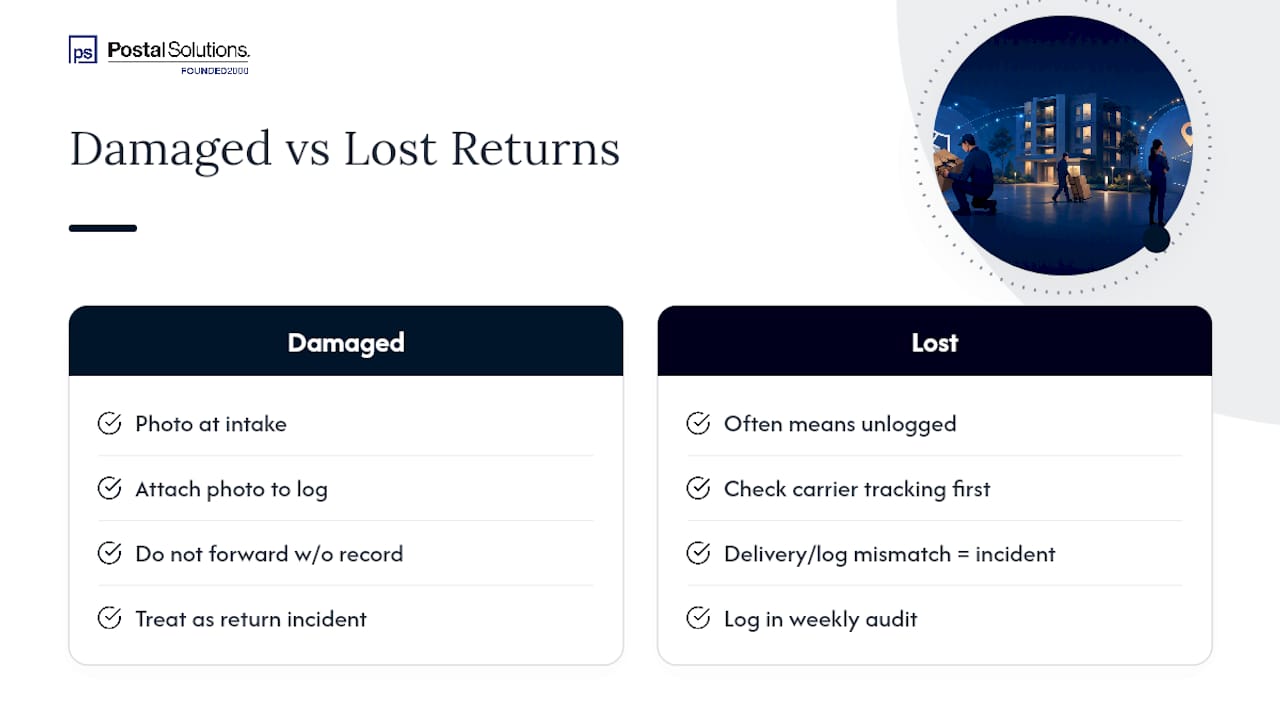
Damage and loss inside the returns workflow are two different problems that need two different responses. A damaged package should be photographed the moment staff notice it, before it’s tagged for return, with the photo attached to the log entry alongside a written description of the damage. Never forward a visibly damaged item back to the carrier without that record; it’s your only evidence if the resident or the shipper disputes what happened.
Lost items are trickier because “lost” usually means “unlogged.” If a resident reports a missing package that never made it into your log, check the carrier’s tracking data first. Tracking that shows delivery to your address but no matching log entry points to either a driver bypassing your intake SOP or a package that walked out of an unsecured room. Either way, that’s an incident, not a shrug, and it belongs in your weekly audit notes with a date and a description of what you found.
The property’s liability here depends heavily on whether staff followed the documented SOP. A property that can show a timestamped log, a photo of the item’s condition at intake, and a record of resident notification is in a defensible position. One relying on memory and a shrugging “it probably got picked up” is not. This is the exact argument for treating chain-of-custody logging as non-negotiable rather than a nice-to-have paperwork exercise: it’s the difference between a five-minute resolved complaint and a drawn-out dispute involving the resident, the carrier, and sometimes a lawyer.
Legal and Privacy Considerations in Returns Handling
Staff should never open, inspect, or reroute mail addressed to a resident, current or former, and that rule holds even when a package sits unclaimed for months. Federal mail tampering laws apply to items sent through the postal system, and courier packages carry their own contractual protections, so the safest posture across the board is: log it, notify about it, hold it, return it. Never open it.
Privacy exposure shows up in smaller ways too. A returns log that lists a former resident’s full name, new forwarding address, and package contents description is sensitive data, and it should be treated that way: access limited to staff who need it, not printed on a clipboard anyone walking through the package room can read.
Refusing deliveries outright is sometimes used as a workaround for properties without adequate space or staffing, but refusal carries its own risk: it can hurt resident satisfaction and marketability, since prospective residents increasingly expect reliable package acceptance as a baseline amenity, not a bonus.
State law on hold periods and disposal of unclaimed property varies enough that a policy written for one property in one state may not hold up in another. If your portfolio spans multiple states, that’s a specific reason to get the hold-timeline language reviewed by counsel state by state rather than copying one policy across the board.
Technology Solutions for Returns Tracking and Management
The core decision in returns technology isn’t which app looks the nicest; it’s whether the system can flag a former resident automatically, before staff waste time trying to notify someone who already moved out. A system that cross-references your rent roll against incoming packages catches ghost packages at intake instead of a week later.
Beyond that flagging function, most useful platforms handle three things: automated resident notifications by text or email, a searchable log of every package’s chain of custody, and reporting that rolls audit data up for a property or portfolio manager without someone manually compiling a spreadsheet every week. Package tracking and access-control systems built for multifamily use tend to integrate with whatever hardware, lockers or a staffed package room, a property already has, which matters more than most buyers realize when comparing options.
Spreadsheets aren’t a bad fallback for a low-volume property, but they don’t scale, and they never flag anything automatically. The moment a property is fielding more than a handful of former-resident packages a month, the labor cost of manually cross-checking names against a rent roll usually exceeds what a modest software subscription would cost. Whatever tool you choose, the test is simple: can it tell you, without a manual search, which packages on the shelf right now belong to someone who no longer lives there?
Ready to Hand Off Your Package Room?
If you’ve read this far and recognized your own package room in the overflow scenarios, the gap usually isn’t policy, it’s staffing bandwidth. Postal Solutions places a dedicated on-site Package Manager at your community up to six days a week to run intake, chain-of-custody logging, weekly audits, and the exact mark-and-return workflow this article walks through, so your leasing team stops absorbing hours they should be spending on tours and renewals.
The service works with whatever hardware you already have, a locker bank, a staffed package room, or nothing formal at all, and it can be structured with an ancillary income component so the amenity helps offset its own cost rather than draining your budget. Properties considering the trade-offs between a locker-only setup and a fully managed on-site package room tend to land on managed service once they see how much staff time returns handling alone is quietly consuming every week.
Start with a property audit: request one to see exactly where your current returns process is leaking time and money, or grab the free package-room management guide for a ready-made SOP template you can adapt today.
An Operator’s Take on Returns Handling
The properties that struggle with returns almost always have a policy document somewhere; what they don’t have is anyone checking that the policy matches what is actually happening on the shelf. That gap between paper and practice is where ghost packages pile up and residents lose trust in the front office.
Get the hold timeline reviewed by local counsel before you print it anywhere official, since a 30-day standard that works fine in one state can be legally wrong in another. Do that, run the weekly audit without skipping weeks, and the payoff shows up fast: hours back for your leasing staff, a package room that looks good on a tour instead of embarrassing, and far fewer complaint calls about missing mail. For more on the day-to-day mechanics, the Package Room Management blog covers the operational details this piece didn’t have room for.
— Postal Solutions
Sources
- Multifamily Package Management Guide for Operators - Postal Solutions
- A Framework for Solving Multifamily’s Package Management Problem | Insights by Blueprint
- Ghost Packages from Former Residents | Smart Package Room
- Package management guidance (NAAHQ)
FAQ
What Counts as a “Return” in Apartment Package Handling?
A return is any package that can’t reach its intended resident, most often because the person moved out, refused delivery, or the address was wrong, and it needs a mark-and-return process rather than sitting on a shelf indefinitely.
How Long Should You Hold a Package for a Former Resident?
A common standard is roughly 30 days, but the exact period varies by state, so confirm the timeline with legal counsel before writing it into policy.
Who Handles Carrier Non-Compliance Issues?
On-site staff should log and escalate bypass incidents directly to the carrier’s local dispatch, since carrier non-compliance is the leading cause of package-system failures at multifamily properties.
Should Property Staff Ever Open a Returned Package?
No. Staff should never open, inspect, or reroute mail addressed to any resident, current or former; the correct steps are log, notify, hold, and return to sender.
Is Outsourcing Returns Handling Worth It for a Smaller Property?
It depends on volume and staff time lost, not unit count alone; a property with frequent overflow or a leasing team pulled off tours to sort packages is a strong candidate for a managed on-site package service regardless of size.
Recommended
Ready when you are
Fix your package room — start with a free proposal
Daily on-site Package Manager, resident text & email pings*, and a tour-ready amenity. Tell us your unit count and we'll send a right-sized proposal — usually within one business day.
- ✓ 16–30 hours back every week
- ✓ Works with any locker system
- ✓ Faster, friction-free resident pickup
- ✓ An easy ancillary income addition