
August 27, 2026
Package Room Safety Starts With Access, Not Just Cameras
Enhance package room safety with access control and smart workflows, reducing theft to near zero and protecting residents effectively.
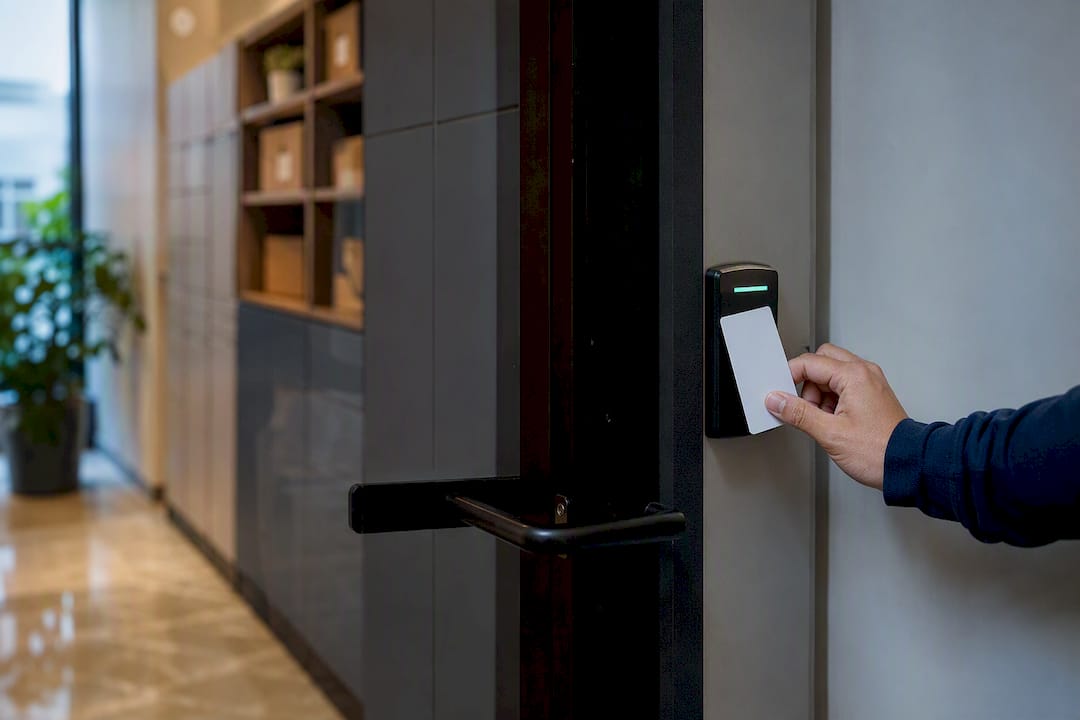
Package room safety comes down to one intervention: a layered system combining access-controlled entry, per-user credentials, audit logs, and enforced carrier workflows. Properties running this combination push theft rates from the 15% to 30% range common in unmanaged areas down to below 0.1%. That gap matters because apartment residents already face outsized risk. They’re targeted roughly three times more often than single-family homeowners, contributing to a national toll of about 250,000 stolen packages daily and $15 billion a year.
You can start closing that gap today, before any hardware order ships:
- Restrict the package room to credentialed access only, effective immediately.
- Post carrier compliance signage at the entry so drivers know the intake rules on day one.
- Send residents a notification explaining the new pickup process and what changed.
Key Takeaways
Package room safety depends on layering access control, audit logging, carrier enforcement, and daily management rather than relying on any single fix.
| Point | Details |
|---|---|
| Access control is the foundation | Replace shared keys or static PINs with per-user cloud credentials that support instant revocation. |
| Audit trails prevent disputes | Log user ID, timestamp, package ID, and staff notes on every package movement. |
| Carrier compliance drives outcomes | Onboard drivers with a pictorial SOP and escalate repeat noncompliance to their terminal manager. |
| Size for peak, not average | Plan overflow staging before November and December volume, which accounts for nearly 20% of the yearly total. |
| Managed daily operations close the gap | Postal Solutions’ on-site Package Manager model applies daily sorting, logging, and weekly audits to keep theft rates near zero. |
Where to Read Next
- The NAAHQ package management guidance covers peak-season sizing standards used across the multifamily industry.
- Postal Solutions’ package security guide for property managers breaks down theft-rate data by access-control tier.
- For a deeper look at locker versus room tradeoffs, see Apartment Package Lockers & Package Room Management.
- Managers building a carrier SOP from scratch can review Package Room Management for Apartments: A Manager’s Guide for a ready template.
Table of Contents
- What an Effective Package Room Management System Includes
- How Do You Build Access Control That Actually Sticks?
- Why Do Carriers Keep Breaking Your Package Room Rules?
- How Big Should Your Package Room or Locker Bank Be?
- What Should a Package Manager Do Every Day?
- What Technology Actually Belongs in a Secure Package Room?
- Your 30/60/90-Day Rollout Plan
- What Twenty-Five Years of Package Operations Has Taught Postal Solutions
- The Real Gap Between Package Room Advice and Package Room Reality
- Let Postal Solutions Run the Package Room So Your Team Doesn’t Have To
- Sources
- FAQ
What an Effective Package Room Management System Includes
Single fixes fail because thieves and sloppy carriers exploit whatever gap you leave open. A camera without access control just records the theft instead of preventing it. A locker system without an overflow plan collapses the first week packages exceed capacity.
A working system layers six components so no single failure point sinks the whole operation:
- Door access control restricted to residents and staff, never a shared key or lobby code.
- Audit logs that timestamp every entry and exit, tied to a specific credential.
- Carrier workflows that give drivers one correct way to drop packages, every time.
- Resident notifications triggered automatically the moment a package arrives.
- An overflow plan for oversized items and holiday surges, built before you need it.
- Daily management so the room stays organized instead of decaying into a pile of boxes.
Large properties often do best with a hybrid setup: lockers for standard parcels and a package room for overflow and oversized shipments, because no single locker bank handles a mattress topper or a case of bottled water.
How Do You Build Access Control That Actually Sticks?
Shared physical keys and static PINs are the most common package room safety failure, and they’re avoidable. Once a key gets copied or a PIN gets texted to a friend, you have zero way to know who actually entered the room or when. There’s no accountability, no way to narrow a suspect list, and no way to prove a package was ever delivered intact.
Cloud-managed, per-user credentials fix that. Each resident and staff member gets a unique login tied to their identity, and you can revoke it instantly the moment someone moves out or reports a lost key. No locksmith call, no rekeying, no waiting.
Carriers need their own tier: time-limited PINs or a carrier-specific mobile credential that expires automatically, so a driver who leaves the route doesn’t retain permanent access.
Your audit log should capture:
- User ID or credential number
- Exact timestamp of entry
- An entry photo, when the hardware supports it
- Package ID or unit number
- Staff action notes (restocked, flagged damaged, escalated)
Pro Tip: Export your audit log weekly and store it off-site. If a resident disputes a missing package six months from now, you want that record retrievable in minutes, not buried in a system nobody remembers how to query.
Cameras alone are a weak deterrent. Paired with access logs, they produce actual evidence you can use to resolve disputes instead of shrugging at grainy footage.
Why Do Carriers Keep Breaking Your Package Room Rules?
Carrier non-compliance is the single biggest operational failure in package management. Seventy percent of operators surveyed named it their top frustration, and the average property already juggles multiple different intake methods trying to compensate. Drivers under route-time pressure will always take the fastest path, which is often the wrong one, unless you make the correct path just as fast.
Build a carrier onboarding packet with:
- A one-page pictorial SOP showing exactly where and how to stage packages.
- A QR code linking to staging rules, posted at the entry itself.
- A direct contact for compliance issues, so a driver’s supervisor hears about problems fast.
Back that packet up with routine enforcement:
- Run daily compliance checks on where packages actually landed versus where the SOP says they should.
- Spot-audit weekly and track repeat offenders by carrier account, not just by individual driver.
- Escalate chronic noncompliance to the carrier’s local terminal manager, with dated examples.
When a driver still won’t comply, fall back to remote unlock by staff, a hold-at-desk option, or logging the drop-off and notifying the resident directly. A single pictorial SOP distributed up front prevents most of the cascading failures that show up during peak weeks.
How Big Should Your Package Room or Locker Bank Be?
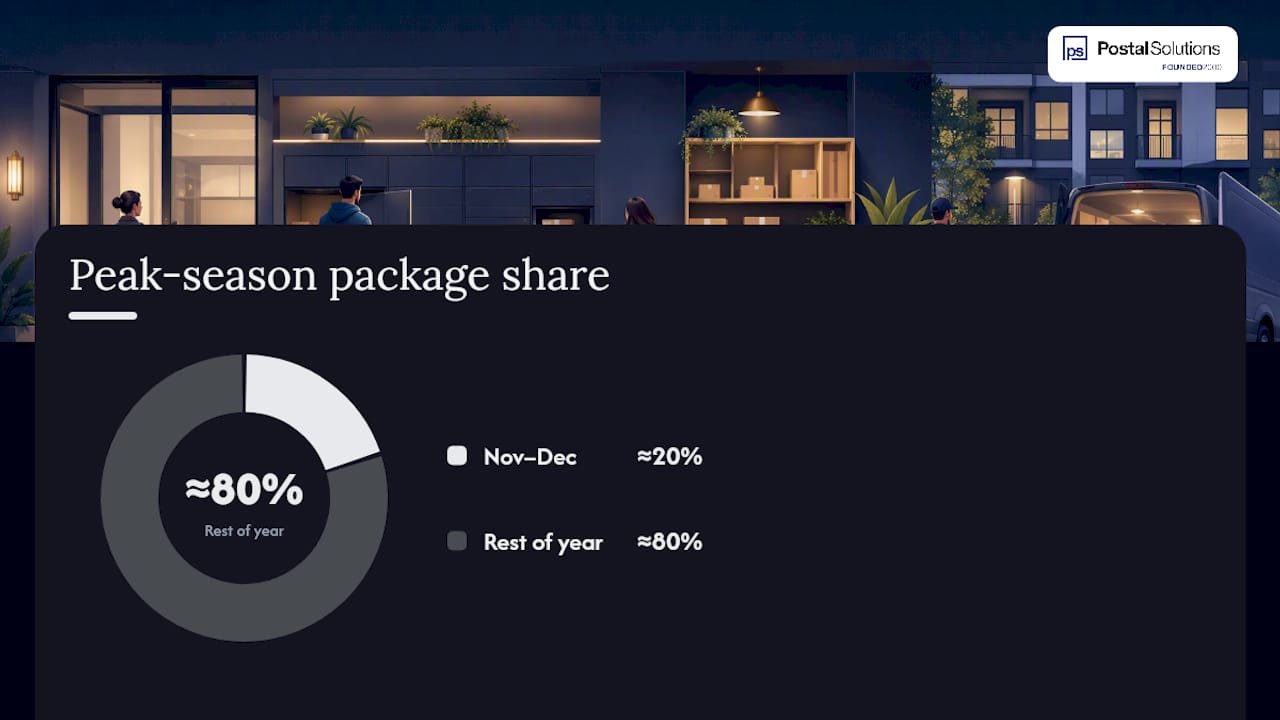
Size for your worst week, not your average one. November and December alone account for nearly 20% of annual package volume, and a room sized for October traffic will overflow into hallways by the second week of December.
A basic access-controlled package room typically runs $1,500 to $3,000 to install, while entry-level locker systems start around $6,900 before software and maintenance. That cost gap is why many mid-size properties start with a room and add lockers later.
| Property Size | Baseline Space Guidance | Peak-Season Adjustment |
|---|---|---|
| — | Small room or 20–30 lockers | Add a secondary staging shelf |
| — | Mid-size room or lockers | Add temporary overflow lockers |
| 250+ units | Room plus locker hybrid | Add a keypad-secured staging area |
Build these overflow habits before you need them:
- Set a firm 48-hour pickup expectation and text reminders at the 36-hour mark.
- Reserve a keypad-secured secondary area strictly for surge overflow, not everyday use.
- Designate a separate zone for oversized, refrigerated, or high-theft-risk shipments, since a $2,000 electronics box shouldn’t sit next to unlabeled overflow.
What Should a Package Manager Do Every Day?
Daily discipline beats expensive hardware every time. Managed daily organization eliminates the errors that generate most resident complaints: mislabeled shelves, packages stuffed into the wrong overflow pile, and pickup lines that stretch past the leasing office door.
- Receive and sort every delivery the same day it arrives.
- Label by unit number immediately, not at end of shift.
- Log each package into the audit system with a timestamp.
- Tidy shelving so nothing sits unclaimed in a random corner.
- Process oversized or special-handling items into their designated zone.
- Send resident notifications the moment items are shelved.
Weekly, reconcile inventory against your logs, spot-check a sample of access records, and pull a few entry photos to confirm the system is capturing what you think it is.
Pro Tip: If your staff spends more than five hours a week on package tasks, a dedicated Package Manager usually pays for itself in recovered leasing and renewal time alone.
What Technology Actually Belongs in a Secure Package Room?
The minimum stack is smaller than most vendors pitch: door access with logging, cameras covering every entry point, and automated resident notifications. Everything past that is an optimization, not a requirement.
- Door access with audit logs is non-negotiable; it’s the backbone that makes every other control meaningful.
- Cameras at entry points document incidents, though they only work as evidence when paired with the access log showing who was present at that timestamp.
- Automated notifications cut resident foot traffic and reduce “where’s my package” calls to the office.
- Exportable logs matter for reporting and for handing evidence to a carrier or insurer during a dispute.
Locker systems add convenience and a stronger deterrent for standard parcels but struggle with oversized freight. A package room handles anything, but needs staff discipline to stay organized. Most large communities land on a hybrid, using lockers for the routine volume and a managed room for everything that doesn’t fit in a locker door.
Your 30/60/90-Day Rollout Plan
Quick wins come first: lock the door to credentialed access, post carrier SOP signage, turn on resident arrival notifications, and designate a temporary overflow shelf. Every one of these costs little and can go live this week.
- Days 1 to 30: Issue credentials, install or activate access logging, train staff on the audit log fields, and distribute the carrier SOP packet.
- Days 31 to 60: Deploy cameras at entry points, integrate notifications with your property management software, and run the first full weekly audit cycle.
- Days 61 to 90: Formalize escalation protocols with repeat noncompliant carriers, review 90 days of audit data, and adjust staffing based on actual package volume.
Track these KPIs monthly:
- Average pickup time from notification to resident retrieval
- Carrier compliance rate against your SOP
- Reported theft or missing-package incidents
- Staff hours logged on package-related tasks
Properties that layer access control with audit trails see theft rates fall below 0.1%, against 15% to 30% for rooms left unmanaged. That single metric should anchor every KPI review you run.
What Twenty-Five Years of Package Operations Has Taught Postal Solutions
Postal Solutions has managed on-site package operations for apartment and student housing communities for 25 years, and the pattern holds across nearly every property: hardware alone never solves package room safety. A dedicated on-site Package Manager working up to six days a week catches what automated systems miss, from a mislabeled shelf to a carrier ignoring the posted SOP.
- Daily sorting and unit-number labeling, combined with weekly audits, eliminates most of the complaints that otherwise land on a leasing agent’s desk.
- Leasing teams that hand off package management recover hours every week that were previously spent chasing lost deliveries instead of closing renewals.
- A professionally managed room becomes a visible amenity leasing teams can point to on tours, not just a compliance checkbox.
The properties with the fewest complaints aren’t the ones with the most cameras. They’re the ones where a real person checks the room every single day, reconciles the log, and catches the mislabeled box before a resident ever notices it’s missing.
The Real Gap Between Package Room Advice and Package Room Reality
Most package room advice fixates on hardware: buy better lockers, add more cameras, install a fancier keypad. That advice isn’t wrong, but it’s incomplete, and it’s why so many properties spend money on equipment and still field theft complaints six months later.
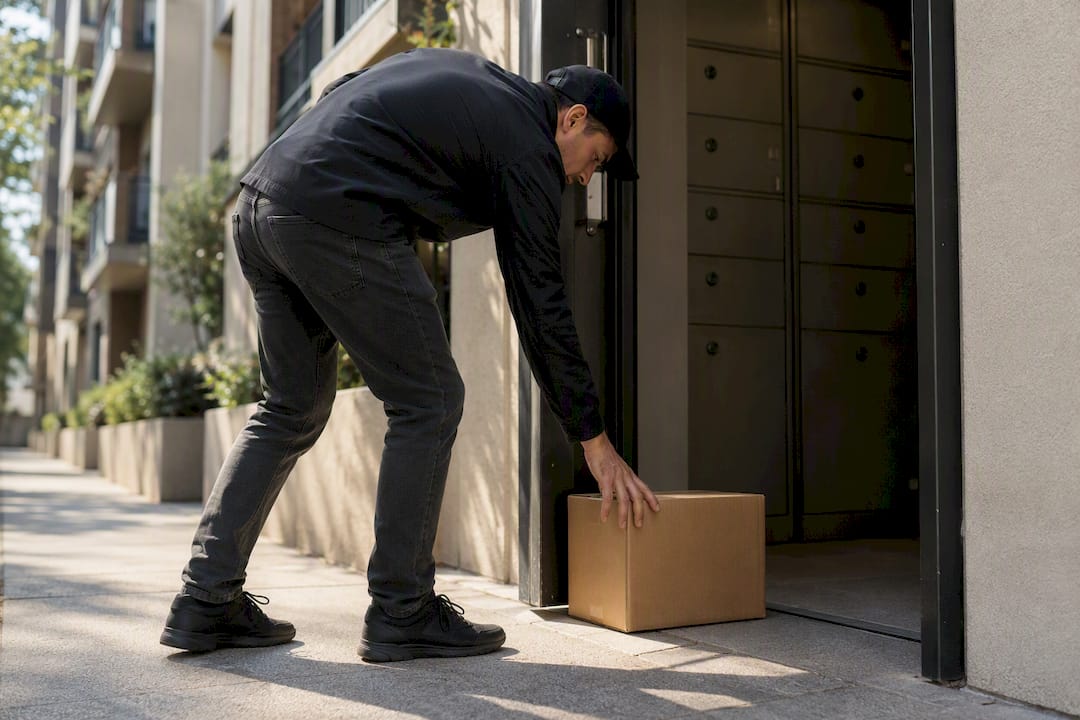
The uncomfortable truth this research points to is that carrier behavior, not resident behavior, breaks most systems. Seventy percent of operators name carrier non-compliance their top frustration for a reason: a driver who tosses a package outside a locked room defeats every dollar spent on that room’s hardware. Fix the human workflow first. Access control and audit logs matter enormously, but they only work if the packages actually make it inside the secured area in the first place.
The second gap is staffing. Property teams treat package management as a task squeezed between leasing calls, when it’s really a discipline that rewards a dedicated person checking the room daily. That’s not a hardware upgrade. It’s an operational choice, and it’s the one most guides underweight because it’s harder to sell than a locker bank.
Start with the SOP and the daily check. Add the technology once the workflow is solid, not before.
— Postal Solutions
Let Postal Solutions Run the Package Room So Your Team Doesn’t Have To
If the checklist above feels like a lot to own on top of leasing, renewals, and resident calls, that’s the exact gap Postal Solutions was built to close. 
Instead of your team splitting attention between sorting boxes and showing units, a dedicated on-site Package Manager works your property up to six days a week: receiving, logging, organizing, and enforcing the carrier workflows outlined above, so residents get 24/7 access to packages that are actually where they’re supposed to be. Communities running this model recover hours of staff time weekly and often turn the package room into a paid amenity that helps offset its own cost. Whether your property already runs lockers, a package room, or a mix of both, Postal Solutions integrates with the hardware you already have.
See how on-site management compares to sending packages off-site in this breakdown of why on-site wins for residents, or grab the free package room management guide and start building your rollout plan this week.
Sources
- A Framework for Solving Multifamily’s Package Management Problem | Insights by Blueprint
- Package Security in Apartments: A Property Manager’s Guide - Postal Solutions
- Apartment Package Theft Costs $15B: Building-Level Solutions | Knockli
- How To Set Up A Package Room In 2026 | Swiftlane
- Package management best practices (NAAHQ guidance)
FAQ
What Is the Fastest Way to Improve Package Room Safety?
Restrict access to credentialed entry immediately, post carrier compliance signage, and turn on resident arrival notifications. Those three steps cost little and can go live the same day.
Do Cameras Alone Stop Package Theft?
No. Cameras document incidents but function as a weak deterrent on their own; pairing them with access logs produces evidence you can actually use to resolve disputes.
How Much Does a Secure Package Room Cost to Set Up?
A basic access-controlled package room runs about $1,500 to $3,000, while entry-level locker systems typically start near $6,900 before software and maintenance.
Should I Choose Lockers or a Package Room?
Lockers work well for standard parcels, while a package room handles oversized and overflow items; many larger properties run both as a hybrid system.
Is It Worth Hiring a Dedicated Package Manager?
If staff spends more than a few hours weekly on package tasks, a dedicated on-site Package Manager, like the model Postal Solutions runs up to six days a week, typically recovers more staff time than it costs.
Recommended
Ready when you are
Fix your package room — start with a free proposal
Daily on-site Package Manager, resident text & email pings*, and a tour-ready amenity. Tell us your unit count and we'll send a right-sized proposal — usually within one business day.
- ✓ 16–30 hours back every week
- ✓ Works with any locker system
- ✓ Faster, friction-free resident pickup
- ✓ An easy ancillary income addition