
August 29, 2026
Property Managers: Grocery Delivery Handling SOP Without New Software
Adopt an on-site grocery delivery SOP or outsource to Postal Solutions. Perishable rules, chain of custody logs, SMS alerts, and downloadable templates.
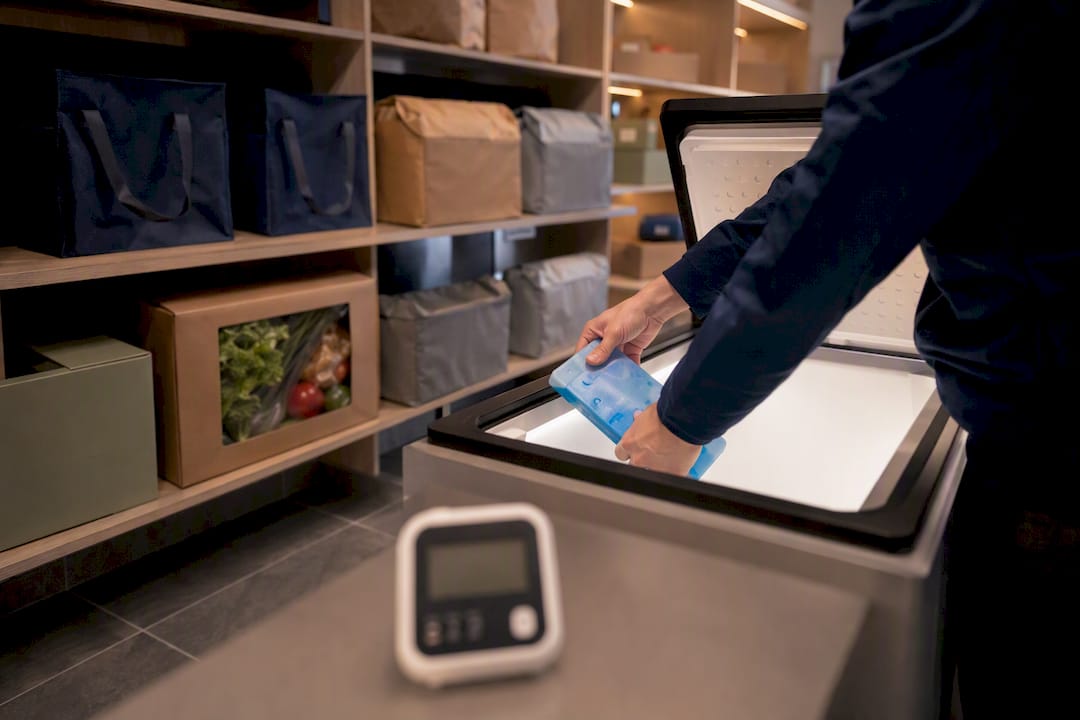
The correct operational model for grocery delivery handling in a multifamily property is a dedicated on-site package room workflow built around three non-negotiables: a perishable protocol with a strict holding window, chain-of-custody logging on every item, and immediate resident notification. Everything else, from shelving layout to holiday staffing, exists to support that core loop.
TL;DR:
- Grocery deliveries require a strict protocol including immediate tagging, logging, and temperature control to prevent spoilage and resident complaints.
- Centralized intake at one designated point and clear categorization help reduce package loss, non-compliance, and handling errors.
- Perishables should be stored in a monitored cool zone with a 24-hour holding window, backed by photo evidence and explicit disposal policies.
- Automated SMS notifications with pickup deadlines and contactless retrieval options improve resident compliance and reduce staff workload.
- A dedicated on-site Package Manager ensures consistent workflow execution, weekly audits, and adherence to protocols, even during peak holiday delivery periods.
Table of Contents
- Why Grocery Delivery Handling Needs Its Own Protocol
- A Compact Operational Checklist for Every Grocery Delivery
- Step-by-Step Intake Workflow for Receiving Grocery Orders
- The Perishable Goods Protocol: Temperature, Timing, and Disposal
- Shelving, Layout, and Overflow: Where Grocery Orders Actually Go
- Notifications and Pickup Verification That Actually Work
- Staffing, Training, and the Chain-of-Custody Log
- Planning for Holiday Surges in Grocery Delivery Volume
- How Postal Solutions Handles Grocery Deliveries On-Site
- What Most Property Managers Get Wrong About Grocery Delivery Handling
- Get Grocery Delivery Handling Set Up at Your Property
- Sources
- FAQ
Why Grocery Delivery Handling Needs Its Own Protocol
Grocery and meal-kit deliveries behave differently than a shoe box or an Amazon return, and treating them the same way in your package room creates spoiled food, resident complaints, and liability exposure. A frozen dinner left on a shelf for two days doesn’t just annoy the resident who ordered it; it can leak, attract pests, and force staff into a cleanup they weren’t trained to handle.
The volume backs up the concern. The average multifamily community receives close to 150 packages per week(https://www.naahq.org/sites/default/files/2022-07/[02.%](https://www.naahq.org/sites/default/files/2022-07/02. Package Management.pdf)20Package Management.pdf), and a meaningful share of that is now grocery, meal-kit, or pharmacy delivery. Grocery delivery logistics inside a package room aren’t a side task anymore. They’re a core part of food delivery management for any property that wants residents to trust the amenity.
This is where handling grocery orders differs from general package acceptance: the clock matters. A missed pickup on a paperback book costs nothing. A missed pickup on a bag of frozen shrimp costs a resident’s dinner and possibly a maintenance ticket for the smell.
A Compact Operational Checklist for Every Grocery Delivery
Pin this near the intake desk. It covers the sequence staff should run every time a grocery or meal-kit delivery arrives, before anything gets shelved.
- Verify the resident and unit against the delivery label before accepting the item from the carrier.
- Tag perishables on the spot with a colored sticker or marker and move them straight to the designated cool zone.
- Log the package immediately: timestamp, carrier, tracking number, and a quick photo of the item as received.
- Send the SMS alert within minutes, not at the end of a shift, and state the pickup deadline in the message.
- Escalate anything oversized, damaged, or leaking to a supervisor before it goes on a shelf with other deliveries.
Five steps, applied consistently, close most of the gaps that cause spoiled food or “it was never delivered” disputes.
Step-by-Step Intake Workflow for Receiving Grocery Orders
Efficient grocery delivery starts with geography. Every carrier should hand off packages at one designated intake point, not wherever a driver finds convenient, because a scattered drop-off system is exactly how bags get left in a lobby and go missing. Centralizing that intake also reduces unauthorized building access since drivers never need to wander past the intake counter.
From there, the workflow runs in five steps:
- Stage at the intake point. Every carrier, from a national courier to a local grocery-delivery driver, drops off in the same spot every time.
- Tag by category. Use a simple color system: one tag color for perishables, one for fragile, one for oversized. Staff should be able to sort a cart of mixed deliveries in under a minute.
- Photograph and log. Capture the item, carrier name, tracking number, and recipient in a digital or paper log the moment it’s tagged, not at the end of the shift.
- Record missing information. If a package lacks a clear unit number, note the carrier’s contact info or driver ID so you can trace it later instead of guessing.
- Document non-compliance. When a driver bypasses the intake point or refuses to log a drop-off, write down the time, the driver ID if visible, and take a photo. Carrier non-compliance is the top frustration cited by 70% of operators running package systems, so this step isn’t optional paperwork. It’s the difference between a documented incident and a shrugged shoulder when a resident asks where their order went.
Pro Tip: Give your intake team a simple laminated card showing the tag colors and the two questions to ask every carrier: “Which unit?” and “Anything cold in there?” It takes ten seconds and prevents most sorting mistakes.
The Perishable Goods Protocol: Temperature, Timing, and Disposal
Perishables need their own rulebook, and it should be written down, posted, and followed the same way every shift. The core question is whether your volume justifies refrigeration or just a designated cool staging zone. Properties averaging more than a handful of grocery deliveries a day should invest in a small refrigerator or cooler unit inside the package room footprint. Lower-volume properties can get by with an insulated, shaded staging area away from HVAC vents and direct sun.
Whichever setup you choose, follow these rules:
- Store perishables on the lowest shelf with separate containment trays to catch leaks before they spread to other packages, a standard recommended in perishable handling guidance.
- Set a firm holding window. A widely used starting point is 24 hours for fresh or frozen food before escalation begins.
- Photograph and timestamp before disposal. No perishable item gets thrown out without photo evidence and a logged decision.
- Authorize disposal in writing. Your lease or mailroom policy should explicitly state that staff can remove spoiled items after the holding window and documented notification attempts.
One number should shape your staffing math here: peak-season delivery volume runs roughly 80% higher than an average week, and grocery orders spike right alongside it. A 24-hour rule that works fine in March gets stress-tested hard in December.
For meal kits, prescriptions, and other special-handling cases, the special deliveries guide covers scenarios that fall outside the standard grocery flow.
Shelving, Layout, and Overflow: Where Grocery Orders Actually Go
Grocery shipping solutions live and die on layout decisions made long before a delivery ever arrives. Fixed lockers are convenient for a standard box, but grocery bags, meal-kit boxes, and multi-bag orders rarely fit a locker’s dimensions cleanly. Flexible open shelving handles that variability far better and, in some deployments, triples effective storage capacity within the same square footage compared to rigid locker banks.
Layout choices that matter most:
- Keep the cold zone inside the package room, not in a separate closet down the hall. Moving perishables between spaces multiplies the chance of a missed step.
- Set aside a clearly marked oversize zone with its own resident pickup scheduling, so a bulk grocery order doesn’t block the shelf a normal-sized package needs.
- Put trash and recycling right next to the room. Grocery deliveries generate a lot of cardboard and plastic, and staff won’t walk it across the property every time.
- Before any retrofit, check power, internet, and lighting. A refrigerator needs a dedicated outlet, and a package log system needs a reliable connection.
Properties weighing package lockers against a full package room should factor grocery volume into that decision specifically, since lockers alone rarely solve for perishable staging.
Notifications and Pickup Verification That Actually Work
The notification sequence for a grocery delivery should look different than the one for a routine package, because the clock is shorter and the stakes are higher.
- Send an SMS the moment the item is logged. State the deadline plainly: “Your grocery delivery has arrived and is refrigerated. Please pick up by 6 PM today to avoid disposal.”
- Send a reminder at the halfway mark. If the holding window is 24 hours, the reminder goes out around hour 12.
- Send a final warning before disposal or return. This message should state the exact time disposal will occur.
- Verify identity at pickup and log the resident’s confirmation, whether that’s a signature, a code entry, or a staff initial next to the log entry.
- Use locker codes or access panels where installed so residents with tight schedules can retrieve items the moment they’re free, rather than waiting for staffed hours.
Contactless pickup pods with QR or PIN-based access are becoming common for meal delivery specifically, and they pair well with a package room that already logs everything digitally.
Staffing, Training, and the Chain-of-Custody Log
Three roles cover most of what a package room needs during a shift: an intake lead who handles carrier drop-offs and tagging, a cold-zone monitor who checks temperatures and holding windows, and a pickup verifier who confirms resident identity and closes out the log entry. On a smaller property, one person may wear all three hats, but the responsibilities should still be written down separately.
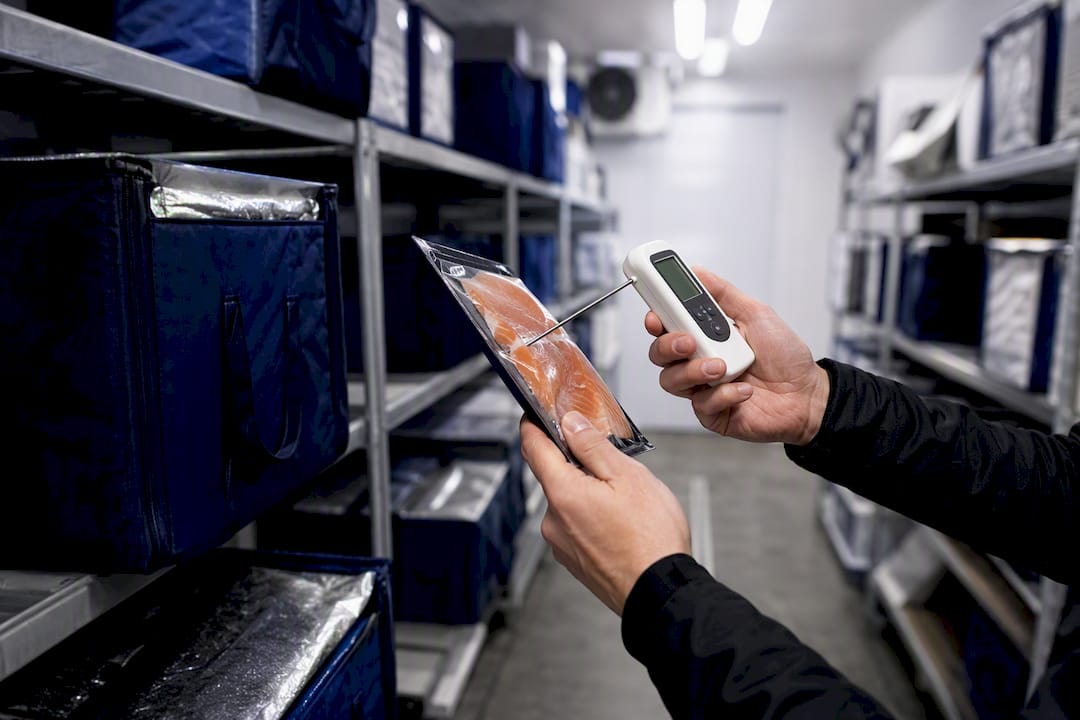
Training should cover perishable identification, leak containment, and how to photograph and timestamp consistently, since inconsistent documentation is what turns a minor dispute into a real liability problem. A defensible log needs, at minimum: date and time, carrier name, tracking number, a photo link, staff initials, and resident pickup confirmation.
Some properties require a signed waiver for high-value or refrigerated deliveries, stored alongside the log entry. Run a weekly audit comparing logged deliveries against pickups to catch shrinkage or recurring carrier problems early.
Pro Tip: A five-minute weekly reconciliation, comparing your log against what actually left the shelf, catches most process failures before they become a resident complaint.
Planning for Holiday Surges in Grocery Delivery Volume
November and December don’t just bring more packages. They bring more grocery and gift-food deliveries stacked on top of an already heavier load, with weekly volume climbing to roughly 270 packages at communities that average 150 in a normal week.
A few adjustments make the difference between a smooth peak and a backed-up cooler:
- Add temporary staff and extend pickup hours during the two to three weeks around major holidays.
- Set up short-term overflow staging with strict, clearly posted pickup windows so perishables don’t linger.
- Give carriers a simple pictorial SOP for peak days, since pictorial guides and QR codes measurably improve driver compliance at scale.
- Consider short-term locker rentals or scheduled off-site routing if your space simply can’t absorb the spike.
- Run a post-season audit to see where the process bent and adjust before next year’s peak.
The Package Room Management blog covers seasonal planning in more depth for properties building out a full annual calendar.
How Postal Solutions Handles Grocery Deliveries On-Site
Postal Solutions runs this exact model through a dedicated on-site Package Manager who works your community up to six days a week. That means one trained person handling intake, tagging, cold-zone monitoring, and logging every day, not a rotating cast of leasing staff squeezing it in between tours.
The perishable protocol, notification cadence, and weekly audits described above aren’t theoretical. They’re the standard operating procedure Postal Solutions applies daily, integrated with whatever locker or package room hardware a property already owns. A third of average community teams spend more than four hours a week on package tasks; a dedicated Package Manager takes that off the leasing team’s plate entirely and turns the package room into a visible, resident-facing amenity instead of a back-office headache.
What Most Property Managers Get Wrong About Grocery Delivery Handling
Most package-management advice treats grocery deliveries as a footnote to a locker discussion, and that’s backwards. The perishable clock is the entire problem. A property that nails carrier compliance and shelving but has no firm disposal policy will still end up with a moldy cooler and an angry resident, because nobody wrote down what happens after hour 24.
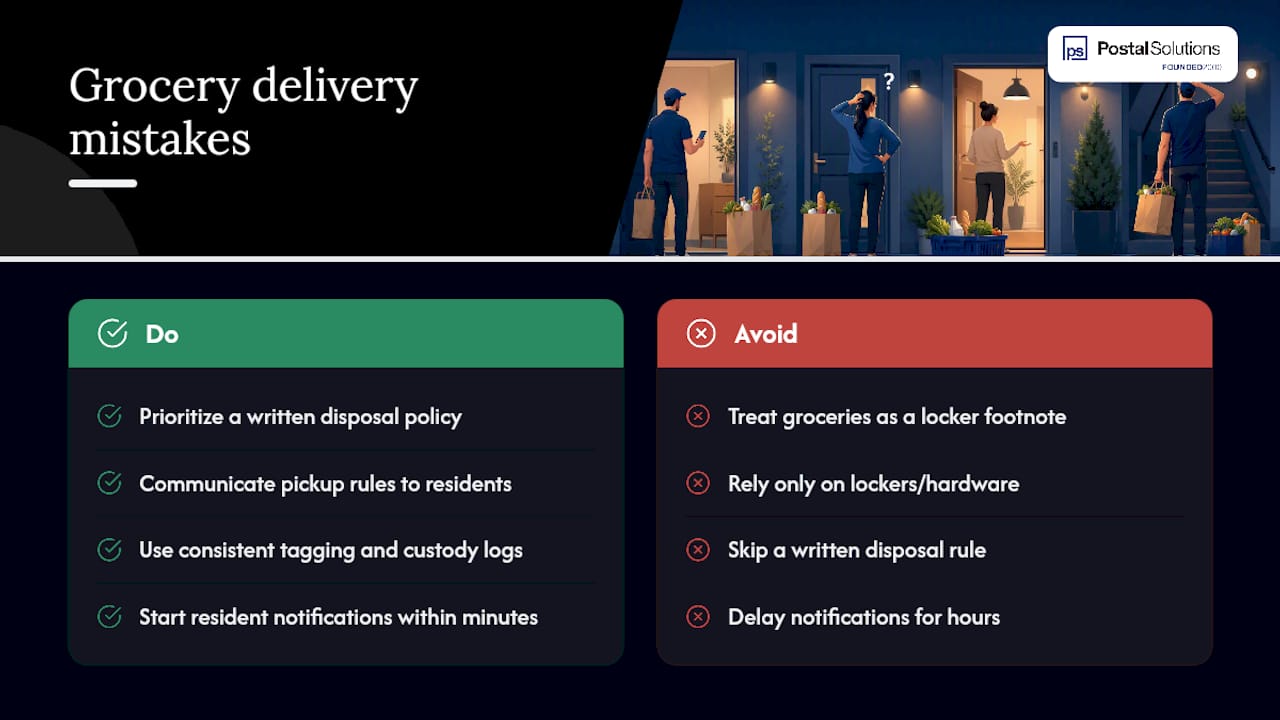
The conventional advice also overweights hardware. Lockers get marketed as the solution, but a locker with rigid compartments doesn’t solve for a grocery bag that doesn’t fit or a meal kit that needs refrigeration. What actually moves the needle is the workflow around the hardware: consistent tagging, a logged chain of custody, and a notification sequence that starts within minutes, not hours.
If you take one thing from this, prioritize the disposal policy before anything else. Every property has a package room. Very few have a written, resident-communicated rule for what happens to a bag of groceries nobody picks up. That gap is where liability lives, and it’s the cheapest problem on this list to fix.
— Postal Solutions
Get Grocery Delivery Handling Set Up at Your Property
Postal Solutions is the direct route to a working grocery delivery handling system, not another piece of software you have to configure yourself. A dedicated on-site Package Manager runs the perishable protocol, the notification sequence, and the chain-of-custody log for you, up to six days a week, instead of leaving it to leasing staff who already have renewals to chase.
A property assessment identifies exactly where your current setup breaks down, whether that’s shelving layout, carrier compliance, or a missing disposal policy, and maps it against the on-site management model that fits your resident volume. The core deliverables are consistent across properties: a trained Package Manager, a written perishable protocol, automated resident notifications, and weekly audits that catch problems before they become patterns.
Download the free package room guide for templates and sample logs, or request a property assessment to see what an implementation plan looks like for your community.
Sources
- A Framework for Solving Multifamily’s Package Management Problem | Insights by Blueprint
- How to Effectively Manage Package Acceptance (NAAHQ)
- Package theft: how apartment buildings can stop stolen deliveries | Bay Alarm
FAQ
How Long Should You Hold a Perishable Grocery Delivery?
A common starting policy is a 24-hour holding window before escalation, with an SMS reminder at the halfway point and a final warning before disposal or return.
Who Is Liable if a Grocery Delivery Spoils in the Package Room?
Liability depends on your lease language and documentation; a clear mailroom policy authorizing staff to remove spoiled items, backed by photo evidence and logged notifications, is the strongest protection available.
Should Every Property Install Refrigeration for Grocery Deliveries?
Not necessarily. Higher-volume properties benefit from a dedicated cooler inside the package room, while lower-volume properties can rely on a shaded, ventilated cool staging zone away from perishable-damaging heat sources.
Can Postal Solutions Manage Grocery and Refrigerated Deliveries?
Yes. Postal Solutions’ on-site Package Manager model includes perishable protocol management, resident notifications, and weekly audits as standard parts of the daily service.
What Causes Most Grocery Delivery Failures in Package Rooms?
Carrier non-compliance is the most cited failure point, named by 70% of operators as a top frustration, closely followed by missing disposal policies for perishables.
Recommended
Ready when you are
Fix your package room — start with a free proposal
Daily on-site Package Manager, resident text & email pings*, and a tour-ready amenity. Tell us your unit count and we'll send a right-sized proposal — usually within one business day.
- ✓ 16–30 hours back every week
- ✓ Works with any locker system
- ✓ Faster, friction-free resident pickup
- ✓ An easy ancillary income addition