
August 10, 2026
UPS Apartment Delivery Policy for Property Managers
Discover best practices for the UPS apartment delivery policy that ensures efficient package management and resident notifications for property managers.
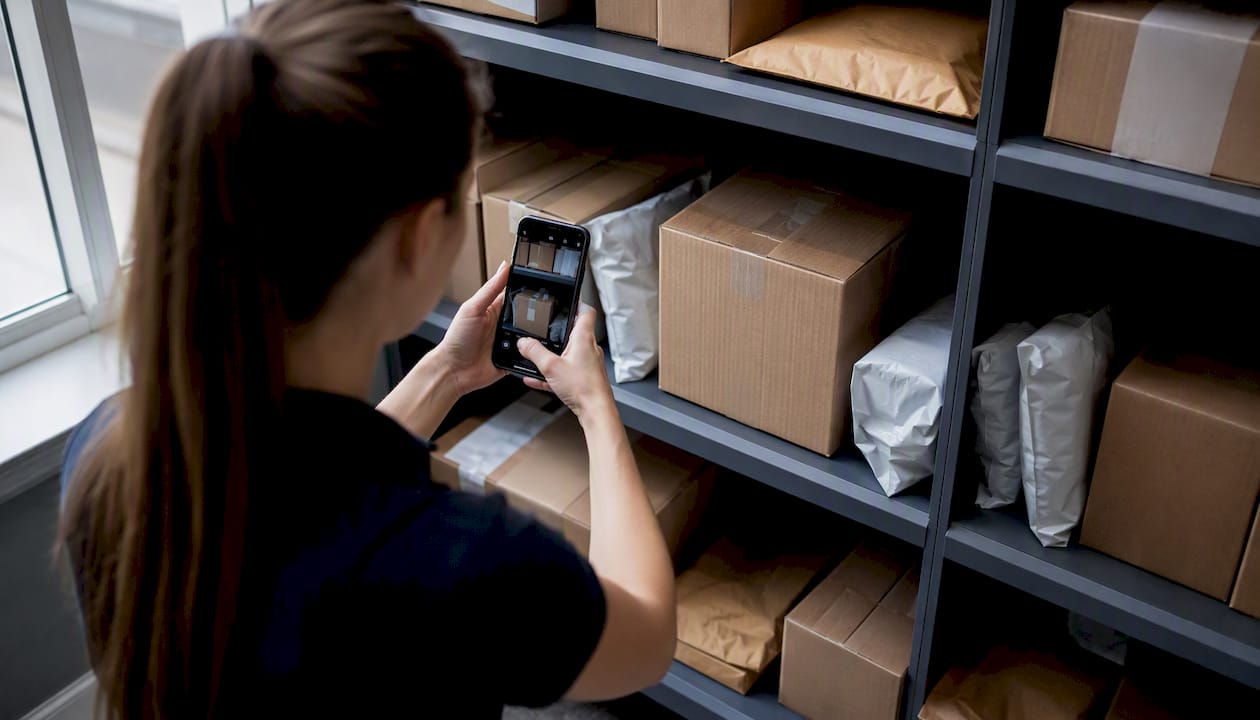
Every UPS delivery, along with packages from FedEx, Amazon, and USPS, must be accepted by a designated on-site Package Manager or authorized staff member, logged into a chain-of-custody record at the moment of intake, and followed immediately by a text or email notification to the resident. The recommended operational model is a dedicated on-site Package Manager, the approach Postal Solutions has refined across 25 years of managing package rooms for apartment and student-housing communities. NAAHQ data indicates that multifamily communities receive a high volume of packages weekly, creating challenges for ad-hoc handling by leasing staff.
Your three non-negotiable actions:
- Accept every eligible package from any carrier and issue a signed or scanned receipt to the driver.
- Log the package immediately with all required fields before placing it in storage.
- Notify the resident by text and email within five minutes of intake.
Pro Tip: Post a one-sentence policy statement at your package room entrance: “All packages are accepted, logged, and held securely for resident pickup within [X] days — unclaimed packages are returned to sender after that window.”
Key Takeaways
A written, enforced UPS apartment delivery policy with a dedicated on-site Package Manager is the single most effective way to reduce staff interruptions, prevent package disputes, and scale through holiday volume spikes.
| Point | Details |
|---|---|
| Volume benchmark | Average communities receive ~150 packages/week, rising to ~270/week during holidays. |
| Log every package | Record carrier, tracking number, recipient, timestamp, location, and photo at intake. |
| Notify immediately | Send a text and email within five minutes of logging to cut pickup dwell time. |
| Plan for peak | Holiday volume spikes roughly 80%; size storage and staffing before Thanksgiving week. |
| Postal Solutions | On-Site Package Room Management covers logging, notifications, audits, and peak scaling. |
Table of Contents
- What does a UPS apartment delivery policy actually require?
- How do you plan for holiday and peak-season package volume?
- What technology and access control does your package room need?
- Who does the work, and what does it cost?
- What liability and insurance language belongs in your policy?
- How do you roll out the policy in 30, 60, and 90 days?
- Why outsource to a dedicated on-site Package Manager?
- What peak-season chaos taught us about policy enforcement
- Postal Solutions handles your package room from day one
- Sources
- FAQ
What does a UPS apartment delivery policy actually require?
A workable apartment package delivery policy covers six operational areas: acceptance rules, logging requirements, notification timing, storage rules, pickup windows, and exception handling.
Acceptance rules. The designated Package Manager or a named backup staff member accepts all carrier deliveries, including UPS, FedEx, Amazon Logistics, and USPS. Refuse packages addressed to former residents with no forwarding authorization, items flagged as hazardous or restricted by federal law, and deliveries that arrive damaged beyond reasonable acceptance. Guest packages and short-term rental deliveries follow the same intake process as resident packages, with a note in the log identifying the unit or host.
Logging requirements. Every package gets a log entry before it leaves the intake counter. Required fields:
Notification and pickup rules. Send a text and email immediately after logging. Set a pickup window of five to seven business days. Packages unclaimed after that window get a second notice; after a defined final deadline, return to sender. Structured intake and immediate notification measurably reduce staff time spent resolving package disputes and improve resident satisfaction.
Exception handling. Oversized items that cannot fit standard shelving go to a designated staging area. Perishables and refrigerated deliveries go directly to a temperature-controlled zone. Medical shipments follow the same intake process with a privacy-sensitive log note. For lost or misplaced packages, the photo record and timestamp are your first line of defense.
Pro Tip: Photograph every package at intake, including the label and any visible damage. A 10-second photo takes far less time than a 20-minute dispute call.
How do you plan for holiday and peak-season package volume?
NAAHQ data puts average weekly volume at roughly 150 packages, rising to about 270 per week during the holidays, reflecting a significant increase.
To forecast your property’s peak daily intake, divide your expected weekly peak volume by five operating days. A 200-unit property at 270 packages per week works out to roughly 54 packages per day at peak, which requires dedicated staging space and a staffing plan that accounts for that daily throughput.
Space planning benchmarks:
- Allow at least one linear foot of open shelving per two to three packages in daily inventory.
- Stage oversized items in a separate zone with at least 6 feet of clearance for pallet-sized deliveries.
- Refrigerated zones should accommodate at least 10–15% of peak daily volume for properties that accept grocery and meal-kit deliveries.
- Open-shelving package rooms hold roughly 2–3x more packages per linear foot than fixed locker banks, making them better suited for high-volume or oversized-heavy properties.
Overflow options, in priority order:
| Overflow Option | Best For | Trade-Off |
|---|---|---|
| Temporary open-shelf staging | Short-term volume spikes | Requires staff oversight |
| Supplemental locker bank | After-hours pickup demand | Limited oversized capacity |
| Scheduled resident door delivery | High-value or perishable items | Labor-intensive |
Holiday activation checklist: extend pickup hours by at least two hours daily, add temporary staff or shift coverage starting the week before Thanksgiving, increase resident communication cadence to daily during peak weeks, and confirm refrigerated capacity before the holiday grocery surge. For a detailed peak-season preparation plan, the operational steps map directly to this forecast model.
What technology and access control does your package room need?
Technology choices should solve specific operational problems, not just add features. The two primary decisions are notification software and storage format (smart lockers vs. open package rooms), and they interact with your staffing model.
Functional comparison:
- Smart lockers: automated 24/7 pickup, built-in audit trail, limited oversized capacity, no refrigerated handling without specialized units.
- Open package rooms with access control: higher capacity per square foot, handles oversized and refrigerated items, requires staff or a managed service for intake.
- Hybrid models, a staffed room plus a small locker bank, frequently outperform single-solution installs because they balance capacity, oversized handling, and after-hours access.
For locker alternatives that work within existing package room infrastructure, the trade-offs between capacity and automation are worth mapping against your property’s actual volume and staffing hours.
Integration checklist: confirm dedicated internet and power at the package room location, verify API or resident directory sync with your property management system, and document the carrier workflow so drivers know exactly where to deliver and how to log the drop.
Carrier non-compliance is the most common operational failure in package systems. Drivers bypassing intake procedures break the chain of custody before a single package is logged. Require vendors to demonstrate how their system detects and responds to driver non-participation.
Pro Tip: Create a one-page pictorial SOP for drivers, laminated and posted at the delivery entrance, showing exactly where to drop packages, how to scan or enter a PIN, and who to call if the system is unavailable. Driver adoption rises sharply when the instructions are visual and immediate.
Who does the work, and what does it cost?
The on-site Package Manager role has a defined scope: intake and logging, resident notifications, shelf organization, oversized and perishable handling, weekly audits, and resident support for pickups and disputes. That scope translates directly into weekly labor hours.
| Property Size | Est. Packages/Week | Est. Weekly Hours | Approx. Monthly Labor Cost |
|---|---|---|---|
| Small | 50 | 8 hrs | $600 |
| Mid | 150 | 15–22 hrs | $1,100 |
| Large | 270 | 25 hrs | $1,875 |
These are illustrative ranges based on a $75/hour fully loaded labor cost. Actual costs vary by market and staffing model.
The real cost of not staffing the role: leasing agents interrupted for package questions lose an average of several minutes per interruption, and those interruptions compound across a full week into hours that could be spent on tours and renewals. Software-only solutions organize the process but do not eliminate the labor of receiving and handling packages. Properties with limited staff need hardware or managed staffing to provide after-hours pickup.
Ancillary income can offset labor costs. Many communities charge residents a monthly amenity fee of $5–$15 per unit for package management, turning the service from a cost center into a partial or full revenue offset. Locker rental fees and concierge pickup tiers are additional options worth modeling before budgeting.
What liability and insurance language belongs in your policy?
The property’s liability for packages is limited, and your resident-facing policy should say so plainly. A short disclaimer in your lease addendum and package room signage should state that the property accepts packages as a courtesy, is not responsible for loss or damage caused by carrier error or resident delay in pickup, and that perishables unclaimed within 24 hours may be discarded.
Insurance checklist:
- Confirm your property insurance covers on-site package handling as part of general premises liability.
- For high-value items, ask your insurer whether a separate inland marine or bailee’s coverage rider is needed.
- Verify whether your carrier agreements (UPS, FedEx) include any shipper-side liability that extends to the receiving property.
- If you charge residents a fee for package management, coordinate with corporate counsel before launch to confirm the fee structure does not create a bailment relationship that increases liability exposure.
Carrier compliance and driver scan-at-intake requirements belong in your written policy. When a driver bypasses the intake process, document the incident, note the carrier and tracking number, and follow up with the carrier’s local dispatch. A pattern of non-compliance is grounds to escalate to the carrier’s commercial account team.
Pro Tip: Add a one-sentence liability cap to your package room door sign: “The property accepts packages as a courtesy and is not liable for carrier errors, theft after delivery, or perishables unclaimed within 24 hours.”
How do you roll out the policy in 30, 60, and 90 days?
A phased rollout keeps the process manageable and gives you real data before full launch.
30 days (foundation):
- Conduct a site survey: measure package room square footage, count existing shelving, and map carrier delivery routes.
- Select your notification software and confirm resident directory integration.
- Draft the resident notice and carrier instruction sheet (templates below).
- Designate the Package Manager and define backup coverage.
60 days (pilot):
- Launch the intake logging process for all carriers.
- Send the resident notice and post package room signage.
- Distribute the carrier instruction sheet to UPS, FedEx, and Amazon drivers via your property’s carrier contact.
- Track daily intake volume, average pickup dwell time, and staff interruptions for 30 days.
90 days (full launch and optimization):
- Review pilot KPIs: target a carrier scan rate above 90%, average intake time under two minutes per package, and pickup dwell under four days.
- Adjust staffing hours based on actual volume data.
- Schedule weekly audits to reconcile logged packages against physical inventory.
- Communicate policy updates to residents and carriers.
Resident notification template: “Hi [Name], a package has arrived for you at [Property Name]'s package room. Pick it up at [Location] by [Date]. Questions? Contact [Contact Info].”
Carrier instruction sheet key points: property name and address, designated delivery entrance, PIN or QR access instructions, contact number for access issues, and a reminder that all packages must be scanned at intake.
Pro Tip: *Run a weekly audit every Friday: count physical packages on shelves, match against the log, and flag any item with a dwell time over five days for a second resident notification.
Why outsource to a dedicated on-site Package Manager?
Outsourcing the package room operation to a managed service resolves the three gaps that in-house staffing rarely closes: consistent intake logging across all shifts, 24/7 resident access without leasing staff involvement, and peak-season scaling without emergency hiring.
Postal Solutions’ On-Site Package Room Management covers every policy obligation described in this guide: chain-of-custody logging at intake, refrigerated and oversized handling, immediate resident text and email notifications, weekly audits, and integration with the package room or locker hardware already on-site. A dedicated Package Manager works the community up to six days a week, which means your leasing team stops fielding package questions entirely.
For operators evaluating the apartment package management services market, the staffing-first principle matters: match the solution to your property’s actual staffing reality before committing to hardware. A large locker bank may not be the right investment for a lightly staffed property with limited units.
The service is structured as a per-property or per-unit monthly fee, with optional ancillary income models that let many communities charge residents a package amenity fee and retain the margin over the cost of management.
What peak-season chaos taught us about policy enforcement
Before a formal intake policy, peak season at a 220-unit community looked like this: packages stacked in the leasing office, staff spending 30–40 minutes per shift just sorting and fielding “where’s my package” calls, and a resident complaint rate that spiked every December. The fix was not more lockers. It was a written policy, a designated Package Manager, and a logging process that created accountability from the moment a driver handed over a box.
The single most effective enforcement change was the photo-at-intake requirement. Residents stopped disputing condition claims almost immediately because the timestamp and photo made the intake record unambiguous. Carrier compliance improved within two weeks once drivers knew every package was photographed on arrival.
Twenty-five years of running on-site package rooms confirms one thing: the policy is the product. The technology and staffing are just the tools that make the policy stick.
Postal Solutions handles your package room from day one
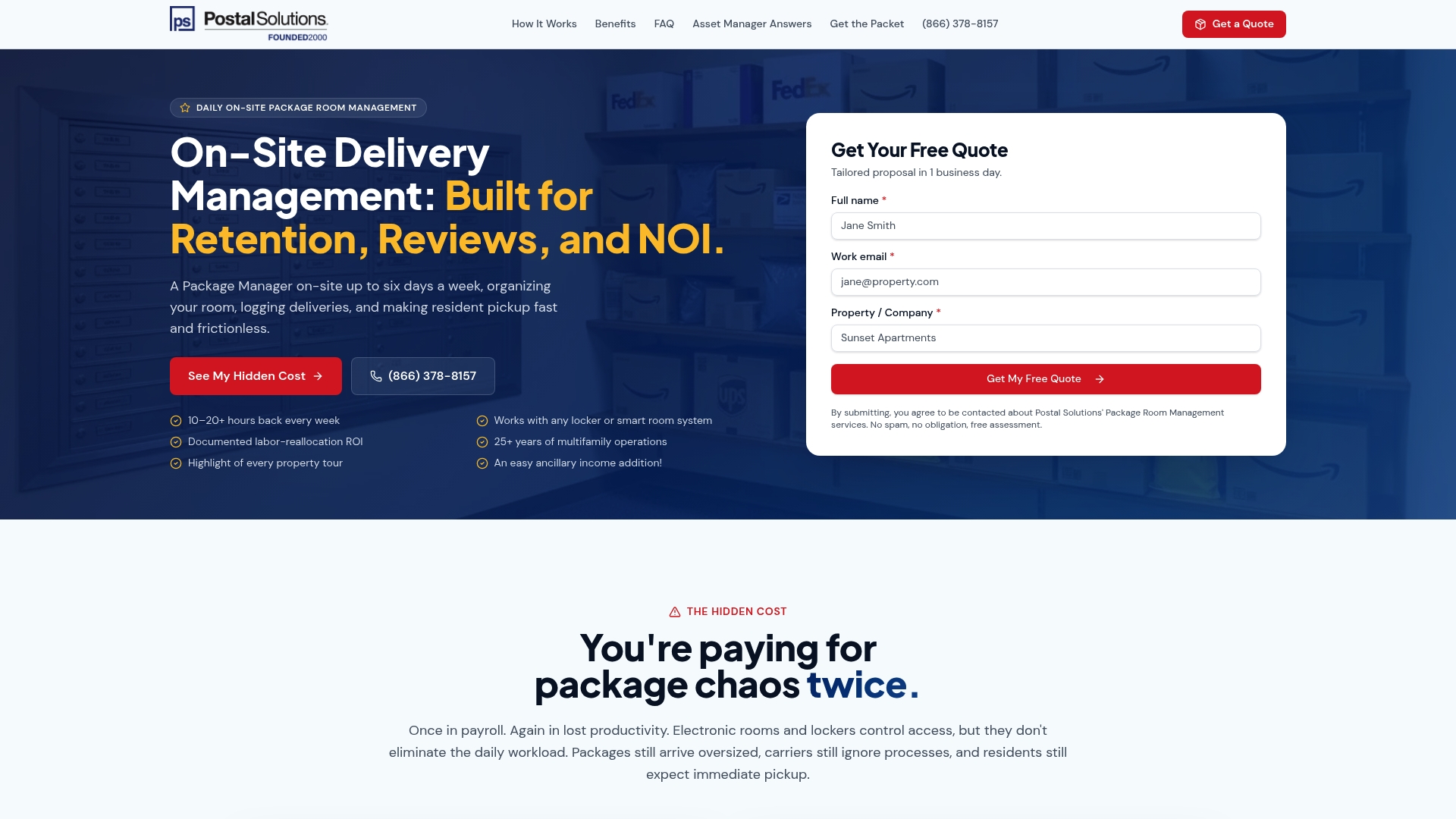
Postal Solutions’ On-Site Package Room Management gives your property a dedicated Package Manager working up to six days a week: accepting every carrier’s deliveries, logging chain-of-custody records, handling refrigerated and oversized items, sending immediate resident notifications, and running weekly audits. Your leasing team stops touching packages entirely.
Onboarding starts with a site assessment, moves to a 30-day pilot with full carrier outreach, and transitions to ongoing managed staffing with no gap in coverage. The service works with the package room or locker hardware you already have.
Download the free Package Room Management guide for ready-to-use templates and a full implementation checklist, or contact Postal Solutions to schedule a site assessment and get a property-specific quote.
Sources
- NAAHQ — Package Management (PDF)
- Techscribe — Multifamily package management solutions impact resident retention
- Insights by Blueprint — A framework for solving multifamily’s package management problem
- ElevateOS — Apartment package management for multifamily
FAQ
What is a UPS apartment delivery policy?
It is a written property rule that designates who accepts UPS and other carrier deliveries, requires chain-of-custody logging at intake, and sets resident notification and pickup timelines. A formal policy reduces disputes, limits liability, and gives staff a clear procedure to follow.
How many packages does the average apartment community receive per week?
NAAHQ data puts average volume at roughly 150 packages per week, rising to about 270 per week during the holiday season, an approximately 80% increase.
Do smart lockers replace the need for a Package Manager?
Not entirely. Software and locker systems reduce chaos but do not eliminate the labor of receiving, sorting, and handling packages. Properties with limited staff still need managed staffing or hardware to cover after-hours pickup and oversized items.
How does Postal Solutions handle UPS apartment delivery compliance?
Postal Solutions’ On-Site Package Room Management assigns a dedicated Package Manager to accept all carrier deliveries, log chain-of-custody records, handle refrigerated and oversized items, send immediate resident notifications, and run weekly audits, covering every requirement of a formal apartment delivery policy.
What should a resident pickup notice include?
At minimum: the resident’s name, a note that a package has arrived, the pickup location, the pickup deadline, and a contact number for questions. Sending the notice within five minutes of intake keeps dwell time short and reduces storage pressure during peak periods.
Recommended
Ready when you are
Fix your package room — start with a free proposal
Daily on-site Package Manager, resident text & email pings*, and a tour-ready amenity. Tell us your unit count and we'll send a right-sized proposal — usually within one business day.
- ✓ 10–20+ hours back every week
- ✓ Works with any locker system
- ✓ Faster, friction-free resident pickup
- ✓ An easy ancillary income addition